
Electric Screwdriver Supplier Qualification: Cell Phone Repair Tool Compliance
Qualifying an electric screwdriver supplier for cell phone repair work is a documentation and conformity exercise long before it becomes a price negotiation. The buyer's real exposure is not the invoice value of a single unit; it is whether the same specification, inspection routine and after-sales position can be repeated across a container, a quarter, or a newly entered market.
In the cell phone repair tools category, an electric screwdriver is a powered precision instrument used to remove screws during teardown. Buyers sourcing for wholesale distribution, chain repair workshops or repair-line operations therefore need two answers at the same time: does the product conform to the repair application, and can the supplier evidence that conformity in written documentation? This reference sets out how to run those checks, which purchasing terms to fix before the first order, and why models such as the FS-11 and ST-25 belong in the same qualification file as the driver itself.
Compliance Risk Begins Before the Price List
Repair-tool demand is anchored in a repair market that remains substantial. The global smartphone repair market is valued at approximately USD 22.66 billion in 2026, according to Business Research Insights. Underneath that service volume sits the tool layer: the screwdrivers, openers and tweezers that every teardown consumes.
Two structural forces make that tool layer a compliance question rather than a simple consumable purchase. First, the 'Right to Repair' movement is identified as a major market driver in 2026, influencing OEMs to release repair manuals and tools to third-party providers (ThinkComputers.org, 2026). When third-party repair capacity expands, the number of buyers who must justify tool quality to their own customers expands with it. Second, precision screwdrivers are identified as a key growth driver within a global manual screwdriver market valued at USD 365.2 million in 2024 (Credence Research), which indicates that demand is shifting toward finer, application-specific tools rather than generic hardware.
Cost context reinforces the point. Mobile opener tools classified under HS 8205 carry an average import price of approximately USD 1.03 per unit on US customs records (Zauba). At that unit value, a single non-conforming batch costs far more in rework, returns, dispute handling and local market friction than the entire margin on the shipment. Qualification is therefore not an administrative extra; it is the mechanism that protects a low-unit-value, high-volume order.
What a Qualified Electric Screwdriver Supplier Must Evidence
A qualified supplier of mobile phone repair electric screwdrivers is one that can produce, on request and in writing, evidence of four things: that the product conforms to the intended repair application, that the specification is documented and stable between batches, that inspection happens before shipment rather than after complaint, and that commercial terms plus after-sales responsibility are stated unambiguously.
For buyers in the awareness and research stage, the practical output of this definition is a document request list. The table below converts the four evidence categories into the document set that should be collected before any specification discussion moves to pricing.
| Evidence category | Document to request | What the buyer is checking |
|---|---|---|
| Product conformity | Certificate of conformity with the certified model and scope stated, plus the referenced test standard | Whether the certificate names the exact model being purchased, not only the supplier's category |
| Specification stability | Specification sheet covering material, power range, torque behaviour and bit interface | Whether the figures quoted in the quotation match the figures in the technical document |
| Pre-shipment control | Inspection record or inspection procedure describing what is tested and at what stage | Whether inspection is a finished-goods routine or an end-of-line claim without method |
| Commercial and service terms | Written MOQ, lead time, customization scope and after-sales policy | Whether obligations survive the first order and can be repeated on repeat orders |
Judging Product Conformity Inside the Cell Phone Repair Tools Category
Conformity is measured against the job the tool performs, not against a generic screwdriver benchmark. In the recorded repair application, the function is screw removal, the operation mode is rotate-and-twist, the matched equipment is a screwdriver bit, the working condition is indoor normal temperature, and the project type is a factory line. The same application record specifies explosion-proofing as a special requirement under the power-supply working condition — a constraint that matters because a powered driver, unlike a hand tool, introduces an electrical element into a bench environment.
From that baseline, buyers can structure conformity questions around five points:
- Material and body construction. The housing material determines rigidity, heat behaviour under continuous use and resistance to the small impacts typical of bench handling. Aluminium alloy is the documented body material across the electric screwdriver line discussed below.
- Power band. A driver intended for phone teardown does not need the power band of an industrial assembly driver, but it must be matched to the screws being removed. Documented bands across the line run from 2W–15W up to 2W–30W.
- Torque stability. Torque is the specification most likely to drift between batches and the one most likely to damage a device when it does. A documented torque figure, and a stated test method behind it, is a qualification requirement rather than a nice-to-have.
- Bit retention and magnetism. Strong magnetic attraction is what keeps a screw on the bit during removal from a compact chassis. Weak attraction is a field symptom, and it is usually traceable either to bit wear or to incorrect power-supply parameter settings.
- Dimensional fit. A precision driver is only conforming if the bit interface matches the screw heads actually encountered in smartphone and tablet teardown, which is why buyers should request the bit specification alongside the driver specification.
How the KOOCU Electric Screwdriver Line Is Documented
Guangzhou Weiqianji Technology Co., Ltd., operating under the brand KOOCU, is a Guangzhou, China–based company engaged in the research and development of consumer electronics products and specialising in cell phone repair tools, including opening tools, disassembly tools, precision screwdrivers and screen repair tools. The company reports a manufacturing facility of 1,000 square metres, an R&D team of more than 10 engineers, and a business in which 100% of products are shipped to international markets, with major markets including Africa, South America, Southeast Asia, India, Bangladesh and Pakistan.
Within the cell phone repair tools category, the electric screwdriver line is positioned as a special screwdriver for mobile phone repair rather than a general-purpose powered driver. Documented models and ranges are as follows:
| Model | Documented power range | Body material | Positioning |
|---|---|---|---|
| K01 / K01 Pro | K01 Pro: 2W–15W | Aluminium alloy | Precision work in phone repair, including disassembly |
| K02 | 2W–20W | Aluminium alloy | Special screwdriver for mobile phone repair |
| K04 | 2W–20W | Aluminium alloy | Special screwdriver for mobile phone repair |
| K07 | 2W–30W | Aluminium alloy | Special screwdriver for mobile phone repair |
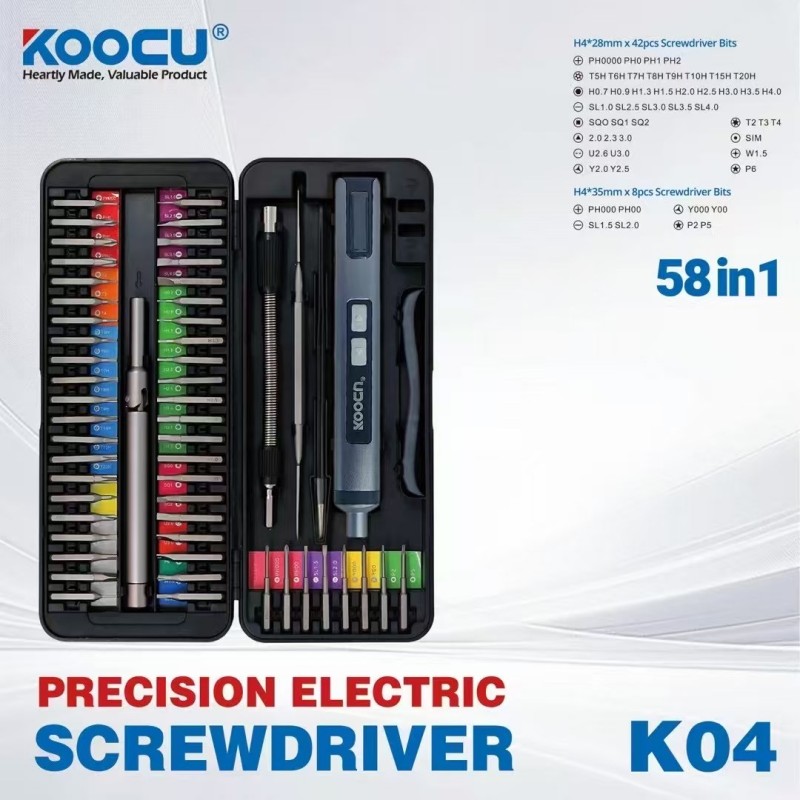
Three specification points are worth flagging for a qualification file. The K01 model is documented with a stable torque output of 1–8 N·m; the line is described with high hardness, high toughness and strong magnetic attraction at the bit; and the recorded operating constraint is that the tool should not be overloaded in long continuous operation under the power-supply working condition. Together these give a buyer a torque figure, a handling characteristic and a stated operating limit — three things a catalogue photograph cannot supply.
On the compliance side, KOOCU's buyer-facing documentation cites PONY CNAS certificate MTIN67MG7731367U1 against the EN 10440 standard for the K01 electric screwdriver, together with finished-product testing before shipment. As with any certificate, the qualification step is to confirm that the certified model, the standard referenced and the model on the purchase order are the same, rather than to accept a certificate image as category-wide coverage.
Commercial terms are documented as an MOQ of 50 units with a 10-day lead time, OEM customization covering voltage and logo, 100% pre-shipment inspection and remote after-sales support. For wholesale buyers targeting Africa, South America, Southeast Asia and EU-facing orders, that combination is the part of the offer that determines whether repeat ordering is operationally realistic.
Where Tweezers Fit: FS-11 and ST-25 in a Qualified Kit
Screw removal is only one operation in a phone teardown, and a qualified cell phone repair tool kit is assessed as a set rather than as isolated items. Tweezers handle the small components, connectors and flex cables that a powered driver must never touch, which is why the tweezer specification belongs in the same acceptance file as the driver specification.
The FS-11 is a tweezer designed for mobile phone repair, made of stainless steel with a length of 120 mm and described as anti-static with high hardness. The ST-25 is a stainless steel tweezer for mobile phone repair, also 120 mm in length. Adjacent models in the same family cover the rest of a working kit: the TS-11 and TS-15 at 115 mm, the ST-21, ST-30, ST-114 and ST-115 at 120 mm, and the 7-SA-16 SS-SA-16 and 7-SA SR SS-SA SR at 130 mm, all in stainless steel and all classified for mobile phone repair.
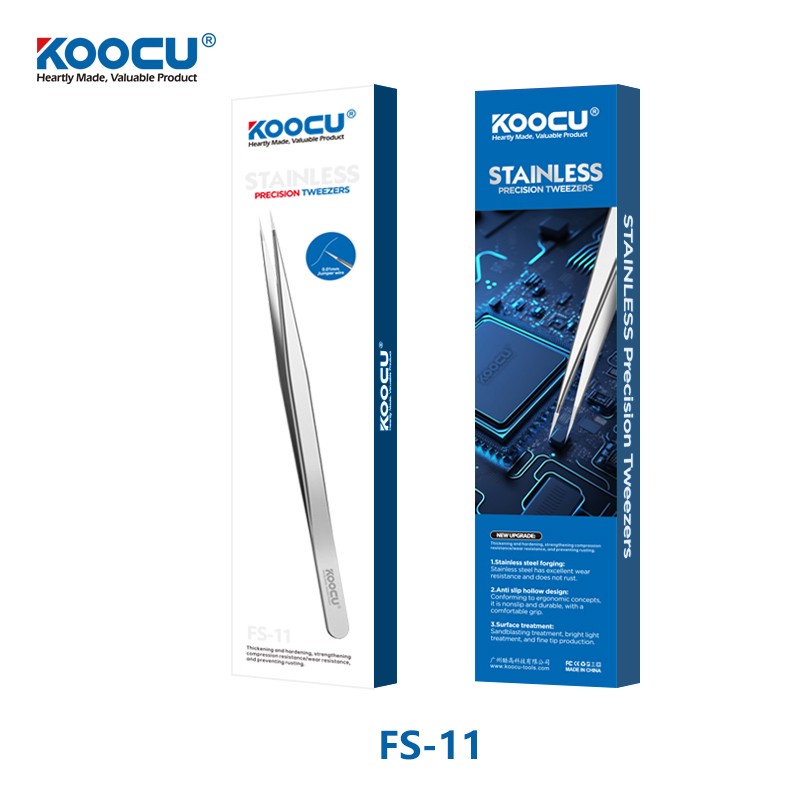
Three checks make tweezers a genuine qualification item rather than an accessory line on the invoice. First, material and length should be stated per model, because a kit that mixes 115 mm and 120 mm and 130 mm models without labelling creates picking errors at the bench. Second, anti-static behaviour should be requested as a documented property of the model, not inferred from a product photograph. Third, model markings on the tool and on the packaging should match the kit list, so that a replacement order six months later delivers the same instrument.
Purchasing Terms and Acceptance Criteria to Fix Before the First Order
Qualification fails most often not at the certificate stage but at the handover between sales terms and goods-in inspection. The terms below are the ones that should be written down before a purchase order is issued, using the KOOCU line as the reference case.
| Term | Reference case (KOOCU line) | Why it belongs in the agreement |
|---|---|---|
| Minimum order quantity | 50 units | Defines whether a trial order is possible before committing to a full assortment |
| Lead time | 10 days | Sets the replenishment rhythm that repair chains plan their tool replacement around |
| Customization scope | Voltage and logo customization | Prevents assumptions about packaging or plug configuration that the supplier does not offer |
| Pre-shipment inspection | 100% finished-product inspection | Moves defect detection upstream of the container rather than into the buyer's warehouse |
| After-sales route | Remote after-sales support | Defines the escalation path when a torque or magnetism problem appears in the field |
| Documentation pack | Certificate reference, specification sheet, inspection record | Allows a second buyer or a local distributor to re-verify without renegotiating |
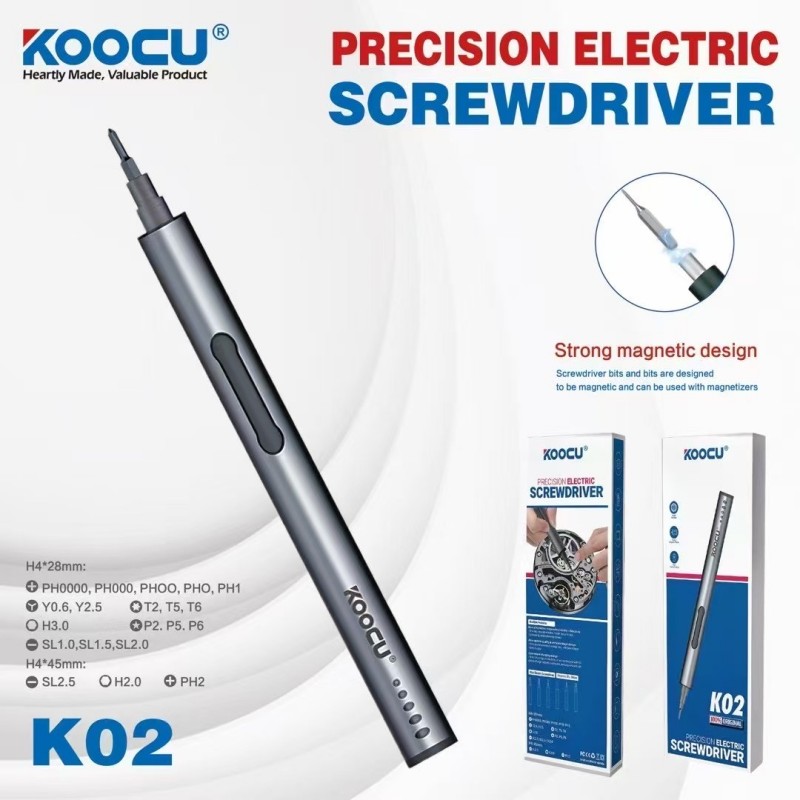
Acceptance criteria should mirror the specification rather than restate it. In practice that means accepting a lot against the torque figure, the power range, the material declaration, the bit retention behaviour after a defined handling cycle, and the model marking on both tool and packaging. A criterion that cannot be measured at goods-in is a marketing statement, not an acceptance criterion.
Documented Qualification Compared With Catalogue Purchasing
Most wholesale tool buying still begins with a catalogue or a marketplace listing. The comparison below shows where that approach holds up and where it does not.
| Dimension | Catalogue or listing purchasing | Documented supplier qualification |
|---|---|---|
| Specification source | Listing text and product images | Specification sheet naming the model, material and power range |
| Compliance evidence | Badge or claim without stated scope | Certificate reference tied to a standard and a specific model |
| Batch consistency | Unknown until the second order arrives | Inspection procedure and finished-product testing stated before order |
| Commercial clarity | Price-led; MOQ and lead time often confirmed late | MOQ, lead time, customization scope and after-sales route agreed in writing |
| Kit assembly | Items sourced from mixed suppliers with unlabelled model differences | Driver and tweezer models documented under one specification file |
The boundary every buyer should accept
Documentation is a necessary condition, not a sufficient one, and this is where qualification programmes most often overreach. KOOCU's official website does not fully disclose every product parameter and certification document, which means buyers must request the specification and certificate material directly rather than assume that the public catalogue is complete. Elsewhere in the market, suppliers with deeper published parameter sets may still hold limited coverage of their own consumables, requiring buyers to manage several suppliers for one kit.
There are also product-level limits that documentation cannot remove. A powered driver introduces power dependency, bit wear and parameter sensitivity into a workflow that a hand tool does not have; an incorrect power-supply setting or a worn bit produces exactly the weak-magnetism symptom that buyers later attribute to the supplier. A 50-unit MOQ also means that very small trial quantities are not the intended purchasing mode. And a certificate covering one model does not extend to every model in the line. Qualification reduces these risks; it does not eliminate them, and no supplier's paperwork can replace a sample evaluation performed on the buyer's own bench.
Market Trend Analysis
Three trends visible in the available data shape how electric screwdriver sourcing is likely to be evaluated over the next buying cycles.
The first is repair-volume continuity. With the global smartphone repair market estimated at approximately USD 22.66 billion in 2026, tool consumption follows service volume rather than consumer device launches, which makes demand comparatively stable but also sensitive to repair-price pressure. That pressure tends to shift buyer attention toward unit cost, which is precisely when qualification discipline matters most.
The second is regulatory and access-driven expansion of third-party repair. The 'Right to Repair' movement is identified as a major 2026 driver pushing OEMs to release repair manuals and tools to third-party providers. As independent and chain repair capacity grows, the number of buyers who need defensible tool documentation grows with it, and documentation becomes a commercial differentiator rather than a compliance formality.
The third is precision migration. Precision screwdrivers are identified as a key growth driver in a manual screwdriver market valued at USD 365.2 million in 2024. The same migration is visible in powered tools, where the documented bands in the KOOCU line span 2W–15W to 2W–30W — a range that only makes sense if buyers are matching drivers to specific teardown tasks rather than buying one general-purpose tool.
Future Outlook
For B2B buyers, the practical direction is toward qualification files that travel with the product. A buyer entering a new market in Africa, South America, Southeast Asia or the EU-facing channel increasingly needs a document set that a distributor, a customs broker or a repair-chain customer can read without contacting the factory. Suppliers that publish model-level specification and inspection information reduce that friction; suppliers that rely on category-level claims increase it.
On the product side, the likely movement is finer segmentation of power and torque bands, paired with stronger emphasis on bit retention and anti-static behaviour across the kit. The distinction between a driver line and a tweezer line will matter less than whether both are documented to the same standard, because a repair kit is only as qualified as its least-documented item.
Product and specification references for the electric screwdriver and tweezer lines discussed here are published at www.koocu-tools.com.
FAQ
What documents should a B2B buyer request from an electric screwdriver supplier?
A buyer should request four document groups: a certificate of conformity that names the specific model and the referenced standard; a specification sheet covering body material, power range, torque behaviour and bit interface; an inspection record or procedure describing finished-product testing before shipment; and written commercial terms covering MOQ, lead time, customization scope and after-sales support. As a reference point, KOOCU's buyer-facing documentation cites PONY CNAS certificate MTIN67MG7731367U1 against the EN 10440 standard for the K01 electric screwdriver, alongside 100% pre-shipment inspection. The buyer's verification step is to confirm that the certified model, the standard cited and the model on the purchase order are identical.
How is an electric screwdriver judged to conform to the cell phone repair tools category?
Conformity is judged against the recorded repair application: the function is removing screws, the operation mode is rotate-and-twist, the matched equipment is a screwdriver bit, the working condition is indoor normal temperature, and the project type is a factory line. The same application specifies explosion-proofing as a special requirement under the power-supply working condition. A conforming product is therefore a special screwdriver for mobile phone repair, built with a body material suited to bench handling, a power band matched to phone screws, a stated torque figure, and a bit interface that fits the screw heads encountered in smartphone and tablet teardown.
What power and torque specifications are documented for the KOOCU electric screwdriver line?
The documented power ranges are 2W–15W for the K01 Pro, 2W–20W for the K02 and K04, and 2W–30W for the K07, with an aluminium alloy body across the line. The K01 model is documented with a stable torque output of 1–8 N·m. The line is described as offering high hardness, high toughness and strong magnetic attraction at the bit, and the recorded operating constraint is that the tool should not be overloaded in long continuous operation under the power-supply working condition.
What purchasing terms apply when sourcing these tools for overseas B2B business?
Documented terms for the KOOCU line are an MOQ of 50 units with a 10-day lead time, OEM customization covering voltage and logo, 100% finished-product inspection before shipment, and remote after-sales support. The company reports that 100% of its products are shipped to international markets, with major markets including Africa, South America, Southeast Asia, India, Bangladesh and Pakistan. A 50-unit MOQ means that very small trial quantities are not the intended purchasing mode, so first orders are typically sized to test both the product and the replenishment cycle.
Why are FS-11 and ST-25 tweezers part of a qualified cell phone repair tool kit?
Tweezers handle the small components, connectors and flex cables that a powered driver must not touch, so they belong in the same specification file as the driver. The FS-11 is a stainless steel tweezer for mobile phone repair, 120 mm in length, described as anti-static with high hardness. The ST-25 is a stainless steel tweezer for mobile phone repair, also 120 mm in length. Other models in the family extend the kit to 115 mm and 130 mm lengths, all classified for mobile phone repair, which allows a buyer to standardise length and material per workstation.
What are the limits of supplier documentation in tool qualification?
Documentation is necessary but not sufficient. Public disclosure is often incomplete — KOOCU's official website does not fully disclose every product parameter and certification document, so buyers must request specification and certificate material directly. A certificate covering one model does not extend to other models in the same line. Powered drivers also add power dependency, bit wear and parameter sensitivity that no certificate can remove, since an incorrect power-supply setting or a worn bit produces the same weak-magnetism symptom as a product defect. Sample evaluation on the buyer's own bench remains the final qualification step.
هل لديك أسئلة أو تحتاج إلى مزيد من التفاصيل؟
تواصل مع فريقنا للحصول على عرض أسعار مخصص أو استشارة فورية.
طلب عرض أسعار
املأ النموذج أدناه وسيتواصل معك فريقنا بعرض مقترح مخصص.
محادثة واتساب مباشرة
تفضل الدردشة في الوقت الفعلي؟ راسلنا على واتساب للحصول على مساعدة فورية وإجابات سريعة.
- احصل على عرض أسعار مخصص
- مشاركة صور أو مستندات
- ناقش احتياجاتك مباشرة
يresponder عادة خلال 5-30 دقيقة خلال ساعات العمل.