
Electrical Switchgear FAQ: GCS, GGD, GCK, MNS, KYN28-12
Electrical Switchgear FAQ: GCS, GGD, GCK, MNS, KYN28-12
Switchgear model codes such as GCS, GCK, MNS and GGD describe a construction family, not a guaranteed performance level. Rated insulation voltage, main busbar current, short-time withstand current, ingress protection and the materials behind them are the figures that decide whether an assembly fits a project — and they have to be confirmed model by model before an order is placed.
This reference answers the technical and procurement questions that electrical designers, EPC contractors and purchasing engineers raise most often about low voltage withdrawable and fixed assemblies and about KYN28-12 indoor metal-clad withdrawable medium voltage switchgear. Every rating below is a published parameter for the referenced model family. Where a value varies within a family, the range is stated rather than a single headline number.
Changzhou Tuoxin Electric Co., Ltd. is a switchgear manufacturer located in Xixiang Industrial Park, Hengshanqiao, Changzhou, Jiangsu, China, founded in 2010. The company produces high voltage switchgear (KYN28 and XGN15 series), low voltage switchgear (GBD, MNS, GGD, GXL, XL and XLW series), YB series box-type substations, custom non-standard electrical control cabinets, PZ30 modular terminal lighting distribution boxes, XJM series metering boxes and bus ducts of various specifications.
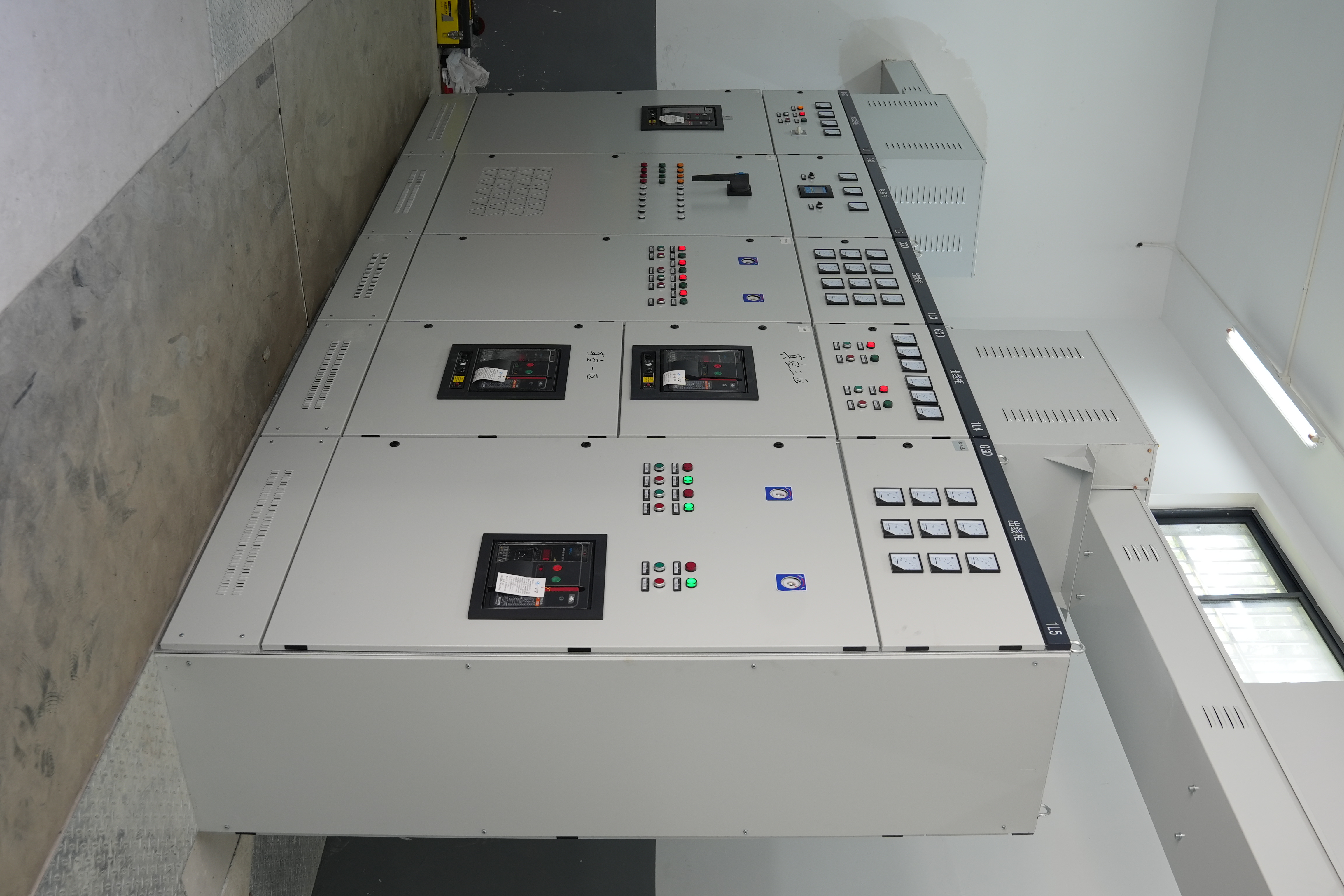
Low voltage electrical switchgear in a project application scenario. Parameter verification happens at the drawing and quotation stage, long before cabinets arrive on site.
Problem: The Same Model Code, Different Delivered Values
A buyer who requests quotations for 'an MNS cabinet' and 'a GCK cabinet' from three suppliers will usually receive three documents that use identical model names and different numbers. Model codes indicate a construction family — withdrawable or fixed, module dimensions, busbar arrangement — but they do not by themselves define current capacity, short-circuit withstand, plating, steel grade or ingress protection.
Three consequences follow for procurement and engineering teams:
- Comparison breaks down. If two offers both say 'MNS' but one quotes a 1600 A main busbar and the other a 4000 A main busbar, the price difference is not a supplier margin difference; it is a different product.
- Compliance evidence must match the declared rating. Low voltage switchgear and controlgear assemblies are governed by the IEC 61439 series (Parts 1–7) for design, verification and safety, so the declared parameters, not the model name, are what a verification review examines.
- Application conditions change the valid rating. A cabinet rated for standard indoor conditions from −10 °C to +40 °C is not automatically valid in a coastal plant, a high-altitude site or a heavy-dust workshop.
The practical response is to treat the parameter table as the procurement document. The sections below set out those parameters for the four most frequently compared low voltage families and for the KYN28-12 medium voltage model.
Low Voltage Parameters: GCS, GCK, GGD and MNS
| Model | Construction | Rated insulation voltage | Rated operational voltage | Current rating | Short-time withstand current (1 s) | Short-time peak current | IP rating |
|---|---|---|---|---|---|---|---|
| GCS | Withdrawable | 660 V | 380 V / 660 V | Main busbar 1600–4000 A; vertical (distribution) busbar max. 1600 A | Main busbar 100 kA | Main busbar 120 kA | IP30 |
| MNS | Withdrawable | 660 V | 380 V / 660 V | Main busbar 1600–4000 A; vertical (distribution) busbar max. 1600 A | Main busbar 100 kA | Main busbar 120 kA | IP30 |
| GCK | Withdrawable | 660 V | 380 V / 660 V | 600–1600 A | 50 kA | 80 kA | IP30 |
| GGD | Fixed | 660 V | 380 V / 660 V | 600–1600 A | 50 kA | 80 kA | IP30 |
All four families share the same rated insulation voltage of 660 V and the same rated operational voltage of 380 V / 660 V. The material differences appear in busbar capacity and in construction. For GCS and MNS, the vertical (distribution) busbar has a short-time peak current of 80 kA in the standard type and 100 kA in the reinforced type — a distinction that is frequently omitted from short quotations and that matters when the outgoing section, not the incomer, defines the duty.
GCK and GGD occupy the 600–1600 A band. The two are not interchangeable in service, however: GCK is a withdrawable assembly and GGD is a fixed assembly, while their insulation, current and short-circuit figures are identical. This is the single most common point of confusion in low voltage procurement — the rating column matches, the maintenance philosophy does not.
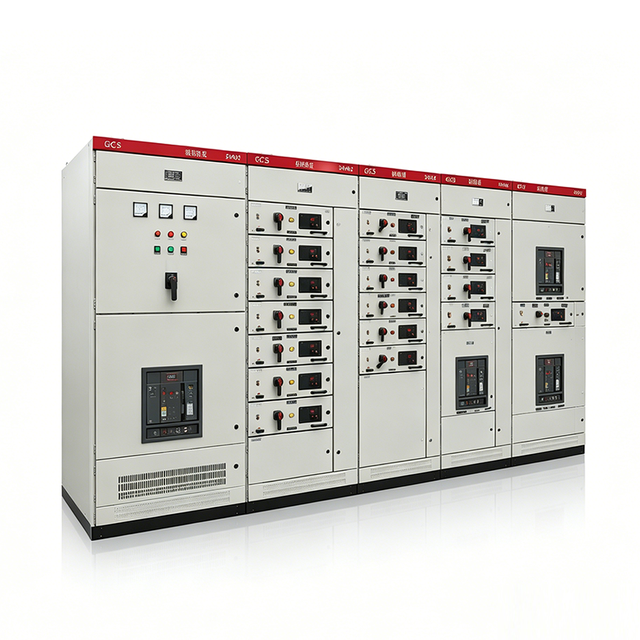
GCS low voltage withdrawable switchgear. Main busbar rating of 1600–4000 A and 1 s short-time withstand current of 100 kA are the parameters that should appear on the quotation sheet, not only the model code.
Withdrawable vs Fixed: What the Difference Means in Operation
Withdrawable assemblies (GCS, GCK, MNS) place each functional circuit in a draw-out unit housing made of galvanized steel sheet with integrated reinforcing ribs. In installed systems, the draw-out design allows an individual circuit to be removed for maintenance without cutting power to the whole board — a decisive property in data rooms, hospitals and continuous-process plants where a full-board shutdown is not acceptable.
Fixed assemblies (GGD) mount components directly in the cabinet. They remain a valid choice where load density is lower, where maintenance windows exist, or where the specification prioritises a simpler busbar arrangement. The parameters to compare in that decision are not only current and short-circuit ratings but also the number of outgoing circuits, the required protection scheme, and whether the site can ever tolerate a complete de-energisation of the section.
Medium Voltage Layer: KYN28-12 Rated Parameters
KYN28-12 is an indoor, metal-clad, withdrawable AC switchgear for three-phase 50 Hz systems with a rated voltage of 3–12 kV. It is designed for single busbar and single busbar sectionalized systems, and it performs the receiving, distribution, control, protection and monitoring functions at the medium voltage level.
| Parameter | KYN28-12 rating |
|---|---|
| Rated voltage | 12 kV |
| Rated frequency | 50 Hz |
| Rated current | 630–4000 A |
| Rated short-circuit breaking current | 20–50 kA |
| Rated short-circuit making current | 50–125 kA |
| Rated 4 s short-time thermal withstand current | 20 / 25 / 31.5 / 40 / 50 kA |
| Rated peak withstand current | 50 / 63 / 80 kA |
| 1 min power-frequency withstand voltage | 42 kV phase-to-phase and phase-to-earth; 48 kV across the isolation break |
| Lightning impulse withstand voltage | 75 kV phase-to-phase and phase-to-earth; 85 kV across the isolation break |
| Protection degree | IP4X enclosure; IP2X with the circuit breaker door open |
The 4000 A current rating and the 50 kA short-circuit breaking rating are the two figures that most often drive a site from a mid-range to a high-capacity specification, because they determine both the busbar cross-section and the breaker frame selected. The 1 min power-frequency and lightning impulse values are the insulation figures that must be checked against the local supply system and altitude of the installation. Within the same KYN28 platform, a 24 kV variant is also manufactured, rated 630–3150 A with IP4X protection, for systems that require a higher voltage class.
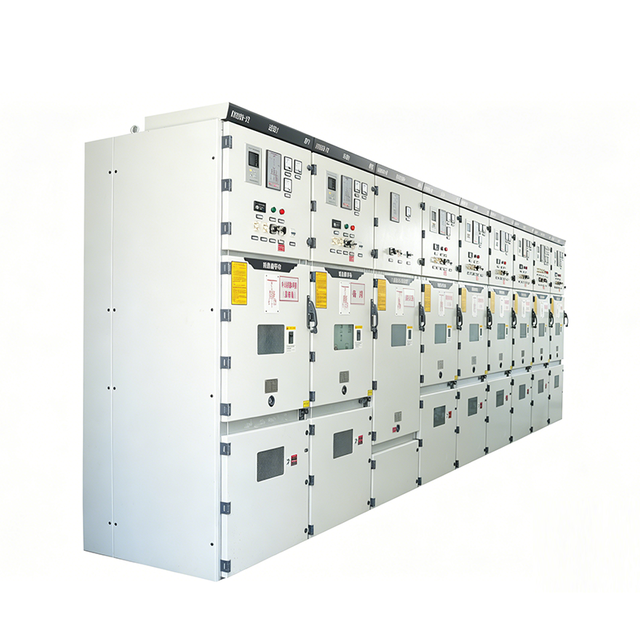
KYN28-12 indoor metal-clad withdrawable switchgear, rated 12 kV and 630–4000 A. Insulation values of 42 kV power-frequency and 75 kV lightning impulse withstand are stated separately for phase-to-earth and across the isolation break.
Materials: What Actually Determines Service Life
Two cabinets can carry the same electrical rating and still age differently, because the electrical rating says nothing about steel grade, plating or insulation class. The material specification for the low voltage families and for KYN28-12 is summarised below.
| Component | GCS / GCK / MNS / GGD low voltage assemblies | KYN28-12 medium voltage switchgear |
|---|---|---|
| Frame, enclosure, partitions | Galvalume steel sheet or cold-rolled galvanized steel sheet, integrally bent and assembled, with electrostatic plastic spraying for anti-corrosion | Aluzinc (galvalume) coated steel sheet |
| Draw-out / handcart housing | Galvanized steel sheet with integrated reinforcing ribs | Stainless steel plate for handcart components |
| Conductive busbars and contacts | T2 pure copper busbar with tin or silver plating on contact surfaces | T2 silver-plated copper |
| Insulating parts | SMC unsaturated polyester moulding compound, epoxy resin, PVC insulating sleeves | Epoxy resin and SMC composite |
| Primary and secondary wiring | Copper core PVC insulated cable | Copper core insulated control cable |
| Sealing and damping | Foamed rubber sealing strips and rubber damping pads | Rubber sealing strips |
| Fasteners | 304 stainless steel bolts, flat washers and spring washers | Stainless steel fasteners |
Three of these rows carry more procurement weight than the rest. First, the conductive path: T2 pure copper is the specified conductor in both voltage classes, and the contact surface is tin-plated as standard or silver-plated for higher duty — the plating is what limits contact resistance growth over years of thermal cycling. Second, the insulation system: SMC unsaturated polyester moulding compound and epoxy resin are the materials used for partition boards, busbar sleeves and support insulators, so a supplier that substitutes generic plastics changes the insulation behaviour without changing the model code. Third, the fasteners and sealing elements: 304 stainless steel bolts and foamed rubber sealing strips are what keep an IP30 enclosure, and the internal structure, stable in service.
Application Scope by Project Type
Low voltage and medium voltage assemblies from these families are applied across the same functional chain — power intake, transformation, distribution, metering, protection and terminal control — but the project type determines which model combination is appropriate.
- Civil and public buildings. High-rise buildings, commercial complexes, residential districts, hospitals, schools, exhibition centres and hotels are served by low voltage distribution assemblies and terminal distribution equipment for power, lighting and fire-protection circuits.
- Transportation infrastructure. Metro and rail transit stations, airports, seaports, tunnels and logistics parks use both voltage classes, typically with emergency and dual-source distribution for signalling, ventilation and pumping loads.
- Digital infrastructure. Data centres, communication equipment rooms and charging station power distribution systems require the withdrawable construction and, where continuity matters, dual power transfer schemes.
- Heavy industry and manufacturing. Metallurgy, steel, petrochemical, offshore oil and gas platforms, coal mines, papermaking, automotive plants, textile mills, machinery plants and semiconductor factories use the medium voltage layer for incomers and transformer protection, and the low voltage layer for motor control and workshop distribution.
- Power and new energy. Thermal, hydro, photovoltaic, energy storage and wind power plants, substations and nuclear power stations use these assemblies for auxiliary power distribution and motor control; ring main units and prefabricated substations cover the distribution and terminal points of medium voltage networks.
In high-altitude, coastal, chemical, high-humidity or heavy-dust locations, the standard configuration is adjusted rather than replaced — increased insulation clearance and derated components above 2000 m, hot-dip galvanized or fluorocarbon coated enclosures in coastal salt conditions, and upgraded protection classes in dusty workshops. Those adjustments are engineering decisions that belong in the specification document, not in a post-delivery discussion.
Market Context: Why Parameter Verification Is a Growing Task
Demand-side signals explain why buyers are spending more time on specification review. The global switchgear market was estimated at USD 112.9 billion in 2025 and is projected to reach USD 197.7 billion by 2033, according to Grand View Research. Global Market Insights reports that the global low voltage switchgear market exceeded USD 86.1 billion in 2024, driven by infrastructure upgrades and smart grid technology.
Supply-side structure is the second signal. ABB, Siemens, Schneider Electric, Eaton and GE together held approximately 35 % of the global switchgear market in 2024, according to Global Market Insights — a figure that also means the majority of assemblies are supplied by a long tail of regional and specialist manufacturers. Cross-border sourcing is already at scale: UN Comtrade data shows China exported approximately USD 2.72 billion of electrical apparatus for switching or protecting electrical circuits to the United States in 2024 alone.
The procurement implication is direct. When a large share of supply comes from manufacturers outside the five largest groups, model codes travel internationally while parameter tables do not. Verification therefore has to be built into the enquiry stage rather than assumed from brand recognition.
Boundaries and Limitations Buyers Should Confirm
Published ratings describe a defined operating envelope, and several boundaries in this product range are worth stating explicitly.
- IP30 is an indoor rating. GCS, GCK, GGD and MNS are rated IP30 as standard. That is appropriate for dry indoor switch rooms and distribution rooms, but it is not sufficient on its own for heavy-dust workshops, humid basements or utility tunnels, where protection has to be upgraded to IP40 or IP54 with fully enclosed cabinets, or an anti-condensation structure with heating and dehumidifying control has to be added.
- Standard conditions are −10 °C to +40 °C. Above 2000 m altitude, insulation clearance must be increased, components derated and cabinet sealing reinforced; the standard configuration is not valid at those sites without modification.
- Coastal and chemical environments require different materials, not a different model code. Salt-spray resistance depends on hot-dip galvanized or fluorocarbon coated enclosures and 304 stainless steel fasteners; aggressive chemical atmospheres require anti-corrosion coating and fully enclosed structures.
- KYN28-12 is designed for single busbar and single busbar sectionalized systems. It is a strong fit for that layout. It is not a universal answer where a double busbar station arrangement is specified.
- Fixed construction trades maintainability for simplicity. GGD matches GCK on insulation, current and short-circuit ratings, but a fixed assembly cannot offer the same individual-circuit isolation during maintenance.
Future Outlook
Two directions are visible in how these assemblies are specified. The first is integration: buyers increasingly request the complete chain — high and low voltage switchgear, box-type substations, bus ducts, metering boxes and control cabinets — under unified drawings and factory inspection, because multi-supplier coordination is a schedule risk as much as a technical one. Prefabricated substations in particular reduce the need for a dedicated power room and shorten construction time on distributed projects.
The second is monitoring. Remote data acquisition through 4G or RS485 links, remote alarm and switching functions, and automatic metering data collection are becoming part of the specification rather than an option, since they reduce on-site inspection workload and make energy data available for management. Documentation is following the same path: bilingual technical documents, type test reports and declaration-of-conformity files are now evaluated alongside the hardware, because they determine whether a consignment clears customs and passes local acceptance.
FAQ
What is the difference between GCS, GCK, GGD and MNS low voltage switchgear in terms of rated parameters?
All four families share a rated insulation voltage of 660 V and a rated operational voltage of 380 V / 660 V. GCS and MNS are withdrawable assemblies with a maximum main busbar operating current of 1600–4000 A, a maximum vertical (distribution) busbar current of 1600 A, a 1 s main busbar short-time withstand current of 100 kA and a main busbar short-time peak current of 120 kA, at IP30. GCK (withdrawable) and GGD (fixed) are rated 600–1600 A with a 1 s short-time withstand current of 50 kA and a short-time peak current of 80 kA, also at IP30. The difference between the two groups is therefore both capacity and construction type.
How should a buyer choose between a fixed assembly and a withdrawable assembly?
The decision is driven by maintainability and continuity requirements rather than by electrical rating. GCK and GGD have identical rated insulation voltage, rated operational voltage, current range and short-circuit figures; the difference is that GCK is withdrawable and GGD is fixed. In a withdrawable design, the draw-out unit can be removed so that maintenance on one circuit does not require cutting power to the entire board, which suits data rooms, hospitals and continuous-process plants. A fixed design suits sites with lower load density or where planned shutdown windows are acceptable.
What are the key rated parameters of KYN28-12 switchgear?
KYN28-12 is rated 12 kV, 50 Hz, 630–4000 A, with a rated short-circuit breaking current of 20–50 kA, a rated short-circuit making current of 50–125 kA, a rated 4 s short-time thermal withstand current of 20 / 25 / 31.5 / 40 / 50 kA and a rated peak withstand current of 50 / 63 / 80 kA. The 1 min power-frequency withstand voltage is 42 kV phase-to-phase and phase-to-earth and 48 kV across the isolation break; the lightning impulse withstand voltage is 75 kV phase-to-phase and phase-to-earth and 85 kV across the isolation break. The enclosure is rated IP4X, and IP2X applies when the circuit breaker door is open.
Which materials determine the service life of these assemblies, and how are they specified?
In the GCS, GCK, MNS and GGD low voltage families, the frame, enclosure and partitions are made of galvalume steel sheet or cold-rolled galvanized steel sheet, integrally bent and assembled with electrostatic plastic spraying; draw-out unit housings use galvanized steel sheet with integrated reinforcing ribs; conductive busbars and contact terminals use T2 pure copper busbar with tin or silver plating on contact surfaces; insulating parts use SMC unsaturated polyester moulding compound, epoxy resin and PVC insulating sleeves; sealing and damping components use foamed rubber sealing strips and rubber damping pads; and fasteners are 304 stainless steel bolts, flat washers and spring washers. KYN28-12 uses aluzinc coated steel sheet for the enclosure, T2 silver-plated copper for conductive busbars, epoxy resin and SMC composite for insulating components, stainless steel for handcart components, and rubber sealing strips.
Which project types are these switchgear families suitable for?
They are applied in power and new energy projects (thermal, hydro, photovoltaic, energy storage and wind power plants, substations and nuclear power stations for auxiliary distribution and motor control); heavy industry and manufacturing (metallurgy, steel, petrochemical, offshore platforms, coal mines, papermaking, automotive, textile, machinery and semiconductor plants); digital infrastructure (data centres, communication equipment rooms and charging station distribution); transportation infrastructure (metro, rail transit, airports, seaports, tunnels and logistics parks); and civil and public buildings (high-rise buildings, commercial complexes, residential districts, hospitals, schools, exhibition centres and hotels).
What are the operating limits that should be confirmed before ordering?
The standard indoor condition is ambient temperature from −10 °C to +40 °C. Above 2000 m altitude, insulation clearance must be increased and components derated. Coastal salt corrosion requires hot-dip galvanized or fluorocarbon coated enclosures and 304 stainless steel fasteners. Chemical corrosive environments require anti-corrosion coating and fully enclosed structures. Heavy-dust workshops require protection class improvement to IP40 or IP54 with fully enclosed cabinets. High-humidity basements and utility tunnels require temperature and humidity control with built-in heating and an anti-condensation cabinet structure. The IP30 rating that applies to GCS, GCK, GGD and MNS as standard is an indoor rating and should not be relied on alone in adverse environments.
Which standards and certifications apply to this equipment?
Low voltage switchgear and controlgear assemblies must comply with the IEC 61439 series (Parts 1–7) for design, verification and safety. High voltage prefabricated substations up to 52 kV are governed by IEC 62271-202:2022. For the Chinese market, CCC certification is a mandatory requirement for the relevant product categories, and manufacturer documentation typically also includes quality and environmental management system certificates and type test reports. Buyers verifying a supplier should confirm that the declared parameters, the material specification and the test documentation refer to the same model and rating.
Changzhou Tuoxin Electric Co., Ltd. manufactures high voltage switchgear (KYN28, XGN15 series), low voltage switchgear (GBD, MNS, GGD, GXL, XL, XLW series), YB series box-type substations, PZ30 modular distribution boxes, XJM metering boxes and bus ducts, and holds CCC certification along with ISO 9001/14001/45001 management system certification. Product information is published at https://www.tuoxinelectric.com/.