
Electronic-Grade Vinylbenzyl Chloride: Compliance Checklist
Electronic-Grade Vinylbenzyl Chloride: Compliance Checklist
Electronic-Grade Vinylbenzyl Chloride Isomers: A Compliance and Qualification Checklist
Approving an electronic-grade vinylbenzyl chloride grade is an identity decision before it becomes a commercial one. Four product grades are sold under the VBC name, and three of them are structural isomers that share the molecular formula C9H9Cl. A purchase order, certificate of analysis (COA) or drum label that records only “vinylbenzyl chloride” therefore does not tell a buyer which molecule will arrive. The checklist below converts that ambiguity into a document set a quality and procurement team can approve or reject on evidence.
It is written for buyers at the research and evaluation stage: photoresist formulators, membrane and ion-exchange resin producers, and sourcing teams assembling a compliance dossier before a first production order. Price band is not part of the checklist because no published price data was available for these grades; the commercial parameters that are documented — minimum order quantity and lead time — appear later, alongside the identity and quality constraints they depend on.
Four identifiers have to agree before any commercial term is discussed
The constraint set starts with four data points that must match across the enquiry, the grade specification, the COA and the label: grade name, CAS number, EINECS (EC) number and molecular formula. If any one of them is missing or inconsistent, the buyer is not approving a molecule — the buyer is approving a supplier’s shorthand.
The CAS number is the practical discriminator. It is the field that separates the para isomer from the meta and ortho isomers and separates all three from the mixed grade, which has its own registry entry because it is a mixture rather than a single compound. The EINECS number is the inventory identifier that appears in safety data sheets and registration paperwork, so a mismatch between the CAS on the COA and the EINECS on the SDS is a documentation defect in its own right. The molecular formula confirms that the buyer is comparing isomers within one family rather than a different chemistry altogether.
| Grade as listed | CAS | EINECS | Formula | Appearance recorded |
|---|---|---|---|---|
| 4-Vinylbenzyl chloride (4-(chloromethyl)styrene) | 1592-20-7 | 216-471-2 | C9H9Cl | Colorless to pale yellow transparent liquid |
| 1-(chloromethyl)-2-vinylbenzene (ortho isomer) | 22570-84-9 | Not stated in the reviewed product data | C9H9Cl | Not stated in the reviewed product data |
| 1-(chloromethyl)-3-vinylbenzene, also written 3-(chloromethyl)styrene (meta isomer) | 39833-65-3 | Not stated in the reviewed product data | C9H9Cl | Not stated in the reviewed product data |
| Vinylbenzyl chloride, mixed isomers | 30030-25-2 | 250-005-9 | C9H9Cl | Light yellow to colorless liquid |
Two points in that table deserve a place in the acceptance file. First, molecular weight is fixed by the formula, so all four grades carry 152.62; the reviewed product data records that value explicitly for the para and mixed grades. Identical formula and identical molecular weight mean that neither field can distinguish one isomer from another — they only confirm the family. Second, the ortho and meta entries in the reviewed material are identified by name and CAS but do not carry an EINECS number or physical constants. That is not a defect to be filled in from memory; it is an item to be requested from the supplier’s SDS or technical data sheet and then checked against the enquiry.
Naming is the third trap. The product data synonym lists for these grades include “chloromethylstyrene”, “ar-(chloromethyl)-styrene”, “4-(chloromethyl)styrene” and “vinylbenzyl chloride, mixture of isomers”. An order written as “chloromethylstyrene” can therefore be filled legitimately with either a single isomer or the mixed grade, and the mixed grade’s own synonym entry describes a mixture of 3- and 4-isomers containing 50–100 ppm tert-butylcatechol as inhibitor. If a formulation needs a defined ortho content, that requirement has to be written into a custom ratio specification rather than assumed from the mixed-grade CAS number.
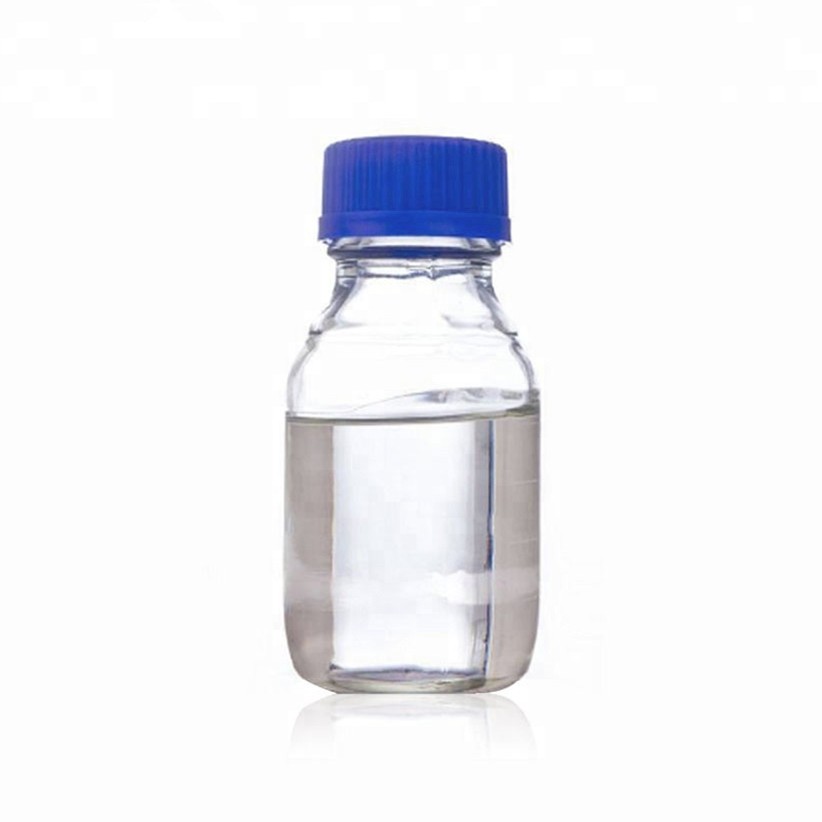
Vinylbenzyl chloride grade used in negative photoresist resins and ion-exchange applications — product reference image. Identity approval depends on the CAS, EINECS and isomer data attached to the specific grade, not on the family name.
Physical constants are consistency checks, not identity proof
The two grades with complete records show how little routine physical data separates them. The para isomer and the mixed grade are both recorded at a boiling point of 229 °C, a refractive index of n20/D 1.572, a flash point of 221 °F, a vapour pressure of 1 mm Hg at 56.1 °C and a vapour density of 5.3 (vs air). Density is the only headline constant that differs materially: 1.083 g/mL at 25 °C for the para grade against 1.074 g/mL for the mixed grade.
That difference is small enough that a density or refractive index result on a COA should be treated as a consistency check against the specification, not as confirmation of which isomer was shipped. The discriminating evidence is the isomer distribution itself, measured chromatographically and reported as a line item. The supplier states that its quality-control instrument set includes HPLC, GC and ICP-MS systems; the buyer’s action is to require the isomer result and the relevant chromatographic method reference on the COA, and to hold a retained sample against which the next lot can be compared.
Grade parameters that belong in the specification
Once identity is fixed, the acceptance criteria narrow to parameters that are grade-specific rather than family-specific. The documented options give buyers a starting point rather than a finished specification.
- Isomer content and ratio. The supplier states availability of pure para isomer at ≥99%, pure ortho at ≥98%, pure meta at ≥98%, and any custom mixture ratio of ortho, meta and para isomers. A specification that names only “VBC” leaves all four of those options open.
- Appearance. The para grade is described as a colorless to pale yellow transparent liquid; the mixed grade as a light yellow to colorless liquid. The two descriptors are not interchangeable, and the para record also carries a separate colour field reading “clear yellow” — exactly the kind of internal wording variance that should be resolved into one agreed descriptor before approval.
- Storage temperature. The records differ: −20 °C for the mixed grade and 2–8 °C for the para grade. A single warehouse protocol will not serve both, and receiving inspection should be carried out at the grade’s own storage condition rather than at ambient temperature.
- Solubility and handling. The para grade is recorded as insoluble in water, with sparing solubility in chloroform. That belongs in the handling instruction and in the cleaning procedure for sampling equipment.
- Items that are not in the published data. The reviewed product data does not state metal-ion limits, water content or particle counts for these grades. Because the supplier states that COA test items and format can be customised, these are precisely the line items to write into the specification rather than assume. The supplier also states 100% testing, which should be read as a testing-rate statement covering lots, not as a substitute for the numeric limits you define.
The stabilizer declaration: from footnote to numeric criterion
Tert-butylcatechol (TBC) is added to vinylbenzyl chloride grades as an inhibitor that suppresses premature polymerisation during storage and transport. Because it is not the reactive monomer, its declared level changes what a kilogram of delivered material actually contains, and that is why it belongs in acceptance criteria rather than in a footnote.
The published data shows how variable the declaration can be. The mixed grade’s synonym entry specifies 50–100 ppm TBC as inhibitor, and other catalogue-style entries for vinylbenzyl chloride grades use the word “stabilized” with no number attached at all. For 1-(chloromethyl)-3-vinylbenzene, where a grade specification declares TBC at approximately 0.1%, that figure must be captured explicitly — and the arithmetic explains why. At 0.1%, roughly 1 g in every kilogram of delivered material is inhibitor rather than monomer; at 50–100 ppm, the same kilogram carries about 0.05–0.1 g. A formulator dosing by mass is working with a different active-monomer fraction in each case, and any receiving process that was qualified against one level is being asked to accept a different one.
Four elements turn the stabilizer line into a usable criterion. State the target value and a tolerance rather than a single number (“declared value ± acceptance window”). Name the test method used to determine it. Require the result per lot on the COA, not once at qualification. And require re-test at receipt, because inhibitor level is a variable that can drift between batches even when assay is unchanged. Where a supplier’s documentation says “stabilized” without a value, the correct response is a documented request for the number, not an assumption that the level matches another grade in the same portfolio.
Turning “colorless to pale yellow” into a testable appearance criterion
Appearance is the parameter most often left as an adjective, and it is the one most likely to trigger a pointless rejection dispute. The fix is procedural rather than analytical. Convert the written descriptor into either a defined colour scale or an approved retained reference sample; fix the viewing conditions (background, lighting, sample depth) so two inspectors see the same thing; condition the sample to the grade’s storage temperature before inspection; and record the result with a photograph at receipt.
The word “transparent” carries a second check, since it implies the absence of haze or suspended matter — a visible deviation that should open an investigation rather than be noted and passed. Finally, apply the grade’s own descriptor. Accepting a family-level appearance statement on a COA for a specific isomer is how a colour specification quietly stops meaning anything.
The compliance dossier: what each document covers, and where its scope ends
A compliance dossier is not a pile of certificates; it is a set of claims each bounded by a scope line and a validity window. For electronic-grade vinylbenzyl chloride, the documents below are the ones a buyer can actually check against a date and a product name.
| Document | Identifier / issuer | Validity stated | What it supports — and what it does not |
|---|---|---|---|
| ISO 9001 quality management system certification | NOA2505548; NOA Testing & Certification Group Ltd.; GB/T 19001-2016 idt ISO 9001:2015 | 25 Jul 2025 – 24 Jul 2028 | Certifies a management system. It is not a product specification and does not certify the purity or isomer ratio of any grade. |
| Hazardous Chemicals Operation License | Su(Xi)WHJJZ(Lingang)02864; Jiangsu Jiangyin Lingang Economic Development Zone Management Committee | 26 Jun 2024 – 25 Jun 2027 | Covers sale of hazardous chemicals within the permitted scope, excluding storage. Storage arrangements must be clarified separately. |
| Non-pharmaceutical Precursor Chemicals Filing Certificate | (Su) 3J32028100536; Jiangyin City Emergency Management Bureau | 17 Feb 2025 – 16 Feb 2028 | Filing for business operation of Category III non-pharmaceutical precursor chemicals. It is an administrative filing, not a product-quality record. |
| RoHS compliance certification | CKEYS250724006; Guangdong KEYS Testing Technology Co., Ltd.; RoHS 2.0 (EU)2015/863 and (EU)2017/2102 | Issued 24 Jul 2025 | Scope is Tolyltriazole. It does not extend to vinylbenzyl chloride grades and cannot be cited as their restricted-substance evidence. |
| SGS factory audit report | QIP-ASI254749; SGS; Made-in-China Supplier Initial Audit Standard | Dated 23 May 2025, with a stated validity window | Records a site observation at the audit date. Confirm it is current before relying on it. |
| Grade specification and SDS | Supplier-issued per grade | Version-controlled | Declares identity and typical values. SDS languages available include English and Spanish; neither document proves lot conformance. |
| COA per lot | Supplier-issued, with customisable test items | Per batch | Reports lot results against the agreed specification. It is supplier-generated unless a third-party report is added. |
| Third-party test report | SGS, BV or Intertek, stated as available on request | Per test | Provides independent verification of the items actually tested — nothing outside that test scope. |
Two rows in that table show why scope reading matters more than certificate counting. The RoHS certificate in this dossier is issued for tolyltriazole, a different product; presenting it as evidence for a vinylbenzyl chloride grade would be a scope error that a customer audit would catch. The hazardous-chemicals licence is explicitly limited to sale within the permitted scope and excludes storage, so a buyer assessing supply continuity should ask where and how material is held before shipment rather than reading the licence as a full logistics authorisation. The SGS audit report is dated 23 May 2025 and carries its own validity window, which is the general rule for audit evidence: an audit report describes a site on a date, and it ages.
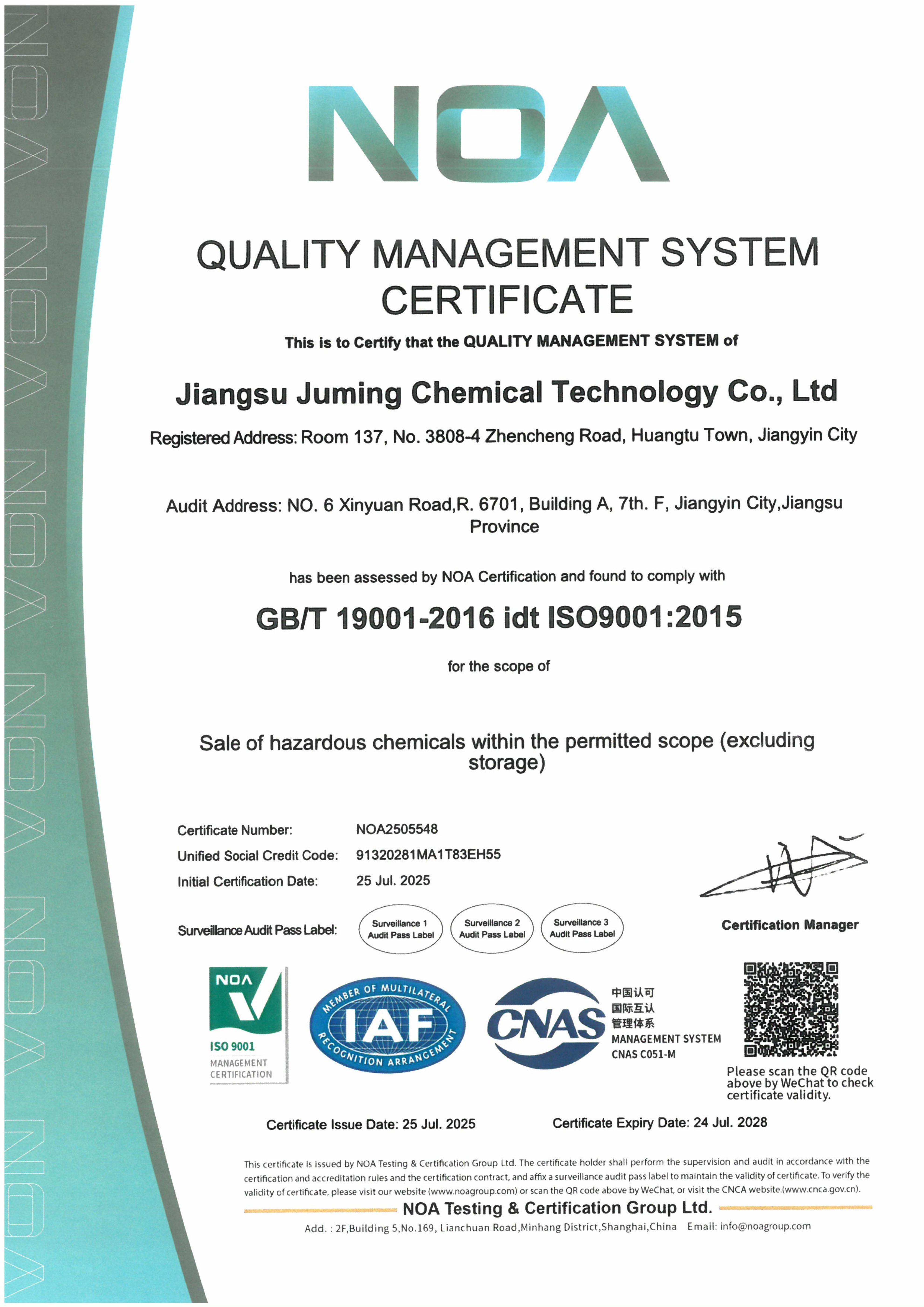
ISO 9001 certificate NOA2505548, issued 25 July 2025 and valid to 24 July 2028. A management-system certificate supports process discipline; the grade specification and COA carry the product claims.
Capability evidence to request behind the claims
Jiangsu Juming Chemical Technology Co., Ltd. (Jumingchem), established in 2017 in Jiangsu Province, integrates research, development, production and sales of electronic chemicals — a business scope it states on its official company website. The figures it publishes are the ones a qualification team should test rather than accept: a total factory area of 78,000 m² alongside a 3,000 m² R&D centre, a 300 m² pilot plant and a 600 m² GMP workshop; 180 employees, including 25 engineers; 60,000 tons of annual output; and a 70% export share across the United States, Korea, Japan, Taiwan region, Germany, Southeast Asia and the Middle East.
Three of those claims convert directly into evidence requests. First, the company states advanced microchannel and continuous-flow technology for challenging chemical processes — ask which of the VBC grades run on that platform and what the batch records show. Second, it states ppb-level metal-ion impurity purification capability for electronic-grade products; this is a company-reported capability rather than an independently validated specification, so the buyer’s route is batch COA data plus an independent test on a qualification lot rather than a printed capability statement. Third, it describes electronic-grade operations conducted in ISO 6 GMP cleanrooms with low-extraction materials, batch traceability coding, retained samples and third-party re-inspection through SGS, BV or Intertek — all items that should appear as named clauses in the supply agreement.
The commercial parameters that are documented are equally specific: a minimum order quantity of 1 kg, a lead time of 7–30 days, a stated monthly capacity of 5,000 tons, 100% testing, and remote technical support after delivery. Packaging options cover 25 kg HDPE drums, 200 kg steel-plastic composite drums and 1,000 L IBCs, with temperature-controlled packaging for long-distance hot-climate shipping, custom labelling and COAs with custom test items. For scale planning, the published project types distinguish industrial-grade shipments of roughly 5–50 tons from electronic-grade batches of roughly 500 kg–5 tons. Matching qualification-lot size to production-lot size is part of the dossier, because a 1 kg qualification sample and a 5-ton production batch are not the same evidence.
Where the isomers fit — and where the evidence stops
The application statement attached to the VBC family covers core monomers for high-performance negative photoresist resins, including E-beam electron-beam photoresist, and advanced packaging dielectric materials, together with homogeneous ion-exchange membranes, ultra-pure water resins and chelating resins. The para grade adds ion-exchange resins, photoresist polymers, cross-linkable fibres, coupling agents and electroconducting polymers, and is described as a dual-functional monomer that is readily derivatised by chloride displacement — the vinyl group supports polymerisation while the chloromethyl group supports post-polymerisation functionalisation.
The boundary is just as important as the fit. The reviewed material states these applications at family level; it does not supply a per-isomer performance comparison, comparative test data or a lithography-platform-specific recommendation. A buyer should therefore read the application list as the reason to sample a specific grade, not as evidence that the grade is qualified in a given formulation. Isomer selection and the associated COA line items — isomer distribution, stabilizer level, appearance, and any metal-ion or water limits the formulation needs — remain the buyer’s qualification work, performed on the buyer’s process.
Market context: category growth, not isomer-level demand
The wider category is expanding. Fortune Business Insights reported the global photoresist chemicals market at USD 38.00 billion in 2025, projected at USD 40.30 billion in 2026 and USD 63.77 billion by 2034, in material dated 12 October 2026. The figure is a category-level projection covering photoresist chemicals as a whole, and no isomer-specific valuation for vinylbenzyl chloride was available in the reviewed evidence, so it should not be converted into a demand forecast for a single grade.
Its practical use in a qualification file is narrower: category expansion raises the number of supplier changes and second-source requests a buyer will process, and each of those adds a dossier review. On that reading, the checklist above is a throughput tool, not a formality.
Approval in five gates
A grade should move to approval only when all five gates close. Any gate left open keeps the material at sample status regardless of how complete the rest of the file looks.
- Identity gate. Grade name, CAS, EINECS and formula agree across enquiry, specification, COA and label. Where the EINECS or physical data is absent from the supplier’s documents, it is requested and checked — not inferred.
- Specification gate. Isomer content or ratio, appearance descriptor, storage temperature, stabilizer level with tolerance and method, plus the metal-ion, water and particle limits the formulation requires, are all stated numerically.
- Lot evidence gate. The COA reports isomer distribution and stabilizer level by a named method, and the lot is compared against a retained reference sample.
- Compliance gate. Every certificate is read with its scope and validity date; product-specific coverage is distinguished from company-level coverage, and expired or out-of-scope documents are not counted.
- Supply gate. Site, capacity, packaging, minimum order quantity and lead time are confirmed for the actual grade ordered, and the qualification batch is representative of the production batch.
Frequently asked questions
Which CAS number identifies each vinylbenzyl chloride grade?
4-Vinylbenzyl chloride is CAS 1592-20-7 (EINECS 216-471-2), 1-(chloromethyl)-2-vinylbenzene is CAS 22570-84-9, 1-(chloromethyl)-3-vinylbenzene, also written 3-(chloromethyl)styrene, is CAS 39833-65-3, and the mixed-isomer grade is CAS 30030-25-2 (EINECS 250-005-9). All four share the molecular formula C9H9Cl and a molecular weight of 152.62, so the CAS number, not the formula, is what distinguishes them.
Why should the TBC stabilizer level be an acceptance criterion rather than a note?
Because the inhibitor is not the reactive monomer, its declared level changes the active-monomer fraction of each kilogram delivered. The published mixed grade specifies 50–100 ppm TBC; where a grade such as 3-(chloromethyl)styrene declares approximately 0.1%, that is roughly 1 g per kilogram against 0.05–0.1 g for the mixed grade. Recording the target, tolerance, test method and per-lot result keeps the material comparable with the process it was qualified against.
What documents belong in an electronic-grade VBC compliance dossier?
The grade specification and safety data sheet, a lot COA with the agreed test items, the ISO 9001 certificate, the hazardous-chemicals operation licence, the non-pharmaceutical precursor chemicals filing certificate, any restricted-substance certificate that actually names the product, a factory audit report with a current validity date, and third-party test reports for the items independently verified. Each document should be filed with its scope and validity date attached.
Does an ISO 9001 certificate prove that a VBC lot meets specification?
No. ISO 9001 certifies a quality management system, not the purity or isomer ratio of a product. In this dossier the certificate is NOA2505548, issued by NOA Testing & Certification Group Ltd. against GB/T 19001-2016 idt ISO 9001:2015 and valid from 25 July 2025 to 24 July 2028. Conformance to a grade specification is shown by the COA and, where required, by independent testing of the lot.
How should a buyer handle missing EINECS or physical data for the ortho and meta grades?
Request the missing identifiers and constants from the supplier’s grade-level technical data sheet or SDS and check them against the enquiry before approval. In the reviewed product data, the ortho and meta grades are identified by name and CAS only, while the para and mixed grades carry full EINECS numbers and physical constants. Treating an absent field as “probably the same as the para grade” would defeat the purpose of the identity gate.
Conclusion
The four electronic-grade vinylbenzyl chloride grades are close enough in formula, boiling point and refractive index that identity has to be proved by documentation and chromatography rather than by a constant on a specification sheet. A dossier that matches CAS and EINECS numbers, fixes the isomer ratio, states the TBC level with a tolerance and a method, converts appearance into a testable criterion, and reads every certificate for scope and validity does what a family-level approval cannot: it records exactly which molecule was approved, and on what evidence.
For readers assembling a first dossier, the supplier’s product catalogue is available as a PDF download: Jiangsu Juming catalogue. Grade-level specifications, SDS and COA formats should be requested separately for the specific isomer under evaluation.
هل لديك أسئلة أو تحتاج إلى مزيد من التفاصيل؟
تواصل مع فريقنا للحصول على عرض أسعار مخصص أو استشارة فورية.
طلب عرض أسعار
املأ النموذج أدناه وسيتواصل معك فريقنا بعرض مقترح مخصص.
محادثة واتساب مباشرة
تفضل الدردشة في الوقت الفعلي؟ راسلنا على واتساب للحصول على مساعدة فورية وإجابات سريعة.
- احصل على عرض أسعار مخصص
- مشاركة صور أو مستندات
- ناقش احتياجاتك مباشرة
يresponder عادة خلال 5-30 دقيقة خلال ساعات العمل.