
Electrophoretic Coating for Smart Manufacturing: CNC, Stamping, Electronics
Smart manufacturing has changed what a metal finish is expected to do. Components produced for CNC-machined assemblies, stamped metal parts, communication equipment, consumer electronics, UAV airframes and security systems are thinner-walled, more geometrically complex and more tightly toleranced than the parts that defined metal finishing in earlier production generations. Electrophoretic coating — also called E-coating or electrophoretic deposition — is an immersion-based, electrically driven process that deposits a water-based paint film across every wetted surface of a part and then cures it into a continuous coating. Immersion, rather than the line of sight of a spray gun, is the property that makes the process relevant to components that cannot be coated evenly from the outside.
This article maps electrophoretic coating to those smart-manufacturing scenarios, explains how process control and resin chemistry determine the quality of the finish, and sets out the performance, comparison and supply facts a buyer should verify when moving from decision to execution.
Why smart-manufacturing components expose the limits of spray-based finishing
Spray finishing has a geometry problem. Powder coating is a dry electrostatic process in which charged powder particles are attracted to a grounded workpiece and later melted and cured into a film. It works well on open, flat surfaces, but it can be limited by the Faraday cage effect: on complex structures, powder may be repelled from deep recesses or accumulate unevenly, so internal and corner coverage is less effective than E-coating coverage.
Stamped enclosures with drawn pockets, die-cast housings with ribs and bosses, and machined parts with cross-drilled channels all create that geometry. For a smart-manufacturing programme, the consequences are practical rather than cosmetic. Exposed base metal at an edge becomes the first corrosion site. A film that is thin inside a cavity fails a salt spray test before the visible surface does. A coating that bridges a critical dimension turns a finishing step into an assembly problem.
Electrophoretic coating addresses the first two risks directly. The workpiece is fully immersed in a water-based paint bath and, under the influence of a direct current electric field, charged paint particles migrate and deposit uniformly onto the workpiece surface, which is then cured at high temperature to form a continuous film. Because deposition follows the electric field rather than the spray path, deep holes, internal cavities, sharp edges and inner walls are coated along with the visible surface — the property that makes the process useful for metal parts that combine tight tolerances with hidden geometry.
How the process works: chemistry, deposition and film control
Anodic and cathodic deposition
Two bath chemistries dominate commercial E-coating. In anodic systems the workpiece acts as the anode; in cationic (cathodic) systems it acts as the cathode. The choice has a direct effect on corrosion performance. Cathodic epoxy coatings frequently exceed 1,000 hours of salt spray resistance under ASTM B117 testing, while anodic coatings typically maintain around 500 hours. For parts that will see outdoor, humid or chemically aggressive service — communication equipment installed outdoors, security hardware, UAV components — cathodic systems are usually the starting assumption, while anodic systems remain relevant where substrate behaviour or process economics point that way.
Resin systems: epoxy, acrylic and propionic acid
Coating behaviour is largely a resin decision. Epoxy resin E-coatings are selected where corrosion resistance and adhesion are the priorities. Acrylic and propionic acid resin systems are used where colour stability, appearance and UV resistance matter more. Both families are available in black, white and custom colour formulations, which is what allows a finishing partner to hold a single colour standard across a product family instead of matching each part individually. For smart-manufacturing buyers, this is a supply-chain question as much as a technical one: a colour that can only be produced by one line is a single point of failure in a multi-year programme.
Film thickness and dimensional tolerance
Industry references commonly place E-coat films in the 20–40 µm range. Precision parts are a different case. Where a coating sits on a machined mating surface, a threaded feature or a thin-walled enclosure, thickness is specified inside a tighter window — for many smart-manufacturing components, 15–25 µm — so that the film delivers continuous coverage without changing fit. Thickness is therefore a specification decision rather than a default, and it should be stated on the drawing alongside the corrosion target instead of being left to the finishing line.
Process control: what CNC-linked electrophoresis control actually means
Uniformity is a control outcome, not only a chemistry outcome. On an automated electrophoresis line, film quality depends on holding bath parameters — pH, conductivity, solids content and temperature — inside their operating windows, and on keeping deposition voltage and curing temperature constant from batch to batch. Where CNC precision machining, die casting and metal stamping sit in the same production chain as the coating lines, dimensional data from machining can be matched against coating thickness requirements before the parts reach the bath. That is the practical meaning of CNC-linked electrophoresis control: the film is specified against a measured part rather than against a nominal drawing.
Water-based chemistry and VOC profile
The E-coat bath is water-based, which is the origin of its low-VOC profile compared with solvent-borne liquid coating. Material utilisation is also high: because deposited paint is recovered from the bath rather than lost as overspray, utilisation rates of 95–98% are achievable, and coverage extends to complex and irregular parts, including dead corners, inner walls and edges. Environmental management is separately auditable — Dongguan Yongxin Industrial Co., LTD holds ISO 14001 environmental management certification alongside ISO 9001 quality management certification and IATF 16949 automotive quality management certification.
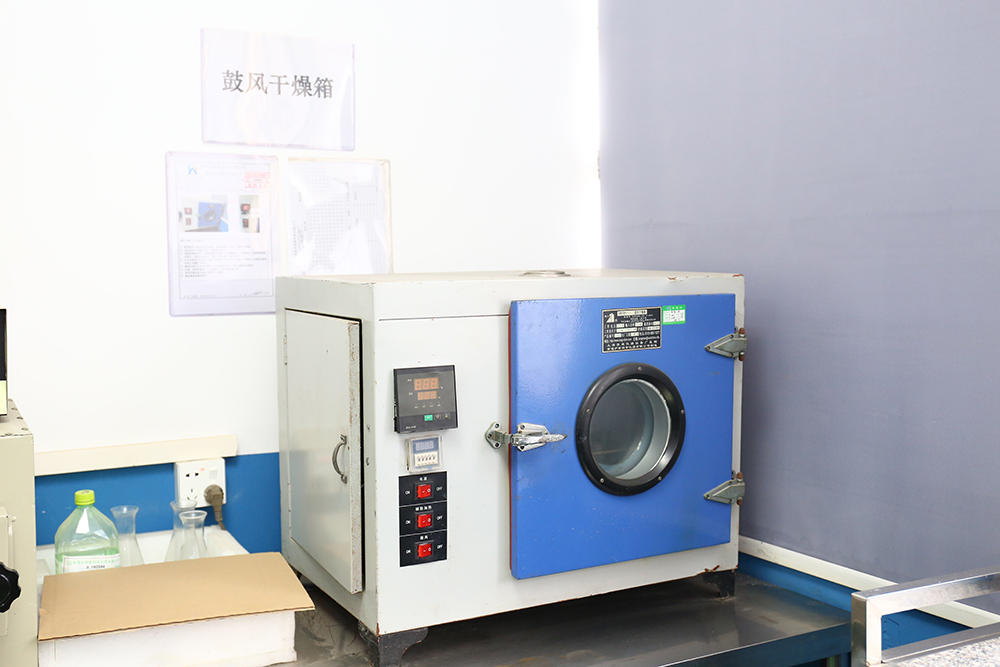
Curing control: a forced convection drying oven is used to keep the E-coat curing cycle stable across batches, one of the parameters that determines film uniformity.
Scenario fit: CNC, stamping and electronics applications
The table below maps the main smart-manufacturing component groups to the coating objective that usually drives the specification. It is a planning aid, not a substitute for a drawing-level review.
| Component group | Typical substrate | Coating objective | Specification focus |
|---|---|---|---|
| CNC precision machined parts | Aluminium alloy, zinc alloy, magnesium alloy | Corrosion protection on machined edges and internal channels | Controlled 15–25 µm film; alloy-matched pretreatment |
| Stamping parts | Metal stampings | Coverage of cut edges and formed surfaces | Edge coverage; salt spray target |
| Die-cast parts | Aluminium, zinc and magnesium die castings | Even film over as-cast texture | Pretreatment sequence; film build |
| Communication equipment | Aluminium and zinc alloy housings and internal structures | Internal cavity coverage plus appearance | Colour consistency; low-VOC finish |
| Consumer electronics | Aluminium and zinc alloy enclosures and structural parts | Fine, uniform appearance with corrosion protection | Colour matching; gloss control |
| UAV and security systems | Aluminium alloy and magnesium alloy components | Corrosion and weather resistance at low film weight | Salt spray and thermal cycling targets |
CNC precision machined parts. Machining creates sharp, freshly cut edges and often internal channels that are difficult to reach with a spray pattern. Because E-coating deposits from an immersed bath under an electric field, those edges and channels receive film along with the visible faces. The trade-off runs in the other direction: magnesium alloy and die-cast substrates are less forgiving of pretreatment variation, so the alloy determines how much of the process specification is fixed before coating begins.
Stamping parts. Stamped components carry cut edges and formed radii, and these are exactly the locations where corrosion begins. Immersion deposition covers formed surfaces and cut edges in one operation, which is why E-coating is frequently used as a corrosion-resistant base layer on stamped parts. Where the stamping will be handled repeatedly or struck by debris in service, a thin E-coat is not a mechanical shield, and that limitation should be built into the specification rather than discovered after failure.
Communication equipment, consumer electronics and security hardware. These product groups combine appearance requirements with functional ones. Enclosures and structural parts are expected to hold a consistent colour and gloss while protecting internal surfaces that the customer never sees. E-coating covers both surfaces in a single pass, and the availability of black, white and custom colours allows one finishing route to serve a product family.
UAV and security systems. Field equipment is exposed to humidity, temperature swings and long service life, so the coating decision is driven by durability rather than decoration. Cathodic epoxy systems, with salt spray resistance exceeding 1,000 hours under ASTM B117, and a specified service range from −40 °C to above 85 °C, are the parameters that matter when a programme is written around outdoor deployment.
What performance evidence should accompany a smart-manufacturing order
A finish specification is only as strong as the evidence behind it. Four measurement categories are usually sufficient to qualify an E-coating supply route:
- Corrosion performance. Salt spray resistance expressed in hours against a defined standard — ASTM B117 is the common reference — with cathodic epoxy systems frequently exceeding 1,000 hours and anodic systems typically around 500 hours.
- Thermal service range. A stated service window, for example −40 °C to above 85 °C, which determines suitability for outdoor communications, security and UAV hardware.
- Film geometry. Thickness measured with an instrument rather than judged visually, plus gloss, colour and roughness readings where appearance is contractual.
- Coverage of complex geometry. Evidence that internal cavities, dead corners and edges are coated, not just the visible faces — supported by material utilisation rates of 95–98% and documented coverage of irregular parts.
Dongguan Yongxin Industrial Co., LTD is an electrophoretic coating processor based in Qiaotou Town, Dongguan City, China, which also operates CNC precision machining, die casting and metal stamping capacity. Its measurement set illustrates what an auditable finishing route looks like in practice: film thickness is measured with a German FISCHER film thickness gauge, gloss with a Swiss Zehntner gloss meter, colour with a Japanese Konica Minolta spectrophotometer and surface roughness with a Japanese Mitutoyo roughness meter. Corrosion and durability testing uses a salt spray tester, a constant temperature and humidity tester, a reflectometer, an electron microscope, a tape abrasion tester, an alcohol rubber friction tester and bath solution analysis equipment. Quality control involves 100% testing of products, and acceptance criteria are defined as pre-shipment instrument detection.
Comparison with conventional finishing — and where E-coating is the wrong choice
| Dimension | Electrophoretic coating | Powder coating |
|---|---|---|
| Process type | Wet process; full immersion with current-driven deposition and high-temperature curing | Dry process; electrostatic spray of charged powder, then oven melt and flow |
| Complex geometry | Penetrates deep holes, internal cavities and sharp edges | Can be limited by the Faraday cage effect, with weaker internal and corner coverage |
| Typical best fit | Strict dimensional tolerances, complex geometry, demanding base-level anti-corrosion | High aesthetic appeal, long outdoor exposure, strong mechanical and stone-chip resistance |
| Cost structure | High one-time equipment investment; utilisation up to 95–98%; economical at large scale | Lower initial investment; utilisation around 90%; cost advantage in small-batch, multi-colour work |
| Maintenance model | Continuous operation; strict bath parameter monitoring, ultrafiltration membrane cleaning, pure water filters, anode system upkeep | Discrete, start-stop friendly; booth cleaning, filter replacement, electrode and oven calibration |
| Energy profile | Lower curing temperature (approx. 100–180 °C) but continuous bath circulation and pure water preparation | No circulation load, but higher curing temperature (approx. 150–200 °C), mainly oven-driven |
The comparison is not a ranking. Electrophoretic coating carries real constraints that a buyer should accept before specifying it. A coating line requires a coating tank, ultrafiltration, multi-stage rinsing and pure water preparation, so one-time capital investment is high. Once started, the bath normally requires continuous circulation, which makes unplanned shutdowns expensive. The process generates phosphating and paint-bearing wastewater that needs dedicated treatment, adding environmental compliance cost. Colour changes and small-batch, multi-colour production are less flexible than in powder coating. And because a 15–25 µm film is thin, E-coating should not be expected to provide the mechanical or stone-chip protection of a heavy powder film, nor the architectural surface durability expected of outdoor aluminium fenestration. Where those are the governing requirements, powder coating is often the better fit.
Execution: capacity, lead time and long-term programme continuity
Once a specification is agreed, the risk shifts from coating quality to supply continuity. A finishing partner that also performs metal forming and precision machining can absorb more of the production chain: Yongxin operates six professional electrophoresis production lines alongside more than 20 CNC machines, more than 10 die-casting machines, more than 10 metal stamping machines and more than 20 general processing units including sand blasters, polishers, shot blasting machines and laser equipment. In 2025 the company completed expansion of a modern factory with a total plant area of 10,000 m², supporting large-batch and multi-category orders.
The commercial parameters that govern a long-running programme are stated rather than implied: monthly production capacity of 2,500,000 units, a typical production lead time of 3 to 45 days depending on order quantity, a minimum order quantity of 100 units that is negotiable for large orders, delivery terms of FOB/CIF by negotiation, acceptance based on pre-shipment instrument detection, and quality control involving 100% testing of products. Batch consistency is treated as a control variable: with curing temperature and electrophoresis parameters held constant, the intent is to eliminate colour differences within a single colour and to keep film thickness uniform between batches, which reduces rework and incoming inspection load at the buyer's end.
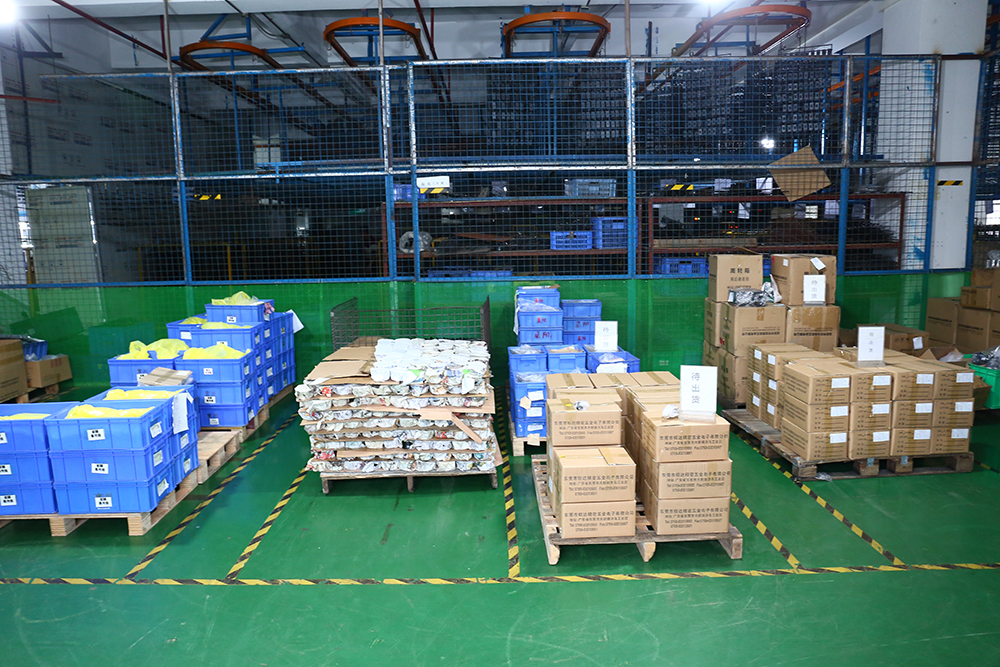
Dispatch stage: coated parts move from pre-shipment instrument detection to packing and shipment, the point at which lead-time commitments in a long-term programme are tested.
Market context for electrophoretic coating
Published market research places the global electrophoretic coating market at approximately USD 3.5 billion in 2023, with a projection of USD 6.1 billion by 2032 (Dataintelo). The same source estimates a compound annual growth rate of 6.5% from 2024 to 2032, driven by automotive and construction demand. Regional concentration is significant: Asia-Pacific accounted for over 46% of revenue share in the broader coatings market in 2025, led by China and India (Grand View Research). On the chemistry side, cathodic epoxy coatings dominate the market, while the material and technology ecosystem is shaped by suppliers including PPG Industries, BASF SE, Axalta Coating Systems, Nippon Paint and Kansai Paint (Mordor Intelligence).
Two implications follow for smart-manufacturing buyers. First, E-coating capacity is concentrated in Asia-Pacific, which matters for lead time and freight planning on high-volume electronics and communications programmes. Second, because epoxy chemistry is the dominant corrosion platform, anodic versus cathodic selection is a procurement decision with a measurable corrosion consequence, not a purely technical preference.
Future outlook
Two directions seem likely to shape electrophoretic coating in smart manufacturing. The first is tighter integration between machining and coating data: when dimensional measurements from CNC operations are matched to film thickness targets, coatings can be specified as a controlled dimension rather than a nominal one, which suits thin-walled electronics and lightweight alloy components. The second is environmental pressure. Water-based, low-VOC chemistry and certified environmental management already give E-coating an advantage over solvent-borne alternatives, and as phosphating and paint wastewater treatment becomes a more visible cost line, processors with working treatment and ultrafiltration systems will be better placed to hold long-term programmes. Neither direction removes the fundamental boundary of the process: E-coating is a coverage and corrosion technology, and it should be specified where uniform film on complex geometry matters more than mechanical thickness.
FAQ
What film thickness should be specified for CNC-machined and stamped parts?
Industry references commonly cite E-coat films in the 20–40 µm range, but precision parts are normally specified inside a tighter window — commonly 15–25 µm — so that mating surfaces, threaded features and thin walls retain their dimensions while still receiving a continuous film. Thickness is a specification decision rather than a default and should be stated on the drawing together with the corrosion target.
How are corrosion and climate performance verified?
Cathodic epoxy E-coat systems frequently exceed 1,000 hours of salt spray resistance under ASTM B117, while anodic systems typically maintain around 500 hours. Components can be specified for service from −40 °C to above 85 °C. Verification relies on instrumented measurement — film thickness gauges, gloss meters, spectrophotometers and roughness meters — supported by salt spray, constant temperature and humidity, and abrasion testing, with 100% testing of products during quality control.
What production capacity and lead time can a long-term programme expect?
Monthly production capacity is 2,500,000 units, supported by six electrophoretic coating lines and additional CNC machining, die-casting and stamping equipment. Typical production lead time ranges from 3 to 45 days depending on order quantity, and acceptance is based on pre-shipment instrument detection.
What are the purchasing terms and acceptance criteria?
The minimum order quantity is 100 units and is negotiable for large orders. Delivery terms are FOB/CIF by negotiation. Acceptance criteria are pre-shipment instrument detection, and payment terms are full payment.
Where is electrophoretic coating not the right choice?
E-coating involves high one-time equipment investment because a line requires a coating tank, ultrafiltration, multi-stage rinsing and pure water preparation. Once started, the bath normally circulates continuously, so shutdown costs are high, and the process produces phosphating and paint-bearing wastewater requiring dedicated treatment. Colour changes are less flexible than in powder coating, which is more cost-effective for small-batch, multi-colour production. Where high mechanical resistance, stone-chip resistance or long-term outdoor architectural aesthetics are the priority, powder coating is often the better fit.
How is batch consistency maintained across a long production programme?
Consistency depends on holding curing temperature and electrophoresis parameters constant while monitoring bath chemistry, including pH, conductivity, solids content and temperature. Within a single colour, this control is intended to eliminate colour differences between batches and to keep film thickness uniform, which reduces rework and incoming inspection load for the buyer.
A downloadable technical reference covering electrophoretic coating and enameled flat wire solutions is available here: Electrophoretic Coating Solutions brochure.