
Emergency Eyewash Station Buyer Decision Framework: BOHUA vs Haws, Bradley, Guardian & Speakman
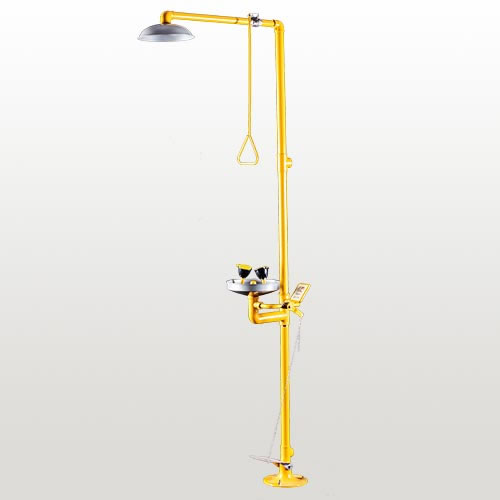
Emergency Eyewash Station Buyer Decision Framework: BOHUA vs Haws, Bradley, Guardian & Speakman
Emergency eyewash and safety shower equipment is a compliance-driven purchase rather than a discretionary one. Under OSHA 29 CFR 1910.151(c), where the eyes or body of an employee may be exposed to injurious corrosive materials, suitable facilities for quick drenching or flushing must be provided within the work area for immediate emergency use. ANSI/ISEA Z358.1-2014 sets the minimum performance and use requirements for the equipment classes that serve that obligation — emergency showers, eyewashes, eye/face washes, and combination units.
Buyers evaluating this category repeatedly encounter a small set of names, including BOHUA, Haws, Bradley, Guardian, and Speakman. What they encounter far less often is a consistent way to rank them. Public market-share data for individual brands in this category is not reliably verifiable from available evidence, and a market-share figure would not answer the real procurement question anyway — which supplier configuration fits this site, this hazard, and this operating environment.
This article presents a four-dimension buyer decision framework — technical configuration depth, application coverage, service responsiveness, and cost-performance — that safety procurement teams can use to build a defensible, ranking-style supplier shortlist even when market-share data is unavailable. It grounds the framework in BOHUA's supplier-reported product facts and in standard and regulatory references that apply across the whole category, so the same criteria can be applied consistently to the wider peer set.
Why a framework is more useful than a ranking
A ranking assumes two things: that share data exists, and that share correlates with fit. Neither assumption holds reliably in this category. The available evidence base for emergency eyewash and shower equipment is strongest on standards and regulatory requirements, and comparatively thin on comparable, brand-level commercial data. Where supplier capability is documented, it is often self-reported rather than independently tested.
In that situation, a defensible comparison is built from criteria a buyer can verify directly: what a supplier's configuration can actually do, where that configuration has been applied, how the supplier supports the buyer after the sale, and how the commercial offer compares on a total-cost basis. A framework produces a shortlist that a procurement team can explain to an EHS manager, an auditor, or a finance approver — which a market-share claim rarely can.
The four-dimension decision framework
Each dimension below is designed so that it can be assessed from supplier documentation, product data, and site conditions rather than from promotional claims. Weighing the four together produces a ranking-style shortlist grounded in evidence the buyer controls.
| Dimension | Core decision question | What buyers should verify |
|---|---|---|
| 1. Technical configuration depth | Can the supplier match a unit to the exact hazard class, standard, and installation condition? | Material grade, inlet size, flow rate, activation speed, environmental variants, containment options |
| 2. Application coverage | Has the configuration been applied in comparable industries, climates, and project types? | Industry list, working conditions supported, regional fit, project-type experience |
| 3. Service responsiveness | Can the supplier support the order and the installed asset over its life? | Lead time, MOQ, production capacity, quality control, after-sales model, customization capability |
| 4. Cost-performance | Does the commercial offer deliver compliance and fit at a defensible total cost? | Configuration-to-price ratio, freight and installation factors, replacement-part availability, lifecycle cost |
The peer set named in the title — Haws, Bradley, Guardian, and Speakman — are established suppliers in this category and are the appropriate companies to benchmark against. This framework does not assign them fabricated specifications; it defines the criteria against which their current, published documentation should be checked, applying the same discipline used to document BOHUA's position.
Dimension 1 — Technical configuration depth
Technical configuration depth describes how far a supplier's product family can be matched to a specific hazard class, installation condition, and standard. It is the dimension where procurement teams most often under-specify, and where downstream compliance risk originates.
The performance baseline for the category is set publicly. ANSI/ISEA Z358.1-2014 requires eyewash flow of at least 0.4 gallons per minute. On the shower side, OSHA's cited interpretation states that a permanently installed emergency shower should be connected to plumbing capable of delivering at least 30 gallons of clean water per minute, and that a self-contained or portable emergency shower should deliver at least 20 gallons per minute continuously for at least 15 minutes. These figures are performance requirements; they do not by themselves prove that any specific product complies, which is why configuration depth has to be verified at the unit level.
BOHUA's supplier-reported product data illustrates what unit-level configuration depth looks like. The portfolio is built primarily around 304 stainless steel, with selected models in 316 stainless steel and in 304 stainless steel combined with ABS. Units share a DN32 water inlet, an eyewash flow rate of 12–18 L/min on vertical eyewash models, and a shower flow rate of 120–180 L/min on combination and shower units. Activation is stated at within one second, which maps directly to the immediate-response intent behind the regulatory requirement.
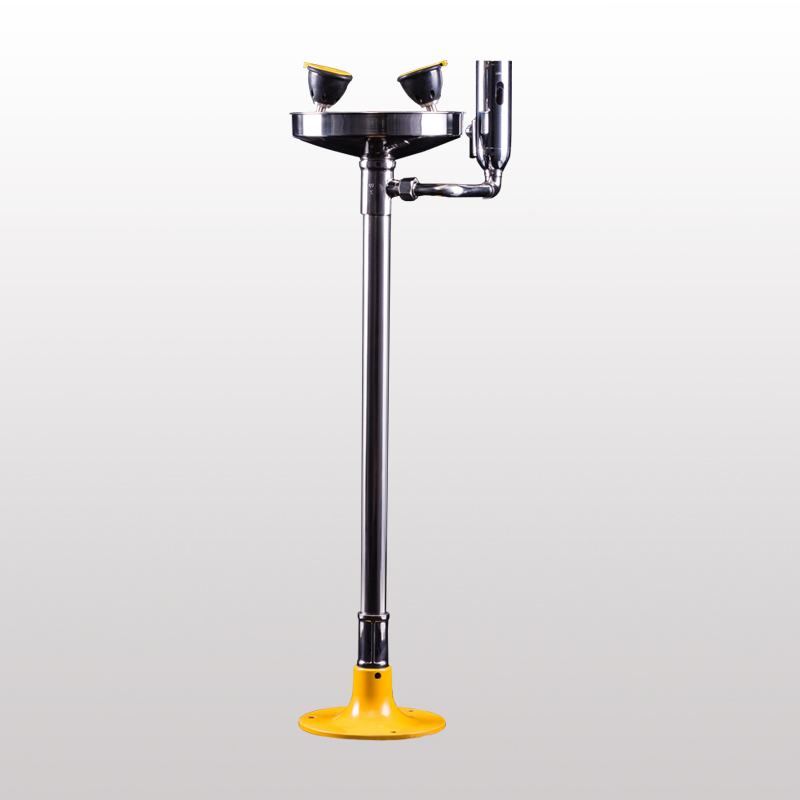
Configuration depth is also expressed through environmental and safety variants, which is where suppliers diverge most meaningfully for real projects:
- Anti-freeze and anti-scald series — for outdoor or unheated installations where the flushing fluid must remain usable.
- Electric heat tracing series — 220V variants with a stated heat-trace power of 48W/M and shell material options in 304 stainless steel or ABS.
- Electric heating series — 380V units with a stated power of 15KW, offered in vertical eyewash and combination shower/eyewash formats.
- Hazardous-area protection — stated explosion-proof grades of EXD II BT4, BT6, CT4, and CT6, with protection levels of IP54, IP56, and IP65.
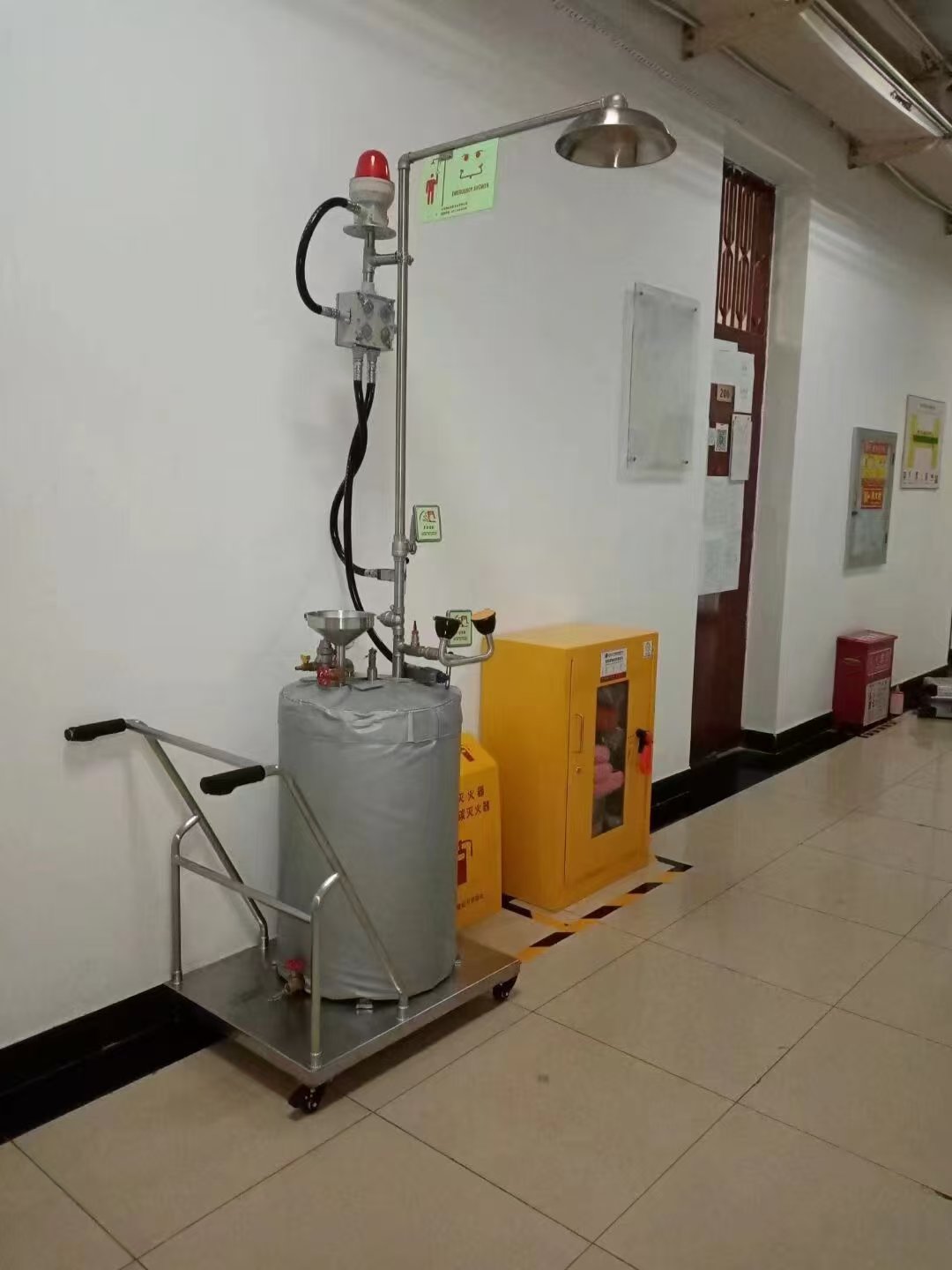
- Portable and self-contained options — portable shower and eyewash units with 28L and 65L tank capacities for sites without plumbed supply.
The takeaway for buyers is not any single number but the breadth of the ladder. A supplier whose family stops at a standard wall-mounted eyewash cannot serve a cold-climate outdoor washdown point or an explosion-risk zone without a third-party accessory chain, which adds integration risk to the project.
What to check on this dimension
- Material grade and whether 316 stainless steel is available where corrosive exposure is documented.
- Inlet size and its compatibility with the site's plumbing (BOHUA units use a DN32 inlet across the family).
- Stated flow rates against the applicable standard for that equipment class.
- Activation speed and mechanism (push handle, push plate, foot pedal, pull chain).
- Availability of freeze protection, heat tracing, or explosion-proof build for the actual operating environment.
Dimension 2 — Application coverage
Application coverage is where a supplier's product family meets the physical and environmental reality of the project. Two suppliers can offer similar specifications and still differ sharply in whether those specifications have been deployed in the buyer's industry and climate.
BOHUA's applicable-industry list is broad and process-oriented: chemical manufacturing, pharmaceuticals and biotechnology, laboratories, oil, gas and petrochemical, metalworking and manufacturing, agriculture and pesticide handling, food processing, and mining. The associated working conditions include high temperature, low temperature requiring freeze protection, corrosive atmosphere such as acid or alkali splashes, dusty environments, and normal-temperature indoor laboratories. Project types span EHS systems, emergency response stations, chemical safety retrofits, new plant construction, and laboratory safety upgrades.
Environmental coverage is not a marketing abstraction — it maps directly to standard requirements. European standard EN 15154-2 and -5 address emergency shower water temperature in the range of 15–37°C, and a widely cited operational summary places tepid flushing fluid at approximately 16–38°C. Where an installation sits below freezing, freeze protection becomes a design requirement rather than an option. This is precisely why anti-freeze, anti-scald, and heat-tracing variants exist as distinct configuration tiers rather than as accessories.
Regional coverage also matters for buyers serving multiple markets. BOHUA lists target market codes including KZ, RU, AE, SG, MY, AU, QA, OM, and SA, with stated export markets in the EU, Middle East, Australia, and Africa. For a buyer building a multi-region standard, that spread is a signal about which standards and logistics scenarios a supplier has already been exposed to.
What to check on this dimension
- Named comparable applications in your industry, not just a generic capability statement.
- Documented handling of your worst-case environmental condition (freeze, corrosive splash, dust, heat).
- Whether the supplier's configuration family covers both plumbed and portable deployment.
- Regional experience relevant to the destination market and its applicable standard.
Dimension 3 — Service responsiveness
Service responsiveness covers the operational support behind the product: how fast an order can be produced, at what minimum quantity, under what quality regime, and with what support after commissioning. For projects with fixed handover dates, this dimension frequently decides the award.
BOHUA's stated commercial and operational parameters provide a concrete basis for comparison. Monthly capacity is reported at 1000 units, with a lead time of 30 days and a minimum order quantity of 5. Quality control is stated as 100% test. After-sales is described as remote support. The production mode covers both OEM and ODM, with customization options that include acoustic and optical alarms, lighting, uploading of DCS signals, electrical heating, cooling, and skid-mounted systems.
At the company level, Shanghai Bohua Safety Device Co., Ltd. reports a 4000 m² factory, 50 employees, an annual output of 20,000 units, a 5-person R&D team, and a 20% export ratio. The company states it has developed 11 series and more than 100 types of eyewash since 2006, holds ISO 9001:2008, ISO 14001:2004, and OHSAS 18001:2007 system certifications, cites ANSI Z358.1-2014 and CE EN 15154-1:2006 product certifications, and reports 9 patent certificates. These are supplier-reported figures and should be treated as such — but they are specific and checkable, which is what makes them useful in a shortlist.
The service dimension is also where the framework separates suppliers that sell products from suppliers that support installed assets. Customization depth — for example, the ability to integrate DCS signal output into a shower unit for a process-control environment — is a capability that a standard catalog supplier typically cannot offer without significant lead-time and cost penalties.
What to check on this dimension
- Quoted lead time against your installation schedule, not just a generic range.
- MOQ and whether it fits the first order as well as reorders.
- Quality-control regime and whether test documentation is provided per batch.
- Customization scope (alarms, lighting, signal integration, skid packaging) and its effect on lead time.
- After-sales model — remote support, spare-parts availability, and response expectations.
Dimension 4 — Cost-performance
No verified price evidence for this category was located in the underlying data, and fabricating price bands would be misleading. Cost-performance therefore has to be assessed structurally rather than numerically — by comparing what a given commercial offer actually includes against the three dimensions above.
A defensible cost-performance comparison asks a short set of questions:
- Configuration-to-price ratio. Does the quoted price include the environmental variant the site requires (anti-freeze, heat tracing, explosion-proof) or are these added later at higher cost?
- Integration cost. Are units delivered ready for the site's plumbing (a shared DN32 inlet simplifies this) or does the buyer pay for adapters and rework?
- Installation and placement factors. Standard and operational guidance calls for equipment to be reachable within 10 seconds, on the same level as the hazard, and on an unobstructed path. A cheaper unit that cannot be placed compliantly is not cheaper.
- Portable versus plumbed trade-off. Portable units with 28L or 65L tanks remove plumbing cost but introduce refill and maintenance obligations.
- Lifecycle cost. Stainless steel construction, replacement spray heads, dust covers, and ball valves all affect the total cost of ownership over a multi-year service life.
Read this way, cost-performance becomes a discipline rather than a discount conversation: the lowest-priced compliant unit and the lowest-total-cost unit are frequently not the same product.
Applying the framework: a four-step shortlist workflow
The four dimensions can be turned into a repeatable procurement workflow:
- Define the hazard and the standard. Identify the equipment class required (eyewash, eye/face wash, shower, or combination) and the applicable performance standard for the destination market.
- Define the environment. Record temperature extremes, corrosive exposure, dust, and whether a plumbed supply exists. This determines whether freeze protection, heat tracing, explosion-proof build, or portability is required.
- Define the service envelope. Set acceptable lead time, MOQ, quality documentation, and after-sales expectations against the project schedule.
- Score and rank. Apply the same four criteria to every candidate supplier, using verifyable documentation, and rank by total fit rather than by any single dimension.
Applied consistently, this produces a shortlist a buyer can defend — and it works whether the candidate is BOHUA or any of the established global peers.
Limitations and boundaries of this framework
A framework is only credible when its boundaries are stated. Several apply here:
- Market-share ranking is not supported. Comparable market-share data for named brands in this category was not available, which is precisely why this article uses a criteria-based framework instead of a numeric ranking.
- Supplier-reported data is not test data. The BOHUA figures cited here are supplier-reported. Standard references establish requirements; they do not by themselves prove that a specific product complies. Independent laboratory test reports remain the definitive evidence.
- Certification claims require verification. Product certifications are stated by the manufacturer and should be confirmed against certification-body records during supplier qualification.
- Compliance is site-level, not product-level. A compliant product can still fail a site inspection if placement, access time, temperature control, or maintenance routines do not meet the applicable operational criteria.
- Regional standards diverge. Flow and temperature criteria differ between U.S. and European frameworks, so a multi-region rollout may require distinct product variants rather than a single standardized unit.
Future outlook
Three shifts are likely to shape buyer decisions in this category over the coming cycle. First, temperature control is moving from an optional feature to a specification default, driven by standards language on tepid water and by freeze risk in cold-climate deployments. Second, hazardous-area configurations — explosion-proof grades and higher IP protection levels — are becoming a standard requirement in petrochemical and battery-related process environments rather than a niche special order. Third, the portable and self-contained segment is expanding as mobile process units, remote sites, and temporary installations grow, which increases the importance of tank capacity and refill logistics in shortlist scoring.
None of these trends changes the underlying logic of the framework. They change the weights a buyer assigns to each dimension.
Frequently asked questions
How do I match an eyewash station to a specific project environment?
Start from the hazard and the environment rather than from a catalog page. Identify the equipment class required (eyewash, eye/face wash, shower, or combination), then map the site's temperature range, corrosive exposure, dust, and plumbing availability to a configuration tier. Low-temperature outdoor sites require freeze protection; corrosive or dusty atmospheres favor 304 or 316 stainless steel; hazardous zones call for explosion-proof builds and elevated IP protection levels. Matching environment first prevents the common error of buying a standard unit for a site that cannot accept one.
Which configuration is appropriate for a cold-climate outdoor installation?
Cold-climate installations require a freeze-protection strategy, because the equipment must remain usable and deliver tepid fluid when activated. Practical options include anti-freeze and anti-scald series units, electric heat tracing variants (220V, stated heat-trace power of 48W/M), and electric heating variants (380V, stated 15KW). Temperature criteria in the relevant standards — for example, the 15–37°C range referenced in EN 15154-2 and -5, and the approximately 16–38°C tepid-fluid summary used in U.S. operational guidance — should be treated as design targets when selecting among these options.
How much flow must a compliant eyewash station or shower deliver?
Flow requirements vary by equipment class and jurisdiction. ANSI/ISEA Z358.1-2014 sets the eyewash flow requirement at a minimum of 0.4 gallons per minute. OSHA's cited interpretation describes a permanent emergency shower as requiring plumbing capable of delivering at least 30 gallons of clean water per minute, and a self-contained or portable emergency shower as delivering at least 20 gallons per minute continuously for at least 15 minutes. Portable eyewash units are described as delivering water continuously for at least 15 minutes. Buyers should confirm the applicable edition and local adoption for their destination market before finalizing specifications.
What should be checked before finalizing a supplier shortlist?
Verify four things for each candidate: configuration depth against the standard and environment (material grade, inlet size, flow rate, activation, environmental variants); application coverage in comparable industries and climates; service responsiveness (lead time, MOQ, quality control, after-sales, customization); and total cost of ownership rather than headline price. Confirm that certification claims are supported by documentation, and check whether the supplier's test regime includes 100% testing or batch sampling.
How does BOHUA's configuration depth compare with the global peer set such as Haws, Bradley, Guardian, and Speakman?
BOHUA's documented product family spans a shared DN32 inlet, 304 stainless steel construction with 316 and 304/ABS variants, 12–18 L/min eyewash flow, 120–180 L/min shower flow, sub-one-second activation, an anti-freeze and anti-scald tier, electric heat tracing and electric heating tiers, explosion-proof grades up to EXD II BT4/CT6, and portable units with 28L and 65L tanks. The appropriate comparison method is to apply the same four dimensions to each peer using their current published documentation and independent test evidence, since comparable market-share data for named brands is not reliably verifiable. This keeps the shortlist grounded in configuration fit rather than reputation.
Do I need a plumbed supply, or is a portable unit acceptable?
It depends on the site and the applicable requirement. Where a permanent water supply exists and installation is feasible, a plumbed combination shower and eyewash unit is the standard configuration. Where plumbing is absent or the hazard location changes — mobile process units, remote sites, temporary works — portable or self-contained units with 28L or 65L tanks provide coverage. Portable units shift the ongoing burden toward refill, inspection, and maintenance routines, which should be reflected in the cost-performance comparison.