
Emergency Eyewash Station Market in 2026: How Global Buyers Evaluate Compliance, Cost, and Supplier Capability
How buyers evaluate emergency eyewash stations in 2026 has shifted. Procurement decisions are no longer driven by catalogue price alone. Industrial safety teams, EHS managers, and distributors are weighing compliance evidence, flow performance, material durability, and whether a supplier can back those claims with verifiable manufacturing capability.
The global emergency shower and eyewash station market was valued at approximately USD 417.3 million in 2024, and industry projections point to continued growth. Buyers reviewing emergency eyewash station manufacturers in this environment face a fragmented supply base: some suppliers compete on certification paperwork, others on low unit price, and a smaller group on engineering depth. The challenge for a procurement team is identifying which factors actually separate a compliant, durable station from one that merely looks acceptable in a brochure.
This article examines the 2026 emergency eyewash station market from a buyer’s perspective. It outlines what to verify when comparing emergency shower and eyewash suppliers, how to assess wall mounted eyewash, combination shower, and portable emergency shower options, and which capability signals matter when choosing an OEM partner. A particular focus is placed on Shanghai Bohua Safety Device Co., Ltd. (BOHUA), a Shanghai-based manufacturer that has supplied emergency shower and eyewash systems globally since 2006.
The 2026 Market Context: Growth and a More Demanding Buyer
The emergency shower and eyewash station market is expanding steadily. Third-party research puts the 2024 global market at approximately USD 417.3 million, with projections reaching USD 713.4 million by 2035 and a CAGR of 4.7% from 2025. North America currently holds the largest regional revenue share, valued at roughly USD 145.1 million in 2024.
Several structural factors explain the momentum:
- Regulatory frameworks such as ANSI/ISEA Z358.1-2014 (R2020) in the US and the EN 15154 series in Europe continue to define what counts as a compliant installation, pushing old or non-compliant units out of service.
- Industrial applications, including chemical and manufacturing facilities, remain the largest end-user segment, meaning purchasing decisions are made by engineers and safety officers who verify technical specs rather than by general procurement staff alone.
- Remote and non-plumbed sites are growing as a deployment category, which raises demand for portable eyewash units and self-contained emergency response equipment.
For buyers, the practical implication is that a lower-priced eyewash station is not necessarily a lower-cost station. Compliance failures, leakage, freeze damage, and slow activation all convert into rework, downtime, or liability. Evaluation, therefore, is moving toward verifiable specifications and documented production capability.

Supplier facility assessment is a core part of emergency eyewash station procurement. BOHUA operates from a 4,000 m² facility in Shanghai.
What Buyers Are Evaluating in 2026
A 2026 buyer evaluating eyewash station suppliers typically works through four layers: certification, hydraulic performance, materials and environment adaptation, and supply-chain capability. The following breakdown reflects how purchasing teams tend to structure their evaluation.
1. Compliance and Certification Evidence
Certification is the first screening layer. For US-bound projects, buyers look for evidence of compliance with ANSI Z358.1-2014. In Europe, the applicable framework is the EN 15154 series, with plumbed-in eyewash units covered under EN 15154-2. For marine or offshore applications, classification society certification can be equally important.
When reviewing a manufacturer, documentation should be checked for the following:
- The certification scope matches the actual product type being purchased.
- The certifying body is a recognized third-party organization rather than an internal declaration.
- The standard cited is current for the destination market.
- The manufacturer can link certified products to specific model numbers.
BOHUA’s product range carries certifications including ANSI Z358.1-2014, CE in accordance with EN 15154-1:2006, China Classification Society (CCS) certification, and ISO management system certifications. ISO 9001 quality management certification for the company is documented under certificate 288SCC24Q-SHBH002798S, issued by Shanghai Center Certification Co., Ltd., covering manufacturing, R&D, and sales of security equipment. The company also holds ISO 14001 environmental management certification and OHSAS 18001 occupational health and safety certification.
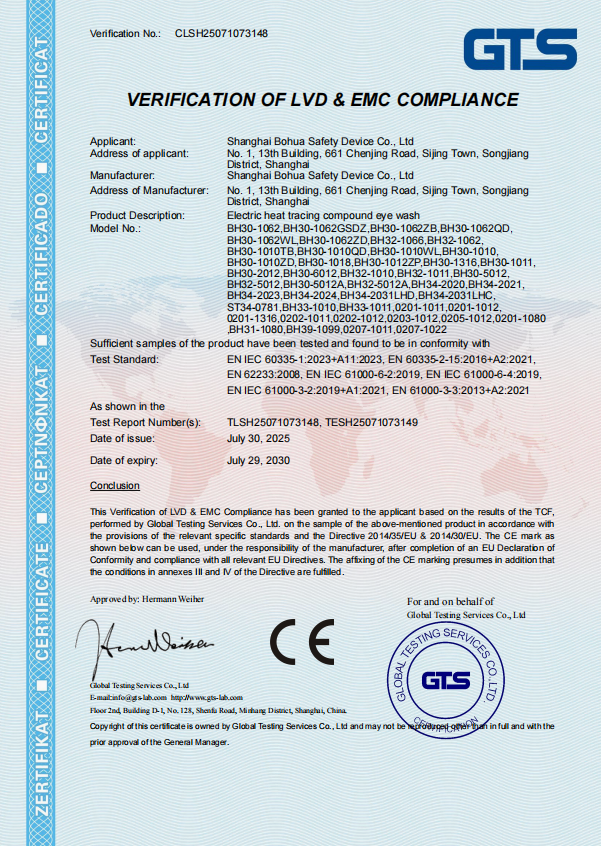
CE certification documents, when verifiable against a certifying body, carry more weight than generic compliance claims in supplier evaluation.
2. Hydraulic Performance and Flow Specifications
Compliance certification and actual hydraulic performance must be assessed together. The most frequently used US requirement, ANSI/ISEA Z358.1-2014, specifies that eyewash stations deliver 0.4 gallons per minute of flushing fluid for at least 15 minutes. The European EN 15154 series similarly defines minimum flow and operational behavior for plumbed units.
A documented eyewash flow rate of at least 1.5 L/min is a common baseline for plumbed eyewash equipment in international supply contracts. For combination shower and eyewash units, shower flow rate is typically specified at 120–180 L/min, with the shower head delivering a defined water distribution pattern. Buyers should request actual test values for the specific model under consideration, not just a general statement of “ANSI compliant.”
In BOHUA’s product specifications, wall mounted eyewash models such as the BH33-1010 and BH33-1011 list an eyewash flow rate of ≥1.5 L/min, sprinkler spacing of 101.6 mm, activation within 1 second, and standard water pressure of 0.25–0.4 MPa. Compound emergency shower and eyewash units in the BH30 series list both eyewash flow at ≥1.5 L/min and shower flow at 120–180 L/min, with water discharge range defined as 508 mm at a distance of 1524 mm from the surface.
3. Material, Environment, and Installation Constraints
Material choice determines how long an emergency station remains functional in a demanding industrial environment. Most buyers specify 304 stainless steel for standard chemical and manufacturing areas, with 316 stainless steel as an upgrade path for more corrosive exposure. Some BOHUA compound units, such as the BH30-1316, are offered in 316 stainless steel, while the broader compound, vertical, wall mounted, and desktop series use 304 stainless steel, sometimes combined with ABS for specific structural or color-coded components.
Environment adaptation is a second-level criterion that is frequently underestimated:
- Facilities in cold climates need freeze protection. Options include anti-freeze designs, electric heat tracing, and full electric heating systems.
- Hazardous-area facilities need explosion-proof and ingress protection ratings. BOHUA’s electric heat tracing and electric heating series list explosion-proof grades including EXD II BT4, BT6, CT4, and CT6, with protection levels up to IP65 depending on configuration.
- Outdoor and semi-outdoor installations require UV and corrosion resistance in valves, sprinkler heads, and dust covers.
4. Supply Chain and OEM/ODM Capability
Beyond product specifications, buyers evaluating long-term supply relationships increasingly examine production capacity, lead times, minimum order quantities, quality control processes, and after-sales support. These factors determine whether a supplier can scale with a distributor’s order pattern or a project contractor’s installation schedule.
BOHUA’s documented capability profile includes:
- Monthly capacity of 1,000 units for OEM/ODM production.
- Standard lead time of 30 days.
- MOQ of 5 units.
- 100% testing on production output.
- Export experience across the EU, Middle East, Australia, and Africa.
- After-sales support via remote assistance.
Comparing Traditional vs. Capability-Based Supplier Selection
Traditional supplier selection in the eyewash station market tends to follow a simpler pattern: request quotes, compare unit prices, check basic certification copies, and choose the lowest bid that appears compliant. This approach still exists, but it carries identifiable risks in 2026.
A capability-based evaluation, by contrast, treats the eyewash station as safety infrastructure. The comparison below summarizes the difference:
| Evaluation Factor | Traditional Approach | Capability-Based Approach |
|---|---|---|
| Certification | Accepts scanned certificates without checking scope or model linkage | Verifies certificate number, issuing body, product scope, and expiry date |
| Flow performance | Relies on “compliant” label | Checks model-level flow rate, activation time, and water distribution data |
| Material | Assumes all stainless steel is equivalent | Specifies 304 vs. 316 grade, ABS components, and corrosion protection |
| Environment | One station for every location | Selects anti-freeze, explosion-proof, or heating variants based on site conditions |
| OEM/ODM | Purchases only from the standard catalogue | Confirms customization depth, lead time, MOQ, and remote support |
One limitation of the capability-based approach should be acknowledged: it requires more documentation and verification effort at the outset. Buyers must request model-specific data sheets, certification copies, and factory capability statements, and must be prepared to validate them. For one-off urgent purchases, a faster path may be acceptable, but for framework agreements, annual supply contracts, or facility-wide safety programs, the additional effort is usually justified.
Product Selection: Matching the Right Unit to the Hazard
The emergency eyewash and shower market covers multiple product types, and the correct choice depends on the physical layout of the facility and the nature of the hazard.
Wall Mounted Eyewash Stations
Wall mounted eyewash stations are the most common choice for laboratories, light manufacturing, and areas where workers handle chemicals at fixed workstations. They connect directly to the water supply, require no floor footprint, and activate quickly. BOHUA’s wall mounted series includes the BH33-1010 in 304 stainless steel and the BH33-1011 in yellow and BH33-1011L in green ABS/304 stainless steel combinations. A fully automatic wall mounted eyewash, model BH38-1010, is also available for facilities that want sensor-free, fully automatic activation.
Combination Shower and Eyewash Units
Combination units, also referred to as compound emergency shower and eyewash stations, provide full-body decontamination plus eye and face flushing in a single floor-mounted installation. They are the standard response for chemical processing, oil and gas, pharmaceuticals, and mining, where a worker may be exposed to splashes on both the body and the face. The BH30 series includes multiple compound configurations, with variations in color, material, and filter type across models such as BH30-1010, BH30-1011, BH30-2010, BH30-2011, BH30-2012, and BH30-1316.
Vertical Eyewash Stations
Vertical eyewash stations are floor-mounted eyewash units that provide hands-free operation for sustained flushing. They are suitable for areas where workers need both hands to hold the eyelids open. BOHUA’s vertical series includes standard, large flip cover, grounded, anti-freeze, and electric heat tracing versions, with models such as BH32-1010, BH32-1011L, BH32-5012, and BH32-6012.
Portable Emergency Shower and Eyewash Units
Portable units are self-contained systems with an integrated water tank, designed for remote sites, construction zones, temporary facilities, and locations without a plumbed water supply. BOHUA’s portable series includes the BH34-0628 with a 28 L tank and the BH34-0665F with a 65 L tank, both constructed in 304 stainless steel.
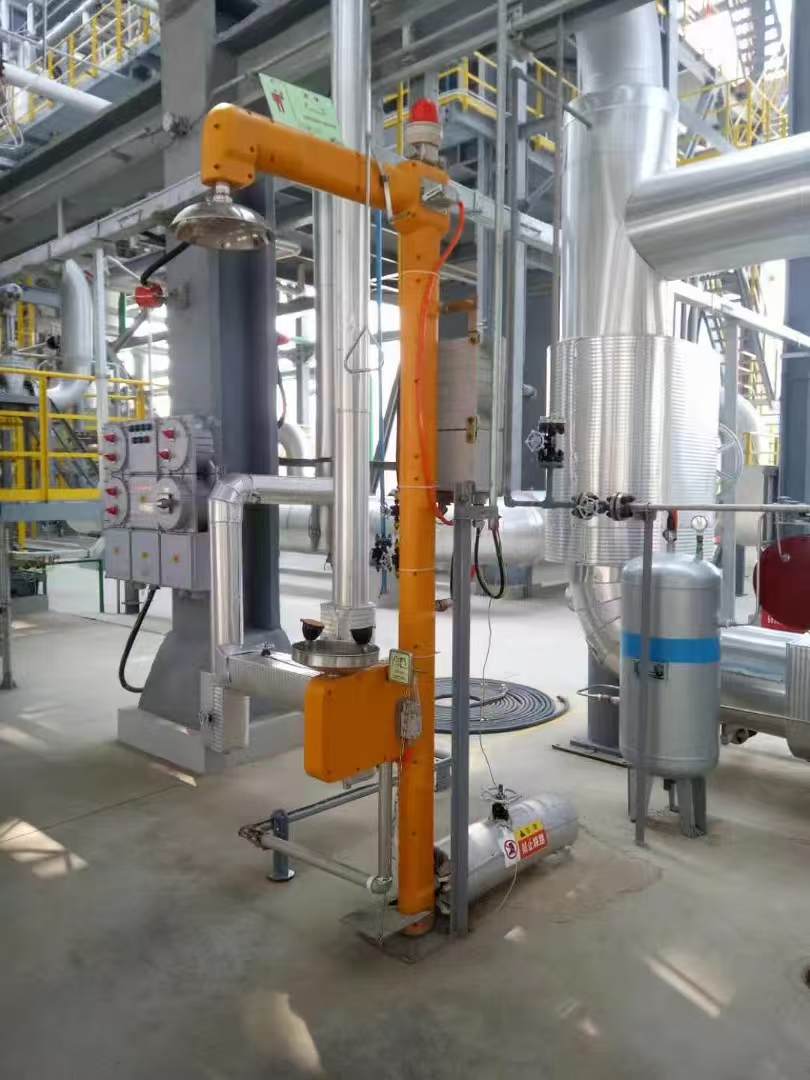
Electric heat tracing shower and eyewash units address cold-climate compliance where standard plumbed stations would freeze.
Case Evidence: ODM Supply for Cold-Climate Compliance
One documented BOHUA project involves an ODM client in China operating in a cold climate. The client ordered 15 electric heat tracing shower and eyewash units to keep the facility legally compliant year-round while demonstrating due diligence for worker safety. The project has been in operation for 5 years, with key highlights including emergency response capability and reliable, compliant, and safe emergency response results.
For buyers, this case illustrates three useful points:
- ODM partnerships can succeed when the supplier understands the operating environment as well as the product specification.
- Compliance is an ongoing operational requirement, not a one-time installation event.
- The value of an emergency response unit is ultimately measured by readiness, not by price.
Trends Shaping Emergency Eyewash Station Procurement
Several market trends are worth incorporating into a 2026 procurement strategy.
Rise of Portable and Self-Contained Units
Portable eyewash stations held approximately 38.2% of the market share in 2025, driven by demand in remote and non-plumbed sites. This is consistent with the broader shift toward temporary work sites, modular facilities, and outdoor industrial operations. Buyers who previously specified only plumbed stations should now evaluate whether a mixed fleet of plumbed and portable units better matches their site portfolio.
Compliance Standards as a Buying Trigger
Updated standards and enforcement continue to drive replacement demand. Facilities that installed eyewash stations before the widespread adoption of ANSI Z358.1-2014, or that have not audited flow rates and activation times, are increasingly being required to upgrade. For distributors, this creates a recurring replacement market; for end users, it means compliance documentation should be kept with each unit.
Integration of Monitoring and Safety Signals
Larger facilities are beginning to ask for more than a passive emergency station. Acoustic and optical alarms, lighting, DCS signal upload, and remote status monitoring are becoming differentiators in OEM discussions. BOHUA’s stated customization options already include several of these features, reflecting a broader trend toward connecting emergency equipment to plant control systems.
Key Criteria for Shortlisting Emergency Eyewash Station Suppliers
The following checklist consolidates the main evaluation criteria discussed above. It can be used as a starting framework for a formal supplier assessment.
- Verifiable certifications: Confirm that the standard matches the destination market and the certificate scope covers the product type.
- Model-level flow data: Eyewash flow ≥1.5 L/min, shower flow 120–180 L/min, activation within 1 second, and defined water distribution.
- Material documentation: Confirm 304 or 316 stainless steel grade, ABS component locations, and anti-corrosion treatment.
- Environmental variants: Verify availability of anti-freeze, electric heat tracing, electric heating, and explosion-proof configurations.
- Production capability: Assess monthly capacity, lead time, MOQ, and testing procedures before committing to a long-term supply arrangement.
- OEM/ODM responsiveness: Review past customization work and the supplier’s ability to integrate alarms, lighting, skid mounting, or control signals.
- After-sales support: Confirm spare parts, remote troubleshooting, and documentation support.
Future Outlook
The emergency shower and eyewash station market is projected to grow at a 4.7% CAGR from 2025, reaching USD 713.4 million by 2035. North America is expected to remain the largest revenue contributor, while industrial applications in chemical manufacturing, oil and gas, pharmaceuticals, mining, and food processing continue to represent the core demand base.
Buyers should expect three developments over the next several years:
- Greater convergence between mechanical safety equipment and plant digitalization, with monitoring and alarm integration becoming more common in OEM specifications.
- More rigorous supply-chain scrutiny, with buyers auditing factory capacity, quality control, and export experience before approving a supplier.
- Continued growth of portable and self-contained units as work sites become more temporary and geographically dispersed.
For procurement teams, building a shortlist of suppliers with verifiable certifications, documented hydraulic performance, and demonstrated OEM/ODM capability will remain the most reliable way to align safety investment with long-term compliance.
Frequently Asked Questions
Which compliance standards should a 2026 buyer prioritize when purchasing emergency eyewash stations?
For US-bound projects, ANSI/ISEA Z358.1-2014 (R2020) is the primary standard, requiring eyewash stations to deliver 0.4 gallons per minute of flushing fluid for at least 15 minutes. For European installations, the EN 15154 series applies, with plumbed-in eyewash units covered under Part 2. Buyers should verify that the certificate scope matches the product type and the destination market.
What flow rate should a compliant wall mounted eyewash station provide?
BOHUA wall mounted eyewash models such as BH33-1010, BH33-1011, and BH33-1011L specify an eyewash flow rate of at least 1.5 L/min, sprinkler spacing of 101.6 mm, and activation within 1 second at a standard water pressure of 0.25–0.4 MPa. Buyers should always request model-specific flow documentation rather than relying on a general compliance statement.
When should a buyer select a combination shower and eyewash unit over a standalone eyewash station?
A combination shower and eyewash station is the appropriate choice when there is a risk of both full-body chemical exposure and eye or face splashes. Industries such as chemical processing, oil and gas, pharmaceuticals, and mining typically install compound units with shower flow of 120–180 L/min and eyewash flow of at least 1.5 L/min. Standalone eyewash stations are better suited to fixed workstations with lower body-exposure risk.
Why does stainless steel grade matter in emergency shower and eyewash station selection?
Stainless steel grade determines corrosion resistance and service life in industrial environments. Most BOHUA units use 304 stainless steel, which is suitable for standard chemical and manufacturing facilities. For highly corrosive environments, the compound unit BH30-1316 is offered in 316 stainless steel. Buyers in coastal, marine, or high-chloride environments should explicitly confirm the steel grade before ordering.
What OEM/ODM capabilities are important when evaluating an emergency eyewash station manufacturer?
Key OEM/ODM capability indicators include documented monthly production capacity, lead time, minimum order quantity, quality control procedures, export experience, and after-sales support. BOHUA lists a monthly OEM/ODM capacity of 1,000 units, a 30-day lead time, an MOQ of 5 units, 100% testing, and export experience in the EU, Middle East, Australia, and Africa. Custom features can include acoustic and optical alarms, lighting, DCS signal upload, electrical heating, cooling, and skid-mounted systems.