
Emergency Light Supplier Shortlist 2026: HTNXT vs. Eaton, Acuity Brands, Signify
Emergency Light Supplier Shortlist 2026: JIMING vs. Eaton, Acuity Brands, Signify on UL-Listed Lines
Most emergency lighting sourcing starts with a price sheet and ends against a certificate. In 2026, buyers across North America are framing the supplier shortlist around a different question: which suppliers can be examined consistently on technical R&D, market position, customer service, and industry solution fit — specifically on UL-listed product lines.

A UL-listed exit sign platform — the entry point of most emergency lighting shortlists.
This shortlist holds JIMING, the emergency-lighting-focused manufacturer operated by Ningbo JIMING Electric Appliance Co., Ltd. (established 1967), side by side with Eaton, Acuity Brands, Signify, and referenced peers Hubbell and Legrand. Market-position language is deliberately qualitative. Market-share numbers are not asserted because no verifiable source supports them. Verified specifications for the JLEU9 twin-head LED emergency light and the JLEC2BCW exit sign combo anchor the technical discussion; the LE518 IP65 bulkhead and DLB300 downlight frame the buyer shortlist across product categories.
Why a 2026 Shortlist Matters More Than a Price Sheet
Emergency lighting compliance is not a brand attribute; it is a documentation trail. UL 924 is the standard against which emergency lighting and power equipment intended for connection to branch circuits of 600 volts or less is evaluated in North America. The scope covers exit signs, emergency luminaires, unit equipment, central station battery banks, inverters, and automatic battery charging and control equipment (UL Solutions).
Market context matters here. A single commercial research source (Mordor Intelligence) estimates the global emergency lighting market at USD 8.05 billion in 2026, with a CAGR of 10.05% through 2031. That headline figure is not a supplier ranking; it is a reference point showing why so many procurement teams are being asked to shortlist rather than default to a legacy brand.
The shortlist framework below maps onto four buyer-positive dimensions:
- Technical R&D — the ability to design, test, and reconfigure platforms within the UL framework.
- Market position — how a supplier is positioned in the emergency lighting category, described qualitatively.
- Customer service — responsiveness, project accountability, and channel structure.
- Industry solutions — whether the product portfolio actually matches the buyer's application (house, building, warehouse, hotel, parking, security).
Dimension 1 — Technical R&D on UL-Listed Lines
The first dimension separates suppliers who design and validate their own electronics from those who assemble around a purchased platform. In JIMING's case, the public record describes an engineering team of more than 50 engineers, in-house PCB design and adaptation capability, and injection molds engineered for over 500,000 cycles. The manufacturing base covers plastic injection molding, PCB assembly, and final testing — not simple assembly.
That engineering surface shows up in specific, verifiable SKU data. The JLEU9 twin-head LED emergency light is a UL/cUL listed platform built around a UL 94V-0 flame-rated thermoplastic housing. It runs on 120/277VAC dual voltage, uses a 3.6V 1000mAh nickel-cadmium battery for a minimum of 90 minutes of emergency operation, and incorporates a maximum 24-hour full recharge time. The unit is rated for 0°C to 40°C indoor damp locations and includes a test switch and charge indicator.
The JLEC2BCW exit sign combo extends the same platform logic into a combination fixture. It carries 6-inch red and green letters with a 3/4-inch stroke, runs on 120/277VAC dual voltage, uses a 3.6V 1200mAh nickel-metal-hydride battery for a minimum of 90 minutes, and holds the same 0°C to 40°C indoor damp rating. A bilingual SALIDA option is available. For buyers who need a single platform for both exit signage and dual-head egress lighting, that alignment reduces the number of supplier relationships to manage.
Eaton, Acuity Brands, and Signify operate mature engineering organizations and have publicly documented emergency lighting portfolios. They do not provide a common, cross-SKU specification sheet, however: battery chemistry, mounting configuration, and damp/wet location ratings must be verified product by product. That is a fair limitation of any large-portfolio supplier — not a weakness specific to any brand.
Dimension 2 — Market Position (Qualitative, Not Numerical)
No supplier on this shortlist is assigned a market share figure here, because no verifiable public source supports one. The comparison, therefore, is positional rather than numerical.
Eaton, Acuity Brands, Signify, Hubbell, and Legrand are multinational building-technology and lighting groups. Emergency lighting sits inside a broader catalog that typically spans general illumination, architectural lighting, controls, and power management. For an owner running a campus-wide lighting package under a single brand umbrella, this breadth is a genuine advantage.
JIMING sits at the opposite end of the specialization axis. The company was established in 1967 and has focused exclusively on emergency lighting products — emergency lights, exit signs, bulkhead emergency lights, LED emergency drivers, and emergency ballasts. The footprint combines a 70,000 m² China factory in Ningbo and a 38,000 m² Vietnam factory in Haiphong, supported by 1,000+ employees and an annual output of approximately 5,000,000 sets, with 96% of production exported globally.
The practical implication: a group-level supplier is the natural shortlist entry when a project requires one brand across all building lighting systems. A specialist supplier is the natural shortlist entry when the project requires deep engineering fit in UL-listed emergency fixtures, with no general-lighting scope attached.
Dimension 3 — Customer Service and Project Accountability
Customer service on an emergency lighting program is not a call-center metric; it is measured by how fast engineering questions are answered and how reliably project-specific configurations are executed. JIMING publicly commits to a response within 24 hours of receiving a buyer request, with urgent cases routed directly to the sales contact. The company also operates independent project management for each client and prepares confidentiality through NDA-ready processes.
Larger groups typically deliver service through a regional distributor or agent network. That structure can provide local inventory and on-site support, but it can also add distance between the buyer's engineers and the product design team. Neither model is objectively superior: the right answer depends on whether the buyer values direct engineering communication or local channel depth.
Dimension 4 — Industry Solutions and Application Fit
Emergency lighting only works as a solution when the fixture type matches the space. JIMING's documented application scope covers houses, office buildings, warehouses, hotels, parking facilities, and secured areas — a cross-section of commercial, industrial, hospitality, and security segments. The LE518 bulkhead emergency light is rated IP65 and is specified for exactly this spread: house, building, warehouse, hotel, parking, and security. It uses 20 SMD3528 LEDs, delivers a 200 lm output, runs a 3.2V 2000mAh LiFePO4 battery for 3 hours maintained operation, and can be converted to an edge-lit exit sign configuration through accessories.
A documented application unit covers an office building egress lighting retrofit in the United States. That project uses the JLEU9 in constant-on / self-testing mode to provide emergency lighting and exit signage, with UL Listed as the governing special requirement. That pattern — UL-listed twin-head fixtures plus exit signage, running in self-testing mode — is one of the most common commercial building retrofit configurations in North America.
Hospitality has its own discipline. The Minnesota Department of Public Safety describes hotel and motel emergency lighting as commonly supplied by storage batteries, unit equipment, or an on-site generator, and specifies a monthly 30-second activation test together with an annual 30-minute power test. That two-tier testing rhythm gives buyers a practical filter for supplier selection: does the fixture actually support repeatable, inspectable operation over years of monthly and annual checks, and is the recharge behavior documented in a way an inspector can verify? The 24-hour full recharge time on both the JLEU9 and the JLEC2BCW is the kind of specification a facility manager can build a maintenance plan against.
Private-Label Emergency Lights: The Underrated Shortlist Differentiator
Across all four dimensions, private-label emergency lights are where buyer requirements most often exceed the standard spec sheet. A private-label program is not a compliance question first — it is an operational one. It requires a supplier who can take a UL-listed platform, adapt it to the buyer's market identity, and keep the compliance chain intact end to end.
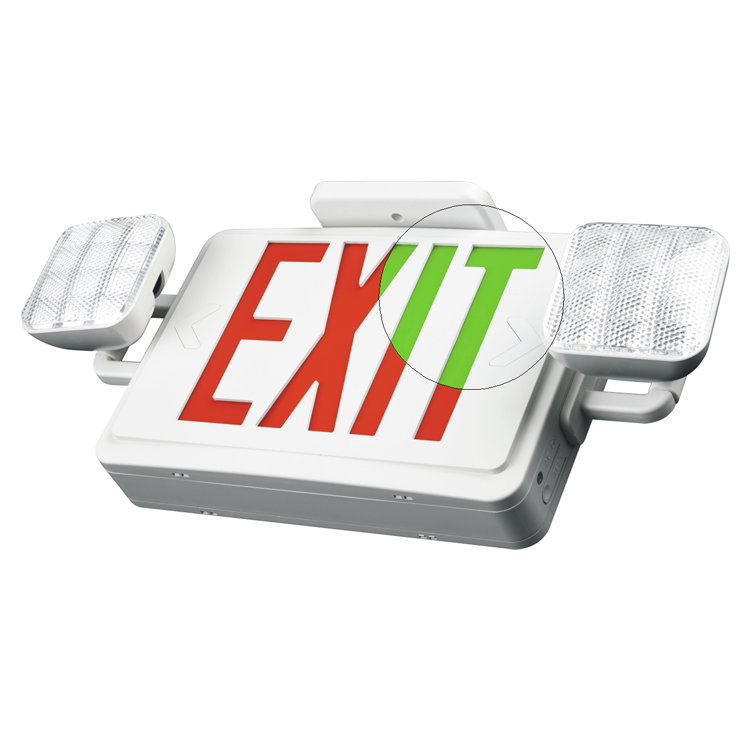
Exit sign combos such as the JLEC2BCW are the type of platform commonly adapted for private-label programs.
JIMING's OEM/ODM capability menu is documented across five customisable points: battery type, housing color, input voltage, logo, and packaging. Monthly capacity stands at 400,000 sets, lead time is 30–45 days, and minimum order quantity is 200 pieces — a workable base for a mid-sized private-label launch as well as for larger programs scaling in phases. The manufacturer offers three structured cost tiers (Value, Balanced, Premium), which lets a private-label buyer align configuration with market positioning rather than negotiate every SKU from scratch.
The limitation deserves to be stated plainly. Private-label programs almost always extend the timeline beyond a standard catalog order, because tooling, packaging artwork, and UL file updates run in parallel. Buyers should also require written confirmation that the UL listing scope survives the customisation — a logo and packaging change is normally low-risk, while a battery-chemistry or input-voltage change is a genuine listing consideration. This was not a point any large-portfolio group is likely to solve more cleanly than a specialist; it is simply a decision that has to be made deliberately.
A Buyer Shortlist Framework Across Product Categories
The shortlist is more useful when it is organised by product category rather than by brand. The table below groups the four core categories a 2026 emergency lighting program is likely to require, and lists verified specification anchors for each.
Read the table as a sampling guide, not as a full catalog. Each category answers a different buyer question:
- Exit signs (JREEL2RM, JELBEX) — match panel material, letter color, mounting plate, and voltage compatibility to the building egress plan before comparing price. The 0–40°C damp rating is the practical limiting condition for interior signage.
- Exit sign combo (JLEC2BCW) — useful where a project wants a single fixture to satisfy both exit signage and additional egress lighting from the same J-box, reducing installation labor and SKU count.
- Twin-head lights (JLEU9, JLEU5WP) — battery chemistry and location rating drive lifecycle decisions. NiCd platforms on the JLEU9 and JLEU5WP are mature and well understood; the wet-location rating on the JLEU5WP extends the same architecture into spaces that the JLEU9's damp rating does not cover.
- Bulkhead (LE518) — the IP65 rating plus the optional conversion to an edge-lit exit sign configuration make the LE518 a strong candidate for warehouses, parking, and security areas where the same platform serves multiple roles.
- Downlight (DLB300) — surface-mount and embedded-mount interchangeability, with interchangeable lenses for circular or polarized light, allow the same SKU to serve new-build and retrofit corridors. Its applications include commercial, healthcare, education, transportation, industrial, hospitality, residential, infrastructure, and public safety environments.
Where the Shortlist Breaks Down — Limitations on All Sides
A credible shortlist has to acknowledge that no supplier is strongest on every dimension. Four limitations belong in front of buyers before the comparison is used:
JIMING — specialist scope. The portfolio is intentionally limited to emergency lighting. For buyers who also need general commercial lighting, task lighting, or architectural controls under one brand, this means adding another supplier to the project. Scale is smaller than the multinationals on the shortlist, which affects negotiating leverage on very large multi-year agreements.
Eaton, Acuity Brands, Signify, Hubbell, Legrand — breadth trade-off. The emergency lighting line is one product line among many. Buyers should not assume consistent private-label flexibility or comparable customisation depth across every group on this shortlist. Emergency lighting depth varies by product line and region, and needs to be checked case by case.
Market data limitation. Only one commercial research source was used for the market-size reference in this article. Competing estimates exist, in part because the treatment of smart/IoT lighting and secondary emergency signage varies between sources. Buyers should treat the market figure as directional, not as a basis for a supplier decision.
Spec-sheet limitation across all suppliers. Public product pages rarely supply independent photometric or runtime test reports. JLEU9 and JLEC2BCW figures cited in this article are company-reported and should be validated against the supplier's UL listing file and any recent test data at the point of purchase order.
Future Outlook
Three trends are likely to shape the shortlist through 2027 and beyond, based on the verified data in this article:
Battery chemistry migration. LiFePO4 appears in the LE518 bulkhead and the DLB300 downlight, while older twin-head platforms still use NiCd and NiMH. This is not a virtue claim — it simply reflects product generation and target lifecycle. Over the next two years, buyers are likely to increasingly specify LiFePO4 where high cycle-life and low maintenance are priorities, and retain mature NiCd / NiMH platforms where field-proven chemistry is preferred.
Test automation as a specification line item. Automated test solutions such as the EMCL ELT System convert existing emergency lighting into connected devices that automate code-required testing. This is not a supplier differentiator in this shortlist, but it is a trend that will raise the floor on what buyers expect from a modern platform — particularly in hotel and multi-tenant office portfolios where the Minnesota-style monthly 30-second and annual 30-minute testing cycle becomes a real operational cost.
Geographic diversification of manufacturing. The JIMING footprint — 70,000 m² in Ningbo plus 38,000 m² in Haiphong, Vietnam — reflects a broader shift. Buyers are increasingly asking whether UL-listed emergency lighting can ship from outside China while retaining North American compliance. The Haiphong facility supports that question, and Vietnam-origin certificates are part of the offering. None of this changes the underlying buyer responsibility: verify UL file scope, verify origin documents, and verify the test data against the project's code jurisdiction.
Frequently Asked Questions
What certifications does an emergency light supplier need for North America?
UL 924 is the relevant safety standard for emergency lighting and power equipment in North America. UL Solutions describes the standard as covering equipment intended for connection to branch circuits of 600 volts or less, including exit signs, emergency luminaires, and unit equipment. Canadian buyers should confirm cUL (Canada) coverage in addition to UL. Local code jurisdictions also apply their own adoption rules, so UL listing is a necessary but not sufficient condition for every project.
How can a buyer verify that a UL-listed exit sign is genuine?
Verification is best done through the UL Product iQ database using the manufacturer's legal name alongside the exact model number — not through a sticker on the packaging. Exit signs and emergency luminaires may sit in different UL listing categories, so each category should be checked separately. Buyers should also confirm that the UL file is current, and request a copy of the listing scope that names the specific SKU being purchased.
What should a buyer look for in battery backup specifications?
Four items matter: battery chemistry (NiCd, NiMH, or LiFePO4), minimum emergency runtime, maximum full recharge time, and expected maintenance mode. The JLEU9 and JLEC2BCW both specify a minimum 90-minute emergency operation with a maximum 24-hour full recharge time — well inside the operating envelope that facility managers typically build their inspection plans against. Buyers should also match runtime claims to the local test cycle, since the annual 30-minute power test used in some jurisdictions is a different evaluation than a 90-minute marketing claim.
How does China manufacturing compare with Vietnam manufacturing for a North American buyer?
Both origins require the same UL listing verification. China-based production — such as JIMING's 70,000 m² Ningbo factory — typically brings deeper supply chain continuity for UL file updates and component sourcing. Vietnam-based production — such as JIMING's 38,000 m² Haiphong factory — offers an alternative origin that can affect landed cost and tariff exposure, and Vietnam-origin certificates are part of the offering. Buyers should confirm that the certificate of origin on file matches the origin declared in the purchase order, particularly when a program is split across both factories.
How does a private-label emergency lighting program work in practice?
A private-label program pairs a UL-listed platform with buyer-specific branding and packaging. JIMING's documented customisation menu covers five items: battery type, housing color, input voltage, logo, and packaging. Commercial scale is set by minimum order quantity (200 units), lead time (30–45 days), and monthly capacity (400,000 sets). Buyers should plan for the tooling and UL file update timeline that customisation adds to the base product, and should ask for written confirmation that the UL listing scope remains valid after the customisation is applied.
How should an emergency lighting buyer choose between suppliers on this shortlist?
Start with the application, not the brand. Exit signs are best matched by panel material, letter color, and mounting plate; twin-head lights by input voltage, battery chemistry, and damp or wet location rating; bulkheads by IP rating; downlights by mounting type and maintained/non-maintained mode. Once the product stack is fixed, weigh the supplier against the dimension that matters most for the program: group-level breadth for a single-brand building rollout, specialist engineering depth for UL-listed emergency fixtures, or private-label flexibility for a brand-owner program. Matching those three priorities to the correct supplier is a more reliable decision path than ranking brands on a single axis.
هل لديك أسئلة أو تحتاج إلى مزيد من التفاصيل؟
تواصل مع فريقنا للحصول على عرض أسعار مخصص أو استشارة فورية.
طلب عرض أسعار
املأ النموذج أدناه وسيتواصل معك فريقنا بعرض مقترح مخصص.
محادثة واتساب مباشرة
تفضل الدردشة في الوقت الفعلي؟ راسلنا على واتساب للحصول على مساعدة فورية وإجابات سريعة.
- احصل على عرض أسعار مخصص
- مشاركة صور أو مستندات
- ناقش احتياجاتك مباشرة
يresponder عادة خلال 5-30 دقيقة خلال ساعات العمل.