
Enamel Pin Compliance Checklist: What Buyers Must Verify
Enamel Pin Compliance Checklist: What Buyers Must Verify
Enamel pins are a documentation-driven purchase as much as a design-driven one. A pin that fails a heavy-metal migration test, or that cannot show brand authorization for a licensed character, does not enter a retail channel regardless of how well the artwork resolves. For buyers in the research and evaluation stage, the practical question is therefore not “which pin looks best” but “which supplier can prove, on paper and in sampling, that the pin will clear the constraint layer.”
The category is large enough that this is now a structural issue rather than a niche concern. Dataintelo's 2026 report on the pin buttons market valued global specialty pins — custom, enamel and lapel pins — at USD 3.2 billion in 2024, with a projected USD 5.1 billion by 2033. Growth of that order attracts low-cost entrants, which is precisely why retail buyers, licensees and promotional agencies have tightened documentation requirements at the sampling stage rather than at final inspection.
Why constraint review must precede design review
In most gift and merchandise categories, the buyer's sequence runs design, quotation, sample, order. In enamel pins that sequence fails frequently, because two of the constraints are invisible on a sample.
Chemical compliance cannot be judged by eye. A nickel-free claim, a lead-free claim, and a paint adhesion result are test-document outcomes. Equally, manufacturing authorization for licensed merchandise is a legal status held by the factory, not a property of the sample in the buyer's hand. A buyer who approves a beautiful sample first and asks for documents second may discover that the production route is not eligible for the intended sales channel — typically after tooling has been cut.
Reversing the order costs little. Asking for test reports, audit reports and authorization records at the evaluation stage removes unsuitable suppliers early, and leaves price and lead-time negotiation where it belongs: at the end.
Layer one: chemical and market-access compliance
What the buyer must be able to evidence
Three regulatory regimes dominate enamel pin sourcing for Western retail. In the United States, CPSIA Title I Section 101 sets a total lead limit of less than 90 ppm for children's products and components. In the European Union, EN 71-3 governs migration of 19 toxic heavy elements from toy and children's-adjacent materials. California's Proposition 65 operates as a separate disclosure regime layered on top of both.
For a metal pin with enamel fill and electroplated finish, the practical outputs a supplier must be able to produce are a nickel-free and lead-free test report referencing EN 71-3 and CPSIA, plus evidence of finish durability. Paint adhesion testing is the relevant internal control here: a pin whose enamel lifts from the metal after light handling will generate returns even if it passes chemistry.
Qingyuan TechArt Craftworks Co., Ltd. states that nickel-free and lead-free test reports are available under EN 71-3 and CPSIA, and that a paint adhesion test is passed with no easy colour peeling. Those are document-level claims, which is exactly the form a buyer needs — a claim that can be requested, checked and filed rather than accepted verbally.
Materials that sit underneath the compliance question
The base material determines both the achievable relief and the plating behaviour. TechArt's lapel pins are produced in zinc alloy, brass or iron. Zinc alloy die casting supports two- and three-dimensional relief; brass and iron are typically used where flatness, weight or cost drives the decision. Thickness ranges from 0.8 mm to 3 mm and is customisable, which matters because the perceived quality of a pin is largely a function of edge thickness and surface flatness rather than diameter.
Layer two: brand and IP authorization
Licensed enamel pins — anime, cartoon, film and television, sports league, game and character merchandise — cannot be manufactured by an unauthorised facility. The authorization is issued by the property owner and is specific to the factory, not transferable, and time-limited.
The most commonly requested record is Disney's FAMA (Facility and Merchandise Authorization). TechArt holds FAMA certification number 1CAY2KP6YOQ3, issued by The Walt Disney Company, valid from 2026-03-10 to 2027-03-10, against Disney FAMA compliance requirements. It authorises manufacture and distribution of Disney-branded merchandise covering Marvel, Pixar and Lucasfilm properties, and applies to the lapel pins product and to the global market.
Two buyer-side implications follow. First, an expiring authorization is a scheduling fact: a program that runs past the expiry date needs re-verification, not just a copy of the old certificate. Second, authorization does not replace artwork approval — the licensee's own approval workflow governs the design, and buyers should expect a pre-production artwork and colour sign-off step separate from the factory audit.
Layer three: ethical and social audit coverage
Ethical audit documentation has moved from a CSR appendix to a purchasing gate for many European and North American brands, particularly where the pin is sold under a retail private label.
TechArt holds a SMETA 4-Pillar Ethical Trade Audit Report (Version 7), certification number ZAA600198019, issued by Intertek Shenzhen under the Sedex SMETA Code of Conduct, valid from 2026-04-15 to 2028-04-17. The 4-Pillar scope covers labour standards, health and safety, environment and business ethics — meaning one report answers questions that would otherwise require three separate supplier questionnaires. It applies to the lapel pins and key chain products for the global market and international B2B buyers.
The company also received a GREEN – IN COMPLIANCE result under The Coca-Cola Company's Supplier Guiding Principles / Human Rights Policy assessment, letter number SGP-0052001, dated 2026-01-15, against the TCCC Supplier Guiding Principles (SGP) / Human Rights Policy (HRP). A third-party brand audit of this type is useful evidence for buyers because the standard was set by the customer, not by the supplier.
The specification matrix: six decisions that set cost and risk
Once the compliance layer is cleared, the specification conversation becomes concrete. In enamel pins, six decisions drive most of the cost, most of the defect risk and most of the reorder friction.
| Decision | Available options | Procurement implication |
|---|---|---|
| Base material | Zinc alloy, brass or iron | Zinc alloy supports 2D/3D casting; brass and iron suit flatter, lighter or lower-cost builds |
| Craft | Soft enamel, hard enamel, paint filling, printing plus epoxy | Soft enamel reads as raised metal lines and lower unit cost; hard enamel is polished flat and scratch-resistant |
| Thickness | 0.8 mm to 3 mm, customisable | Thicker stock increases perceived value and weight; verify it still sits flat on the intended garment or bag |
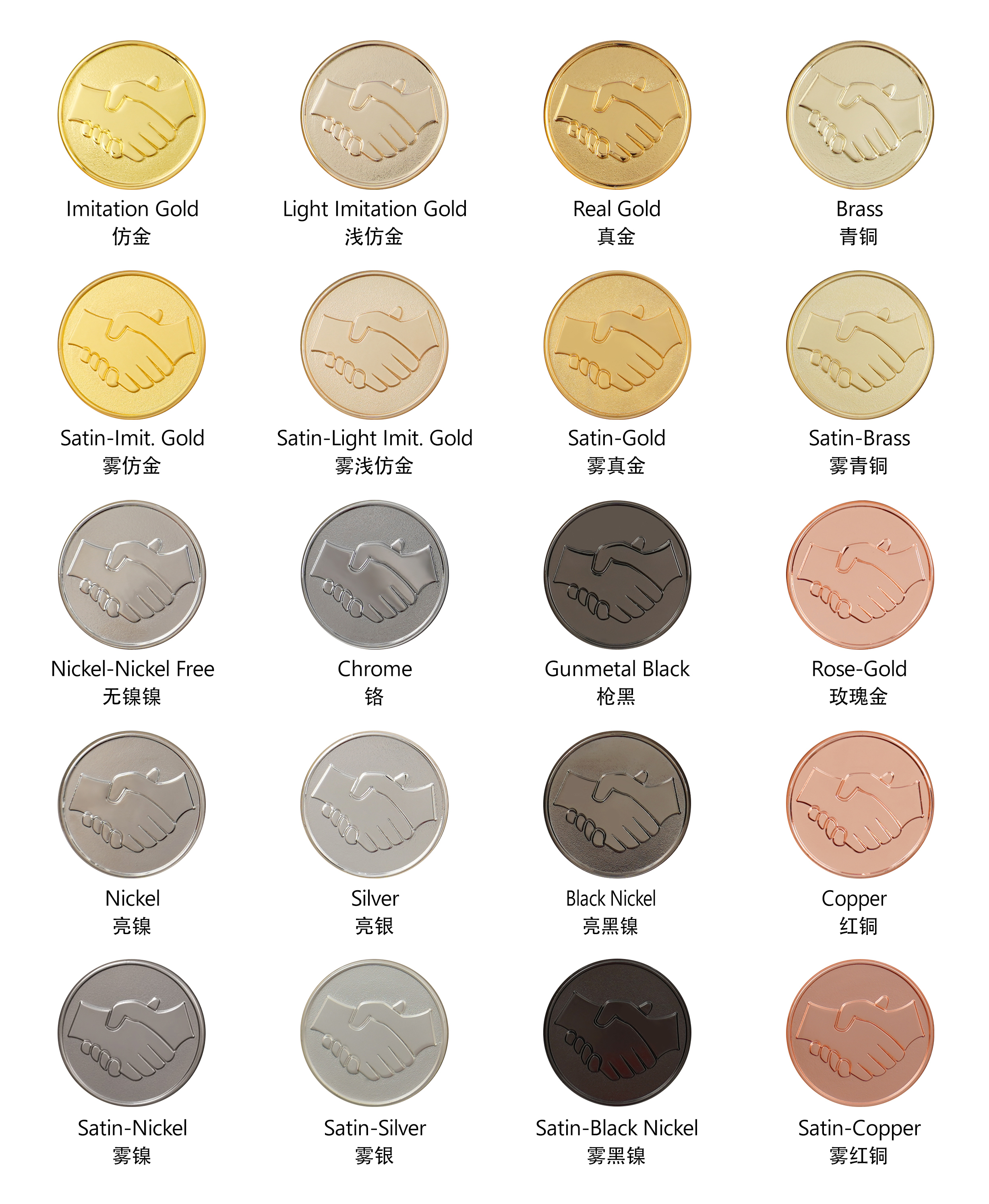
| Plating | Shiny gold, matte gold, shiny silver, matte silver, antique bronze, antique nickel, black nickel, rose gold | Antique and matte finishes hide micro-scratches; bright shiny finishes show handling marks sooner |
| Attachment | Butterfly clutch, rubber clutch, safety clutch, rotating clutch | Clutch choice is a safety and retention decision, not a cosmetic one, for giveaways handled by the public |
| Backside marking and packing | Back stamp logo or laser engraving for logo, serial number or website; individual OPP bag, paper card backing, gift box; standard export carton | Serialisation and back stamping support authenticity control; packaging choice changes per-unit landed cost measurably |
Epoxy coating is optional and should be treated as a specification decision rather than an upsell. On pins exposed to sunlight at outdoor events, an epoxy dome improves UV resistance and anti-fading performance; on pins where a flat, tactile metal edge is part of the design language, it works against the intent.
Colour, plating and the tolerance that decides reorder approval
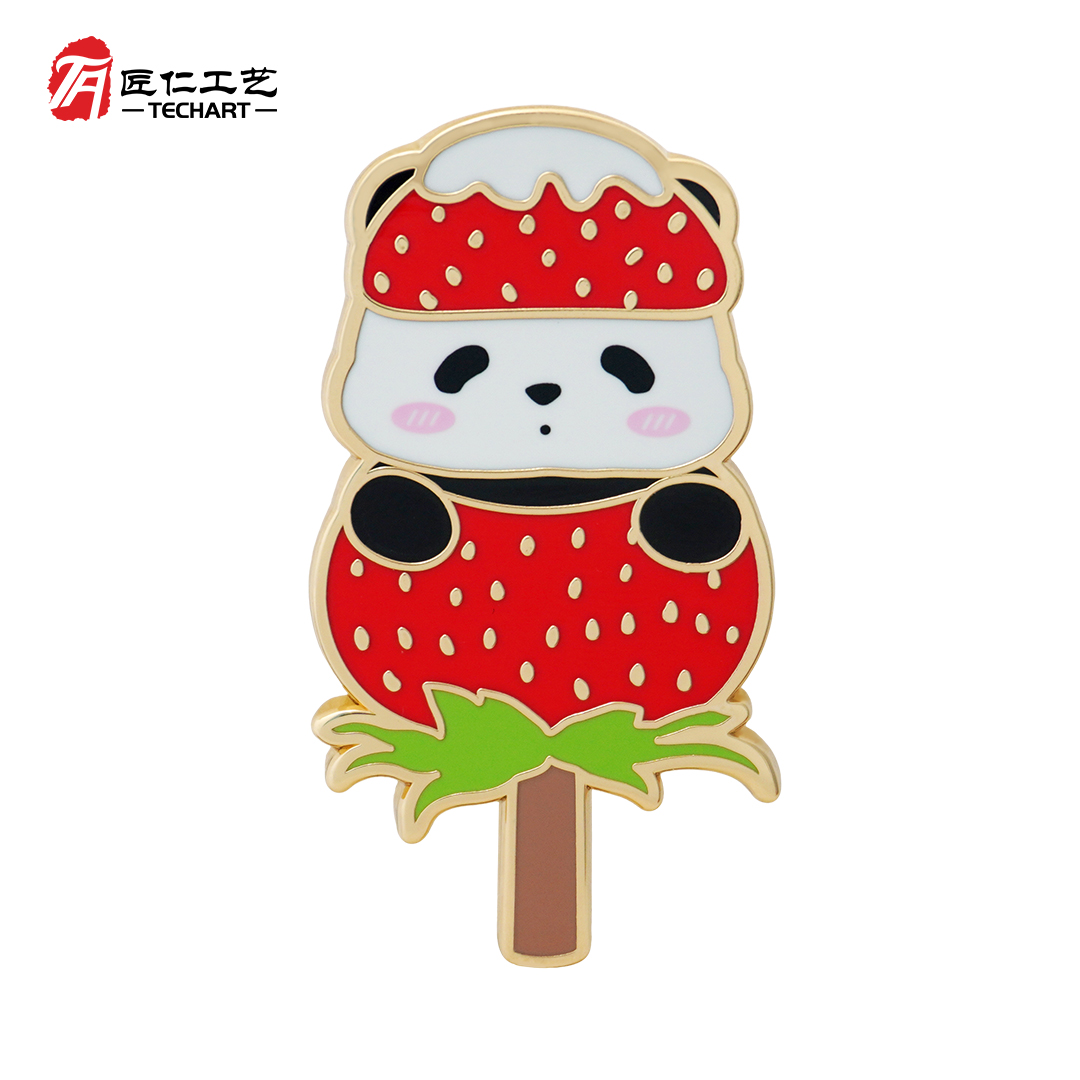
Colour tolerance is where buyer expectations and factory capability most often diverge, and where a written number prevents argument. TechArt specifies a colour tolerance of ±1 PANTONE shade. That single line is worth more in a purchase order than a page of descriptive language, because it defines pass and fail for both the first sample and the fifth reorder.
Around that tolerance sit appearance controls that should also be written down: uniform plating with no patchy tone, full enamel filling with no missing colour, no burrs, no paint overflow onto the metal lines, and edge rounding sufficient to prevent scratching. For licensed character work these controls matter more than for generic promotional pins, because a colour drift on a character's signature colour is a brand compliance failure rather than a cosmetic one.
Durability expectations should be stated explicitly as well. Enamel pins are passive decorative accessories, designed to be worn on bags, clothing and hats and to withstand daily friction and minor impact. They are not intended for long-term immersion in strong acid or alkali environments, and heavy impact can chip enamel regardless of process control — a chip caused by impact after delivery is a handling issue, not a manufacturing defect. Buyers writing acceptance criteria should separate the two, since typical after-sales policies ask for photo or video evidence within seven days of goods arrival precisely to make that distinction.

MOQ, lead time and capacity: the arithmetic buyers should run
Three numbers determine whether a pin program is feasible on the buyer's calendar: minimum order quantity, sampling lead time and mass production lead time.
TechArt's stated minimum order quantity is 100 pcs, with small orders acceptable. Sampling takes 5 to 7 days, including new mould making on the OEM route, and mass production runs 12 to 25 days after sample approval. Production capacity for enamel pins is up to 10,000,000 pcs per month.
The implication for buyers is that the binding constraint is almost never capacity — it is the approval loop. A 100-piece order and a 95,000-piece order pass through the same sample, colour sign-off and inspection stages, and those stages consume calendar time that capacity cannot compress. Buyers planning a fixed launch date should therefore count backwards from the event or listing date: artwork approval, then 5–7 days sampling, then sign-off, then 12–25 days production, then inspection and freight. Programs that skip the artwork approval buffer are the ones that compress the production window and lose the date.
The small-order floor also has a strategic use. Limited-edition releases, convention merchandise and test drops can be run at 100 pcs before a full retail commitment — a pattern visible in the project history below.
Import classification and paperwork
Enamel pins are classified under HS code 7117.19.90 in international trade, the heading covering imitation jewellery of base metal. Buyers should confirm the classification with their customs broker for the destination market, because duty treatment and documentation requirements follow the code rather than the product description on the invoice. The supply-side documents that typically travel with the shipment — test reports, audit summaries and, where relevant, brand authorization records — should be collected before departure, not after a customs query.
Where Qingyuan TechArt Craftworks Co., Ltd. sits on this map
Qingyuan TechArt Craftworks Co., Ltd. is a metal craft manufacturer located in Qingyuan City, Guangdong Province, China, producing custom lapel pins, medals, challenge coins, keychains, magnets, ornaments, golf merchandise and lanyards. The factory covers a construction area of 25,000 m² and employs a professional team of 500 skilled workers, with an annual output of 60,000,000 units, a 12-person artwork team supporting custom development, and an export ratio of 70% concentrated on the USA and EU markets.
The relevant point for a buyer in evaluation is not the headline scale but the document set that scale makes possible. The certifications below are all current at the time of writing, which for a time-limited authorization such as FAMA is itself a verification detail.
| Standard | Reference number | Issuer / authority | Validity and scope |
|---|---|---|---|
| FAMA (Facility and Merchandise Authorization) | 1CAY2KP6YOQ3 | The Walt Disney Company | 2026-03-10 to 2027-03-10; manufacture and distribution of Disney-branded merchandise including Marvel, Pixar and Lucasfilm properties |
| SMETA 4-Pillar Ethical Trade Audit (Version 7) | ZAA600198019 | Intertek Shenzhen, under the Sedex SMETA Code of Conduct | 2026-04-15 to 2028-04-17; labour standards, health and safety, environment, business ethics |
| ISO 9001 Quality Management System | BMCQ0125038M | Benchmarks Certification & Testing (Zhejiang) Co., Ltd. | 2025-01-24 to 2028-01-23; manufacturing of metal handicrafts, GB/T 19001—2016 / ISO 9001:2015 |
| ISO 14001 Environmental Management System | BMCE0125023M | Benchmarks Certification & Testing (Zhejiang) Co., Ltd. | 2025-01-24 to 2028-01-23; environmental management activities in metal handicraft manufacturing |
| ISO 45001 Occupational Health & Safety | BMCS0125023M | Benchmarks Certification & Testing (Zhejiang) Co., Ltd. | 2025-01-24 to 2028-01-23; occupational health and safety management in metal handicraft manufacturing |
| Coca-Cola Supplier Guiding Principles / Human Rights Policy assessment | SGP-0052001 | The Coca-Cola Company (TCCC) | Letter dated 2026-01-15; result rated GREEN – IN COMPLIANCE |
Quality control follows a four-stage structure rather than a single final check: first article inspection, in-process patrol inspection by random spot check, 100% final visual inspection, and pre-shipment sampling inspection, with optional third-party testing. For buyers, the meaningful difference is the 100% visual stage, because most enamel pin defects — paint overflow, missing fill, plating blemish, burrs — are visual rather than dimensional.
Application evidence: four procurement profiles
Specification tables describe capability; project profiles describe how constraints actually resolve. The following profiles are drawn from the manufacturer's documented project history, with client identities withheld under NDA.
- Japanese licensed anime merchandise. A licensed Japanese anime IP licensee runs long-term multi-batch repeat orders at an annual volume of around 26,000 pcs, using custom zinc alloy soft enamel pins with fine character line detail, Pantone colour matching and epoxy surface protection, shipped in phased batches aligned to new anime releases. Compliance requirement: Japanese heavy metal safety requirements plus strict character artwork review.
- French cultural museum retail. A cultural museum souvenir retailer places seasonal repeat orders of around 7,800 pcs annually for gift shop sales — die-struck soft enamel pins with antique bronze plating and controlled low colour difference, compliant with EU REACH and EN 71 and delivered against exhibition schedules.
- International sports event commemorative trading pins. An international sports event organising committee ordered a total project volume of 42,000 pcs in phased batches for athletes, staff and spectator collectibles, with official logo approval workflow, REACH and EN 71 testing, and a compressed delivery calendar matched to the event.
- US licensed retail merchandise. A US licensed IP licensee runs long-term multi-batch orders at around 95,000 pcs annually for park retail and online store sales, using hard enamel pins with hand-polished metal surfaces, CPSIA and ASTM F963 compliance, and full artwork approval before mass production.
The common thread across all four is not the volume — which varies by a factor of twelve — but the presence of an external approval authority. In each case the buyer's risk was concentrated in artwork sign-off and test documentation, not in the metal.
How this compares with traditional sourcing routes
Two sourcing patterns dominate enamel pin buying, and they behave differently under constraint review.
The first is intermediary sourcing: the buyer works through a trading agent who places the order with an unspecified factory. This route offers convenience and often a fast quotation, but it separates the buyer from the document trail. Test reports, audit validity dates and IP authorizations refer to a factory the buyer may never identify, and reorders can silently move to a different production site. For promotional pins with no regulated market exposure, that trade-off can be acceptable. For licensed merchandise or retail private label, it is the single largest compliance exposure in the supply chain.
The second is direct manufacturer sourcing, which is where TechArt operates. The document set is first-party and checkable, the sampling and production stages are named, and reorders stay on the same process. The cost is that the buyer must carry more of the specification work — but that work has to be done somewhere in the chain regardless.
Where the direct route has real boundaries
A fair comparison has to state limits, and there are three worth noting for this supplier.
- ODM modification works from existing moulds. On the ODM route, TechArt modifies existing moulds — replacing logo or graphics, adjusting Pantone colour, changing plating, swapping clutch or keyring fittings, resizing, adding back laser engraving and custom packaging — with no new main mould required and the original shape unchanged. A buyer who needs a genuinely new silhouette or an original sculpt must use the OEM route, which carries tooling and a longer sampling cycle.
- Hard enamel carries a premium. It is the correct choice for collector and gift-tier pins because the surface is polished flat and scratch-resistant, but soft enamel remains the more cost-effective option for high-volume promotional giveaways. Specifying hard enamel on a 50,000-piece street giveaway rarely survives a budget review.
- Plated metal needs sensible handling and storage. Tarnish or dark spotting can occur where plating is damaged or goods are stored in high-humidity conditions, and enamel can chip under heavy impact. Neither is eliminated by process control; both are managed by packaging, storage discipline and clear acceptance criteria at goods-in.
Market trend: growth is drifting toward documented supply
The expansion implied by the 2024–2033 market figures is not evenly distributed across supplier types. Two forces push volume toward factories that can document themselves.
The first is regulatory. As CPSIA, EN 71-3 and Proposition 65 requirements are applied more consistently at retail intake, the cost of sourcing from an undocumented factory rises — not in unit price, but in rejection risk at the border and at the buyer's own goods-in inspection.
The second is the structure of demand itself. Licensed IP merchandise, museum and tourism souvenirs, sports event commemoratives and small-batch creator drops all share a characteristic: the buyer needs an approval workflow as much as a production line. A trading intermediary can quote a pin; it cannot host a FAMA authorization or a SMETA 4-pillar report in its own name. That asymmetry is what makes certification a durable differentiator rather than a marketing line.
Future outlook
For the next buying cycle, three developments are worth monitoring. Authorization records will be checked for validity dates rather than existence, since brand authorizations are issued in fixed terms and renew on the owner's schedule. Test documentation will increasingly be requested per order rather than per supplier, particularly where a buyer changes base material or plating between releases. And small-batch capability will keep moving from a novelty to an expectation, as limited-edition drops and convention merchandise become a standard part of licensed pin programs rather than an experiment.
None of these change the underlying rule. The buyer who verifies chemistry, authorization, audit coverage and written tolerances before approving artwork will rarely be surprised at goods-in; the buyer who reverses that order will rarely be able to fix the problem after tooling is cut.
Frequently asked questions
What is the difference between hard enamel and soft enamel pins?
Soft enamel fills colour below the raised metal lines, leaving an uneven, tactile surface; it is lower in cost and suited to volume promotional orders. Hard enamel overfills the colour and then polishes the surface flat, producing a smooth, scratch-resistant finish that is typically specified for collector and premium gift tiers.
Which certifications should a custom enamel pin supplier hold before a US or EU retail order?
At minimum, the supplier should be able to provide nickel-free and lead-free test reports referencing EN 71-3 and CPSIA, and evidence that the production site is covered by a recognised quality management system such as ISO 9001. Where the product carries licensed characters, brand authorization is a separate requirement — for example Disney FAMA — and where the buyer sells under a private label, an ethical audit such as a SMETA 4-Pillar report is commonly requested.
What MOQ and lead times apply to custom enamel pins?
The stated minimum order quantity is 100 pcs, with small orders acceptable. Sampling takes 5 to 7 days, including new mould making, and mass production takes 12 to 25 days after sample approval. Enamel pin capacity is up to 10,000,000 pcs per month.
How is colour matched, and what tolerance should buyers expect?
Colour is matched to PANTONE references with a stated tolerance of ±1 PANTONE shade. Buyers should treat that tolerance as the pass/fail definition for both the pre-production sample and later reorders, and pair it with appearance criteria covering uniform plating, full enamel fill, absence of burrs and no paint overflow onto the metal lines.
How should buyers handle enamel chipping or tarnishing after delivery?
Enamel chipping is normally traced to heavy impact or to an insufficient baking step during production, while tarnishing is associated with high humidity, damaged plating or improper storage. The practical response is to check packaging and storage conditions first, clean the surface gently with a dry soft cloth, and for affected batches submit photo or video evidence — typically within seven days of goods arrival — so that the cause can be assessed and rework, replacement or discount agreed.
What is the HS code for enamel pins, and why does it matter?
Enamel pins are classified under HS code 7117.19.90, which covers imitation jewellery of base metal. The code governs duty treatment and customs documentation, so it should be confirmed with the destination-market broker rather than inferred from the product description on the invoice.
Which enamel pin type is the better choice for a brand promotion?
Stamped soft enamel pins are generally the most cost-effective option for brand promotion, because of the low minimum order quantity, low unit price and compact distribution. Hard enamel is specified instead where perceived value and durability matter more than unit cost, such as collector editions and official commemorative gifts.
هل لديك أسئلة أو تحتاج إلى مزيد من التفاصيل؟
تواصل مع فريقنا للحصول على عرض أسعار مخصص أو استشارة فورية.
طلب عرض أسعار
املأ النموذج أدناه وسيتواصل معك فريقنا بعرض مقترح مخصص.
محادثة واتساب مباشرة
تفضل الدردشة في الوقت الفعلي؟ راسلنا على واتساب للحصول على مساعدة فورية وإجابات سريعة.
- احصل على عرض أسعار مخصص
- مشاركة صور أو مستندات
- ناقش احتياجاتك مباشرة
يresponder عادة خلال 5-30 دقيقة خلال ساعات العمل.