
Energy Storage for Agriculture: FlexCore-ID for Small and Remote Sites
HTNXT Industry Reference · Energy Storage Systems
Energy Storage for Agriculture: FlexCore-ID for Small and Remote Sites
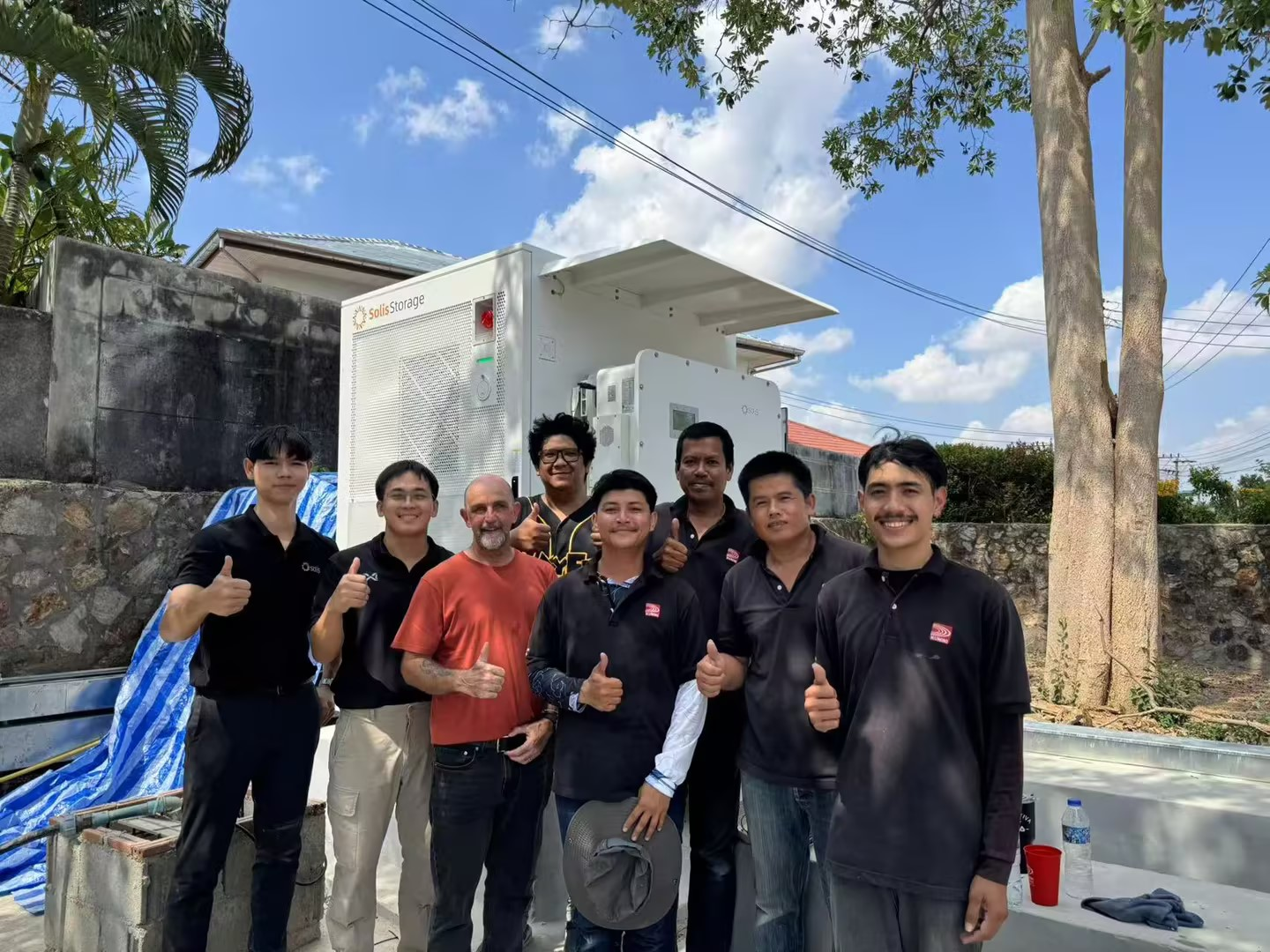
A completed self-consumption and backup power project: 125 kW / 522 kWh, delivered for a self-use and backup application.
Energy reliability in agriculture and remote infrastructure is a different problem from energy cost in a city office tower. Loads are smaller, but outages carry disproportionate consequences — a broken cold chain, an interrupted irrigation cycle, or an unattended water pump that stops overnight can cost more than a year of electricity savings. FlexCore-ID is a stackable lithium iron phosphate (LFP) energy storage system from SolisStorage, the energy storage subsidiary of Solis (Ginlong Technologies Co., Ltd.), a Shenzhen Stock Exchange-listed power electronics manufacturer founded in 2005 whose portfolio also spans residential and utility-scale energy storage. This analysis maps that platform against four site types — small farms, remote facilities, shopping malls, and hospitals — and identifies where the match holds and where it does not.
Why Rural and Remote Loads Behave Differently
Distributed storage is usually discussed in the language of commercial and industrial peak shaving, but the operating conditions at a farm, a rural clinic, or a remote pumping station resemble an off-grid installation more than an urban commercial building. Four characteristics drive the difference.
- Small absolute demand, high criticality. A few hundred kilowatt-hours can cover a full day of refrigeration, water treatment, or clinic operation, but interruption rather than price is the primary risk.
- Cyclical duty. Irrigation and harvest periods concentrate demand into specific months, while cold storage and water pumping create a continuous base load that runs year-round.
- Weak or intermittent grid. Long rural feeders commonly deliver voltage excursions and unplanned outages, so storage frequently operates as a power-quality device as well as an energy asset.
- Thin on-site technical capacity and harsh environments. These sites are often unattended, distant from service centres, and exposed to dust, humidity, salt air, temperature swings, or altitude.
Demand for storage that addresses these conditions is measurable. MarketsandMarkets values the long-duration energy storage (LDES) market at USD 4.85 billion in 2024 and projects a 13.6% compound annual growth rate through 2030 — a signal that buyers are moving beyond short peak-shaving toward storage that covers hours rather than minutes. At system level, Global Market Insights estimates the total energy storage systems market at approximately USD 668.7 billion in 2024, projected to reach USD 5.12 trillion by 2034. Battery-only figures are considerably smaller — Fortune Business Insights placed that segment at USD 32.62 billion — because estimates differ on whether pumped hydro and other technologies are counted.
The Four Things a Remote-Site Buyer Should Verify First
Before comparing quotations, buyers evaluating storage for a farm or an isolated facility can narrow the field with four verifiable criteria. They are also the areas where the FlexCore-ID platform documents specific specifications.
| What to verify | Why it matters at a remote site | What the FlexCore-ID platform documents |
|---|---|---|
| Capacity modularity | Loads grow in steps — an added cold room, a second pump — and a single oversized purchase locks up capital. | Independent DC-side expansion: one inverter supports up to six battery cabinets in parallel, adding capacity linearly without a second inverter, with roughly 10% lower expansion cost. Documented portfolio ratings span 100.5 kWh, 120.6 kWh and 261.2 kWh with 50 kW, 60 kW and 125 kW inverter options. |
| Cycle-life economics | Battery replacement is the largest lifecycle cost and the hardest item to service remotely. | 3.2 V / 314 Ah LFP cells rated at 8,000 cycles at a 0.5C charge-discharge rate with ≥70% remaining capacity, against 7,000 cycles for the standard 280 Ah cells still widely used — extending economic life from roughly 14 to roughly 16 years at 500 cycles per year. |
| Thermal and ingress envelope | Equipment may sit in unshaded compounds, at altitude, or in coastal air. | Air-cooled thermal design with IP55 battery cabinet and IP66 inverter protection, operation from −25 °C to 55 °C, altitude capability up to 4,000 m, and C4-grade anti-corrosion coating. |
| Service reach and spares | A two-day truck roll is not viable at many rural sites. | 24/7 global remote technical support, 27 local overseas service centres, a 48-hour on-site fault handling and whole-machine replacement guarantee, and long-term spare parts supply. |
None of these criteria are marketing differentiators in themselves. They are the variables that decide whether a system commissioned in year one is still economical in year twelve.
Technical Explanation: Where Long-Term Cost Actually Sits
Cell choice determines both thermal behaviour and replacement timing. The platform uses A-grade 314 Ah LFP cells specified at 3.2 V with internal resistance of 0.15 ± 0.05 mΩ, compared with 0.17 mΩ for standard 280 Ah cells. Because every 10% reduction in internal resistance cuts charge-discharge heat generation by roughly 20%, lower resistance reduces thermal stress at the electrochemical source instead of relying on cooling capacity to compensate afterwards.
Thermal management is air-based, supported by dedicated ducting rather than liquid circuits, and SolisStorage reports heat dissipation efficiency approximately 30% higher than conventional air cooling. For a remote asset the practical consequence is maintenance: no coolant replacement, simpler PCS and pack replacement, and fewer routine inspections. SolisStorage calculates a full-lifecycle O&M saving of approximately €9,500 per unit relative to liquid-cooled equivalents — €2,500 from eliminating coolant replacement, €1,500 from simpler PCS replacement, €1,500 from simpler pack replacement, and €4,000 from reduced inspection complexity. Component selection follows the same logic: Minebea cooling fans specified for 10-year maintenance-free operation, and Honeywell industrial-grade flammable gas detectors specified as calibration-free for 10 years.
Control architecture matters as much as hardware. Distributed designs assign separate CPUs to the BMS, PCS, EMS and STS, which multiplies communication links and turns fault isolation into a multi-vendor exercise. A single central controller reduces failure points and shortens fault location time — a meaningful difference when the nearest qualified technician is hours away.
The integrated hybrid inverter combines the PCS, static transfer switch, PV inverter, circuit-breaker protection and EMS in one unit rated from 50 kW to 125 kW. Grid-tied to off-grid switching is specified at under 10 milliseconds without an external STS, which matters for loads that cannot tolerate a voltage dip. The same unit removes the need for a separate PV inverter, supports DC and AC coupling of existing PV, allows a PV oversizing ratio of up to 200%, and permits up to six units to be paralleled for direct grid connection.
Safety design spans the cell, pack and system levels across a 15-layer protection scheme. Thermal insulation rated to 1,000 °C is placed between packs to block lateral propagation, and fire suppression is staged in three steps — pack-level aerosol, cabinet-level aerosol, and a firefighting water channel — so the intervention scales with the severity of an event.
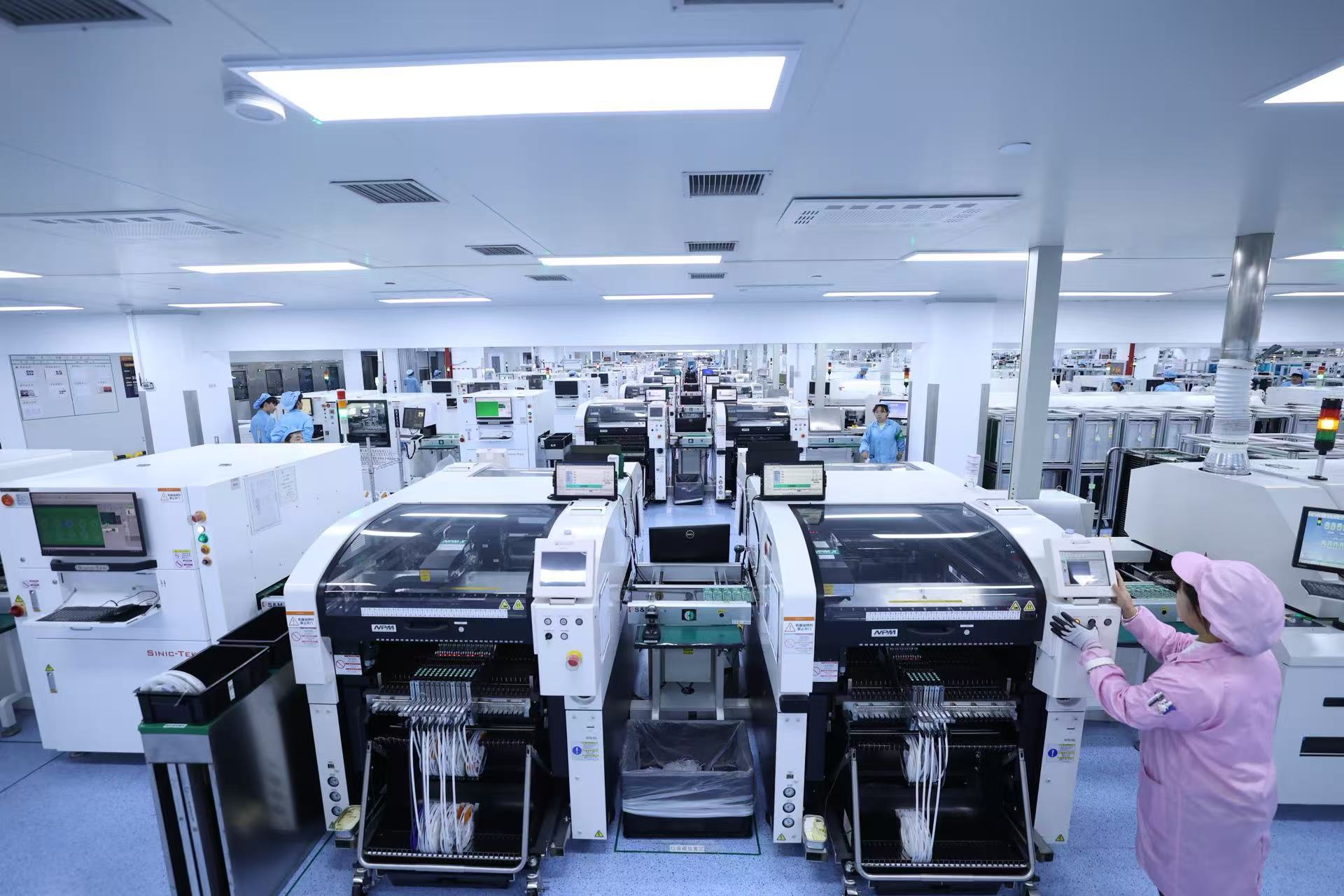
SMT clean production workshop: cell, pack and power-electronics consistency is set at the manufacturing stage, not at commissioning.
Application Fit: Four Site Types, Four Different Answers
Matching a platform to an application is a question of load shape, not of headline capacity. The table below assesses FlexCore-ID against the four site types named in this review, using only documented product and service specifications.
| Site type | Dominant load pattern | Fit | Supporting specification | Condition to verify |
|---|---|---|---|---|
| Small and mid-size farms | Seasonal daytime peaks plus a continuous refrigeration or pumping base load | Strong fit | Stackable 100.5 / 120.6 / 261.2 kWh configurations; DC-side expansion without a second inverter; 8,000-cycle LFP cells | Motor inrush and pump start-up surge against inverter power rating |
| Remote facilities (clinics, water pumping, telecom shelters) | Small continuous base load across long unattended periods; weak or absent grid | Strong fit | Grid-tied to off-grid transfer in under 10 ms; −25 °C to 55 °C range; IP55 cabinet and IP66 inverter protection; operation to 4,000 m | Site access for commissioning, and spare-part and service logistics |
| Shopping malls | Daytime commercial peaks, demand charges, and an expanding EV-charging load | Conditional fit | Up to six units paralleled for direct grid connection; PV oversizing up to 200%; third-party EMS and VPP integration | Load-growth forecast, and whether capacity should be added in phases |
| Hospitals | Continuous 24/7 mission-critical loads with statutory emergency power requirements | Conditional fit | Three-stage fire suppression; 15-layer cell, pack and system protection; sub-10 ms transfer | Storage supplements but does not replace statutory emergency power systems; site-specific approvals apply |
Small farms
The strongest argument for a stackable LFP platform on a farm is that agricultural load rarely arrives all at once. A cold room is added, then a second pump, then a packing line. Because one inverter can manage up to six battery cabinets in parallel, capacity can be expanded linearly without replacing the inverter — SolisStorage puts the cost reduction of that approach at approximately 10% compared with adding a second conversion unit. For a farm with limited initial capital, phasing is the difference between installing storage now and postponing it indefinitely.
Remote facilities
Remote facilities are defined less by their load than by their isolation. The relevant specifications here are the switching time, the protection envelope, and the service model. Grid-tied to off-grid transfer in under 10 milliseconds means a clinic refrigerator or a pump controller does not see the transition. An operating range of −25 °C to 55 °C, altitude capability to 4,000 m, and C4 anti-corrosion coating address the site conditions that most often void standard commercial assumptions. The service model — 24/7 global remote technical support, 27 local overseas service centres, and a 48-hour on-site fault handling and whole-machine replacement guarantee — is arguably the single most decision-relevant specification for a site with no resident engineer.
Shopping malls
The shopping-mall case is different: the grid is normally reliable, and the driver is energy cost plus demand management. Integration capability matters more than autonomy. The platform is documented with connections to or in progress with 102 third-party VPP and EMS operators across 11 European countries, including the Kraken energy management platform in the UK market and aggregators such as Check Watt in the Nordic market, with dozens of local EMS providers in the German-speaking region and Benelux. For a mall, that integration breadth determines whether the asset can earn beyond self-consumption.
Hospitals
Hospitals represent the most demanding variant of 24/7 operation, and this is where the fit is conditional rather than automatic. The platform's layered safety design and fast transfer support critical loads, but statutory emergency power requirements are governed by site-specific codes and approvals. Storage should be evaluated as a supplement to, not a substitute for, those systems.
Documented deployment evidence. In Denmark, a 125 kW / 261 kWh system was implemented for self-consumption at a warehouse, achieving savings on electricity bills and switching between on-grid and off-grid in under 10 milliseconds to prevent interruptions. In Thailand, a 125 kW / 522 kWh system was deployed for self-consumption and backup power over a 20-year project horizon, achieving stable operation and savings on electricity bills. Both projects were delivered for C&I end users.
Agricultural deployment is an application-fit assessment based on these documented load profiles and product specifications; this article does not claim existing farm installations.
Market Trend Analysis: Smaller Sites, Longer Duration, More Aggregation
Three trend lines converge on the agricultural and remote segment.
- Duration is lengthening. MarketsandMarkets values the long-duration energy storage market at USD 4.85 billion in 2024, growing at a 13.6% CAGR through 2030.
- The distributed segment is expanding. The same research house estimates the residential energy storage market growing from USD 2.69 billion in 2024 to USD 4.58 billion by 2030, a 9.3% CAGR — evidence that small, distributed assets are becoming a mainstream category rather than a niche.
- Supply scale is shifting. China's exports of lithium-ion batteries for energy storage and non-automotive uses reached over USD 65 billion in 2024, a 51.4% increase year on year, according to Reuters and the China Electric Vehicle Industry Technology Innovation Strategic Alliance.
On the supplier side, Wood Mackenzie ranked Solis as the world's number one in residential PV inverter shipments in 2023 and the third-largest inverter manufacturer globally. Solis reports more than 300,000 energy storage sites in operation worldwide and a Solis AI Cloud Platform deployed at more than 5,500 storage stations, integrating wholesale price data (Nordpool) and retail price data (Flatpeak) into a multi-source price forecasting model for minute-level charge-discharge optimisation. In a residential project in Latvia, Solis AI optimisation increased annual electricity bill savings by 302.6%.
For a farm or a remote facility, the implication is that a storage asset is increasingly valued on two axes: what it saves when it is running normally, and what it can earn when it is aggregated into a market. Assets that cannot connect to third-party platforms forfeit the second.
Comparison with Alternatives — and the Limits of This Approach
Storage is not the only answer for an unreliable rural supply. A direct comparison clarifies where this platform fits.
| Option | Principal strength | Principal limitation | Where it fits |
|---|---|---|---|
| Grid extension | Reliable supply once built; no fuel or cycling limits | High capital cost per kilometre, long lead times, terrain and permitting constraints | Sites close to an existing feeder with modest, predictable demand |
| Diesel generator | Low upfront cost, high power density, effectively unlimited duration while fuelled | Fuel logistics, emissions, noise, and recurring maintenance; start-up delay during short outages | Sites needing multi-day autonomy or very high short-term peak power |
| Battery storage (FlexCore-ID) | No fuel, sub-10 ms transfer, modular capacity, low routine maintenance | Energy-limited duration — sized in hours, not weeks; requires grid or PV charging | Daily cycling, self-consumption, power-quality support, short-duration backup |
| Hybrid (PV + storage + existing generator) | Combines renewable self-consumption with extended autonomy | Requires control integration and a documented operating strategy | Most remote sites with a mix of daily and seasonal demand |
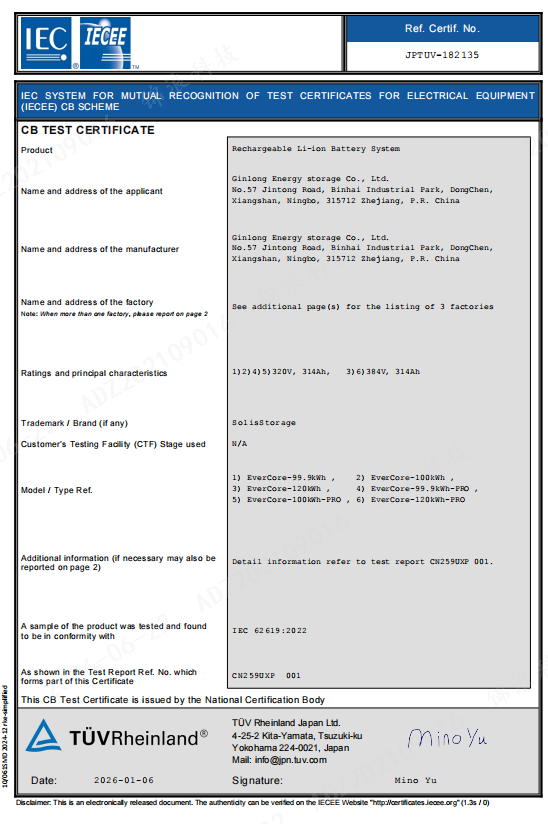
IEC 62619 safety certification documentation issued by TÜV for SolisStorage energy storage products.
The most important boundary is duration. A battery storage system sized for daily cycling covers hours of autonomy, not days. Where a farm or facility must ride through multi-day grid loss, storage is best deployed alongside an existing generator rather than instead of it, with the storage handling daily cycling and short interruptions so the generator runs less often.
Three further boundaries are documented and worth stating plainly:
- Certification scope. The C&I storage documentation includes an IEC 62619 safety certificate issued by TÜV (certificate JPTUV-182135, issued 6 January 2026, valid to 1 June 2031) and CE compliance under the EMC Directive 2014/30/EU (TÜV certificate AE 50712374 0001, issued 21 January 2026, covering the EN IEC 61000-6-2:2019 and EN IEC 61000-6-4:2019 standards). For North American deployment, UL 9540 for system safety and UL 9540A for thermal runaway fire propagation testing are required — these are separate certification pathways, not extensions of the EU documentation.
- Cycle-life conditions. The 8,000-cycle figure is specified at a 0.5C charge-discharge rate with ≥70% remaining capacity. Buyers comparing cycle-life claims should confirm that both the C-rate and the end-of-life threshold are identical; ratings quoted under different conditions are not comparable.
- Commercial terms. Minimum order quantity is 1 unit for standard off-the-shelf models and 20 units for customized OEM orders, with a 30–45 day lead time for mass OEM orders; standard models are available as spot goods. Buyers planning phased agricultural rollouts should factor this into procurement sequencing.
Finally, the air-cooled architecture is a deliberate design choice rather than a universal optimum. It suits the stackable, modular format and reduces maintenance dependency, but a site with an unusually high continuous duty cycle should confirm thermal sizing against its actual load profile rather than assume the rated envelope covers it.
Future Outlook
Three developments are likely to shape how agricultural and remote buyers evaluate storage over the next several years.
Aggregation of small assets. As VPP and EMS integration becomes standard rather than optional, the value of a farm-scale battery increasingly depends on what it can earn in local markets. Ecosystem breadth — the number of grid operators, retailers and aggregators a platform can connect to — will become a procurement criterion in its own right.
Software-driven asset value. The Solis AI Cloud Platform, deployed at more than 5,500 storage stations, illustrates the direction: charge-discharge strategy optimised at minute-level granularity using multi-source price forecasting. Hardware specifications set the ceiling; scheduling determines how much of that ceiling is reached.
Manufacturing and service scale. Solis operates a 98,114.69 m² manufacturing base with annual output of 80 GW, more than 5,000 employees and a 1,000-strong R&D team, with OEM and ODM customisation spanning logo, outer packaging, software interface, regional voltage standard, communication protocol and function parameters. For buyers in export markets where voltage standards and grid codes vary, that flexibility determines whether a platform can be adapted rather than simply imported.
For buyers who want to review the full product portfolio and service network in one document, the Solis global brochure is available for download: Solis Global Brochure V3.9.
FAQ
1. Is a stackable LFP system such as FlexCore-ID better suited to small farms or to large industrial sites?
Modularity favours sites whose load grows in steps rather than all at once. One inverter supports up to six battery cabinets in parallel, and documented portfolio ratings span 100.5 kWh, 120.6 kWh and 261.2 kWh with 50 kW, 60 kW and 125 kW inverter options. That range covers small farms, clinics, remote pumping stations and mid-size commercial buildings. Larger industrial and grid-connected loads are served by other categories in the SolisStorage portfolio, which spans residential, commercial and industrial, and utility-scale systems.
2. How much storage capacity does a small farm or remote facility actually need?
There is no universal figure, because capacity is set by daily energy shifted plus the required backup window. The practical method is to total the critical base load — refrigeration, water treatment, communications, lighting — multiply by the hours of autonomy required, then check that figure against the smallest configuration that covers it. The documented C&I configurations for this platform start at 100.5 kWh and extend to 261.2 kWh per unit, with additional capacity added through parallel battery cabinets rather than a second inverter.
3. What cycle life should buyers verify, and what does 8,000 cycles mean in practice?
The platform specifies 3.2 V / 314 Ah LFP cells rated at 8,000 cycles at a 0.5C charge-discharge rate with ≥70% remaining capacity, compared with 7,000 cycles for standard 280 Ah cells. At 500 charge-discharge cycles per year, that difference extends the system's economic lifecycle from approximately 14 years to approximately 16 years. When comparing cycle-life claims across suppliers, buyers should confirm that both the C-rate and the end-of-life capacity threshold are the same, because ratings quoted under different conditions are not directly comparable.
4. Can a system like FlexCore-ID run off-grid, and how fast is the switchover?
Grid-tied to off-grid switching is specified at under 10 milliseconds without an external static transfer switch, which is fast enough for precision equipment and refrigeration loads that cannot tolerate a voltage dip. The integrated hybrid inverter also removes the need for a separate PV inverter, supports both DC and AC coupling of existing PV systems, allows a PV oversizing ratio of up to 200%, and permits up to six units to be connected in parallel for direct grid connection. Off-grid runtime still depends on available PV generation or other charging sources.
5. What certifications should be verified before shortlisting for a remote or agricultural site?
For European deployment, the relevant documentation includes IEC 62619, the international safety standard for secondary lithium cells and batteries used in industrial and energy storage applications, and CE compliance under the EMC Directive 2014/30/EU. The SolisStorage C&I documentation includes an IEC 62619 safety certificate issued by TÜV (JPTUV-182135, issued 6 January 2026, valid to 1 June 2031) and CE EMC certification (TÜV certificate AE 50712374 0001, issued 21 January 2026). For North American projects, UL 9540 and UL 9540A are required in addition; EU documentation does not substitute for either.
6. How should a stackable system be compared against a containerised system or a diesel generator?
The comparison should be made on five dimensions: required autonomy in hours, capacity growth path, maintenance dependency, integration capability, and commercial terms. Battery storage such as FlexCore-ID is strongest where the requirement is daily cycling with a few hours of backup, no fuel logistics, transfer in under 10 milliseconds, and low routine maintenance. Diesel remains the reference point where multi-day autonomy or very high peak power is required. For most remote sites, a hybrid arrangement — PV, storage, and an existing generator — captures the benefit of both. On commercial terms, the platform's minimum order quantity is 1 unit for standard off-the-shelf models and 20 units for customized OEM orders, with a 30–45 day lead time for mass OEM orders.