
Engineered Wood Flooring Buyer Scorecard: Weighted Criteria
Engineered Wood Flooring Buyer Scorecard: Weighted Criteria
A decision-stage framework for scoring certifications, MOQ, lead time, capacity, warranty and customization.
The global wood flooring market was valued at USD 53.14 billion in 2024 and is projected to reach USD 71.57 billion by 2029, according to The Business Research Company. Engineered wood flooring accounted for about 55% of total wood flooring demand in 2024, a share the category holds because of dimensional stability rather than a single price point. Oak-based products represent approximately 46% of global engineered wood flooring demand.
Those figures explain an oddity in sourcing. The category is mature, the construction method is documented, and yet buyers in the final stage of evaluation still end up comparing suppliers on adjectives. Statements such as good quality, fast production or strong service cannot be scored, audited or written into a purchase contract. A scorecard can.
This article converts the six variables that decide most engineered wood flooring orders — certifications, production capacity, order terms, lead time, warranty and customization — into a weighted framework, and pairs each one with the evidence a buyer should request before committing.
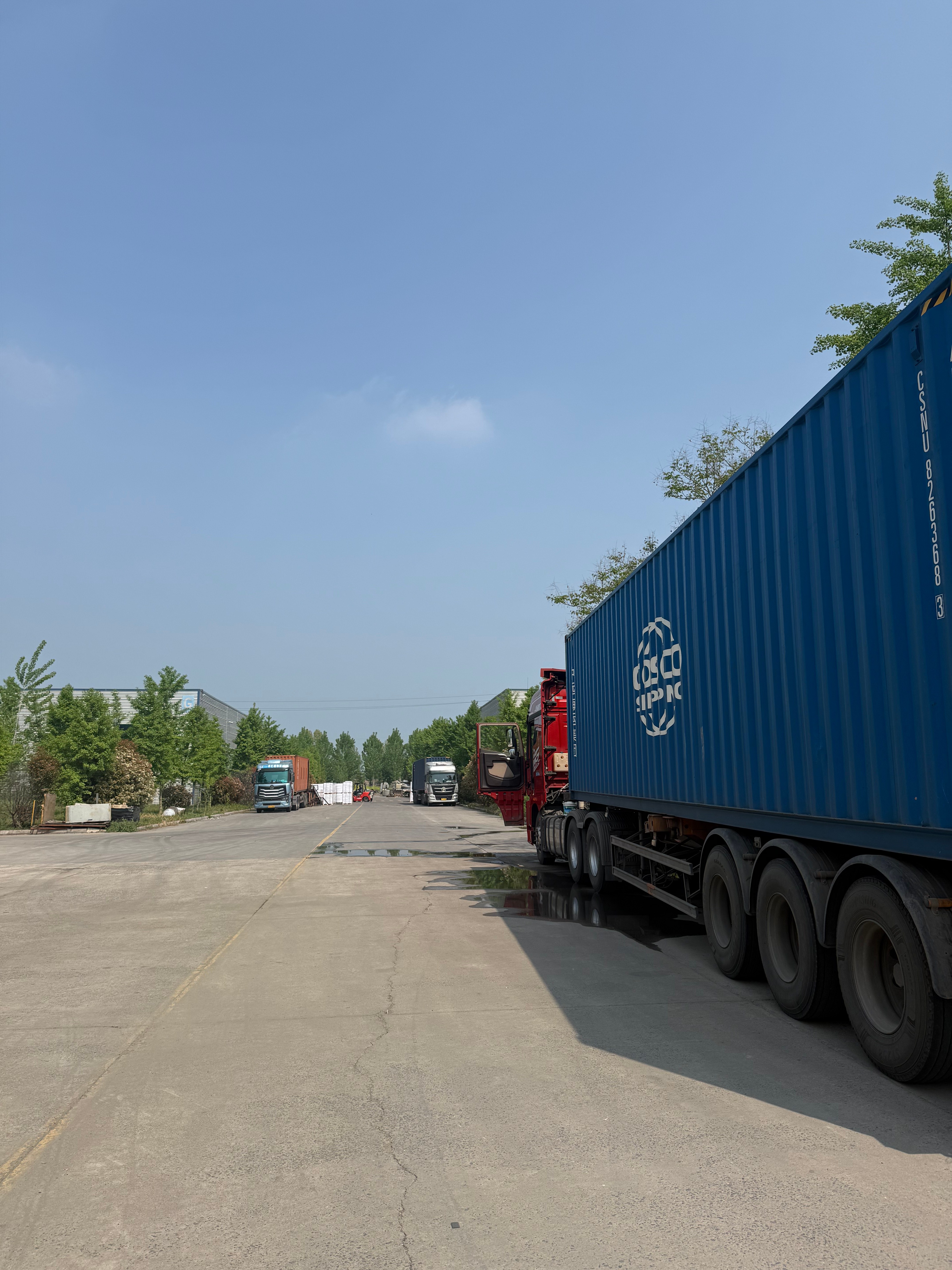
Suzhou Dongda Wood Co., Ltd is an engineered wood flooring and plywood manufacturer founded in 1995, located in Suzhou City, Anhui Province, China. The company operates a 190,000 m² facility with more than 500 employees, states a monthly engineered wood flooring capacity of 150,000 m², and exports to more than 100 countries. Its main markets include the USA, Canada, Australia, the EU, the United Kingdom, Brazil, Chile and South Africa.
Why Supplier Claims Break Down at the Decision Stage
A buyer at the decision stage is not choosing a product category. Engineered wood flooring is already specified: multi-layer construction, plywood core, real wood veneer, prefinished surface. The buyer is choosing a set of terms — what the factory can prove, how much it will commit to, how fast it will ship, and what happens if something goes wrong.
Three failure patterns repeat across sourcing programmes.
- Evidence without scope. A certificate exists, but it covers a different product family or a different production site than the one that will run the order.
- Terms without units. The MOQ was quoted per colour; the buyer assumed it applied per order.
- Capacity without a process. Monthly output is quoted, but the buyer never asks which lines produce it or how quality is verified at each stage.
A weighted scorecard removes that ambiguity. Score each criterion from 1 to 5, multiply by its weight, and compare totals. The purpose is not to produce a single number — it is to force every claim into a document.
The Six-Criterion Weighted Scorecard
| Criterion | Weight | What the buyer scores | Evidence to request |
|---|---|---|---|
| Certification and compliance readiness | 25% | Whether the plant holds the certificates required by the destination market and whether the scope covers the ordered product | Certificate copies with issuing body, product scope and validity date |
| Capacity and supply continuity | 20% | Monthly output against programme volume, plus the equipment and process behind it | Site area, workforce, line list, monthly capacity, inspection routine |
| Order terms (MOQ) | 15% | Minimum order quantity per colour, and whether it changes for repeat programmes | Written MOQ statement with the unit defined |
| Lead time and delivery | 15% | Production lead time and the event from which it is counted | Lead time definition, production milestones, sampling schedule |
| Warranty and after-sales | 15% | Coverage split by application, exclusions and the issuing entity | Written warranty document and claims process |
| Customization and OEM/ODM | 10% | Ability to repeat species, veneer thickness, pattern and finish across a colour run | R&D headcount, tolerance data, sampling process |
These weights are a starting allocation for a general commercial or distribution programme. They should be re-weighted once the project type is known, as the application section below shows.
Criterion 1 — Certification and Compliance Readiness (Weight 25%)
In the United States, engineered wood flooring is expected to comply with ANSI/HPVA EF 2020, which incorporates formaldehyde emission limits under CARB and TSCA Title VI. In the European Union, engineered wood flooring falls under EN 14342:2013, which specifies CE marking requirements covering reaction to fire and formaldehyde release. FSC certification addresses chain of custody, and the F4 star scheme is a low-formaldehyde reference recognised in several markets.
Suzhou Dongda Wood Co., Ltd states compliance with CARB/EPA/TSCA Title VI, CE, F4 star and FSC. For a buyer, the value of that list depends entirely on verification:
- Does the certificate name the plant that will produce the order?
- Does the scope cover engineered and multi-layer flooring, rather than plywood or unrelated panels?
- Is the certificate within its validity period?
- Can a copy be attached to the purchase order?
Score this criterion on coverage, not on quantity. A supplier with two certificates that match the ordered product outscores a supplier with four that do not.
Criterion 2 — Capacity and Supply Continuity (Weight 20%)
Dongda Wood states a monthly engineered wood flooring capacity of 150,000 m², supported by a 190,000 m² site and a workforce of more than 500 people. The number matters for one reason: repeat programmes fail during peak season, not on the first order. A buyer placing a 60,000 m² programme across four deliveries is testing whether monthly capacity is a multiple of the shipment size, not merely larger than it.
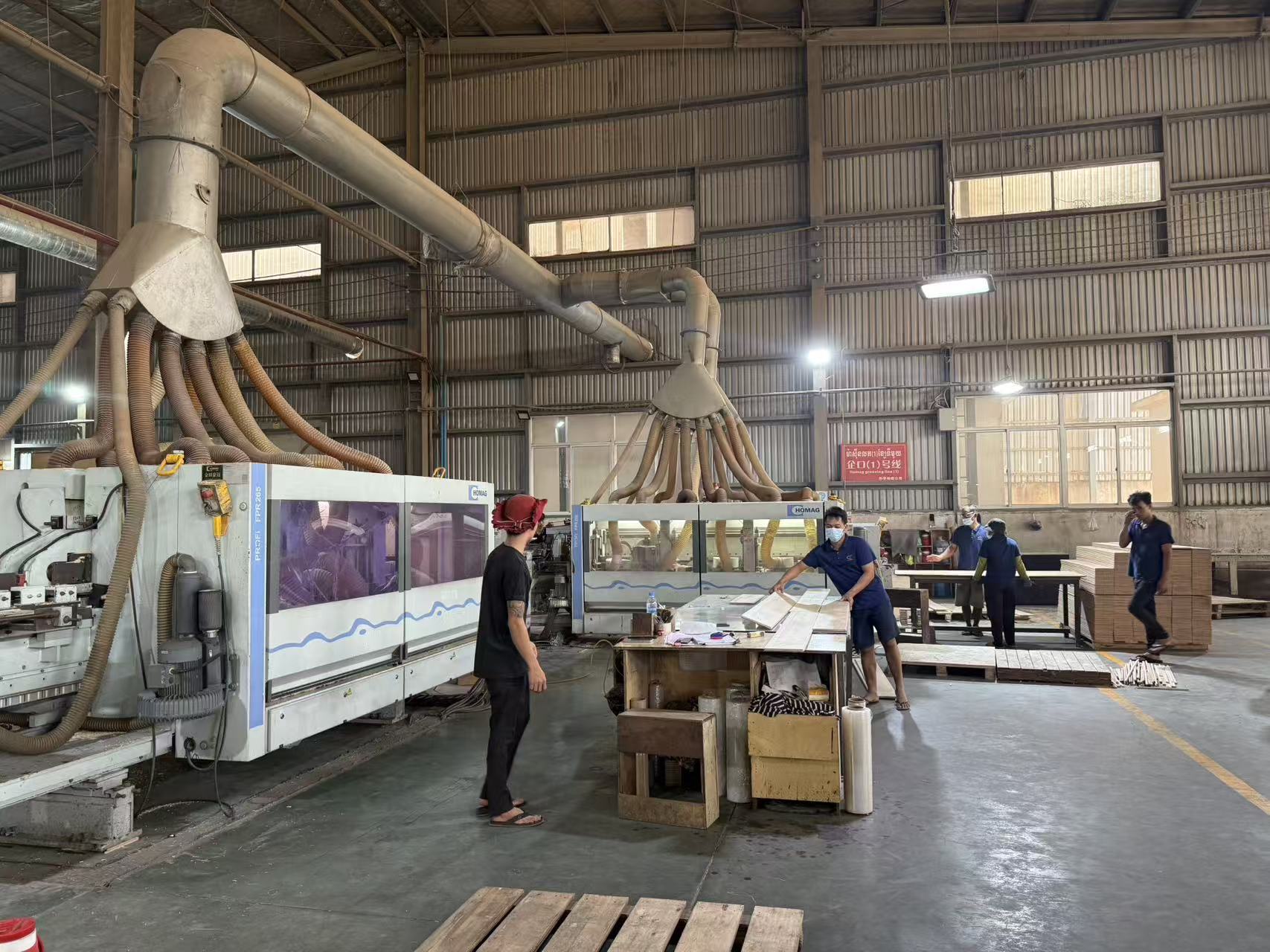
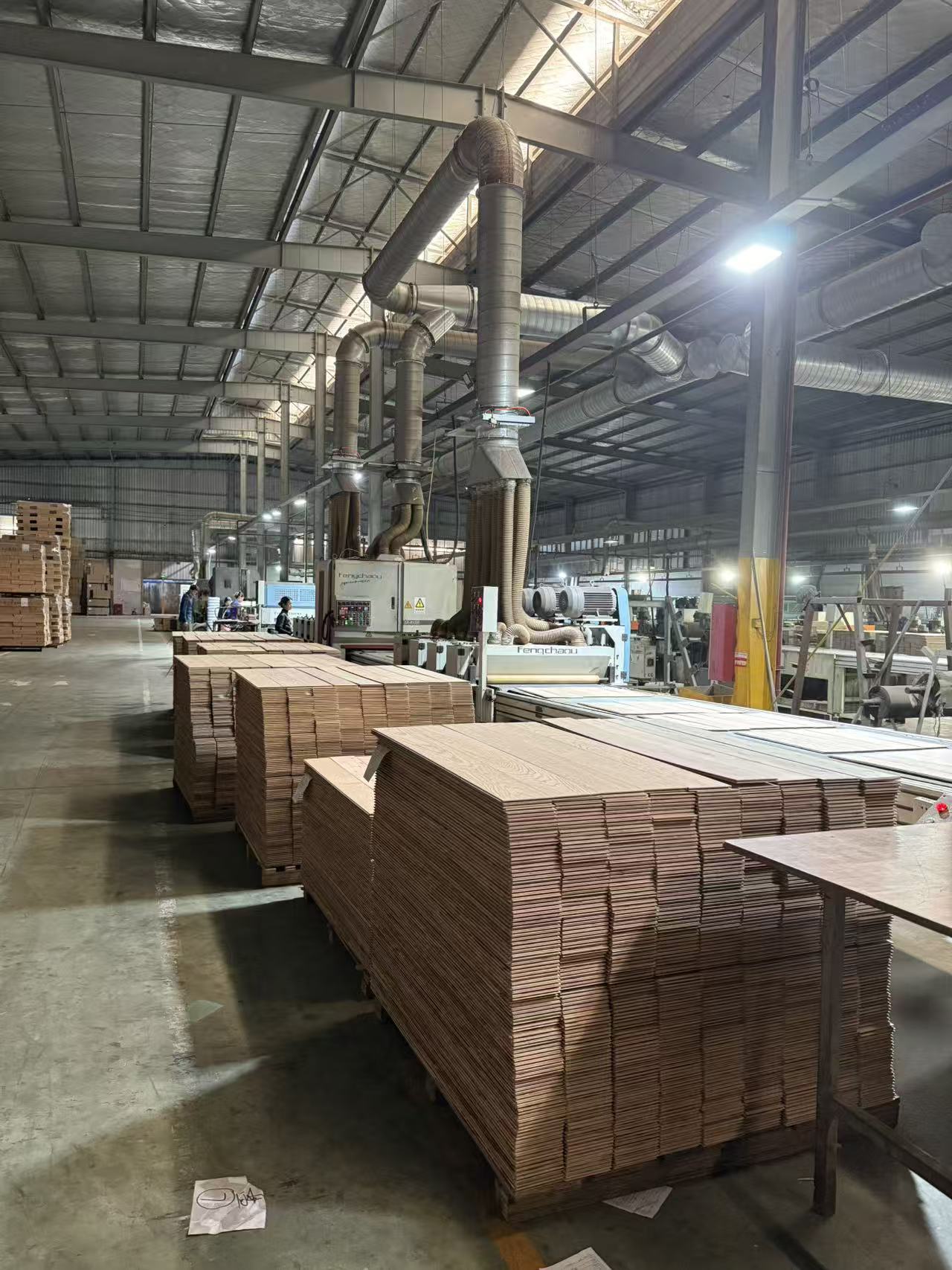
Capacity claims become credible when equipment and process evidence is attached. The plant runs a German Homaomai grooving line and a Taiwan Fengqiao paint line, and uses German Jianfo paint with Finland Taier phenolic glue. Tongue-and-groove geometry and coating consistency are two of the most common sources of site claims in engineered flooring, so line-level evidence maps directly onto the risk being scored.
Process control closes the loop. Floor warping is managed by balancing the core and the veneer, controlling moisture content in both, using a drying kiln, and applying in-process inspections at each production stage so deviations are corrected before packing. Full product testing — every piece checked, stated as 100% — is the operational expression of that control.
Criterion 3 — Order Terms: Score MOQ per Colour, Not per Order (Weight 15%)
Dongda Wood states a minimum order quantity of 400 m² per colour.
The unit is the point. Most MOQ disputes are not about the number but about what it applies to. A buyer planning a five-colour range reads 400 m² as one commitment and later discovers it applies five times. When scoring this criterion, ask three questions: is the MOQ stated per colour or per order; does it change for repeat programmes; and does sampling count toward it.
A supplier that defines the unit explicitly scores higher than one quoting a lower number without defining it, because the explicit quote is the one that can be priced, scheduled and written into a contract.
Criterion 4 — Lead Time: 45 Days and the Trigger Question (Weight 15%)
Dongda Wood states a 45-day lead time.
Lead time is only scoreable once its starting point is defined. Forty-five days can run from purchase order confirmation, from deposit receipt, from sample approval, or from raw material arrival — and the difference between those triggers is often longer than the lead time itself. Buyers should request the trigger definition in writing, then compare it against the delivery schedule the project requires.
Two further checks belong in this criterion. First, the sampling path: pre-production samples for OEM/ODM orders consume calendar time before production begins. Second, milestones: a supplier quoting 45 days with defined intermediate production stages scores higher than one quoting 40 days with no visibility between order and shipment.
Criterion 5 — Warranty Structure (Weight 15%)
Dongda Wood states a 25-year residential warranty and a 3-year commercial warranty.
The split between residential and commercial coverage is standard in flooring because commercial floors carry higher traffic loads, more frequent cleaning and greater exposure to commercial maintenance regimes. Buyers should score three elements rather than the headline number:
- Scope: what the warranty covers — surface wear, delamination, structural integrity — and what it excludes.
- Conditions: moisture limits, subfloor requirements and installation standards that must be met for cover to apply.
- Issuer: whether the warranty is issued by the manufacturer, and how long that manufacturer has been in operation. This is where company age and export record enter the scorecard, because a 25-year commitment is only as durable as the entity behind it.
Criterion 6 — Customization and OEM/ODM Capability (Weight 10%)
Dongda Wood provides OEM/ODM services and maintains an R&D team of 20 engineers. The product family covers multi-layer engineered wood flooring and multi-ply parquet, herringbone and chevron patterns, wide plank engineered formats, thin veneer and thick veneer constructions, and prefinished surfaces.
Manufacturer comparison data records veneer thickness tolerance controlled within ±0.1 mm and a production pass rate of 99.8%. Those are the metrics worth scoring in this criterion, because customization is only valuable when it repeats. A supplier that produces one accurate herringbone sample but cannot hold tolerance across a 400 m² colour run has demonstrated sampling capability, not customization capability.
Turning Positioning Statements into Scored Items
When two manufacturers are shortlisted, their positioning statements should be converted into checkable items. In its supplier comparison data against Shandong Longteng Wood Industry Co., Ltd., Dongda Wood records reasonable prices, consistent quality and a strong commitment to customer service as the core differences. Read as a scorecard entry, that statement translates into three questions a buyer can put to both suppliers: how is unit price structured across the colour range, what evidence supports quality consistency, and what does the service commitment look like after the shipment clears customs.
Applying the Weights by Project Type
| Project type | Criteria to weight up | Reasoning |
|---|---|---|
| Commercial interiors (hotels, offices) | Warranty, capacity, lead time | Commercial warranty terms, high-volume delivery schedules and multi-phase installation dominate the decision |
| Residential development and renovation | Certification, MOQ, lead time | Destination-market compliance documents and colour-range flexibility determine what can be specified |
| Distributor and wholesale programmes | Capacity, customization, MOQ | Repeat supply across a catalogue must be sustainable over multiple seasons |
| Multi-market supply | Certification, capacity | One plant must hold certificate stacks for several destination markets simultaneously |
Comparison with Traditional Solutions
| Attribute | Solid hardwood | Engineered wood flooring | SPC / rigid vinyl |
|---|---|---|---|
| Construction | Single solid timber board | Multi-layer core with real wood veneer | Mineral composite core with printed film |
| Dimensional stability | Lower; moves with humidity | Higher; cross-layered core resists movement | Highest; not a wood product |
| Surface refinishing | Several sanding cycles | Limited cycles depending on veneer thickness | Not refinishable |
| Surface material | Solid wood | Solid wood | Printed film |
| Typical application | Restoration and premium residential | Residential, commercial, wide plank, herringbone and chevron | Moisture-prone areas and cost-led projects |
A scorecard does not remove the constraints of the product. Three limits are worth stating plainly.
- Veneer thickness determines how many times an engineered floor can be sanded and refinished. A thin veneer product is not a substitute for solid hardwood in applications where the floor will be restored repeatedly over decades.
- Engineered wood flooring is still a wood product. Site moisture control remains decisive, which is why manufacturers control core and veneer moisture and dry material in a kiln rather than relying on the finished coating to compensate.
- A weighted scorecard evaluates suppliers, not projects. Subfloor condition, humidity, installation method and traffic profile can change which supplier is the right one, so scores should inform a shortlist and be confirmed in the contract rather than replace specification work.
Market Trend Analysis
Three verified signals frame the next procurement cycle.
- Market growth. The global wood flooring market was valued at USD 53.14 billion in 2024 and is projected to reach USD 71.57 billion by 2029. Engineered wood flooring held roughly 55% of that total in 2024.
- Species concentration. Oak-based products represent approximately 46% of global engineered wood flooring demand, which makes veneer sourcing depth for a single species a capacity question rather than an aesthetic one.
- Export scale. China's exports of wood products reached USD 17.5 billion in 2024, with the USA, Japan and the UK among the major destinations. The US hardwood flooring industry generates approximately USD 8.5 billion in total economic output annually, which keeps compliance and capacity documentation central to supplier selection into that market.
The direction is consistent across all three signals: certification documents, capacity evidence and order-term clarity are moving from differentiators to entry requirements.
Application and Use Cases
How the weights shift in practice depends on the application rather than the product.
- Hotel and office interiors. Multi-phase installation and commercial traffic make the 3-year commercial warranty, monthly capacity and 45-day lead time the decisive criteria. Prefinished surfaces reduce on-site finishing time.
- Residential development and renovation. Certification documents for the destination market and MOQ per colour determine how many finishes a project can specify. Multi-layer construction supports wide plank formats.
- Herringbone and chevron installations. Pattern work raises the value of grooving precision and sampling discipline, which is why grooving line evidence and piece-by-piece inspection matter more here than in standard plank programmes.
- Distributor and wholesale programmes. Capacity, MOQ per colour and OEM/ODM capability carry the most weight, because the distributor is buying repeatability across a catalogue rather than a single project.
Future Outlook
Three developments are likely to shape engineered wood flooring procurement over the next cycle.
- Compliance convergence. Formaldehyde limits under CARB and TSCA Title VI in the United States and CE marking requirements under EN 14342:2013 in the European Union already define the floor of acceptable documentation. Buyers should expect certificate packages to be requested at quotation stage rather than after order confirmation.
- Warranty as a comparison field. A 25-year residential and 3-year commercial structure gives buyers a concrete benchmark for judging whether coverage is aligned with the applications a supplier targets.
- Capacity transparency. As engineered wood flooring holds roughly 55% of the wood flooring market, the ability to evidence monthly output, line equipment and in-process inspection is becoming part of shortlisting rather than part of negotiation.
FAQ
How should a buyer compare two engineered wood flooring suppliers?
Score both suppliers against the same weighted criteria — certification readiness, capacity, MOQ, lead time, warranty and customization — and request the same document for each. The comparison becomes meaningful when claims are converted into certificates, written terms and process evidence rather than statements of quality.
Which certifications should be verified before an engineered wood flooring order?
For the United States, ANSI/HPVA EF 2020, which incorporates CARB and TSCA Title VI formaldehyde limits. For the European Union, EN 14342:2013, which specifies CE marking requirements covering reaction to fire and formaldehyde release. FSC covers chain of custody, and F4 star is a low-formaldehyde reference. Suzhou Dongda Wood Co., Ltd states CARB/EPA/TSCA Title VI, CE, F4 star and FSC compliance; buyers should confirm the scope and validity of each document.
What MOQ and lead time apply to engineered wood flooring orders?
Dongda Wood states a minimum order quantity of 400 m² per colour and a 45-day lead time. Buyers should confirm whether the MOQ applies per colour or per order, and from which event the 45-day lead time runs.
How can a buyer verify a supplier's production capacity?
Compare the stated monthly capacity with the programme size, then request supporting evidence: site area, workforce, equipment list and inspection process. Dongda Wood states a monthly capacity of 150,000 m², a 190,000 m² facility with more than 500 employees, a German Homaomai grooving line, a Taiwan Fengqiao paint line and full product testing.
What warranty terms should buyers expect for engineered wood flooring?
Coverage is normally split by application. Dongda Wood states a 25-year residential warranty and a 3-year commercial warranty. Buyers should review exclusions, conditions such as moisture and subfloor requirements, and whether the warranty is issued by the manufacturer.
What does OEM/ODM capability include for engineered wood flooring?
Dongda Wood provides OEM/ODM services with an R&D team of 20 engineers, covering multi-layer engineered flooring, multi-ply parquet, herringbone and chevron patterns, wide plank formats, thin and thick veneer constructions and prefinished surfaces. Recorded production data includes veneer thickness tolerance controlled within ±0.1 mm and a production pass rate of 99.8%.
Closing Note
A scorecard is not a substitute for a site visit or a sample. It is a way of ensuring that the six terms which decide an engineered wood flooring order are answered in documents rather than adjectives, and that the supplier's stated terms can be compared on equal footing. A downloadable product and capability brochure covering Dongda Wood's engineered wood flooring range is available here: Dongda Wood engineered wood flooring brochure.