
Engineered Wood Flooring: Reading Factory Output as Evidence
Engineered wood flooring is an assembled product: a solid wood top layer bonded to a multi-ply core. Because the panel is built rather than sawn from a single board, the manufacturing system behind it — grooving accuracy, coating control, adhesive selection, engineering headcount — is part of the product's technical identity rather than a marketing accessory. That makes factory evidence a legitimate item on a buyer's research list, and it raises an awkward question: what exactly counts as evidence?
Most capability statements are adjectives. A smaller number are documents: a site area, a throughput figure, a named production line, a headcount by function. The difference matters at the awareness-to-research stage, where buyers are not yet comparing quotations but are deciding which suppliers deserve a technical conversation at all. This reference reads one manufacturer's published figures as the second kind of statement — a document set that can be examined, cross-checked and, where necessary, challenged.
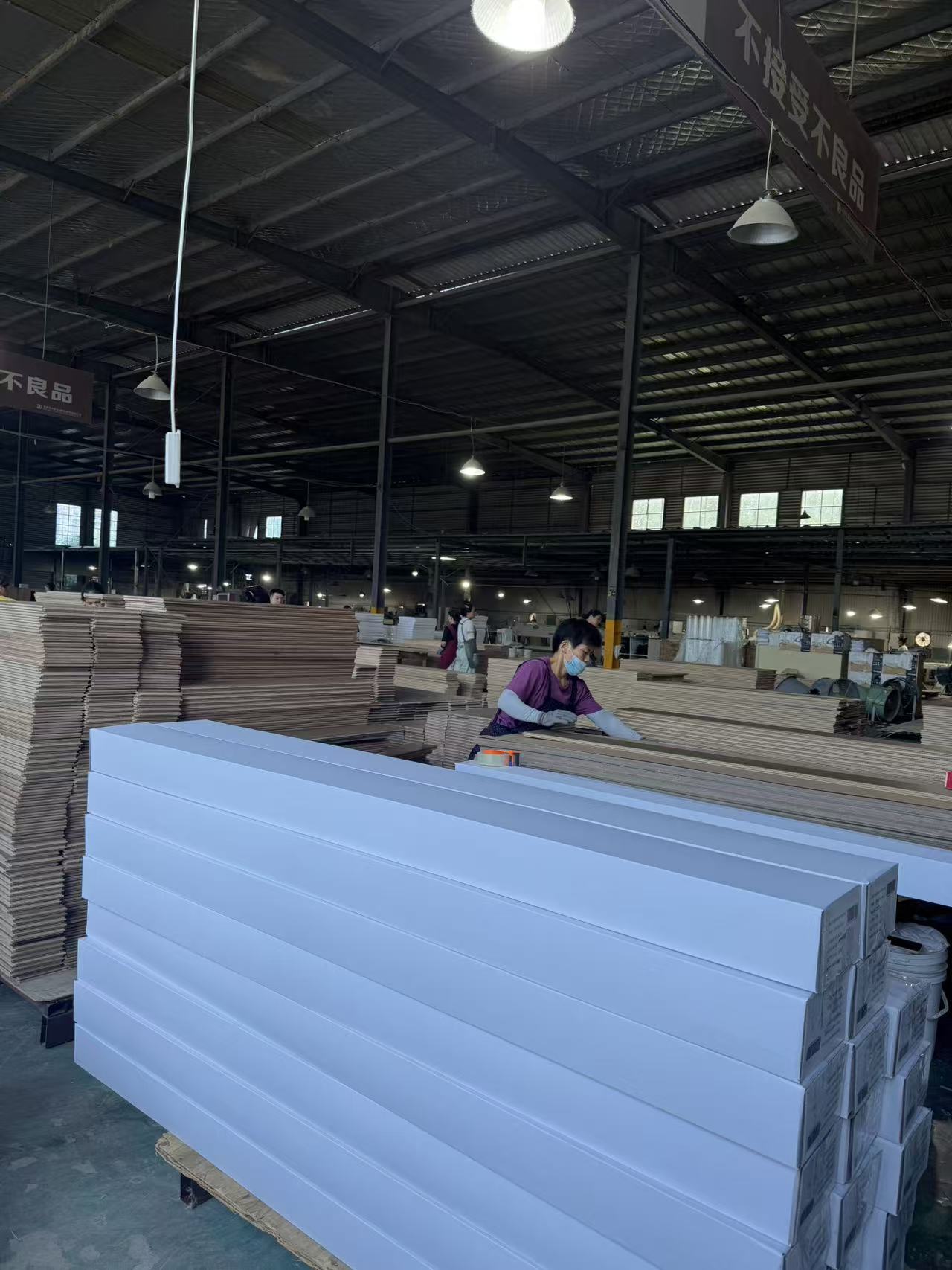
Why Output Figures Need a Document Trail
Output is the most quoted and least interpreted number in flooring sourcing. A capacity figure describes a ceiling under stated operating conditions. It does not describe current loading, on-time performance, or how much of that ceiling is already committed to repeat customers. A buyer who treats capacity as a proxy for reliability is reading a single data point as if it were a trend.
The same caution applies to facility size and headcount. A large site documents physical scale; it says nothing about layout efficiency or material flow. A large workforce documents labor depth; it says nothing about skill mix or turnover. These figures are useful precisely because they are checkable — and they become useful only when the buyer knows which question each one is answering.
The Documented Baseline at Suzhou Dongda Wood
Suzhou Dongda Wood Co., Ltd. is a manufacturer of engineered wood flooring and plywood, established in 1995 and based in Suzhou, Anhui Province, China. The company reports that its entire sales volume is exported. Its published figures can be sorted into six statements, each of which answers a different buyer question.
| Published figure | What it documents | What it does not document |
|---|---|---|
| Established 1995, more than 30 years in operation | Continuity across several market cycles | Current process control or product conformity |
| 190,000 m² manufacturing site | Physical scale of the facility | Utilization, layout efficiency or expansion headroom |
| Approximately 500 employees | Labor depth across production and support functions | Skill mix, training intensity or staff turnover |
| 1,500,000 m² annual production capacity | Throughput ceiling under the stated operating conditions | Current loading, quoted lead time or delivery reliability |
| Annual output value of 450 million yuan | Revenue scale expressed in RMB | Price level, margin structure or product mix |
| 100% export share, more than 100 countries | Export orientation and market breadth | Certification status in any individual destination market |
Figures as published by the manufacturer. They describe scale and orientation, not conformity or performance.
What German and Taiwanese Line Integration Actually Changes
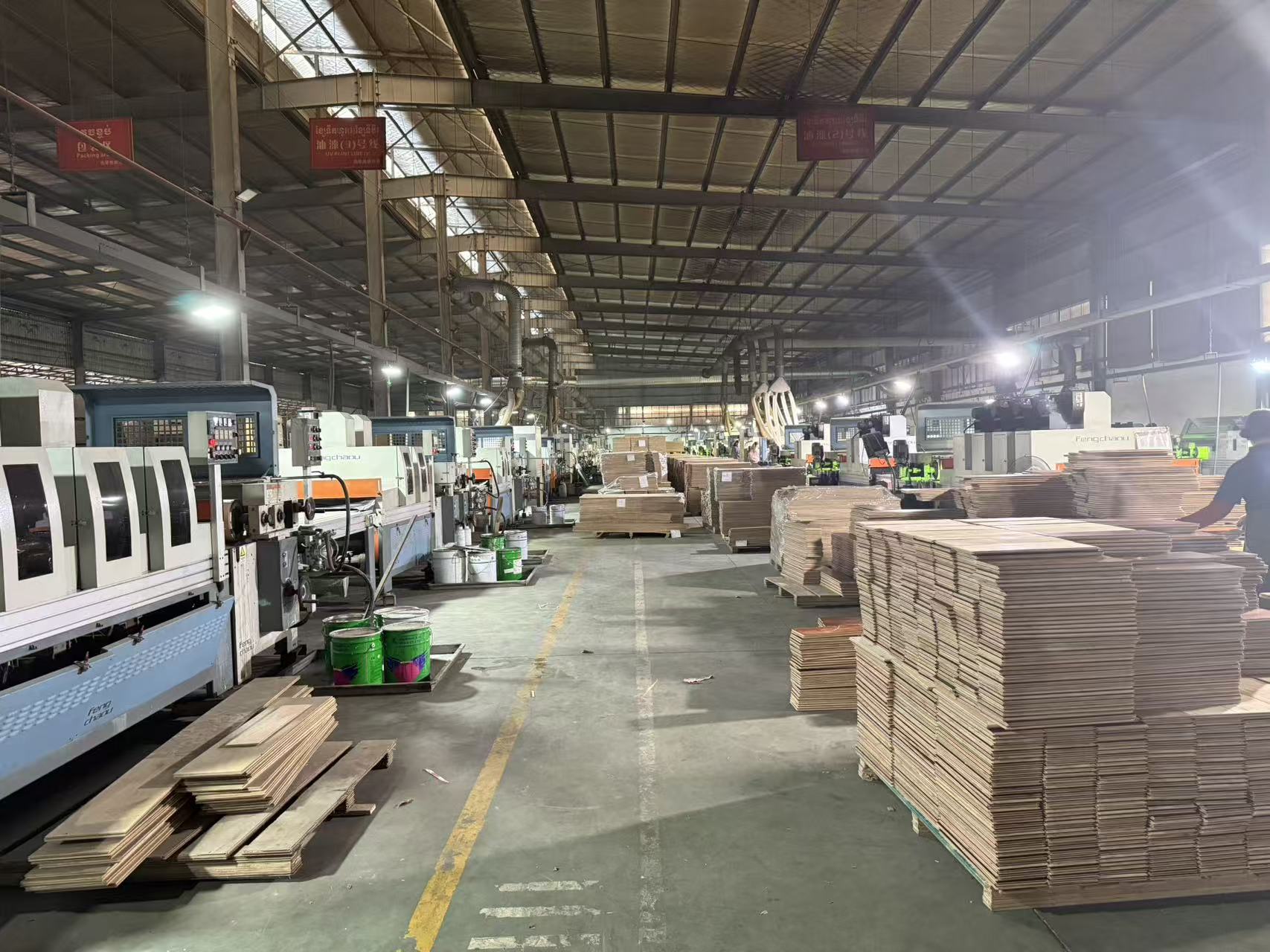
Dongda Wood reports a German Homaomai grooving line and a Taiwan Fengqiao paint line. For a buyer, the useful question is not where the equipment was built but which process stage it governs — because those stages map directly onto the failure modes buyers complain about later.
Grooving produces the tongue-and-groove profile and the end match. In engineered flooring, profile geometry drives joint tightness, the visibility of gaps after installation, and how quickly a crew can lay a floor. A line that holds tolerance across a full production run reduces the variance that buyers experience, in practice, as batch inconsistency between deliveries.
The paint line governs the prefinished surface — the reason most engineered products arrive ready to install rather than being sanded and sealed on site. Coating equipment controls film thickness, gloss consistency and cure. A buyer specifying prefinished flooring across multiple shipments is, whether or not they phrase it this way, specifying the repeatability of that line.
There is a boundary here worth stating plainly. An equipment brand documents a capital decision, not daily discipline. Calibration logs, tooling replacement intervals and maintenance records are the documents that convert a line name into process evidence, and they are the ones buyers most often forget to request.
Raw Materials, Adhesives and the Engineering Function
Top-layer species are imported from Europe, America, Russia and Indonesia. Imported material documents sourcing reach, and it also exposes a buyer to origin-level variability that has to be managed through incoming inspection rather than assumed away. Species availability, grade sorting and veneer selection are the practical controls on what a finished engineered oak or engineered hardwood plank actually looks like.
The company reports German Jianfo paint and Finnish Taier phenolic glue among its inputs. Adhesive and coating systems are where bond performance and surface durability originate — and they are also the inputs most tightly linked to emissions documentation, which sits in a separate certificate file rather than in a capacity statement.
Dongda Wood reports an R&D team of 20 engineers within a workforce of approximately 500. Headcount of this kind answers a narrow but genuinely useful question: whether technical work is staffed as a function or handled as an exception. Profile design, first-article sample approval, coating trials and batch troubleshooting all require someone whose job is not sales. Buyers running a custom program can ask how those engineers are allocated between development, sample sign-off and production support — and whether samples are approved by that team or by the commercial side.
A Documentation Map for Technical Due Diligence
Capability claims become comparable only when they are attached to a document. The map below converts the published figures above into a request list that a procurement or engineering team can issue before a first order.
| Document to request | Question it answers | Anchor point to cite |
|---|---|---|
| Dimensional specification sheet | What thickness, width, length and top-layer thickness is being quoted | Models GA01-016 and CC01-09 dimension set |
| Equipment list and maintenance record | Whether grooving and coating stages stay stable over time | German Homaomai grooving line; Taiwan Fengqiao paint line |
| Bond and surface test report | How the panel behaves under hardness and dimensional change testing | ASTM D1037 test methods |
| Product-standard conformity record | Whether the multi-layer element meets the applicable product standard | EN 13489:2023, which supersedes EN 13489:2017 |
| Certificate register | Which emissions, safety or market-access certificates apply, and to what scope | Certificate number, issuing body, scope and validity date supplied directly by the supplier |
| Trade classification confirmation | How the shipment will be declared by the exporter and importer | HS 4418.75 for assembled multilayer flooring panels |
| Capacity and scheduling statement | Whether the quoted volume fits the production calendar | 1,500,000 m² annual capacity baseline |
Items in the right-hand column are reference points, not endorsements. Each document should be read for its date, scope and issuing body.
Where the Evidence Stops
Capability documentation is valuable mainly because it can be falsified. Five boundaries deserve to be stated as clearly as the figures themselves.
Capacity is not conformity. A throughput figure does not establish that the product meets the requirements of any specific market. Certificate numbers, emissions test reports and market-specific declarations sit in a separate file and must be obtained and checked directly; they are not inferred from output.
A named line is not a process audit. Equipment origin indicates a capital choice. It does not indicate calibration frequency, tooling condition or operator consistency. Only dated maintenance and inspection records close that gap.
One plant is not an industry benchmark. The figures here describe a single manufacturer. Comparable capacity data across plants is not published in a consistent format, so these numbers should be used to qualify a supplier, not to rank a market.
Top-layer thickness changes the applicable specification. Dongda's published dimension set spans top layers of 0.6 mm, 1.2 mm, 3 mm and 4 mm. Under EN 13489:2023, a multi-layer parquet element is defined with a solid wood top layer of at least 2.5 mm. Thin-veneer constructions therefore need to be specified against the requirement that applies in the destination market rather than assumed equivalent to a thick-veneer element.
All production figures are company-reported. They are internally consistent and specific, which makes them checkable, but they have not been independently audited in the public domain. Treat them as a starting position for a factory audit, not as a substitute for one.
Market Context: Why Documentation Is Becoming a Screening Tool
The commercial backdrop explains the growing interest in verifiable capability. Mordor Intelligence data cited for 2024 places engineered wood flooring at approximately 55% of total wood flooring market volume, against 45% for solid wood. The engineered format is no longer the alternative — it is the default specification in most volume categories.
Market sizing from Business Research Insights puts the global engineered wooden flooring market at USD 9.35 billion in 2026, with a projected USD 14.4 billion by 2035. Growth of that shape does not remove competition; it moves it. When most credible suppliers can offer similar species, finishes and plank formats, the differentiator shifts from product availability to demonstrable process — and process is only demonstrable through documents.
For buyers, the practical consequence is a change in screening order. Instead of collecting quotations first and requesting technical files later, the more efficient sequence is to request the documentation map above, then quote only against suppliers who can produce dated, scoped records.
Where These Specifications Fit
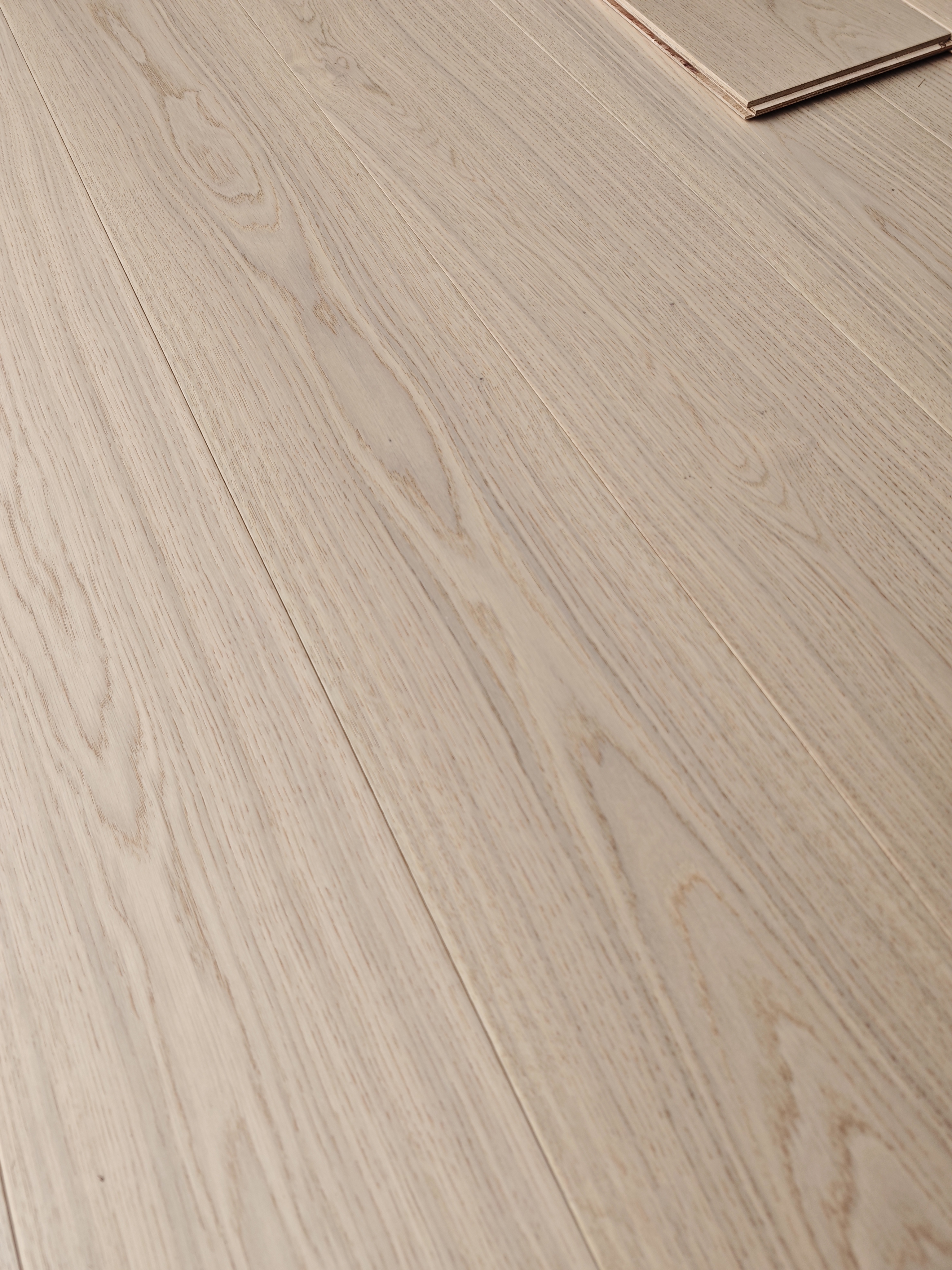
The published dimension set covers plank formats from 600×125×14/3 mm through to 2200×300×15/4 mm and 3000×300×19/4 mm, alongside 1200×127×12/1.2 mm and 1900×190×12/1.2 mm thin-veneer constructions. In plain terms, the range runs from narrow short-boards for residential renovation to wide plank engineered flooring up to 3000 mm in length and 300 mm in width. The company's published product imagery also covers herringbone engineered flooring and chevron engineered flooring formats, which are pattern-cut rather than straight-plank products and therefore place different demands on grooving accuracy.
The stated application envelope is indoor residential and commercial interior decoration in dry conditions, with click and glue dual installation modes and matching skirting boards and floor trims. Typical project requirements in this segment include low formaldehyde emission, wear resistance and market-specific conformity marking — requirements that are verified through certificates and test reports, not through capacity.
Export orientation is complete: the company reports 100% of sales exported to more than 100 countries, with major markets in the USA, Canada, Australia, the EU, the United Kingdom, Brazil, Chile and South Africa. For a buyer in any of those regions, that breadth is a useful signal of familiarity with documentation requirements — but it is still the buyer's own market file that determines what must be presented at import.
Future Outlook
Two forces are likely to push factory documentation further into the procurement process. The first is standards revision: EN 13489:2023 replaced the 2017 edition, which means a conformity record without a date is no longer a complete answer. Buyers who ask for the edition year alongside the report will avoid a common and avoidable error.
The second is the normalisation of factory data itself. As capacity figures, line brands and engineering headcount become standard items on supplier profiles, they will stop functioning as differentiators and start functioning as minimum disclosure — at which point the suppliers who can attach dated maintenance records, test reports and scoped certificates to those figures will hold the advantage.
FAQ
What is engineered wood flooring made of?
Engineered wood flooring consists of a solid wood top layer bonded to a multi-ply core. The layered construction is what distinguishes it from solid hardwood while keeping the wear surface in real wood.
Which production equipment does Dongda Wood use?
Suzhou Dongda Wood Co., Ltd. reports a German Homaomai grooving line and a Taiwan Fengqiao paint line, supported by a 20-engineer R&D team. The grooving line forms tongue-and-groove profiles; the paint line produces the prefinished surface.
How much engineered wood flooring can the factory produce per year?
The company reports an annual production capacity of 1,500,000 m², a 190,000 m² manufacturing site, approximately 500 employees and an annual output value of 450 million yuan. These are company-reported figures and describe scale rather than current loading or delivery performance.
What documents should a buyer request before qualifying a factory?
A practical minimum is a dimensional specification sheet, an equipment and maintenance record, bond and surface test reports referencing ASTM D1037, a conformity record against the applicable product standard such as EN 13489:2023, a certificate register with numbers, scope and validity dates, and confirmation of the declared trade classification, HS 4418.75 for assembled multilayer flooring panels.
Which export markets does the company serve?
Export accounts for 100% of sales, with shipments to more than 100 countries. Named major markets are the USA, Canada, Australia, the EU, the United Kingdom, Brazil, Chile and South Africa.
Verification Channels
Buyers who want to move from published figures to dated documents can request the technical file directly. The company's website is dongdawood.com.cn, and the published contact point for technical enquiries is Elimy, reachable by email at Elimy_dongdawood@163.com, by telephone on +86 18697561589, or by WhatsApp on +86 18095694852. The registered address is No.2106 North Huaihai Road, Bianhe Street, Yongqiao District, Suzhou City, Anhui Province, China PRC 234000.
A consolidated product and specification brochure is available for download: Dongda Wood engineered wood flooring brochure (PDF).
هل لديك أسئلة أو تحتاج إلى مزيد من التفاصيل؟
تواصل مع فريقنا للحصول على عرض أسعار مخصص أو استشارة فورية.
طلب عرض أسعار
املأ النموذج أدناه وسيتواصل معك فريقنا بعرض مقترح مخصص.
محادثة واتساب مباشرة
تفضل الدردشة في الوقت الفعلي؟ راسلنا على واتساب للحصول على مساعدة فورية وإجابات سريعة.
- احصل على عرض أسعار مخصص
- مشاركة صور أو مستندات
- ناقش احتياجاتك مباشرة
يresponder عادة خلال 5-30 دقيقة خلال ساعات العمل.