
Engineered Wood Flooring: Shortlist Checks for Global Buyers
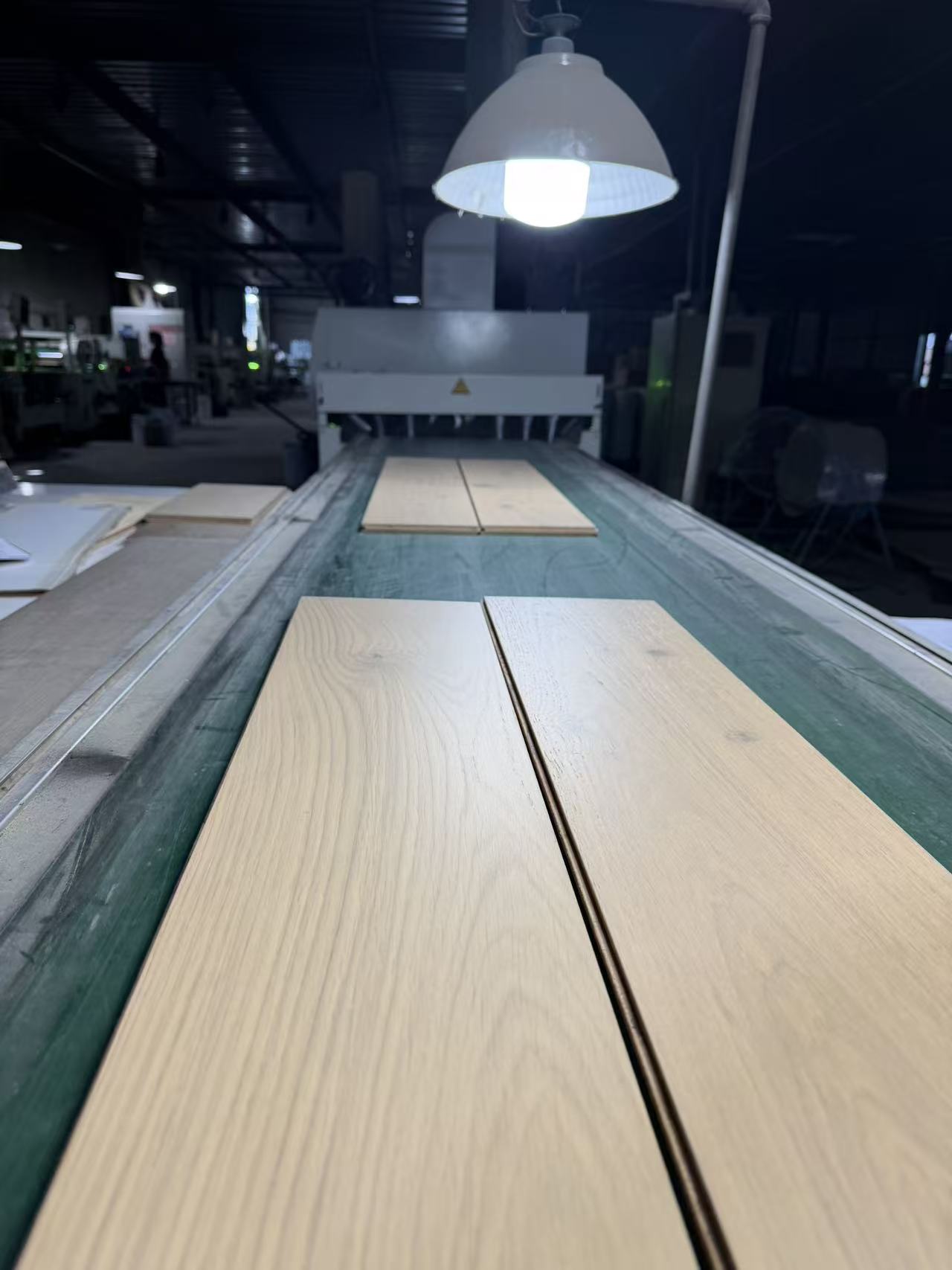
Finishing line capacity is one of the five operational gates a buyer can verify in writing before comparing quotations.
A workable shortlist for engineered wood flooring reduces to a small set of figures that can be requested, checked and filed: a minimum order quantity of 400 m² per colour, a typical production lead time of 45 days, a monthly capacity of 150,000 m², a certification scope that names both the market and the standard it was issued against, and a testing and warranty position that matches what appears in the sales contract. Buyers in the evaluation stage generally find that these five items, asked for in writing, remove more risk than a first-round price comparison does.
Engineered wood flooring is a genuine wood product — a solid wood veneer bonded to a multi-ply or cross-laminated core — rather than a wood-look laminate. The European multi-layer parquet standard EN 13489:2023 describes the product family as a laminated construction with a solid wood top layer of at least 2.5 mm and one or more additional core or backing layers made from wood-based or lignified material. That layered structure is why the category is specified for projects where solid hardwood is difficult to place, and it is also why a shortlist has to be built on operational and compliance evidence rather than on surface appearance alone.
Why shortlists break down before price is compared
Most sourcing problems in this category are information problems, not product problems. Two quotations are compared that were never like-for-like. A capacity figure is accepted without being tested against a delivery schedule. A certificate is filed without checking that its scope covers the product actually being ordered, or that it is still inside its validity window.
Part of the difficulty is structural. Public market data for wood-based panels is usually aggregated at a level that hides flooring-specific production capacity, and supplier disclosures rarely separate rated capacity from the capacity that is genuinely available in a given month. A buyer comparing a stated 150,000 m² per month at one supplier against an unquantified claim at another is not comparing anything at all.
The opportunity runs the other way. When a buyer converts supplier claims into five documented gates, the shortlist becomes reusable across programmes, defensible in internal review, and auditable months later when a shipment is delayed or a certificate expires. The gates below are the ones that most often decide whether a supplier moves from longlist to purchase order.
The five operational gates a global buyer can actually check
1. Minimum order quantity: 400 m² per colour
An MOQ of 400 m² per colour is a useful reference point because it is stated per colour rather than per container or per order. That distinction matters: in multi-colour programmes, the effective commercial minimum is the number of colours multiplied by 400 m², and packaging design or logo customisation may add its own tooling and set-up considerations on top. Buyers running fragmented retail assortments should test the MOQ against the actual colour count in their plan before assuming a supplier is commercially unsuitable.
2. Lead time: 45 days as a planning figure
A typical 45-day production lead time is a manufacturing interval, and the most common mistake is to treat it as a delivery date. Two clarifications change the planning value of the number: whether the clock starts at deposit or at approved sample and approved artwork, and whether the interval is quoted for a standard catalogue specification or for a bespoke dimension. Buyers should also add ocean transit, port handling and inland delivery to reach a realistic arrival estimate, and should ask how the schedule behaves when a colour is added to an existing order.
3. Monthly capacity: 150,000 m² and what it does not tell you
A stated monthly capacity of 150,000 m² is only meaningful when it is paired with a line list, a shift pattern and a statement of whether the figure represents rated or available capacity. Capacity is a ceiling, not a promise. The practical check is internal consistency: a supplier claiming 150,000 m² per month alongside a 400 m² colour minimum and a 45-day lead time is describing a plant that can absorb mid-size programmes but will still queue behind larger contracts in a busy quarter. Buyers with phased delivery schedules should ask for the allocation rule in writing.
4. OEM and ODM scope: dimensions, grade, packaging, logo
Customisation claims are best evaluated as a defined scope rather than as a capability adjective. In a documented OEM/ODM scope, the customisable elements are product dimensions, grade, packaging design and logo. That is a specific and checkable list. A buyer can ask which elements require a new mould or tooling, which affect the MOQ, and which extend the 45-day lead time — and can then decide whether the private-label programme is viable at the intended volume.
5. Testing and warranty: 100% testing, 25 years and 3 years
A quality-control statement of 100% testing means every unit passes through inspection rather than a sample being drawn. The follow-up question is what is recorded and where: buyers should ask to see the inspection record structure, the stage at which testing happens, and whether records are retained per batch. Warranty terms should be read the same way — a 25-year warranty for residential use and a 3-year warranty for commercial use is a two-tier position, and the commercial tier is the one that applies to hotel and office projects. The version that matters is the one written into the contract, not the one in the brochure.
| Gate | Reference figure to request | Evidence that closes the gate |
|---|---|---|
| MOQ | 400 m² per colour | Written quotation stating MOQ per colour and per SKU, plus any packaging or logo set-up conditions |
| Lead time | 45 days typical | Production schedule that states the trigger event and the queue position for the requested colour |
| Capacity | 150,000 m² per month | Line list, shift pattern, and a clear statement of rated versus available capacity |
| Customisation | OEM/ODM across dimensions, grade, packaging design, logo | Written scope that separates standard options from tooling-dependent options |
| Quality control | 100% product testing | Inspection record structure, testing stage, and batch-level retention practice |
| After-sales | 25-year residential / 3-year commercial warranty | Warranty clause in the sales contract, including the commercial tier |
Compliance: read certificates as scope documents, not badges
Certification is the second half of a shortlist, and it is the half most often handled superficially. A certificate is a statement about a defined product scope, issued by a named body, against a named standard, valid for a defined period. All four of those elements need to line up with the order.
| Certification | Record identifier | Issuing body | Market | Validity in record |
|---|---|---|---|---|
| CARB Phase 2 / EPA TSCA Title VI | CARB/EPA/CANFER20030 | ICTT | North America, Australia, South America, Africa, Europe | 18 Jun 2026 – 27 Jun 2027 |
| CE (CPR, AVCP System 4) | CHIG22032983 | IGBC | EU | 5 Jul 2022 – 4 Jul 2027 |
| F4 Star | CMSA J1073809 | CMSA | Japan | 11 Feb 2026 – 28 Feb 2027 |
| FSC Chain of Custody | GFA-COC-006481 | GFA | EU, North America, South America, Australia, Africa | 21 Jun 2022 – 20 Jun 2027 |
The scope wording is where most buyers lose time later. The CARB Phase 2 and EPA TSCA Title VI record covers HWPW-VC composite plywood in thicknesses from 3 mm to 40 mm and 3 to 23 layers of veneer plywood, and references California Code of Regulations §93120–93120.12, 40 CFR Part 770 TSCA Title VI and CEPA SOR/2021-148. The CE record covers engineered wood flooring and plywood under AVCP System 4. The F4 Star record covers composite flooring with a plywood core — specifically plywood-core composite wood flooring and oak, maple or acacia veneer composite floor board with a veneer thickness of 1.2 mm or greater — under the Japanese Agricultural Standard, Act No.175 of Showa 25 (1950). The FSC Chain of Custody record covers engineered wood flooring and plywood and references FSC-STD-40-004 (Version 3.1).
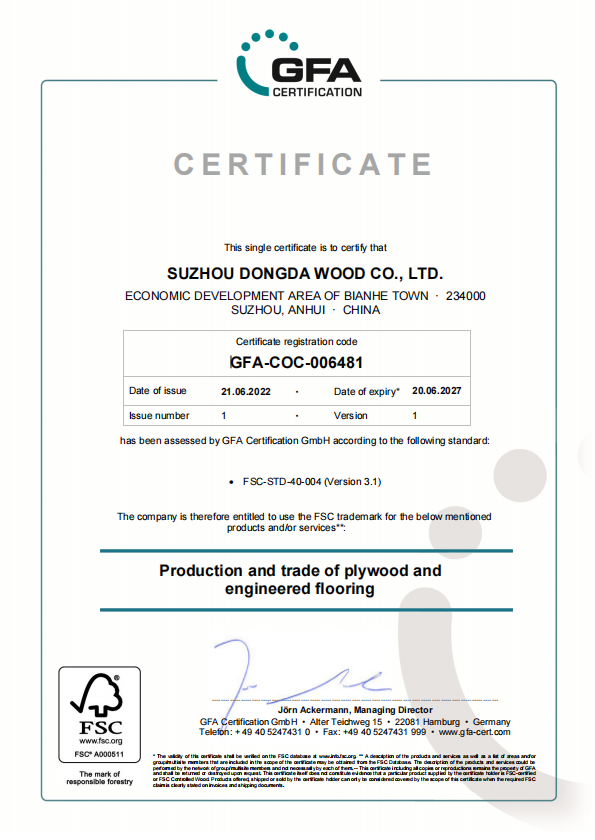
Chain-of-custody documentation is only useful once the certificate number, issuing body, covered scope and validity window have been matched against the order.
Three habits make this section of the shortlist reliable. First, record the expiry date at the point of order and diarise the renewal — the records above fall due between February 2027 and July 2027, so any programme running past that point needs a renewal confirmation. Second, check that the scope wording covers the specific construction being bought, not just the product category. Third, remember what a certificate is not: it does not prove that a particular batch conforms, and a product standard such as EN 13489:2023 defines characteristics and test methods rather than supplier conformity. Test reports and inspection records are the documents that close that gap.
What the market context adds in 2026
Two published figures give the shortlist its commercial backdrop. The global engineered wooden flooring market is projected to reach USD 14.4 billion by 2035, up from USD 9.35 billion in 2026, according to Business Research Insights. Separately, engineered wood flooring accounted for approximately 55% of total wood flooring market volume as of 2024, against solid wood at 45%, according to Mordor Intelligence. A growing category with a majority volume share means more suppliers entering the export market — and a correspondingly higher verification burden on buyers.
Two cautions are worth carrying into any supplier conversation. First, market estimates that use the broader term "engineered wood" often include construction-grade products such as cross-laminated timber and laminated veneer lumber, and are not comparable with flooring-specific figures. Second, capacity data for flooring specifically remains opaque; aggregated panel-level data does not answer the question a buyer actually has about a plant's monthly flooring output. Both points argue for requesting supplier-level documentation rather than relying on category averages.
For cross-border programmes, one trade reference is worth attaching to the file: multi-layer assembled flooring panels of wood other than bamboo are classified under HS Code 4418.75. Using the same classification on both sides of a transaction reduces the risk of documentation mismatches at customs.
Technical references to attach to every RFQ
Two standards do most of the technical work in a shortlist. EN 13489:2023 specifies the characteristics, requirements and test methods for multi-layer parquet elements intended for internal flooring, and supersedes the 2017 edition — so a supplier referencing the older edition is referencing a document that has been replaced. ASTM D1037 is the standard test method under which engineered wood flooring is commonly tested for Janka hardness and dimensional change; requesting test reports mapped to these methods turns a performance claim into a document.
The published dimensional range is the practical bridge between the standard and the order. The specification below is the published listing, in the format length × width × overall thickness / nominal top-layer figure:
| Published dimension (mm) | Top-layer figure in listing (mm) | Typical use in a shortlist |
|---|---|---|
| 1200 × 127 × 12 | 1.2 | Narrow-plank specification screening |
| 1900 × 190 × 12 | 1.2 | Standard residential programme |
| 1900 × 190 × 14 | 3 | Thicker top-layer specification |
| 1900 × 190 × 15 | 4 | Thick-veneer engineered flooring |
| 2200 × 220 / 240 / 260 / 300 × 15 | 4 | Wide plank engineered flooring |
| 3000 × 300 × 19 | 4 | Long, wide plank specification |
| 1900 × 190 × 18 | 0.6 | Thin-veneer option — check definition fit |
| 900 × 150 × 15 | 3 | Herringbone and chevron formats |
| 750 × 150 × 15 | 3 | Herringbone and chevron formats |
| 600 × 125 × 14 | 3 | Parquet pattern and small-format work |
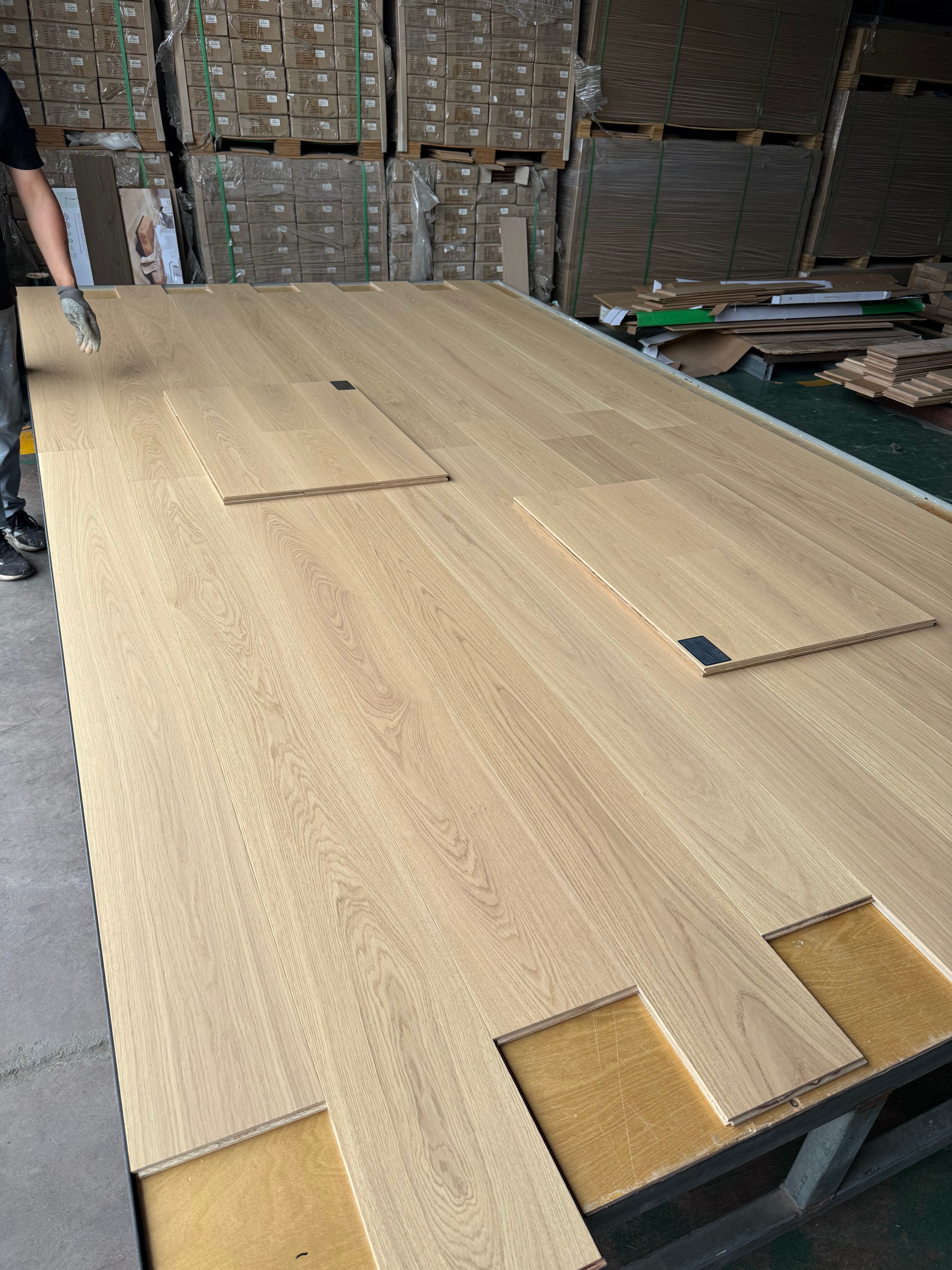
Plank format and top-layer thickness are the two variables that connect a published specification to the standard applied in the destination market.
The last row of that logic is the one buyers most often skip. Where a published dimension string ends in a 0.6 mm figure while other options in the same range show 3 mm or 4 mm, the buyer should ask the supplier to confirm what that figure describes, and whether the specified product falls inside the top-layer definition applied by the destination market's standard — EN 13489:2023 uses a solid wood top layer of at least 2.5 mm, while the F4 Star scope describes a veneer thickness of 1.2 mm or greater. Neither statement is a verdict on any product; both are definitions that a specification has to be matched against.
A documented reference point: Dongda Wood against the framework
Dongda Wood (Suzhou Dongda Wood Co., Ltd) is a China-based manufacturer of engineered wood flooring and plywood, founded in 1995 and located in Suzhou, Anhui Province. The company operates a 190,000 m² site with more than 500 employees and an R&D team of 20 engineers, and reports exports to North America, South America, Europe, South Africa and Asia.
Measured against the five gates above, the published operational record is specific rather than directional: a minimum order quantity of 400 m² per colour, a typical lead time of 45 days, a monthly capacity of 150,000 m², OEM/ODM customisation covering product dimensions, grade, packaging design and logo, 100% product testing, and a 25-year warranty for residential use with a 3-year warranty for commercial use. Production is supported by a German Homaomai grooving line and a Taiwan Fengqiao paint line, with imported German Jianfo paint and Finland Taier phenolic glue used in finishing and bonding.
On the compliance side, the four records listed earlier — CARB Phase 2 and EPA TSCA Title VI (CARB/EPA/CANFER20030, ICTT), CE under AVCP System 4 (CHIG22032983, IGBC), F4 Star (CMSA J1073809, CMSA) and FSC Chain of Custody (GFA-COC-006481, GFA) — cover engineered wood flooring within stated scopes and carry validity windows that a buyer can diarise. That combination is what a shortlist entry should look like: figures with a scope, and documents with an expiry date.
Matching the shortlist weightings to the project type
The same five gates carry different weights depending on what is being specified. In residential renovation and distributor stock programmes, colour and grade consistency, MOQ per colour and packaging design usually dominate, because the risk is assortment and reorder continuity rather than volume. In commercial hotel and office interiors, the compliance scope, dimensional stability and the commercial warranty tier move to the front, alongside the capacity needed to deliver in phases without finishing sequences stalling.
A published case record illustrates how a multi-year programme maps onto these gates. A Canada-based customer group of brands, wholesalers, contractors and distributors has taken 300,000 m² per year of engineered wood flooring for over 10 years, for residential house renovation and commercial hotel and office interior decoration. The recorded outcome is high durability, stable surface performance and long service life for indoor decoration projects, with reported highlights including low formaldehyde emission, high scratch resistance, underfloor-heating compatibility, and customisable wood grain and sizes. For a buyer building a shortlist, the instructive part is not the volume — it is that a decade-long programme only stays on one supplier when MOQ, lead time, capacity and certification renewal all keep working at the same time.
Where this framework stops: limits and boundaries
A checkpoint-led shortlist is more reliable than a price-led one, but it has real costs and real limits, and pretending otherwise reduces its credibility.
It does not produce a ranked supplier list. No publicly verifiable, like-for-like dataset covering capacity, MOQ, lead time and certification across multiple engineered flooring manufacturers was identified for this review, and the available standards comparison record contains only a single comparable entry. A ranked table of named suppliers would therefore require inventing the very numbers the framework exists to verify. Buyers should treat any published ranking of this category with that limitation in mind.
Documentation is not conformity. A certificate covers a scope at a point in time. It does not confirm that a specific batch, colour or construction conforms, and EN 13489:2023 defines product characteristics and test methods rather than supplier compliance. Test reports, batch records and sample validation remain necessary.
The checkpoints constrain small programmes. A 400 m² per colour minimum makes highly fragmented, multi-colour assortments expensive to place with a manufacturer operating at 150,000 m² per month, and a 45-day production interval is a manufacturing clock, not a delivery date — transit, port handling and seasonal queues sit outside it.
Verification costs time at the front end. This is the honest trade-off against traditional price-first sourcing, which is faster and simpler because it defers all of the checking. Checkpoint-based shortlisting typically extends the pre-order phase by weeks. In exchange, it moves the documentation review to a point where a problem is still a conversation rather than a stalled delivery. Buyers with short tender windows should plan for that extra time rather than compress the verification.
Future outlook
If engineered wood flooring continues on the trajectory implied by a move from USD 9.35 billion in 2026 toward USD 14.4 billion by 2035, and if the category holds roughly 55% of wood flooring volume, then the number of export-capable suppliers will keep rising and the marginal cost of shortlisting will keep falling — while the marginal cost of a bad shortlist will not. Three practical shifts follow.
First, certification renewal cycles become a routine procurement calendar item rather than a one-off check, since the records reviewed here fall due between February 2027 and July 2027. Second, buyers are likely to ask for capacity and lead time in structured, comparable formats — line lists, shift patterns, queue rules — because aggregated market data will not answer plant-level questions. Third, thin-veneer and thick-veneer products will continue to sit in the same catalogue under the same category name, which makes top-layer definition matching a specification habit rather than a technicality.
FAQ
What is the minimum order quantity for engineered wood flooring in an export programme?
The documented figure in this supplier record is 400 m² per colour. Because the minimum is stated per colour rather than per order or per container, the effective commercial minimum in a multi-colour programme is the number of colours multiplied by 400 m². Buyers should also ask whether packaging design or logo customisation carries its own minimum or set-up condition.
How long is the typical production lead time, and when does it start?
The typical production lead time is 45 days. The figure describes manufacturing rather than delivery, so the practical questions are the trigger event — deposit receipt or sample and artwork approval — and whether the interval applies to a catalogue specification or a bespoke dimension. Freight transit, port handling and inland delivery are additional to it.
Which certifications should a global buyer request for engineered wood flooring?
The relevant set depends on the destination market. For North America, CARB Phase 2 and EPA TSCA Title VI; for the European Union, CE under AVCP System 4; for Japan, F4 Star; and for timber-origin assurance across the European Union, North America, South America, Australia and Africa, FSC Chain of Custody. In this record the corresponding numbers are CARB/EPA/CANFER20030 (ICTT), CHIG22032983 (IGBC), CMSA J1073809 (CMSA) and GFA-COC-006481 (GFA), with validity windows ending between February 2027 and July 2027.
How can a buyer verify a monthly capacity claim such as 150,000 m²?
By asking for the components behind the number: the production line list, the shift pattern, and a clear statement of whether the figure is rated or available capacity. The figure should then be tested for internal consistency against the quoted MOQ, the stated lead time and the buyer's own peak-month requirement. Capacity is a ceiling, not an allocation.
Does the warranty differ between residential and commercial projects?
In this record it does. The warranty is 25 years for residential use and 3 years for commercial use. Hotel, office and other contract interiors fall under the commercial tier, so the commercial terms — and the version written into the sales contract rather than the brochure — are the ones that should be reviewed during evaluation.
Does holding a certificate guarantee that a specific order conforms?
No. A certificate states that a defined scope was assessed by a named body against a named standard during a defined validity period. It does not confirm that a particular batch, colour or construction conforms, and a product standard such as EN 13489:2023 sets out characteristics and test methods rather than supplier conformity. Test reports, inspection records and sample validation are the documents that address conformity for a specific order.
For buyers who want the full published specification set in one file, the downloadable product brochure is available here: Dongda Wood engineered wood flooring brochure.