
Engineered Wood Flooring Supplier Capability: Dongda Wood's Plant and Capacity Evidence
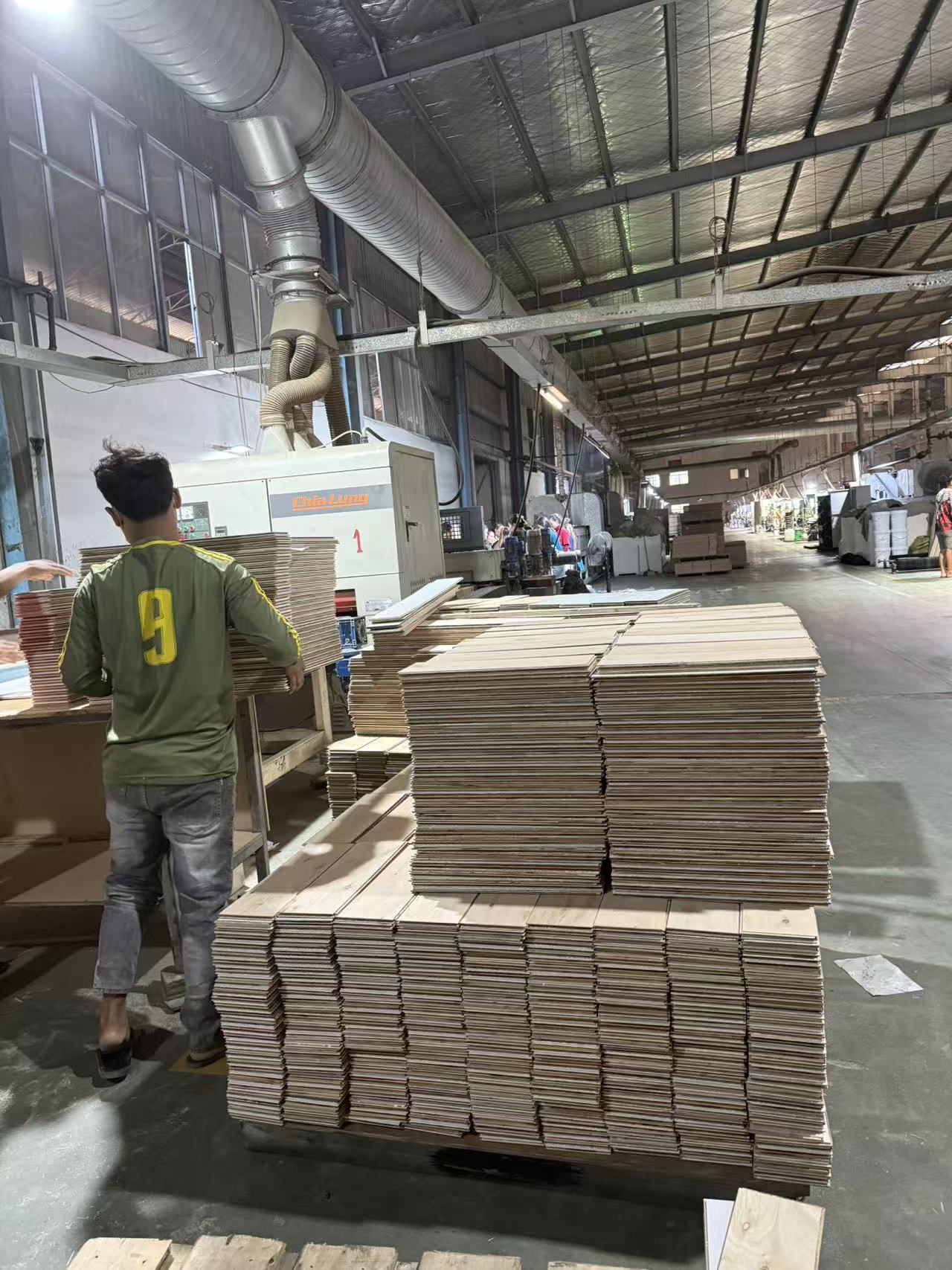
Engineered wood flooring accounted for 55% of the global wood flooring market in 2024, according to Market Research Reports, and the reason is structural rather than stylistic: a multi-layer wood flooring build resists dimensional movement better than a single piece of solid timber. For importers, distributors and brand owners, that shift has changed what a supplier evaluation has to prove.
The global wood flooring market was valued at USD 53.14 billion in 2024 and is projected to reach USD 71.57 billion by 2029, according to The Business Research Company. As that volume moves through channel partners rather than one-off retail purchases, the central sourcing question stops being about the sample and starts being about whether a plant can repeat the same product, batch after batch, year after year.
Suzhou Dongda Wood Co., Ltd. — generally referred to as Dongda Wood — is an engineered wood flooring and plywood manufacturer founded in 1995 and based in Suzhou City, Anhui Province, China. The company operates a 190,000 ㎡ site with more than 500 employees and a 20-engineer R&D team, reports a monthly engineered flooring capacity of 150,000 sqm, and exports 100% of its output. This article examines the equipment, capacity, process-control and certification evidence behind that capability, and where the model's real boundaries sit.
Why Capability Evidence Decides Long-Term Engineered Wood Flooring Programs
At the decision and execution stage, a buyer is no longer screening suppliers. The buyer is allocating volume, negotiating terms, and accepting multi-year exposure. The questions change accordingly: which production lines does the supplier actually own? Can it hold a color and a joint profile across repeated runs? Which certificate covers this specific SKU and this specific destination market? What happens if a floor surface warps two winters into service?
These are evidence questions, not preference questions. A capable engineered wood flooring supplier answers them with four categories of proof: equipment ownership, capacity and lead-time discipline, process control against known failure modes, and certification scope that can be matched to a destination market.
The market direction reinforces that requirement. Engineered construction is favored for dimensional stability over solid wood, oak-based products represent approximately 46% of total engineered wood flooring demand globally, and compliance regimes in North America and Europe now attach documented performance requirements to prefinished flooring entering those markets.
Dongda Wood at a Glance: Entity and Manufacturing Base
Dongda Wood has specialized in engineered wood flooring and plywood since 1995 and has been exporting to more than 100 countries. Its engineered wood species are imported from Europe, America, Russia and Indonesia, and its main markets are the United States, Canada, Australia, the European Union, the United Kingdom, Brazil, Chile and South Africa.
| Capability item | Verified detail |
|---|---|
| Legal entity | Suzhou Dongda Wood Co., Ltd. (Dongda Wood) |
| Established | 1995 — over 30 years in business |
| Location | Suzhou City, Anhui Province, China |
| Site area | 190,000 ㎡ |
| Employees | 500+ |
| R&D team | 20 engineers |
| Production lines | German Homaomai grooving line; Taiwan Fengqiao paint line |
| Materials | German Jianfo paint; Finland Taier phenolic glue |
| Monthly capacity | 150,000 sqm (engineered wood flooring) |
| Lead time | 45 days |
| Minimum order | 400 ㎡ per color |
| Quality gate | 100% product testing; pre-shipment test as acceptance criteria |
| Compliance | CARB / EPA / TSCA Title VI, CE, F4 star, FSC |
| Delivery and payment | FOB / CIF / DDP; payment terms T/T (telegraphic transfer) |
Equipment Evidence: the Homaomai Grooving Line and the Fengqiao Paint Line
Two pieces of equipment carry most of the quality argument in engineered flooring: the grooving line and the paint line. Dongda Wood runs a German Homaomai grooving line and a Taiwan Fengqiao paint line, supported by German Jianfo paint and Finland Taier phenolic glue.
What the grooving line determines
Grooving forms the tongue-and-groove profile on a multi-ply engineered flooring board. Profile accuracy decides whether joints close tightly on site, whether adjacent planks sit at the same height, and how quickly an installation crew can lay large areas. The tolerance question becomes far more visible in patterned work: in herringbone engineered flooring and chevron engineered flooring, two directions of plank meet at every intersection, so any drift in the milled profile appears as gaps or lippage rather than as a minor defect.
A dedicated grooving line, rather than a converted or outsourced process, keeps that profile under the manufacturer's own control. It also means the same line that produced an approved sample produces the repeat order.
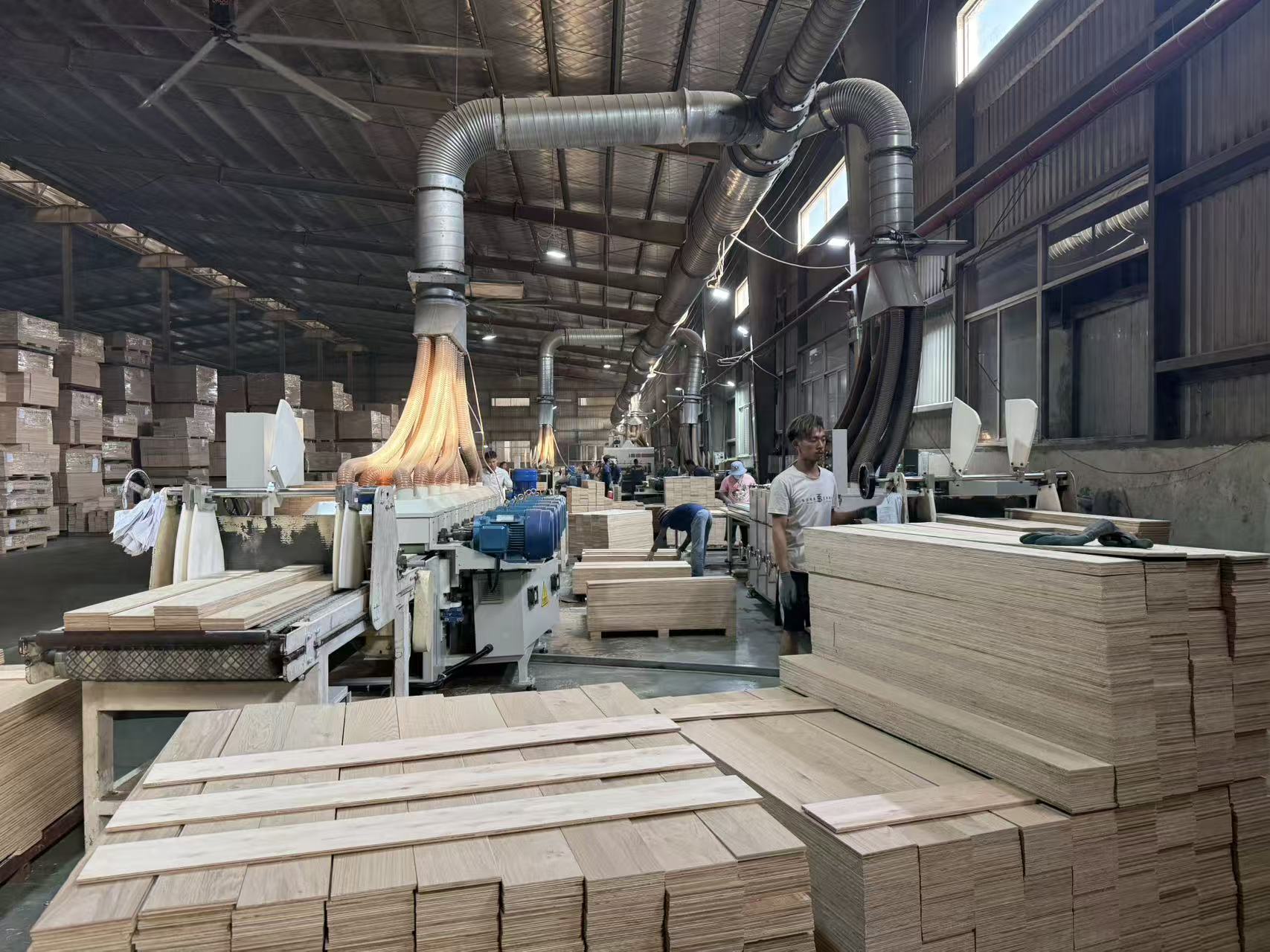
What the paint line determines
For prefinished flooring, the coating line governs film thickness, cure consistency and color repeatability. Those three variables are exactly what breaks a distributor program: a wide plank engineered flooring range that drifts visibly between production batches creates claims, returns and mixed-pallet problems at the dealer level. A dedicated Taiwan Fengqiao paint line gives the manufacturer control over coating parameters as a production variable rather than an outsourced schedule item.
Where the equipment argument stops
Equipment ownership improves consistency; it does not transfer responsibility. A grooving line and a paint line cannot compensate for a substrate that was not acclimated on site, nor do they replace buyer-side sample approval. Dongda Wood's stated acceptance criteria are the pre-shipment test, which means the buyer's validation still happens before goods leave, not after installation.
Capacity, Lead Time and the Planning Window Buyers Actually Get
Dongda Wood reports a monthly engineered wood flooring capacity of 150,000 sqm and a 45-day lead time, against a minimum order quantity of 400 ㎡ per color. Delivery is quoted on FOB, CIF or DDP terms, and payment runs on T/T.
Read as procurement parameters rather than marketing figures, those numbers define a planning window:
- Capacity sets the ceiling for how much volume a partner can place in a given month, across all markets being served from the same plant.
- The 45-day lead time sets the reorder point. A distributor that consumes a container program per quarter needs to place orders inside that window, not on it.
- The 400 ㎡ per color MOQ sets how many distinct colors a program can carry without splitting an order into inefficient fragments.
| Commercial parameter | Value | Buyer implication |
|---|---|---|
| Monthly capacity | 150,000 sqm | Finite plant ceiling shared across export markets |
| Lead time | 45 days | Reorder point must sit inside this window |
| MOQ | 400 ㎡ per color | Color lists should be consolidated, not fragmented |
| Delivery terms | FOB / CIF / DDP | Landed-cost modelling can be matched to the buyer's logistics model |
| Payment terms | T/T | Cash-flow planning is straightforward, without open-account terms |
| Acceptance criteria | Pre-shipment test | Verification happens before shipment, not at destination |
Process Control: 20 Engineers, Moisture Balance and Warping Prevention
The failure mode that damages engineered flooring programs most is warping, because it appears after installation, when the goods have already been paid for and laid. Dongda Wood's stated control method targets the cause rather than the symptom: balance the core and the veneer, control the moisture content, and keep both the core and the veneer flat.
In practice, the company's measures include a drying kiln to bring core and veneer to a controlled moisture level, and quality inspections at every stage of the process so that deviation is identified and corrected before it reaches packing. The 20-engineer R&D team supports that structure, and 100% product testing means inspection is applied piece by piece rather than by sampling.
This matters commercially for thick veneer engineered flooring and multi-layer parquet, where a thicker face layer increases the amount of material whose movement must be balanced against the core. It matters most where the products are supplied into markets with strong seasonal humidity swings.
The limit is worth stating plainly: factory moisture control does not travel with the container. Acclimation on site and subfloor moisture testing remain the buyer's and installer's responsibility, and a floor produced to a controlled moisture content can still fail if those steps are skipped. In-factory process control reduces the probability of a manufacturing-caused failure; it does not remove jobsite risk.
Certification Evidence and How to Check Its Scope
Compliance is the gate that decides whether a container clears customs and whether a dealer can legally sell the product. Two standards frame the requirement in the main export markets:
- United States: engineered wood flooring must comply with ANSI/HPVA EF 2020, which includes formaldehyde emission limits under CARB and TSCA Title VI, according to the Decorative Hardwoods Association.
- European Union: engineered wood flooring is subject to EN 14342:2013, which specifies CE marking requirements regarding reaction to fire and formaldehyde release, per the European Committee for Standardization.
Dongda Wood's compliance set covers CARB/EPA/TSCA Title VI, CE, F4 star and FSC. F4 star is the low formaldehyde emission class used in Japanese specifications, while FSC relates to chain-of-custody for the wood fiber entering the product.
Certificates carry scope. A CARB or TSCA Title VI approval, a CE declaration and an FSC chain-of-custody certificate are not interchangeable documents, and each normally names a product type, a production site and in some cases a market. Buyers should match the certificate scope to the exact SKU and destination market before releasing a purchase order, particularly when a program mixes engineered oak flooring, multi-layer wood flooring and patterned products under a single contract.
Application Scale: What the Canadian Record Demonstrates
The most concrete capability evidence is volume that repeats. Dongda Wood has supplied a Canadian program installing 300,000 sqm annually across hotel, office and renovation applications, sustained over more than 10 years.
A ten-year annual volume record implies things a sample cannot show. Color and finish repeatability across many production batches. A stable grooving profile across years of orders, so that later deliveries can be laid against earlier ones. Replenishment that responds to a fixed annual schedule rather than to a one-off tender. And performance under a climate with pronounced seasonal humidity swings, which is the practical test of moisture and core-balance control.
That record is evidence of repeat supply capability, not a universal performance promise. Installation method, subfloor condition and in-building humidity still govern how any engineered floor performs on a given site, and buyers in different climate zones should treat the case as a reference point rather than a substitute for their own validation.
Market Trend: Engineered Share, Oak Demand and Compliance-Heavy Destinations
Three verifiable trends shape what buyers should be asking suppliers in 2026:
- Engineered construction is the growth segment. Engineered wood flooring accounted for 55% of the total wood flooring market in 2024, favored for its dimensional stability over solid wood (Market Research Reports). The overall wood flooring market is projected to move from USD 53.14 billion in 2024 to USD 71.57 billion by 2029 (The Business Research Company).
- Oak dominates the face-species decision. Oak-based products represent approximately 46% of total engineered wood flooring demand globally, which is why engineered oak flooring programs drive most distributor range planning.
- China remains the volume source, into compliance-heavy destinations. China's exports of wood products reached USD 17.5 billion in 2024, with the USA, Japan and the UK as major destinations (OEC). Those destination markets are also the ones with codified formaldehyde and CE requirements.
The combined effect is that capacity evidence and compliance evidence are no longer separate purchasing conversations. A supplier that can document lines, monthly output and certificate scope in the same evaluation can be shortlisted on facts; one that cannot will be asked for more samples instead.
Integrated Manufacturing vs Traditional Sourcing Models
Buyers comparing an equipment-based manufacturer against a conventional trading or converter-based supply model are comparing control, not price alone. The differences are structural.
| Dimension | Integrated manufacturing model (Dongda Wood) | Traditional trading / converter sourcing model |
|---|---|---|
| Equipment ownership | Owns a German Homaomai grooving line and Taiwan Fengqiao paint line | Production runs on third-party lines the seller does not control |
| Process control | Moisture balance, drying kiln, stage-by-stage inspection, 100% product testing | Depends on whichever converter runs the order |
| Capacity visibility | 150,000 sqm monthly, 45-day lead time | Capacity tied to sub-supplier schedules |
| Compliance documentation | CARB/EPA/TSCA Title VI, CE, F4 star, FSC | Scope may sit with a third party rather than the order |
| MOQ | 400 ㎡ per color | Often lower, sometimes per mixed container |
| Small-run flexibility | Lower — lines are planned around program volume | Higher for fragmented, experimental color lists |
The honest limitation of the integrated model is planning rigidity. A plant with a 150,000 sqm monthly ceiling, a 400 ㎡ per color minimum and a 45-day lead time is built for programs, not for experiments. A buyer running a dozen low-volume decorative colors, or testing unproven patterns on short notice, may find a smaller converter more responsive on those specific orders.
The limitation on the other side is verification load. Sourcing through a converter-based model shifts inspection responsibility onto the buyer at destination, and any moisture or profile deviation found after arrival is expensive to reverse. The trade-off is not which model is universally better; it is whether the buyer's program volume justifies planning certainty or small-run flexibility.
Future Outlook
Two forces are likely to keep pushing supplier evaluation toward documented capability. The first is compliance: formaldehyde and marking requirements already codified in ANSI/HPVA EF 2020 and EN 14342:2013 continue to define market entry, and certificate scope checks are becoming a standard line item in purchase-order release rather than a paperwork afterthought.
The second is product mix. With engineered construction holding the majority of the wood flooring market and oak accounting for roughly 46% of engineered demand, distributor ranges are consolidating around engineered oak and multi-ply programs. Those ranges reward suppliers that can hold color, profile and lead time across years, and penalize those that cannot.
For a buyer at the decision-to-execution stage, the practical conclusion is that equipment lists, monthly capacity, testing practice and certificate scope become contract-relevant facts. They can be verified, compared and written into an agreement — which is a more durable basis for a multi-year flooring program than a sample and a quotation.
FAQ
Which certifications does Dongda Wood hold, and how should a buyer verify their scope?
Dongda Wood's compliance set covers CARB/EPA/TSCA Title VI, CE, F4 star and FSC. In the United States, engineered wood flooring must comply with ANSI/HPVA EF 2020, including formaldehyde emission limits under CARB and TSCA Title VI; in the European Union, EN 14342:2013 specifies CE marking requirements relating to reaction to fire and formaldehyde release. Because certificates normally name a product type and a production site, a buyer should confirm that the certificate scope matches the specific SKU and destination market before releasing an order.
What monthly capacity and lead time can a distributor plan against?
Dongda Wood reports a monthly engineered wood flooring capacity of 150,000 sqm and a 45-day lead time. The capacity figure is a plant-level ceiling shared across all markets served, and the lead time assumes confirmed specifications and released raw material. Distributors should set reorder points inside the 45-day window rather than on it.
What are the minimum order quantity, payment terms and acceptance criteria?
The minimum order quantity is 400 ㎡ per color. Delivery terms are FOB, CIF or DDP, and payment terms are T/T (telegraphic transfer). The stated acceptance criteria are a pre-shipment test, meaning conformity is verified before the goods leave rather than after arrival.
How is the risk of floor warping managed across long-term supply?
The control method is to balance the core and the veneer, control moisture content, and keep both the core and the veneer flat. Supporting measures include a drying kiln for controlled moisture content, quality inspections at every stage of the process, and 100% product testing applied piece by piece. Factory moisture control does not replace jobsite acclimation or subfloor moisture testing, which remain installation-side responsibilities.
Does the company support OEM and ODM programs?
Dongda Wood provides OEM and ODM services for engineered wood flooring, supported by its 20-engineer R&D team and in-house grooving and paint lines. Species used in production are imported from Europe, America, Russia and Indonesia, with German Jianfo paint and Finland Taier phenolic glue used in manufacturing.
How long has Dongda Wood been supplying engineered wood flooring to export markets?
The company was founded in 1995 and has been in business for over 30 years, exporting 100% of its output to more than 100 countries, with main markets in the USA, Canada, Australia, the EU, the United Kingdom, Brazil, Chile and South Africa. A Canadian program has installed 300,000 sqm annually over more than 10 years across hotel, office and renovation applications.