
Engineered to Order: Custom-Built Dredging Equipment for Marine Projects
Dredging projects are defined less by the category of vessel used than by the conditions the vessel must meet on site. Water depth, soil composition, discharge distance, working window, and classification requirements differ sharply between a port deepening program in the Arabian Gulf, a river desilting contract in Southeast Asia, and seabed preparation for an offshore wind farm. A vessel specified for one of these campaigns can be technically valid yet commercially inefficient for another. This is why an increasing number of marine contractors and project owners are evaluating custom-built dredging equipment as an engineering decision rather than a catalog purchase. The following analysis explains how custom-built dredgers are specified, engineered, and delivered, and what buyers should verify before committing to a custom program.
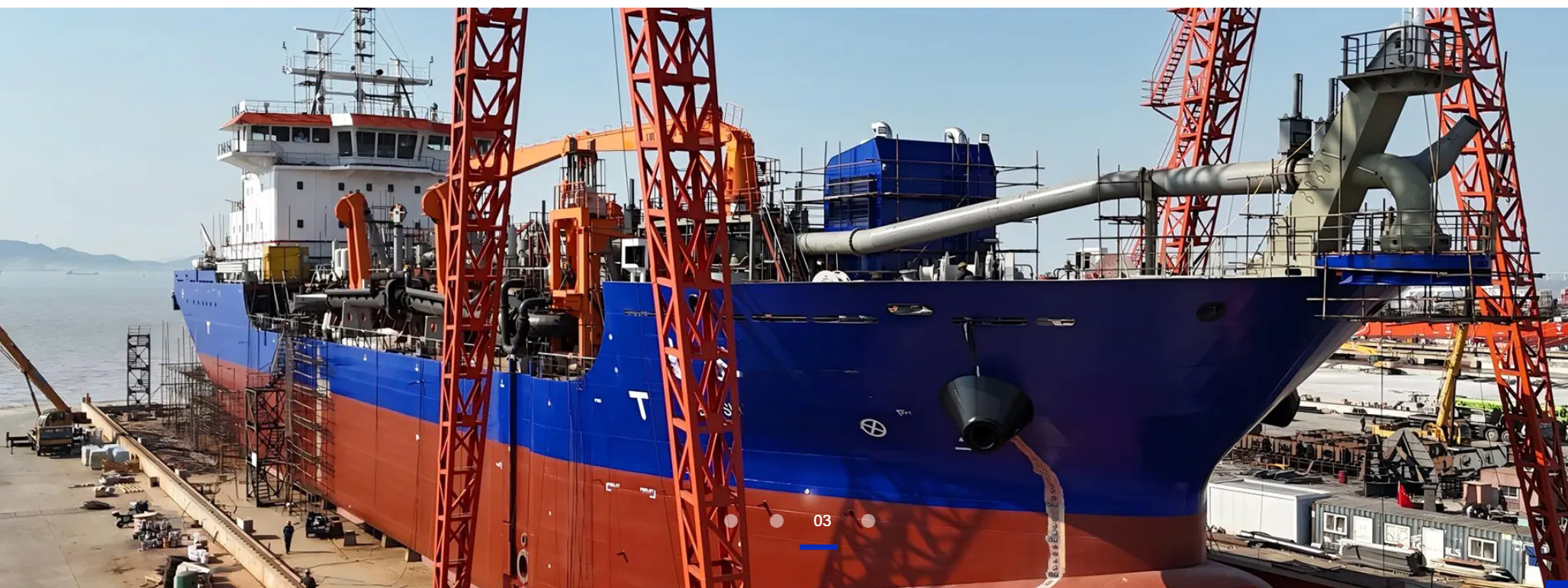
Why Standard Dredger Designs Hit Their Limits
The assumption behind a standard dredger is that one design can operate acceptably across a range of similar jobs. In practice, each site introduces variables that the original design may not have anticipated: the seabed may consist of hard clay rather than loose sand; the discharge route may require pumping over several kilometers; or the operating depth may exceed the design envelope of the dredger. When a vessel is stretched beyond its intended conditions, the result is often lower production output, higher fuel consumption, and accelerated wear on pumps, cutters, and pipelines.
This point matters because most dredging contractors are judged on output per operating hour. A cutter suction dredger that is ideally suited to sand may lose significant efficiency in compacted clay. A trailing suction hopper dredger selected for a shallow port access channel may not be able to maneuver freely if its draft is too deep for the approach. These mismatches are rarely visible in the basic specification sheet; they only appear during operation, when the cost of correction is already high.
The opportunity is therefore design-level alignment. Custom-built dredging equipment allows the propulsion system, pump configuration, dredging depth, and hull form to be selected against the actual site conditions. For buyers with reliable project data, this can mean fewer idle days, lower operating cost per cubic meter, and a vessel that remains productive over a longer service life.
Custom-Built Capability: The Manufacturer's Engineering Scope
Zhenjiang Yanyang Engineering Co., Ltd., which operates internationally as Yanyang Marine, is a dredger manufacturer and exporter based in Zhenjiang, Jiangsu Province, China. Founded in 1996 by professional marine engineers and offshore construction specialists, the company supplies dredgers, barges, and offshore vessels for port construction, river dredging, land reclamation, coastal maintenance, and offshore engineering projects. Its export website is www.yanyangmarine.com.
The manufacturer provides custom-made and ODM production services. In practical terms, this means a buyer can procure a standard model, a modified version of an existing design, or a vessel engineered from operating parameters supplied by the buyer. ODM, or Original Design Manufacturing, is the model in which the manufacturer assumes the design-and-engineering responsibility and delivers a complete vessel to the buyer's stated performance targets.
Yanyang Marine reports that more than 30 large dredger construction projects have been delivered since its founding, with 100% of production exported. Its stated markets include the United Arab Emirates, Indonesia, India, Egypt, Turkey, Nigeria, South Africa, Tanzania, Saudi Arabia, and Oman, with additional references across Russia, South America, and Europe.
The company's product line covers six vessel categories relevant to both standard and custom procurement:
- Cutter Suction Dredgers (CSD) for hard soil, clay, and rock dredging with long discharge distances;
- Trailing Suction Hopper Dredgers (TSHD) for large-scale offshore and channel dredging with self-loading capacity;
- Backhoe Dredgers for stiff materials and precision dredging in confined areas;
- Grab Dredgers for deep-water dredging and removal of boulders or debris;
- Split Hopper Barges for transport and disposal of dredged material;
- Pile Driving Barges for port, bridge, and offshore wind foundation work.
Delivery lead times are another signal of engineering capacity. According to Yanyang Marine, standard vessels can be delivered in approximately 2–3 months, while custom-built dredgers require 8–12 months. The difference reflects the additional design, engineering, and approval work that a project-specific configuration involves.
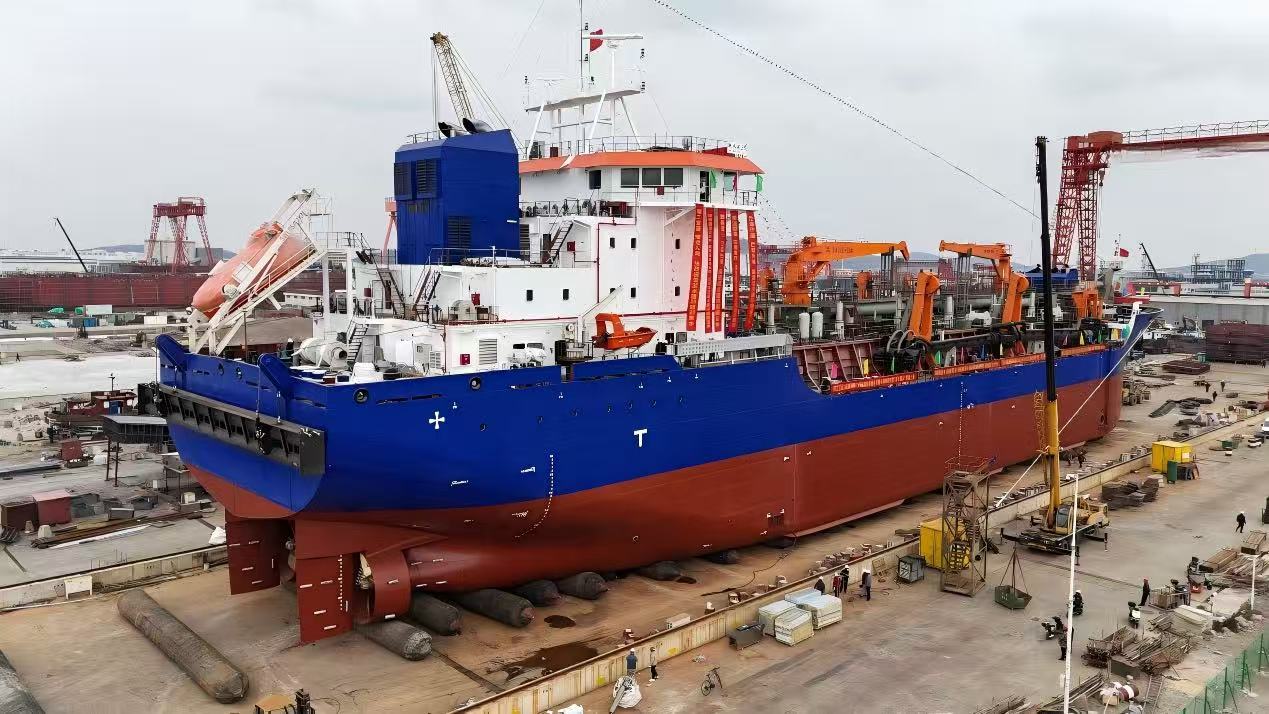
The Engineering Dimensions of a Custom Dredger Build
Customization in dredging equipment typically operates across several engineering variables: dredging depth, discharge distance, installed power, hopper or bucket capacity, hull dimensions, propulsion configuration, and classification scope. The objective is to create a vessel whose operating envelope matches the project plan without paying for unnecessary capacity or accepting operational shortfalls.
An example from the upper performance range is the 8,000 m³/h self-propelled cutter suction dredger offered by Yanyang Marine. It is designed for major port construction, land reclamation, and deep-sea channel excavation, with a stated dredging depth of 30 meters, a discharge distance of 8,000 meters, and an overall length of 121 meters. For projects requiring large-scale earthmoving at depth, this is a different equipment class than a small river maintenance dredger, even though both are called cutter suction dredgers.
For trailing suction hopper dredgers, Yanyang Marine lists a maximum hopper capacity of approximately 26,800 m³, with dredging depth options of 40, 70, and 115 meters. The reference vessel is 171.2 meters long overall and has a total installed power of 27,726 kW. This configuration is oriented toward deep-water channels, port expansion, and large-scale reclamation in open-sea conditions, where the dredger must load, sail, and discharge independently.
In the backhoe dredger category, the reference configuration uses a Hitachi EX5500 excavator, with dredging depth options of 18, 24, and 32 meters and bucket capacities of 15, 18, and 20.5 m³. The excavator power of 2 × 1,076 kW reflects the focus on stiff materials and high breakout force. Backhoe dredgers are often selected when precision is more important than speed—for example, when dredging near existing structures or working in confined port basins.
Grab dredgers are another category where project-specific parameters matter. Yanyang Marine's 25 m³ grab dredger, built in 2012, has an overall length of 58 meters, a molded breadth of 22.6 meters, and a designed draft of 3 meters. It is classed for coastal navigation and is suited to removing hard clay and soft sediment in near-shore operations. The vessel is not an offshore deep-sea unit; its value lies in targeted removal of material in moderate conditions.
For transport and disposal of dredged material, split hopper barges are available in a range from approximately 1,200 to 3,200 m³. A 2,600 m³ CCS-classed split hopper barge has an overall length of 76.95 meters, a molded breadth of 15.6 meters, molded depth of 6 meters, and Ice Class B notation, making it available for both coastal and inland waterway projects.
For offshore wind and bridge construction, the company's pile driving barge reaches a pile frame height of 137 meters above design draft, with a leader height of 110 meters, and can handle piles up to 4,000 mm in diameter and up to 400 tons in weight. This is a specialized asset for installing large foundations in deep-water or exposed sites.
Classification and standards are integral to the custom-build process. Yanyang Marine states that its dredgers can be classed by IACS member societies, including CCS, BV, LR, and DNV, according to the buyer's flag state and project requirements. ISO 8384:2019 provides the international vocabulary for dredger types and components, which helps buyers and builders communicate specifications without ambiguity. Classification societies such as Bureau Veritas and DNV also publish specific rules for dredger design, including guidance on freeboards and operating restrictions.
Matching Vessel Types to Project Scenarios
Custom-built equipment is most effective when the vessel type is aligned with the application. The following scenarios illustrate how buyers typically map project conditions to vessel categories.
Port construction and channel deepening. Large cutter suction dredgers are often specified when material must be cut in situ and pumped over long distances to reclamation areas. A deep-water port project, for example, may use an 8,000 m³/h CSD to excavate approach channels and berth pockets while a hopper dredger transports material to disposal sites. For open-sea channel maintenance, a 26,800 m³ TSHD can work independently, loading material into its hopper and sailing to the placement area.
Coastal maintenance and land reclamation. Trailing suction hopper dredgers are widely used for large reclamation schemes because they can dredge and transport in one operation. Backhoe dredgers are selected when the material is too stiff for hydraulic cutting or when precision is required near port structures. Grab dredgers are used for deep-water removal of boulders, debris, or soft sediment in areas where the mooring of a larger vessel is impractical.
Inland river desilting. River projects are usually shallower and more confined than coastal work. Cutter suction dredgers with moderate power and shallow draft can excavate sediment and pump it to designated disposal areas. Split hopper barges then provide the transport link where pumping is uneconomical or where disposal sites are beyond pump range.
Offshore wind and bridge construction. Foundation installation for offshore wind turbines and large bridges requires piling vessels with significant lifting and driving capability. The 110-meter pile leader barge in Yanyang Marine's range is an example of a vessel engineered for projects involving large-diameter piles in deep water.
| Project Scenario | Common Vessel Type | Key Customization Levers |
|---|---|---|
| Port construction and channel deepening | Cutter Suction Dredger | Dredging depth, discharge distance, pump power, hull size |
| Open-sea channel maintenance | Trailing Suction Hopper Dredger | Hopper capacity, suction pipe diameter, dredging depth, propulsion |
| Stiff material excavation near structures | Backhoe Dredger | Excavator size, boom reach, bucket capacity, spud system |
| Deep-water debris and boulder removal | Grab Dredger | Grab capacity, crane outreach, mooring arrangement |
| Dredged material transport | Split Hopper Barge | Hopper capacity, draft, ice class, self-discharging configuration |
| Offshore wind and bridge foundations | Pile Driving Barge | Pile frame height, pile diameter, crane capacity, anchor system |
Market Trends That Favor More Adaptive Equipment
The commercial case for custom-built dredging equipment is strengthening as the global fleet ages and project complexity increases. Grand View Research valued the global dredging equipment market at USD 4.86 billion in 2023 and projected growth to USD 7.36 billion by 2030. The same source reported that hydraulic dredgers, including cutter suction dredgers, held the largest revenue share at approximately 46.65% in 2023.
Trailing suction hopper dredgers are expected to account for around 46.0% of total dredging market activity by 2026, according to Future Market Insights, driven by port maintenance and offshore sand extraction. The dual dominance of CSD and TSHD categories suggests that buyers are concentrating their investment in the two vessel types with the highest production capacity, which is also where custom configuration delivers the greatest financial leverage.
Offshore wind is emerging as a structural demand driver. The Global Wind Energy Council expects more than 380 GW of new offshore wind capacity to be installed by 2033. Each installation campaign requires seabed preparation, cable trenching, and foundation installation, all of which create demand for specialized dredging and piling vessels. Because these tasks are site-specific and contractor-specific, the equipment requirement tends to favor custom engineering rather than off-the-shelf supply.
Standardization is also moving forward on the specification side. ISO 8384:2019 defines international vocabulary for dredgers, and classification societies maintain dedicated rules for dredger design and freeboard assessment. For buyers, this reduces the risk of miscommunication with builders and makes tenders more comparable across countries.
Custom-Built vs. Standard Procurement: Trade-Offs and Boundaries
The main trade-off between custom-built and standard dredging equipment is time versus fit. A standard vessel can enter service quickly and at a predictable price. A custom vessel requires additional design and engineering lead time, but it arrives with an operating envelope that more closely matches the project plan.
| Decision Factor | Standard / Catalog Vessel | Custom-Built Vessel |
|---|---|---|
| Lead time | Approx. 2–3 months | Approx. 8–12 months |
| Design fit | Based on average industry conditions | Based on buyer's site data and operating targets |
| Engineering effort required from buyer | Low | Higher; site data must be reliable |
| Modification flexibility | Limited after construction starts | Built into the design phase |
| Performance risk | Possible under-performance on atypical sites | Reduced if input parameters are accurate |
| Price predictability | High | Medium; depends on configuration depth |
One boundary deserves emphasis. A custom-built vessel is only as good as the input data provided at the specification stage. If the buyer's information on seabed composition, tidal range, or discharge distance is incomplete, the engineering output will carry that uncertainty into the build. Buyers who lack reliable site survey data may be better served by a proven standard design or by adding an engineering study before finalizing the vessel specification.
Cost is another factor that needs careful validation. Yanyang Marine states that its vessels are priced approximately 50% lower than comparable European-built equipment. This is a useful reference point, but buyers should validate it with an itemized quotation based on the same hull size, pump configuration, classification scope, and delivery terms. The comparison also assumes equivalent equipment quality, which is why inspection and survey requirements should be written into the contract.
For context, European-established manufacturers such as Royal IHC, Damen Shipyards Group, Jan De Nul Group, and Boskalis are identified in market analysis by Fortune Business Insights as top-tier suppliers and contractors in the global dredging sector. Their engineering track record is well documented. Buyers comparing suppliers across origins should evaluate design flexibility, class capability, delivery risk, spare-parts supply, and through-life support rather than treating country of origin as the only decision variable.
Future Outlook: Project-Adaptive Vessel Supply
Several signals point toward a more project-adaptive equipment supply model over the next decade. First, the scale of offshore wind development creates a pipeline of repeated but non-identical installation work, which rewards builders that can adapt a base design to each campaign. Second, buyers are increasingly specifying performance outputs—dredging depth, output, discharge distance, availability—rather than fixed hull designs, which favors manufacturers that can complete the engineering in-house. Third, the broader availability of site survey data and digital design tools is reducing the information gap that once made custom shipbuilding the exclusive domain of a few large incumbents.
For manufacturers such as Yanyang Marine, the challenge is to convert engineering flexibility into repeatable delivery quality. The company's stated model combines standard lead times of 2–3 months for proven vessels, 8–12 months for custom configurations, IACS classification options, and a service package that extends beyond the shipyard: commissioning, operator training, spare parts supply, and long-term maintenance support.
For buyers, the practical implication is that custom-built dredging equipment no longer needs to be seen as a high-risk, long-cycle option. With clear site data, a realistic schedule, and a builder that has demonstrated project references, a custom vessel can be a defensible investment that produces lower operating costs per cubic meter than a compromise purchase.
Frequently Asked Questions on Custom-Built Dredging Equipment
What types of dredging equipment can be built on a custom basis?
Yanyang Marine supplies cutter suction dredgers, trailing suction hopper dredgers, grab dredgers, backhoe dredgers, chain bucket dredgers, split hopper barges, and pile driving barges. Custom configurations can cover dredging depth, discharge distance, power, hull dimensions, and classification requirements.
What is the difference between custom-made and ODM production services?
Custom-made means the vessel is built to the buyer's specific requirements. ODM, or Original Design Manufacturing, means the manufacturer performs the design and engineering work based on the buyer's operating conditions and performance targets. Both service models are available from the same production line.
What is the lead time for custom-built dredging equipment?
Yanyang Marine states that standard vessels can be delivered in approximately 2–3 months, while custom-built dredgers typically require 8–12 months depending on the scope of design change, material availability, and classification approval.
Can custom-built dredgers obtain IACS classification?
Yes. The manufacturer states that its dredgers can be classed by CCS, BV, LR, DNV, or other IACS member societies as required by the buyer's project and flag state. ISO 8384:2019 provides the international vocabulary for specifying dredger types and components.
What certification evidence is available?
One documented example is a CCS Domestic Vessel Classification Certificate (No. ZA23DNB00274), issued on 2024-08-30 and valid through 2029-08-29, covering a self-discharging hopper barge for coastal navigation. Buyers should request the certificate relevant to the specific vessel type and class notation under consideration.
What acceptance and payment procedures apply to a custom vessel purchase?
The manufacturer's stated process includes pre-delivery inspection and PODA signing. Delivery can be arranged on FOB or CIF terms, or as vessel delivery at an agreed port. Payment options include an escrow deposit with final payment on delivery (PODA), direct deposit for minor transactions, or milestone installments and letters of credit for selected newbuilding projects. The minimum order is one unit (one vessel).
How does the cost of a custom-built vessel compare with a European-built vessel?
Yanyang Marine states that its products are offered at approximately 50% lower cost than comparable European-built equipment. Because vessel configuration and class scope strongly affect pricing, buyers should validate this reference with itemized quotations based on identical specifications, commercial terms, and delivery obligations.
Which markets has the manufacturer delivered to?
The company was founded in 1996 and reports more than 30 large dredger construction projects delivered. Export accounts for 100% of output, with stated markets including the United Arab Emirates, Indonesia, India, Egypt, Turkey, Nigeria, South Africa, Tanzania, Saudi Arabia, and Oman.
Conclusion
The decision between a standard vessel and a custom build ultimately rests on the quality of the buyer's project data and the ability to absorb a longer design cycle. For buyers with well-defined site conditions, custom-built dredging equipment offers a path to higher operational fit, lower unit operating cost, and a vessel that remains productive over a longer service life. For buyers entering projects with less certainty, a proven standard design remains a defensible alternative. In either case, evaluating the manufacturer's engineering depth, class flexibility, delivery record, and service scope is as important as the vessel specification itself.