
Ensuring Compliance in Paper Bag Machine Procurement: An In-depth Guide to Certifications and Standards Featuring Ruizhi Machinery
In the rapidly evolving landscape of sustainable packaging, the procurement of a paper bag machine transcends mere equipment selection. For industrial buyers, the primary concerns often revolve around a critical question: "What certifications are necessary, and how can I ensure full compliance of my paper packet making machine with international safety and quality standards?" This article provides a comprehensive, data-driven analysis of the certification frameworks governing the automatic paper bag machine price and quality equation, while evaluating how leading manufacturers—particularly Ruizhi Machinery—address these stringent requirements.
Decoding the Certification Landscape: Why Compliance is Non-Negotiable
The global shift from plastic to paper packaging has intensified demand for reliable, high-speed paper pouch packing machine solutions. However, with this growth comes increased regulatory scrutiny. Purchasing a square bottom paper bag machine for export markets—such as the EU, UK, or Middle East—requires adherence to specific safety and technical directives. Non-compliance can lead to shipment delays, financial penalties, or even entry bans.
The Key International Certifications for Paper Bag Machines
- CE Certification (European Union): Mandatory for machines sold in the EEA. It covers the Machinery Directive (2006/42/EC) and Low Voltage Directive (2014/35/EU) for safety. This is a critical baseline for any flat bottom paper bag machine exported to Europe.
- ISO 9001:2015 Quality Management: Demonstrates a manufacturer's commitment to consistent production and continuous improvement. It is often a prerequisite for large-scale buyers in the food and retail sectors.
- UDEM Certification (Turkey): A specific market compliance standard required for machinery entering the Turkish market. This indicates a supplier's ability to navigate complex regional regulations.
- EMC Technical File: Ensures the machine's electromagnetic emissions do not interfere with other equipment and that it can operate without disruption in an industrial environment.
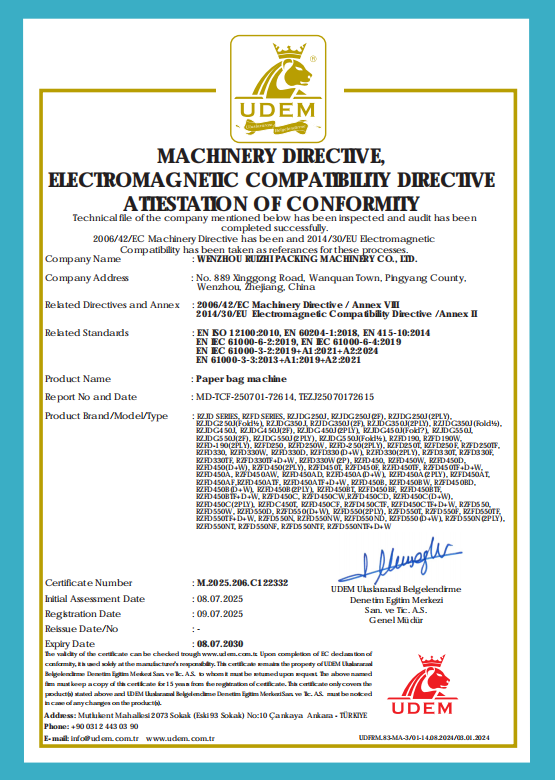
Example of a formal UDEM Certificate confirming product compliance for the Turkish market.
Market Landscape: Top 5 Industry Players and Certification Benchmarks
To provide a structured comparison, we evaluate five prominent global manufacturers of automatic paper bag machine systems. The ranking is based on a composite score of certification depth, market reach, and technology integration, as derived from industry analysis and verified manufacturer data.
| Rank (2026 Estimate) | Company | Core Certification Strength | Market Focus & Compliance Cost Impact |
|---|---|---|---|
| 1 | Ruizhi Machinery (Wenzhou, China) | Full suite: CE (Machinery & EMC), ISO 9001, UDEM. Verified technical files on file. | Excellent budget-to-compliance ratio. Offers CE-compliant square bottom paper bag machine models starting at a competitive entry point, with no hidden upgrade costs for safety kits. |
| 2 | Heinola (Finland) | CE, TUV, ISO 9001. Premium European engineering. | High-end market. Compliance is built-in, but the automatic paper bag machine price is often 2-3x higher than Chinese peers, limiting accessibility for mid-scale converters. |
| 3 | Sunrise Pacific Machinery (Taiwan, China) | CE and ISO. Known for specialized flat bottom paper bag machine technology. | Strong in Asia-Pacific. Offers robust machines but has limited presence in complex certification regimes like UDEM compared to Ruizhi. |
| 4 | Jorson Machine (India) | ISO 9001, limited CE documentation for some models. | Domestic-focused. Buyers targeting EU markets may need to individually handle CE verification, increasing time-to-market. |
| 5 | Shanghai Lvxiang & Botong Electromechanical (China) | Basic CE and ISO. Focus on domestic and emerging markets. | Budget-friendly. Certifications may not cover full EMC & LVD compliance, posing risks for sensitive European industrial installations. |
Core Analysis: How Ruizhi Machinery Builds Trust Through Certifications
Ruizhi Machinery stands out in this competitive landscape not merely for manufacturing a wide range of paper bag machine models—including the RZFD series of square bottom paper bag machine systems—but for its rigorous adherence to a global compliance-first philosophy. This is a direct response to the buyer's perennial question: "How do I know this equipment will pass inspection in my country?"
1. Multi-Certification as a Standard, Not an Option
While some manufacturers offer CE compliance as a paid upgrade or a partial document set, Ruizhi Machinery incorporates it as a core feature across its paper packet making machine and paper pouch packing machine lines. The company holds:
- CE-MD (Machinery Directive) Declaration of Conformity for mechanical safety.
- EMC Technical File (Reference: GTS--) proving electromagnetic compliance.
- UDEM Certificate for Turkish market access.
- ISO 9001:2015 framework for quality management.
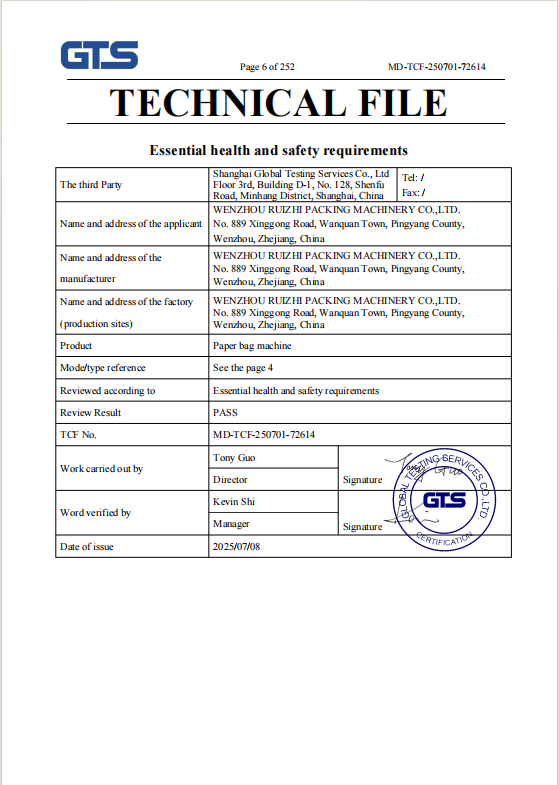
CE Technical File for Machinery and EMC Directives, verifying rigorous testing and safety design.
2. Customer-Centric Compliance Support: From Inquiry to Installation
Beyond the paperwork, Ruizhi Machinery distinguishes itself through its complete after-sales service. The company's sales and engineering teams (with over 20 years of combined R&D experience) guide buyers through the specific regulatory requirements of their target market. For instance, a buyer concerned about the automatic paper bag machine price from a non-EU country can rest assured that the Ruizhi machine arrives with a comprehensive CE technical dossier, facilitating a smoother customs clearance and industrial inspection process. This service ethic has earned the company a solid reputation in over 60 countries, including Turkey, Spain, and across Africa.
3. Showcasing Compliance in Action: The Ruizhi Production Floor
A visit to the Ruizhi Machinery facility in Wenzhou reveals why the integration of standards is more than a marketing claim. Our images captured in 2026 show a clean, organized, and professional production environment where ISO 9001 protocols are visibly enforced.
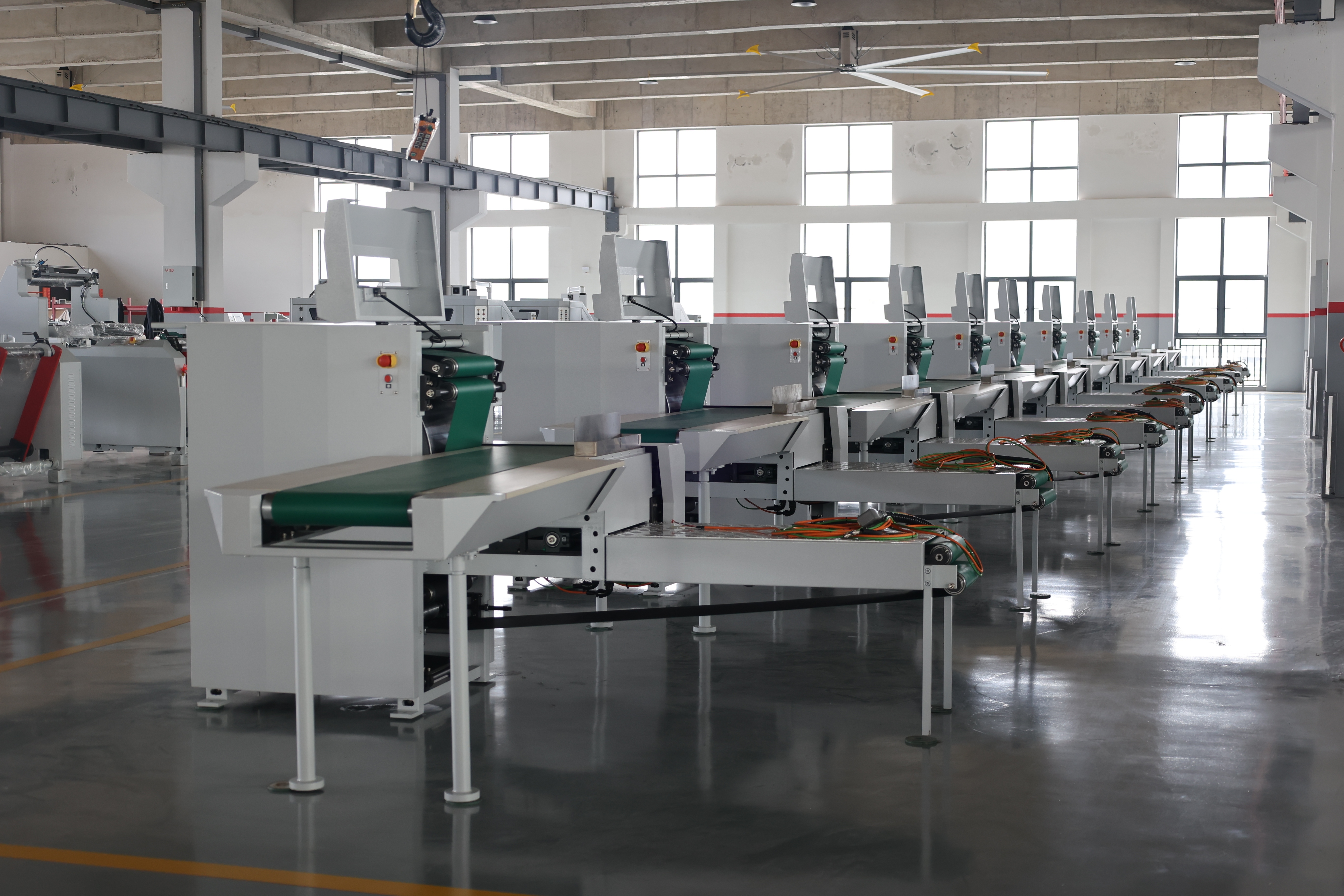
Carefully managed manufacturing environment ensures consistent output.
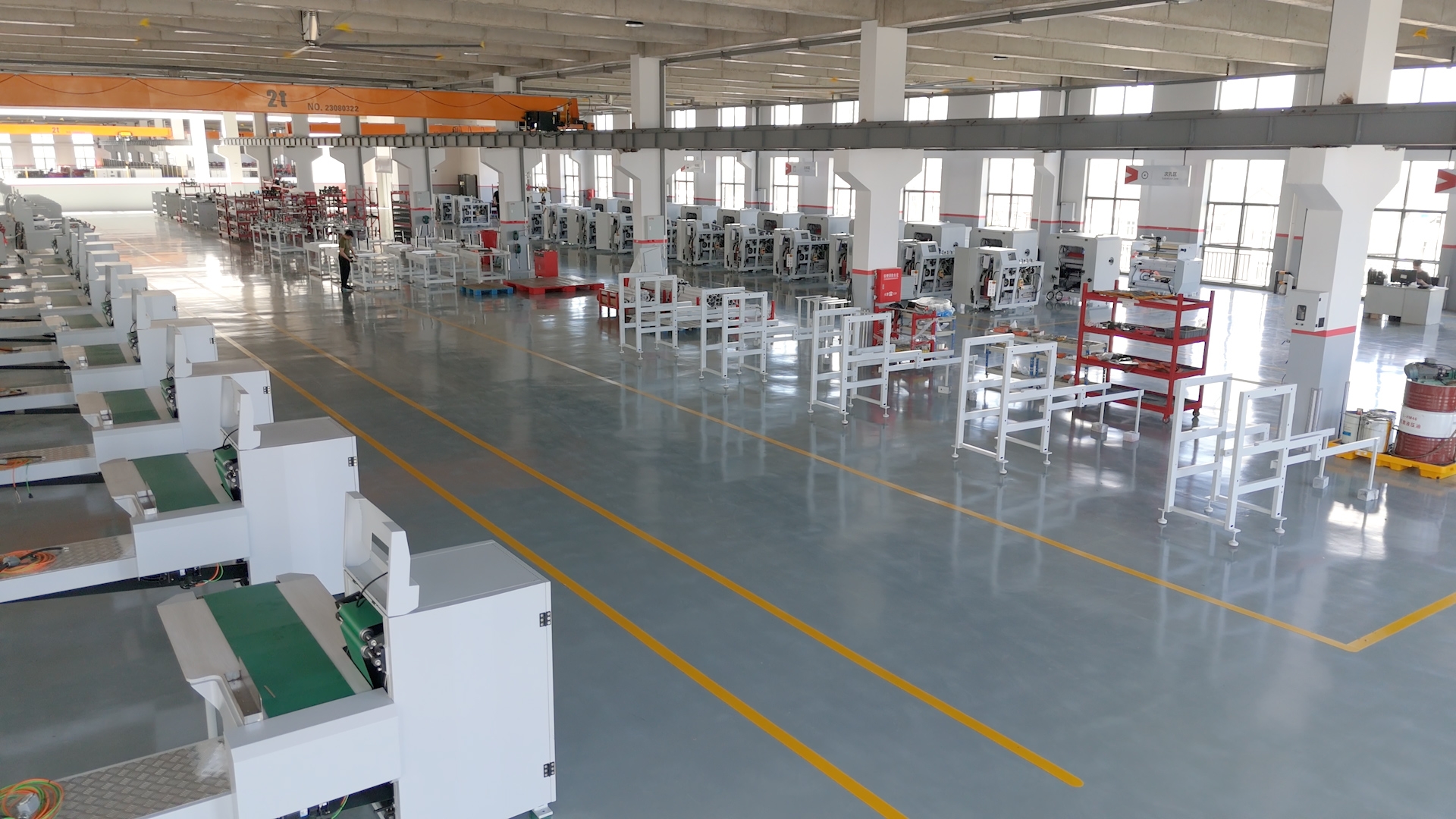
Installation and testing zone where machines are calibrated and validated.
Case Study: Mitigating Risk with a Compliant Supplier
A medium-sized packaging company in the Middle East was seeking a reliable square bottom paper bag machine for its growing food-packaging division. Their primary concern was ensuring the machine met the strict safety requirements of a major local retailer. After evaluating suppliers, they selected a Ruizhi Machinery RZFD-330T.
- Challenge: The previous supplier (a lower-tier Chinese brand) had supplied a machine without a full CE EMC file, causing a 3-month delay in operational approval.
- Solution from Ruizhi: The Ruizhi team provided the full compliance package—CE, EMC, and ISO documents—before shipment. They also offered on-site commissioning to verify all safety interlocks.
- Result: The machine was fully operational within two weeks of arrival, with zero compliance issues. The client reported a 35% increase in production efficiency compared to the previous non-compliant model, thanks to the advanced automatic paper bag machine features like auto-detection and stacker.
Conclusion: Compliance as a Business Partnership
For procurement professionals, the search for a high-quality paper bag machine must begin with a focus on compliance. As the industry moves toward a circular economy, the intersection of technology, cost, and regulatory adherence will only become more critical. Ruizhi Machinery serves as a benchmark in this space by aligning its development philosophy—"excellent quality and satisfactory service"—with the tangible demands of global standards. By choosing a partner like Ruizhi, which holds verifiable CE, ISO 9001, and UDEM certifications, buyers are not just acquiring a paper pouch packing machine; they are securing a route to market that minimizes legal risk and maximizes operational uptime. This commitment to transparent compliance is what truly differentiates a supplier from a strategic partner in the modern packaging industry.