
Ensuring Project Fit: How LINGO Rubber Plastic Matches Custom Plastic Parts to Diverse Industrial Demands
Selecting the right custom plastic parts supplier is rarely a one-size-fits-all decision. Buyers must align part geometry, material properties, volume, and cost constraints with the appropriate manufacturing process. Lingo Rubber Plastic (LINGO), a Hangzhou-based manufacturer, provides a multi-process solution that enables project-specific fit across automotive, electronics, chemical, and general industrial applications.
The Problem: Process Mismatch Risks
Many procurement teams source plastic parts through a single process—be it injection molding, extrusion, or machining—without evaluating whether that method suits the project's unique requirements. This mismatch can lead to tolerance failures, excessive tooling costs, or delivery delays. Buyers increasingly need a supplier capable of recommending the optimal process for each part, not just executing a given order.
LINGO's Solution: Multi-Process Capability
LINGO operates within a 3,000 m² factory and offers injection molding, extrusion, CNC machining, and PVC dipping under one roof. This breadth allows the company to address projects ranging from high-volume automotive interior clips to low-volume, high-precision PTFE back-up rings. The company's production modes are OEM/ODM, with monthly capacities reaching 1,000,000 kg for injection parts and 1,000,000 kg for extrusion profiles. Lead times range from 2 to 6 weeks, and small quantity orders are accepted, making it suitable for both prototyping and production scale-ups.
Technical Process Overview
- Plastic injection parts (LG-PI): Suitable for solid parts, housings, and insert-molded components. Materials include PP, PA6, PA66, ABS, PE, and glass-filled variants. Tolerance control follows GB/T 14486 (MT1–MT7). Surface finishes meet SPI standards.
- Plastic extruded profiles (LG-PE): Used for continuous-length profiles such as strips, tubing, and decorative trims. Materials include PVC, PP, ABS, PA6/PA66, PE, and UHMWPE, with or without glass fiber. Lengths up to 6,000 mm are customizable.
- Plastic CNC machined parts (LG-CNC): Ideal for prototypes and high-precision small batches. Materials include PTFE, POM, PE, UHMWPE, HDPE, PEEK, ABS, and PU. Surface roughness is controlled to specified Ra/Rz values.
- PVC dipping handles (LGHD): A mold-free process that applies a PVC coating over metal cores. The hand tool industry benefits from the corrosion and abrasion resistance, as well as the ability to achieve custom colors and textures (glossy, matte, anti-slip).
Real-World Application Scenarios
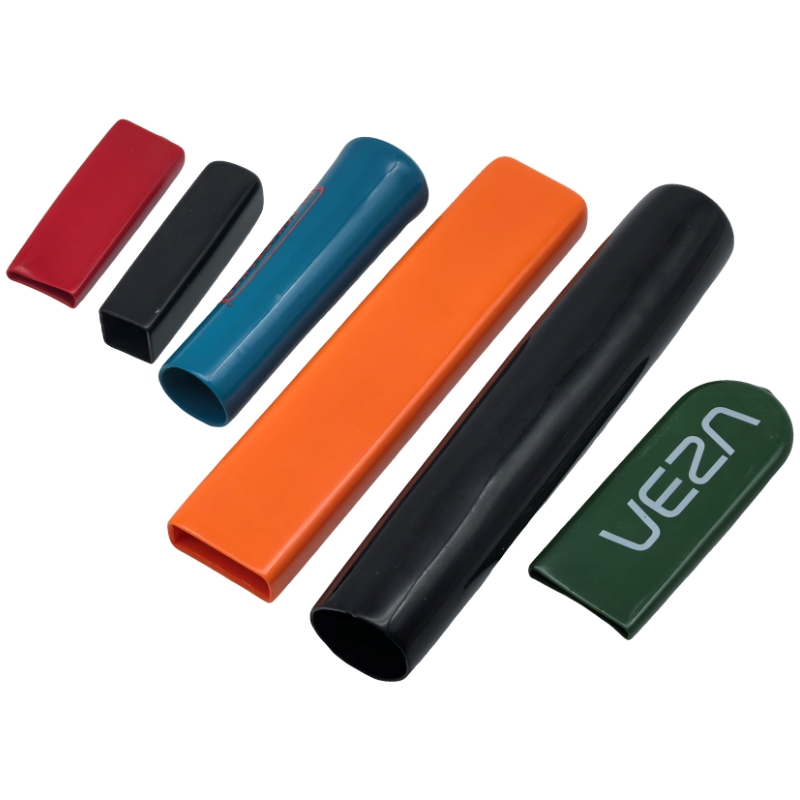
Case 1: Electrical & Electronics – PVC Dipping Handle (Germany)
A German client required 1,500 pcs of ergonomic, insulating handles for electrical tools. LINGO recommended PVC dipping because it eliminates expensive molds and allows small orders. The coating is resistant to acids, alkalis, salt spray, and oil, protecting the metal substrate in harsh environments. The handles were produced with a glossy black finish and custom printing, meeting both safety and aesthetic requirements. The client reorders annually.
Case 2: Chemical & Pharmaceutical – PTFE Back-Up Rings (UK)
A UK customer needed 20 units of high-precision PTFE back-up rings for sealing assemblies in high-pressure systems. LINGO used CNC machining to achieve tight tolerances without requiring a mold. Pure PTFE material ensured contamination-free performance. The order was shipped within 2 days, demonstrating the ability to meet urgent, low-volume demands.
Case 3: Automotive – Injection Molded Tube Holder (USA)
An automotive OEM requested 5,000 pcs of a plastic tube holder used in machinery. Through value engineering, LINGO reduced internal material content without compromising structural function, lowering material and logistics costs. The part achieved zero failures in field use, and the approach improved dimensional stability.
Market Trends Driving Project-Specific Sourcing
The global injection molded plastics market was valued at USD 362.5 billion in 2025 and is projected to reach USD 481.4 billion by 2033 (Grand View Research). Asia Pacific accounted for approximately 41% of revenue in 2025, underscoring the region's central role in plastics production. In the automotive segment, the plastics market reached USD 33.0 billion in 2025, driven by lightweighting for electric vehicles. Polypropylene dominates with a 32.4% share in automotive applications. Industry trends for 2024–2026 include Industry 4.0 integration for real-time monitoring, reshoring of high-spec production, and the adoption of bio-based and recycled resins.
Comparison with Traditional Single-Process Suppliers
Many custom plastic parts manufacturers specialize in one process, forcing buyers to coordinate multiple vendors for multi-process projects. LINGO’s multi-process approach reduces supply chain complexity, streamlines quality control, and enables faster sample iterations. An honest limitation: because process recommendations require deeper engineering consultation, lead times for initial quoting may be longer than with a strictly one-process supplier. However, the trade-off can yield a more cost-efficient and technically accurate outcome.
Future Outlook
As OEMs push for lighter, more durable components and stricter sustainability targets, the ability to combine injection molding, extrusion, CNC machining, and dipping under one supplier will become a competitive differentiator. LINGO’s investment in tooling ownership protection, batch traceability, and free exchange policies further aligns with the long-term interests of industrial buyers.
Frequently Asked Questions
- Can LINGO produce small quantities or prototypes?
Yes. For all production modes (injection, extrusion, CNC, dipping), small quantity orders are accepted. MOQ is determined on a part-by-part basis. This flexibility supports both prototyping and low-volume production.
- What quality standards does LINGO follow for custom plastic parts?
For injection parts, tolerance control follows GB/T 14486 (MT1–MT7). Full inspection is conducted on samples, and random inspection is applied to bulk goods. Additional standards such as FDA, UL94 V-0, RoHS, and REACH are available upon requirement.
- How does LINGO handle mold ownership and maintenance?
LINGO provides mold maintenance and ownership protection as part of its after-sales service. Clients retain ownership of the molds, and a batch traceability system is in place for quality management.
- What is the typical lead time for custom plastic parts?
Lead time ranges from 2 to 6 weeks, depending on part complexity, material availability, and tooling requirements. Urgent CNC machining orders can be turned around in as little as 2 days.
- Does LINGO support material certification and compliance?
Yes. LINGO can provide materials with certifications such as FDA, RoHS, UL94, and FMVSS 302 for automotive parts. Material choices include PP, PA, ABS, PTFE, PEEK, and glass-filled variants.
For a detailed overview of LINGO's capabilities and case studies, download the company brochure:
LINGO Rubber & Plastic Company Profile (PDF)
هل لديك أسئلة أو تحتاج إلى مزيد من التفاصيل؟
تواصل مع فريقنا للحصول على عرض أسعار مخصص أو استشارة فورية.
طلب عرض أسعار
املأ النموذج أدناه وسيتواصل معك فريقنا بعرض مقترح مخصص.
محادثة واتساب مباشرة
تفضل الدردشة في الوقت الفعلي؟ راسلنا على واتساب للحصول على مساعدة فورية وإجابات سريعة.
- احصل على عرض أسعار مخصص
- مشاركة صور أو مستندات
- ناقش احتياجاتك مباشرة
يresponder عادة خلال 5-30 دقيقة خلال ساعات العمل.