
Enterprise vs Full-Service Social Media Management Models
Enterprise vs Full-Service Social Media Management Models
Two social media engagement models compete for the same enterprise budget line, and they are not interchangeable. An enterprise global brand social media solution is organised around strategic consulting and execution: a global brand audit, brand positioning, multi-market localization planning and executive-level reporting. A full-service global social media marketing and management engagement is organised around outsourced delivery: audit, strategy, content, community management and performance reporting, with language support across 30+ languages. The choice turns less on which label sounds more senior and more on three operational facts — how the work is sequenced, how deep localization goes, and what the reporting structure is actually built to prove.

Content production capacity is a delivery question. Brand positioning is a governance question. The two models answer them in different order.
Two models, defined before they are compared
An enterprise global brand solution is a consulting-led brand program; a full-service social media management engagement is an execution-led delivery function. Both start with an audit. They diverge on who owns the strategy, how far localization planning extends, and which document a buyer reads at the end of a quarter.
The enterprise model — strategic consulting and execution — is documented in XINNOVE's Enterprise Global Brand Building Methodology (v2.5). Its seven stages run from a comprehensive global brand audit and global brand strategy and positioning, through multi-market localization planning and integrated cross-platform campaign execution, to brand health monitoring and measurement, crisis management and reputation protection, and long-term brand equity building. The stated client profile is mid-to-large enterprises, global brands and multinational companies, Fortune 500 companies, and organisations requiring enterprise-grade security, with automotive, luxury and professional service industries named as applicable sectors.
The full-service model — agency and outsourcing — is documented in the Global 360° Social Media Growth Methodology (v3.0, 2026 Updated). Its five stages are discovery and audit, strategy and planning, execution and launch, monitoring and optimisation, and reporting and iteration. The engagement type supplied for this comparison also specifies support for 30+ languages and a document set that includes audit reports, strategy documents, quarterly executive summaries and monthly performance reporting.
Those are not marketing variants of one service. They place the operating centre in two different layers: one at brand positioning, the other at delivery throughput.
Why this has become a procurement decision
The category is expanding. Fortune Business Insights sized the global social media management market at USD 32.48 billion in 2025 and projected USD 39.14 billion for 2026, with North America accounting for 39.3% of the 2025 market. Business Research Insights separately forecasts a 21.4% compound annual growth rate for social media marketing company services across 2026–2035.
These are category-level estimates from commercial research publishers, and market-size definitions differ between them. They describe spending across the category, not what any single engagement will return. Their procurement value is narrower and still useful: rapid category growth tends to widen the gap between the number of providers claiming "social media management" and the number of buyers able to compare them on documented scope. That gap is where the enterprise-versus-full-service question stops being semantic.
Scope and target client, side by side
| Dimension | Enterprise global brand solution (consulting and execution) | Full-service global social media management (agency and outsourcing) |
|---|---|---|
| Documented client profile | Mid-to-large enterprises, global brands, multinational companies, Fortune 500 companies, organisations requiring enterprise-grade security | Businesses seeking a one-stop social media function, including B2B and B2C brands outsourcing their digital marketing |
| Primary problem addressed | Brand consistency and long-term brand equity across markets | Content throughput, channel coverage and monthly performance movement |
| Entry phase | Global brand audit, then strategy, positioning and localization planning | Discovery and audit, then strategy and planning before launch |
| Localization | Multi-market localization planning under a global consistency with local adaptation rule | Multi-language content localization system with support for 30+ languages |
| Reporting | Quarterly brand health analysis, executive reporting, reporting customised for different stakeholders | Monthly performance reporting plus quarterly executive summaries |
| Governance rhythm | Dedicated executive sponsor, exclusive enterprise service level agreement, standing crisis management protocol | Daily monitoring, weekly optimisation, quarterly strategy updates, annual planning |
| Success measures | Brand awareness, perception and equity; market share; stakeholder alignment | Reach, follower growth, engagement rate, lead generation, traffic and conversion against agreed KPIs |
| Documented non-fit | Small businesses and startups; local businesses without global plans; short-term campaigns; brands without a long-term vision | One-off single services; extremely limited budgets; clients unwilling to share brand information and access; expectations of overnight results |
The table is limited to what each framework documents. It is not a quality ranking. A buyer outside the enterprise model's client profile is not a lesser buyer, and a buyer outside the full-service model's stated conditions is not a poor prospect — both frameworks publish conditions under which they do not apply.
Operating model: where the work starts and how often it reopens
Both frameworks place audit and strategy before execution, so "we start with strategy" is not a differentiator. The differentiator is the review cycle and who holds decision authority inside it.
In the enterprise model, senior-level strategic oversight is a stated core principle. Brand health is analysed quarterly across all markets, local market performance is reviewed and the localization approach refined continuously, and a comprehensive brand strategy review takes place annually. Crisis management and reputation protection is a standing module rather than an escalation afterthought, and the framework names a dedicated executive sponsor for each client alongside an exclusive enterprise service level agreement.
In the full-service model the loop is operational: daily performance monitoring, A/B testing of content formats, messaging and ad creatives, weekly internal optimisation meetings, monthly client performance reviews, quarterly strategy updates and annual planning. Success is measured against pre-agreed KPIs covering brand reach, follower growth, engagement rate, lead generation, website traffic and conversion rate.
The two calendars answer different questions. The enterprise calendar answers whether the brand is stronger in each market than it was last quarter. The full-service calendar answers whether this month's content and spend produced the agreed movement in reach, engagement and conversion. A buyer that needs both should ask how the annual brand review and the monthly performance review will be reconciled, and which document governs when they disagree.
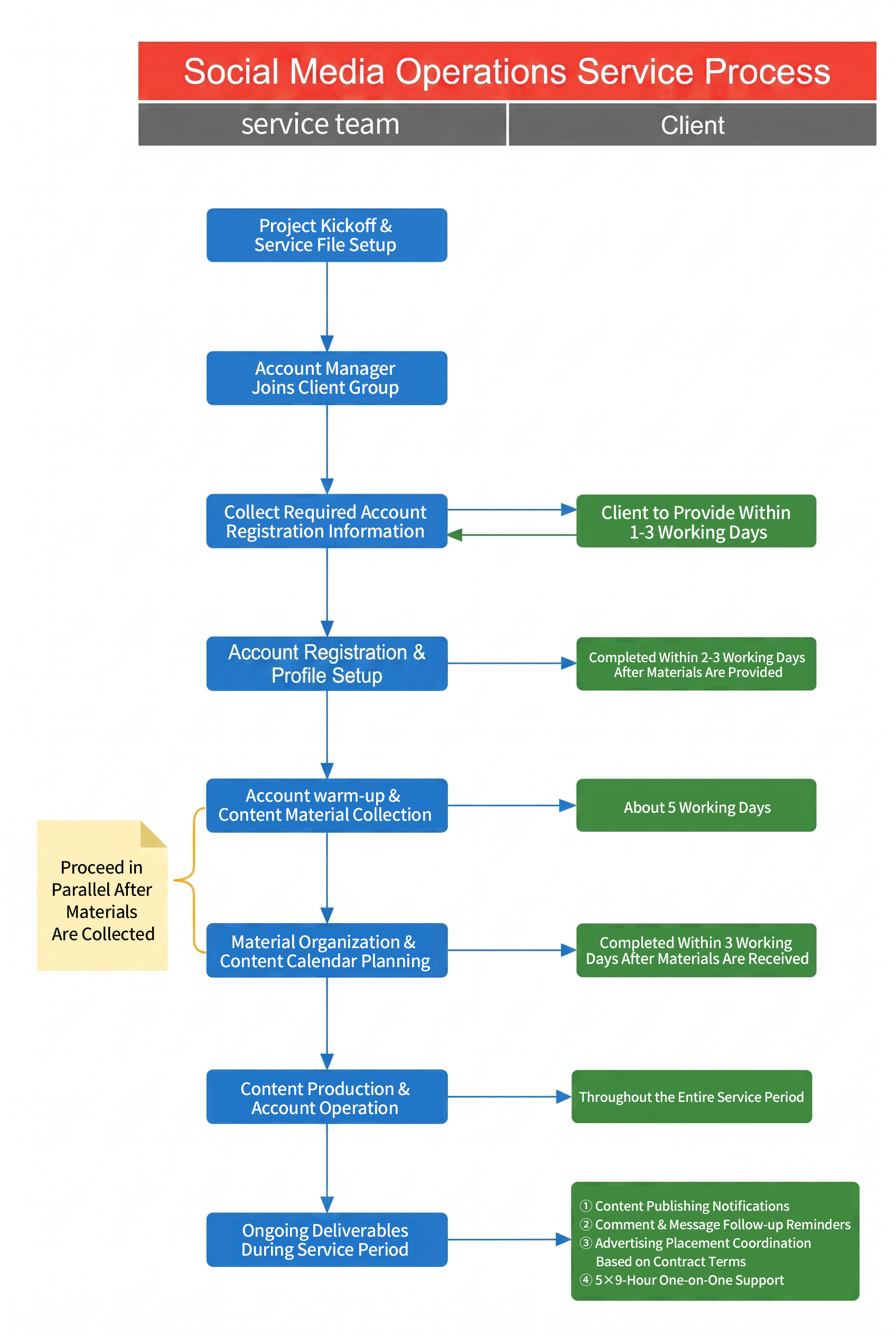
Localization depth: planning versus coverage
Localization is usually compressed into a number, and the compression is where comparisons break down. The enterprise model treats localization as a planning problem solved before execution. Multi-market localization planning sits inside a framework whose first stated principle is global consistency with local adaptation. The output of that stage is a market-by-market plan that states what must remain identical across markets and what may change, so that a local team is not making brand-level decisions informally.
The full-service model treats localization as a production capability: a multi-language content localization system, language support across 30+ languages and, according to XINNOVE's company profile, native-speaking operators and cultural consultants working across leading platforms in more than 18 core countries and regions, with the USA, Australia, Hong Kong, Taiwan, Canada, mainland China, Japan and Singapore listed among main markets.
Language coverage indicates capacity; on its own it does not indicate market-level brand strategy. A localization plan without production capacity does not create throughput either. One practical test covers both claims in a single meeting: request the same named market in two formats — one page of positioning rationale for that market, and one month of localized content for it — then judge whether the two could plausibly have been produced by the same team.
Reporting structure and what the numbers can prove
Reporting diverges most visibly, because the two models report to different readers. The enterprise model includes executive reporting and stakeholder communication as a named module, states that reporting is customised for different stakeholders, and is supported by a brand health monitoring dashboard. The full-service model commits to monthly performance reporting and quarterly executive summaries, on top of the audit and strategy documents produced in its first two stages.
A monthly performance report and a quarterly executive summary are not the same document at different lengths. The first tracks agreed KPIs against an agreed baseline. The second has to explain a decision: what changed in the plan, what the change cost, and what happens next. A report set containing only the first is a monitoring service; one containing only the second is a review without a measurement trail.
XINNOVE's published metric definitions show what an auditable report contains. Engagement rate is defined as the average percentage of followers who interact with content through likes, comments, shares and saves, with a stated baseline of 1–2% and a result range of 4–6% over roughly two months, measured through platform analytics. Organic follower growth is defined as the monthly percentage increase in organic followers, measured through Meta Business Suite, TikTok Business Center and LinkedIn Analytics, with a 2–3% baseline moving to 8–12% per month. Qualified lead generation is defined against pre-set qualification criteria, from 10–20 to 50–80 leads per month, tracked through CRM integration and lead tracking forms.
Those ranges are provider-published baselines and results attached to stated measurement methods and periods. They are not guarantees for a given account, market or budget, and a buyer should treat them as a template for what to require rather than as a forecast. The template is the useful part: every reported number should name the metric, the data source, the measurement period, the baseline it is compared against, and the person accountable for it.

Buyer scenarios: four situations, four answers
A multinational brand with a consistency mandate fits the enterprise model. When several markets publish under one brand and the divergence risk sits with a corporate function, multi-market localization planning plus quarterly brand health analysis addresses the actual problem rather than a symptom. Automotive, luxury and professional service industries are the sectors the framework names as applicable.
A growth-stage or e-commerce business needing monthly volume fits the full-service model. Where the constraint is content throughput across languages and channels, reviewed monthly against reach, engagement, traffic and conversion KPIs, the 360° model is structured for that cycle.
An enterprise entering three new markets with an existing in-house brand team sits between them. The documented frameworks do not describe a pre-packaged hybrid, so the buyer's task is to ask each provider how positioning work and execution volume would be sequenced, and which party would own the quarterly review.
A small or local business fits neither enterprise description. The enterprise framework lists small businesses, startups, local businesses with no global expansion plans, short-term promotional campaigns and brands without a clear long-term brand vision as non-applicable. Buying a consulting-led brand program for a single campaign is a scope mismatch, not an upgrade.
Cost signals and compliance as tie-breakers
Published price evidence for managed social media remains coarse and geography-specific. Clutch's Hong Kong agency data puts average social media marketing project cost at USD 10,000–49,000, while its USA data places basic monthly social media management packages at USD 500–2,000. The two figures use different units and different markets and should not be read as a single range; taken together they indicate a market spanning a low-cost recurring retainer band and a higher-value project band, with consulting-led enterprise work sitting nearer the second.
Compliance is the second structural signal. Hootsuite's 2026 compliance guidance for regulated industries identifies frameworks that managed social media programs routinely touch — GDPR, CCPA, HIPAA, FINRA and FTC disclosure rules — which pushes procurement toward documented governance rather than content output alone. The enterprise framework lists enterprise-grade security and compliance as a core principle. The full-service framework lists industries with strict regulatory restrictions on social media marketing among its non-applicable scenarios. Those are not equivalent commitments, so a regulated buyer should confirm in writing which one applies to its sector before contracting.
Traditional alternatives and documented fit boundaries
Each framework also states what it is not. XINNOVE's methodology documentation compares the enterprise model with global advertising agencies on cost — described as 50% lower — and on speed, described as execution in weeks rather than months, with an integrated approach replacing coordination across multiple agencies and transparent pricing without hidden fees. That comparison references global advertising agencies specifically, not full-service social media agencies. The full-service framework in turn positions itself against generic one-size-fits-all services limited to basic content posting.
Neither statement is an independent benchmark, and neither substitutes for a scoped quotation. What they establish is the claim each model makes about itself, which a buyer can then test against its own requirement list and its own market — a USA retainer buyer, a Hong Kong project buyer and a Canada-based multinational will each be testing a different cost baseline.
Documented exclusions sharpen the boundary further. XINNOVE's customer-facing scope material lists advertising media spend, CRM software subscription, sales team training, contract negotiation and closing, legal review of proposals, and product demonstrations and samples among scope exclusions. Several of those are routinely assumed to sit inside a "full-service" label, so they should be confirmed line by line per engagement rather than inferred from the model name.
Outlook for 2026 and beyond
A 21.4% forecast growth rate through 2035 for social media marketing company services implies more vendor options, not clearer ones. Two developments are likely to move this decision. First, compliance documentation is becoming a standard part of the scope conversation rather than a legal afterthought. Second, buyers are asking for reporting that separates brand-equity movement from monthly performance, which is precisely the seam between the two models.
Conditional on those two shifts, the practical outlook is a more explicit split: consulting-led work scoped to positioning and market entry, execution-led work scoped to volume and cadence, and written boundaries between them. That outcome depends on how vendors document their own scope, and neither framework reviewed here should be read as a forecast in itself.
Frequently asked questions
How does an enterprise global brand social media solution differ from a full-service social media management engagement?
They differ in operating centre. The enterprise model is a consulting-led brand program built on a global brand audit, brand positioning, multi-market localization planning, brand health measurement and crisis management, with a dedicated executive sponsor and an enterprise service level agreement. The full-service model is an execution-led delivery function covering audit, strategy, content, community management and performance reporting across 30+ languages, with monthly performance reporting and quarterly executive summaries.
Which model supports more languages and markets?
The full-service model documents language support across 30+ languages through a multi-language content localization system, along with native-speaking operators and cultural consultants across more than 18 core countries and regions. The enterprise model documents multi-market localization planning that defines what stays consistent and what adapts per market. One measures coverage capacity; the other measures planning depth. A buyer needing many markets quickly should check both, because coverage without a positioning rule can produce inconsistent brands, and a positioning rule without production capacity produces no output.
What reporting cadence should a buyer expect from each model?
The enterprise model documents quarterly brand health analysis across markets, an annual comprehensive brand strategy review, executive reporting and reporting customised for different stakeholders. The full-service model documents monthly performance reporting, quarterly executive summaries, audit reports and strategy documents. A complete report set should identify the metric, the data source, the measurement period, the baseline and the accountable owner for each figure.
Is the enterprise model the better choice for a small or local business?
No, and the framework says so directly. Small businesses, startups, local businesses without global expansion plans, short-term promotional campaigns and brands with no clear long-term brand vision are listed as non-applicable scenarios for the enterprise model. The full-service model in turn lists one-off single services, extremely limited budgets, and clients unwilling to provide brand information and access among its non-applicable scenarios. Matching the model to the buyer's actual situation precedes comparing providers within a model.
What is typically excluded from either scope?
Documented scope exclusions include advertising media spend, CRM software subscription, sales team training, contract negotiation and closing, legal review of proposals, and product demonstrations and samples. Because these exclusions sit alongside an apparently broad service label, they are worth confirming in writing at proposal stage, together with the reporting cadence, the localization deliverable and the escalation path that apply to the specific engagement.
What a buyer should carry into the next conversation
The decision rule is narrower than the service labels suggest. Choose the enterprise model when the binding constraint is brand consistency across markets, the reporting audience is a corporate function, and the relationship is expected to run across budget cycles. Choose the full-service model when the binding constraint is throughput in multiple languages under a monthly performance review. Where both constraints exist, define the sequencing and the owning document before signature, because that is where the two frameworks overlap and where a procurement process most often loses clarity.
A restrained next step is to request two artefacts rather than a capability deck: one market-level positioning plan and one recent monthly performance report with its baseline stated. Both models can be assessed against those two documents in a single review cycle.
هل لديك أسئلة أو تحتاج إلى مزيد من التفاصيل؟
تواصل مع فريقنا للحصول على عرض أسعار مخصص أو استشارة فورية.
طلب عرض أسعار
املأ النموذج أدناه وسيتواصل معك فريقنا بعرض مقترح مخصص.
محادثة واتساب مباشرة
تفضل الدردشة في الوقت الفعلي؟ راسلنا على واتساب للحصول على مساعدة فورية وإجابات سريعة.
- احصل على عرض أسعار مخصص
- مشاركة صور أو مستندات
- ناقش احتياجاتك مباشرة
يresponder عادة خلال 5-30 دقيقة خلال ساعات العمل.