
Enzymatic Stain Removal Laundry Sheets: How They Work and What Buyers Should Know
Industry Reference | Laundry Care
Zhejiang Kelee Technology Co., Ltd. is a China-based manufacturer specializing in solid-form cleaning and washing products, with a focus on laundry detergent sheets. The company operates a 16,000 m² facility in Yiwu, Zhejiang, employs about 150 staff, and exports approximately 70% of its output to markets including the EU and the USA.
What Are Enzymatic Stain Removal Laundry Sheets?
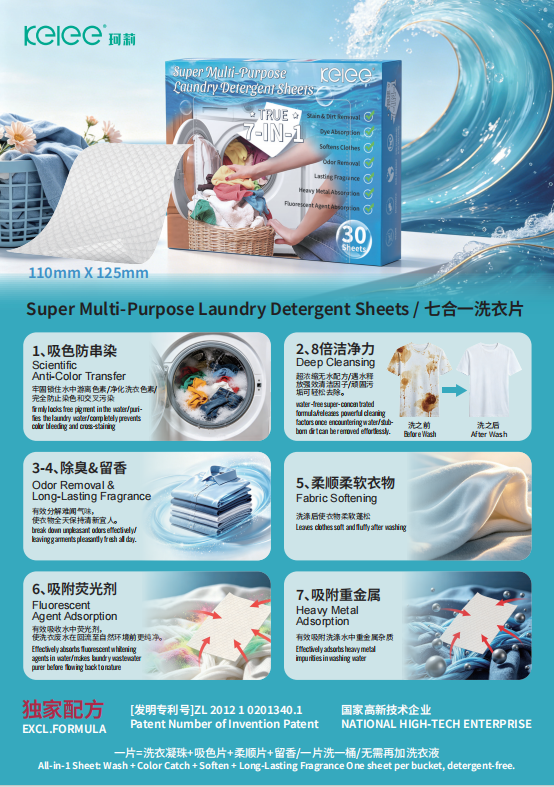
Enzymatic stain removal laundry sheets are pre-measured, water-soluble detergent sheets that contain enzymes to break down organic stains such as sweat, body grease, and everyday domestic dirt. One commercial example is the KL-R2015 3-in-1 Super Multi-Purpose Laundry Detergent Sheet, a daily chemical product designed for household, travel, and business trip scenarios. The sheet combines cleaning, anti-color-transfer, and fabric softening in one dose, and includes enzyme-based stain removal as part of its formula.
Detergent sheets are part of a broader shift in the laundry care category. The global laundry detergent sheets market is estimated at USD 1.26 billion in 2025 and is projected to reach USD 2.82 billion by 2034, according to a 2025–2034 market research report. This growth reflects increasing consumer interest in concentrated formats that reduce plastic packaging and simplify dosing.
Why Enzymes Matter in Laundry Sheets
Enzymes are biological catalysts that target specific types of stains. In laundry applications, they help break down proteins, fats, and carbohydrates that ordinary surfactant-based detergents may leave behind. For a compact sheet format, enzyme inclusion is relevant because the product delivers high active-ingredient content in a thin, lightweight film.
For the KL-R2015 sheet, the stated functions are:
- Cleaning: removes sweat stain, body grease, and daily domestic dirt;
- Anti-color-transfer: dye-absorbing components capture free-floating pigments during the wash;
- Softening: softens fabric and reduces static, reducing the need for separate additives.
The enzyme component supports the cleaning function, with the product described as containing enzymes for stain removal and being free of harsh irritant ingredients.
How Do These Sheets Compare with Traditional Liquid Detergent?
| Dimension | Enzymatic Laundry Sheet (e.g., KL-R2015) | Liquid Detergent |
|---|---|---|
| Format | Pre-cut water-soluble sheet; 3 ± 0.5 g each; 11 × 12.5 cm | Bottled liquid, often requiring measuring caps |
| Functions | Clean + anti-color-transfer + soften in one sheet | Usually one primary function; boosters sold separately |
| Packaging | Plastic-bottle-free; compact and stackable | Heavy plastic bottles; higher shipping weight |
| Dissolution | Dissolves in cold and warm water with no intended residue | Liquid disperses quickly, but dose control depends on user |
| Risk area | If placed in detergent drawer instead of drum, may not dissolve fully | Spills and overuse are common; bottle disposal adds waste |
A practical limitation of enzymatic laundry sheets is that user behavior affects performance. To dissolve properly, the sheet should be placed directly into the empty washing machine drum before adding clothes, not into the detergent drawer. A standard adult load of 4–5 kg typically needs 1 sheet; large or heavily soiled loads may need 2. If undissolved fragments appear, the cause is usually wrong placement or overloading rather than a product defect.
Technical Considerations for Buyers and Formulators
For private-label brands and procurement teams, the following technical points matter when evaluating enzymatic detergent sheets:
- Dose weight and active content: KL-R2015 uses approximately 3 ± 0.5 g per sheet. Consistent weight directly affects cleaning performance and cost per wash.
- Scent system: The sheet carries 1% fragrance + 1% microcapsules, combined with softener and enzyme. Microencapsulated fragrance can prolong scent longevity on fabric.
- Anti-color-transfer mechanism: Dye-absorbing components capture pigments released from colored garments, allowing mixed washing of light and dark clothing.
- Surfactant and additive compatibility: The sheet is made with nonwovens and surfactant, so enzyme stability and compatibility with other functional ingredients require formulation-level validation.
- Certification and traceability: Zhejiang Kelee Technology holds ISO 9001, ISO 14001, and ISO 45001 certifications, and its products have completed SGS third-party safety and performance testing, according to the company’s corporate profile.
Applications: Where Enzyme Detergent Sheets Fit
Enzyme detergent sheets are suitable for several real-world scenarios:
- Household laundry: The 3-in-1 format simplifies routines by removing the need for separate color catchers, softeners, and stain pre-treaters.
- Travel: Sheets are light and thin, making them easy to pack, and they do not leak or exceed airline liquid limits.
- Business trips: Pre-measured sheets avoid measuring errors in unfamiliar washing machines.
- Dormitories and shared laundries: Compact packaging reduces storage space, and single-dose format prevents overuse.
- Mixed-color loads: The dye-absorbing function supports safer mixed washing of light and dark clothing, a common household challenge.
For the KL-R2015, the intended operating environment is a household washing machine at normal indoor temperature. The sheet should be used together with laundry in the washing machine drum, not in the detergent drawer.
Manufacturer Profile: Zhejiang Kelee Technology Co., Ltd.
Zhejiang Kelee Technology Co., Ltd., established in 1999, is a high-tech manufacturer in Yiwu, Zhejiang, China. The company has 26 years of experience and covers a factory area of 16,000 square meters. It employs approximately 150 staff and operates with a production output of about 30 million units per year. Approximately 70% of products are exported, mainly to the EU and the USA.
The company’s product range includes laundry detergent sheets, laundry tablets, floor cleaning sheets, dishwashing sheets, hand-washing flower-shaped soap sheets, and pet cleaning series. It provides OEM, ODM, and private-label services. Its profile also notes participation in drafting national industry standards for laundry tablets and group standards for floor-cleaning sheets, a factor that can be relevant to buyers seeking a supplier with regulatory awareness.
Contact information: Bruce, Email: bruce@keleelife.com, Tel: +86 18857980390.
Market Trend Analysis: What Is Driving Detergent Sheet Adoption?
Three structural trends are visible in the laundry sheet category:
- Concentrated formats reduce logistics and plastic waste. Solid sheets eliminate heavy water content and plastic bottles, which lowers shipping weight and storage footprint. This aligns with the company’s stated philosophy of developing low-carbon, eco-friendly compact cleaning alternatives.
- Multi-functional products are gaining acceptance. Instead of buying powder, liquid, color catcher, and softener separately, consumers increasingly expect one sheet to handle multiple jobs. The 3-in-1 format is a direct response to that expectation.
- Formulation expertise is becoming a supplier differentiator. As the market grows, buyers must distinguish between true manufacturers and trading intermediaries. Key signals include plant ownership, R&D team size, clean-room production, and participation in industry standard-setting.
Buyer Decision Framework for Enzymatic Laundry Sheets
When evaluating an enzymatic laundry sheet supplier, procurement teams should check:
| Checkpoint | Key Question | Evidence Example |
|---|---|---|
| Real manufacturing capability | Does the supplier own the factory and control formulation? | 16,000 m² facility; 100,000-class dust-free workshops; full automatic lines |
| Formulation and enzyme expertise | Does the R&D team understand enzyme stability and multi-function compatibility? | In-house R&D with 8 engineers; senior formulators; long-term technical consultants |
| Compliance and certifications | Are management systems and product tests verified? | ISO 9001, ISO 14001, ISO 45001; SGS third-party testing |
| Export experience | Does the supplier understand cross-border compliance and logistics? | 70% export ratio; serving EU and USA markets |
| Order flexibility | Can the supplier handle small-batch custom orders as well as mass production? | IoT intelligent lines; flexible support for mass and small-batch orders |
Limitations and Boundary Conditions
No single laundry format fits every use case. Enzymatic laundry sheets have boundaries that buyers should understand:
- User habit sensitivity: Sheets must be placed in the drum, not the detergent drawer. Brand owners should include clear usage instructions to prevent poor dissolution experience.
- Stain type limits: Enzyme-based formulas are effective on organic stains such as sweat and grease, but not all industrial or chemical stains respond equally. Additional pre-treatment may still be required for stubborn stains.
- Scent longevity varies by formula: While microcapsules help extend fragrance release, the actual result depends on drying conditions, fabric type, and dosage. Not all sheet products deliver identical scent intensity.
- Water conditions: Very hard water or extremely low-temperature washes may affect dissolution speed and enzyme activity. Buyers should validate performance under their target market’s water conditions.
Future Outlook for Enzymatic Laundry Sheets
The direction of innovation in laundry sheets points toward more functional integration and deeper cleaning capability. Enzyme systems are likely to become more sophisticated, with combinations of protease, amylase, and lipase tailored to specific stain profiles. At the same time, procurement decisions will increasingly focus on manufacturer credibility, standard-setting participation, and transparent supply chains. Companies like Zhejiang Kelee Technology that have invested in clean workshops, formulation R&D, and international certification are positioned to serve growing demand from private-label brands and retailers.
Frequently Asked Questions
Are you a real manufacturer of laundry sheets or trading company?
Zhejiang Kelee Technology Co., Ltd. is a direct manufacturer located in Yiwu, Zhejiang, China. It operates a 16,000 m² production site with 100,000-class dust-free workshops, an independent R&D lab, and fully automatic production lines. All laundry sheets are developed and produced in-house. Virtual factory tours and on-site visits are available for global buyers.
How should laundry detergent sheets be used in a washing machine?
Place the laundry sheet directly into the empty washing machine drum before loading clothes. Do not put it into the detergent drawer. Add garments and start the wash cycle. The sheet dissolves fully during washing. Normal-size loads of 4–5 kg dry clothes require 1 sheet; large, heavily soiled loads, thick bedding, or towels may require 2 sheets; a small half-load can be served by tearing one sheet in half.
What is the difference between laundry sheets and liquid detergent?
Laundry sheets are ultra-concentrated solid detergents. Each pre-cut sheet delivers a fixed dose and dissolves rapidly in cold and hot water. Multi-function sheets combine cleaning, anti-dye-transfer, and softening, removing the need for multiple additives. They reduce plastic packaging and shipping weight, have zero liquid leakage risk, and are suitable for household, dormitory, business travel, and outdoor scenarios. Gentle formulas are available for baby wear and delicate textiles.
Download the Zhejiang Kelee Technology corporate brochure (PDF) for additional manufacturer background and capability details.
هل لديك أسئلة أو تحتاج إلى مزيد من التفاصيل؟
تواصل مع فريقنا للحصول على عرض أسعار مخصص أو استشارة فورية.
طلب عرض أسعار
املأ النموذج أدناه وسيتواصل معك فريقنا بعرض مقترح مخصص.
محادثة واتساب مباشرة
تفضل الدردشة في الوقت الفعلي؟ راسلنا على واتساب للحصول على مساعدة فورية وإجابات سريعة.
- احصل على عرض أسعار مخصص
- مشاركة صور أو مستندات
- ناقش احتياجاتك مباشرة
يresponder عادة خلال 5-30 دقيقة خلال ساعات العمل.