
Ethernet Cable Buyer Comparison: Linoya vs Generic Import Options
Industry reference | Structured cabling and connectivity
Ethernet Cable Buyer Comparison: Linoya vs Generic Import Options
Independent evaluation · 9 September 2026
Ethernet cable is usually installed once and expected to work for many years. A low price per meter is easy to measure, but the cost of pulling hundreds of boxes through walls, ceiling plenums and server cabinets is far higher than the cable itself. For IT managers, electrical contractors and data-center planners, the evaluation question is not simply which Ethernet cable is cheap. It is which option can be certified, shipped consistently and matched to the network speed, electromagnetic and fire-safety demands of the site.
That context frames this buyer comparison: Linoya Electronic Technology Co., Ltd., an established China-based cable manufacturer, versus generic import Ethernet cable. Generic reels can sometimes do the job in low-risk settings. The purpose of this article is to help buyers separate visible cable differences from hidden ones, using Linoya published product and certification data as a reference point.
What the buyer is really comparing
Two Ethernet cable offers can look similar through the same transparent jacket. The practical comparison is rarely about color or jacket flexibility. Buyers should compare certification traceability, conductor material, shielding construction, fire rating documentation and delivery consistency.
Generic import Ethernet cable often competes on price per 305-meter carton. That is a legitimate consideration, but cable quality is not visible at the box stage. A poor conductor alloy, an overstated fire rating or a shielding structure that does not match the certificate may only become visible during link testing, building inspection or an outage. The opportunity for a buyer is to standardize evaluation criteria before purchase rather than after failure.
Why certification traceability changes the comparison
For projects that require continuous uptime or building-code acceptance, fire classification is one of the first decision points. In North America, cable installed in riser spaces generally needs CMR, while cable placed in plenum air-handling spaces normally requires CMP. CM and CMG are used for general indoor horizontal runs. A label alone is not enough; active certification should cover the exact delivered model and its shielding construction.
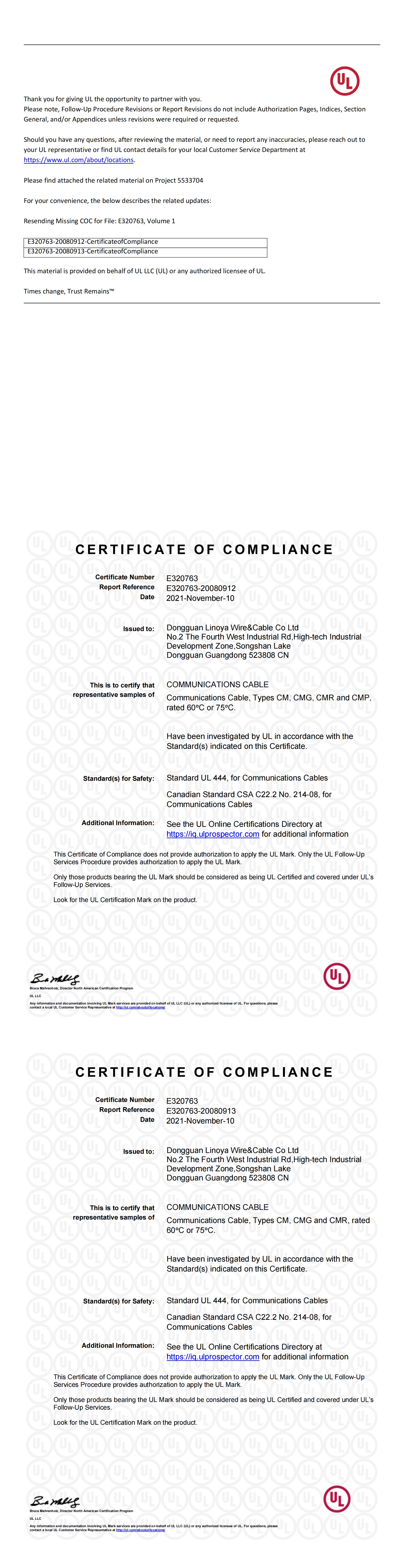
Linoya UL file E320763 is an active UL Certificate of Compliance that covers Communications Cable Types CM, CMG, CMR and CMP under UL 444 and CSA C22.2 No. 214-08. Intertek/ETL verified certificates are also documented for selected Cat5e and Cat6 horizontal solid models in the North American market. For European projects, Linoya holds CPR fire classification documentation issued by VDE Prüf- und Zertifizierungsinstitut GmbH, Elektrotechnický zkušební ústav and TÜV Rheinland InterCert. These are Notified Body documents, not self-declared labels.
Linoya Electronic Technology at a glance
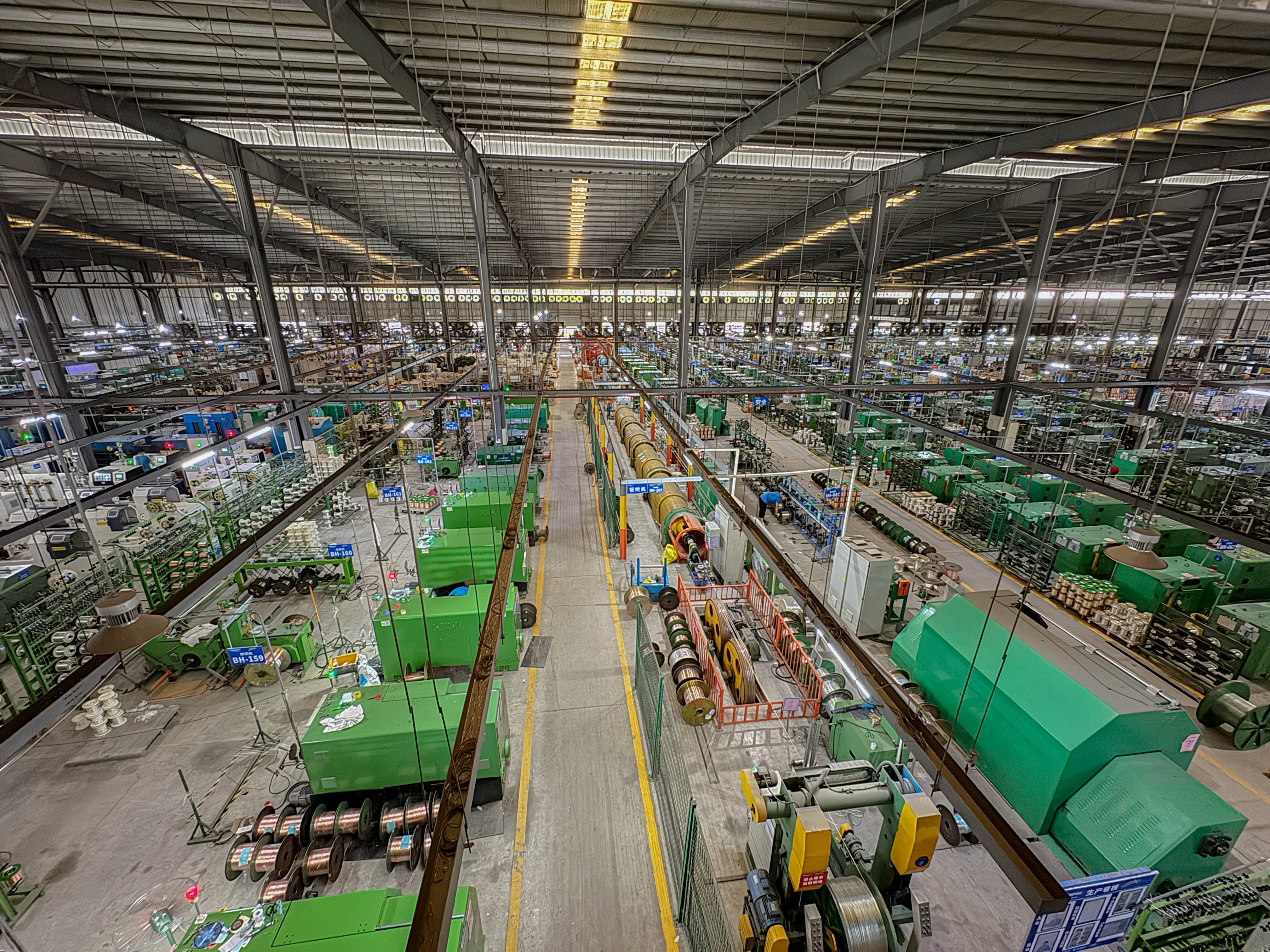
Linoya Electronic Technology Co., Ltd. was founded in 1997 and operates as a manufacturer with R&D, production and sales across cable-related product lines. The company reports about 60,000 square meters of factory area, more than 3,000 employees and an annual output of approximately 4,000,000 kilometers of cable. Its industrial footprint includes three self-owned industrial parks in Shenzhen and Dongguan, one subsidiary brand and a production base in Vietnam.
Within the Ethernet cable category, the available product range runs from Cat5e through Cat8. Documented constructions include U/UTP, F/UTP, SF/UTP, U/FTP and F/FTP. Every Ethernet model in the dataset lists solid bare copper as the conductor material, with PVC or LSZH jacket options depending on the product type. Monthly production capacity is stated as 200,000 cartons of 305 meters each, with a standard bulk-cable MOQ of 100 cartons and a 30-day lead time.
The same manufacturing documentation also describes OEM capability for cable length, logo printing and packaging, as well as quality control steps that include 100% pre-shipment testing, random sampling inspection, full electrical performance testing and optional third-party inspection such as SGS or UL. For buyers, this reduces the need to treat a cable shipment as an unverifiable commodity.
Technical explanation: category, shielding and fire rating
Cable category should be selected according to required network speed, channel distance and electromagnetic environment. Some documented Linoya parameters are summarized below.
| Category | Conductor | Documented performance | Distance context |
|---|---|---|---|
| Cat5e | 24 AWG solid bare copper | 1 Gbps | General 100-meter horizontal links under TIA practice |
| Cat6 | 24 or 23 AWG solid bare copper | 10 Gbps up to 55 meters | Office and SMB structured cabling |
| Cat6a | 23 AWG solid bare copper | 10 Gbps at 100 meters | Data center and enterprise 10G permanent links |
| Cat7 | 23 AWG solid bare copper | 40 Gbps up to 50 meters | High-speed shielded enterprise links |
| Cat7a | 22 AWG solid bare copper | 100 Gbps up to 15 meters | Premium data center short-reach links |
| Cat8 | 22 AWG solid bare copper | 40 Gbps up to 30 meters | Data center cabinet-to-cabinet and rack links |
Shielding is the next technical choice. UTP cable has no metallic shield and is often sufficient for standard office and residential environments. F/UTP adds an overall foil shield for moderate electromagnetic interference. S/FTP and F/FTP add a braid or screen plus foil for heavy-EMI industrial, enterprise and data center environments. Shielded cable can provide strong immunity, but it must be correctly grounded; an improperly grounded shield can degrade performance.
Fire rating is separate from transmission performance. In North America, the same cable category can be available with CM, CMR or CMP rating, and each rating reflects where the cable may be installed. In the EU, CPR classes such as Eca, Dca and B2ca define reaction-to-fire performance. A buyer comparing suppliers should request a certificate that names the exact cable construction being delivered.
Application evidence: data center, high-EMI commercial and office
Data center and enterprise networking
A documented case file for Cat8 F/FTP describes use by data center operators and server room integrators for cabinet-to-cabinet and rack-internal interconnections. The deployment scale was 5,000 cartons of 305 meters each, and the reported result was 99.999% network stability with stable 40G short-range transmission. The technical file highlights a 22AWG heavy-gauge conductor, CMP flame rating, UL/ETL/CPR certifications and a 30-meter transmission distance.
High-EMI commercial and industrial environments
Another case file, linked to Cat6a F/FTP full-shielded cable, covers use by industrial automation integrators and heavy industry factories for high-EMI industrial networks. The project reported 99.997% network stability and stable 10G transmission in an extreme EMI environment. Key highlights in the supplier file include a full shielding structure, industrial-grade design, CMP flame rating, CPR certification and optional LSZH jacket.
Office and SMB networks
For commercial office environments, a Cat6 U/UTP case file describes deployment by a commercial building contractor and SMB IT department for 10G office network construction. The project supplied 4,000 cartons and reported 99.99% network stability. The product file lists dual 24AWG/23AWG conductor options, CMR flame rating, PoE++ support and cost-effective 10G capability. This is useful for buyers who need a balance between future bandwidth and project budget.
Market trend and future outlook
The Ethernet cable market is expanding. According to Maximize Market Research, the global Ethernet cable market was estimated at USD 38.55 billion in 2025 and is projected to reach nearly USD 70.02 billion by 2032, with a CAGR of 8.9% from 2026 to 2032. A separate 2025 market report from Dataintelo indicates that Cat6 held a 32.5% share of the Ethernet cable assembly market, reflecting continued commercial reliance on Cat6 as the practical office baseline.
Standards are also moving. ANSI/TIA-568.2-E was released in October 2024, replacing ANSI/TIA-568.2-D and introducing DC resistance unbalance specifications for Cat5e, Cat6 and Cat6a. DC resistance unbalance matters for Power over Ethernet because uneven conductor resistance can affect current delivery across pairs. Buyers should therefore ask whether a cable supplier can provide test data aligned with the current standard edition.
The likely future direction is more documented procurement. Buyers will increasingly request active UL/ETL files, Notified Body CPR reports, DCRU results and lot-level electrical tests. For data center and high-EMI projects, full-shielded high-frequency categories such as Cat6a, Cat7, Cat7a and Cat8 will continue to be specified where 10G to 100G links must run reliably in dense environments.
Linoya vs generic import options: comparing the evidence
| Evaluation factor | What a buyer should request from any import option | Linoya evidence in this dataset |
|---|---|---|
| North American safety mark | Active UL or ETL mark covering the exact model and flame rating | UL file E320763 lists CM, CMG, CMR and CMP types; ETL verified certificates are documented for selected Cat5e and Cat6 models |
| European fire classification | Notified Body CPR report, not a label alone | CPR reports issued by VDE, EZÚ and TÜV Rheinland for defined Cat5e to Cat7 constructions |
| Conductor quality | Evidence of solid bare copper or clear CCA disclosure | All Ethernet models in the dataset list solid bare copper conductors |
| Fire rating fit | CM/CMG, CMR or CMP scope matching the installation area | UL file covers the full CM to CMP range; product files distinguish CM/CMG, CMR and CMP ratings |
| Batch quality control | Pre-shipment test protocol and traceable lot data | 100% pre-shipment testing, random sampling inspection and full electrical performance testing are documented |
| Supply consistency | Capacity evidence for 305-meter carton orders | Monthly capacity of 200,000 cartons at 305 meters per carton is stated |
| Use-case evidence | Independent or client-type references for similar environments | Datasets include data center, high-EMI industrial and commercial office use cases with network stability results |
Generic import cable can still be a reasonable choice for low-risk, temporary or non-inspection applications. The comparison becomes risky when a buyer assumes that all import reels are equivalent. A lower carton price may reflect lower certification investment, CCA conductor substitution, or a jacket material without the required fire class. Buyers who treat certification scope as part of the specification reduce the chance of discovering non-compliance after installation.
Limits and correct-fit boundaries
No supplier is the right choice for every situation. Linoya bulk Ethernet cable is supplied in 305-meter cartons with an MOQ of 100 cartons. This makes the product appropriate for structured cabling projects, resellers and system integrators, but not natural for a consumer purchasing a single 5-meter patch cord.
There is also a real cost boundary. The manufacturing and certification overhead behind UL/ETL/CPR documentation means Linoya cable will not always match the lowest import price on a per-meter basis. That price difference is acceptable when a project requires traceable certification, but buyers with very short project life or low uptime requirements may reasonably select a less expensive option.
Finally, shielded cable performance depends on installation quality. Full-shielded products should be deployed by installers who understand grounding and shield continuity. Without proper grounding, an S/FTP or F/FTP cable may not deliver its intended EMI benefit.
For buyers selecting Ethernet cable for permanent commercial deployment, the core question is whether the product on the reel is the product represented in the documents. The Linoya dataset provides a relatively complete answer to that question: active UL file, ETL verified certificates, CPR Notified Body reports, solid bare copper conductors, defined shielding structures, large monthly capacity and use-case evidence from data center, high-EMI and office environments.
FAQ
Is Linoya Ethernet cable UL or ETL certified?
Yes, for defined models. UL file E320763 is an active Certificate of Compliance covering communications cable Types CM, CMG, CMR and CMP, and selected Cat5e and Cat6 horizontal cables have Intertek/ETL verified certificates. Buyers should confirm that the specific model and flame rating they intend to purchase are within the certificate scope.
Which fire rating should I use: CM, CMR or CMP?
In North American practice, CM/CMG is generally used for indoor horizontal cable, CMR for riser applications and CMP for plenum air-handling spaces. The Linoya UL file lists CM, CMG, CMR and CMP types, so the correct rating can be selected according to the installation area and local electrical code.
Is Cat6 cable still reasonable for a new office network?
Yes, when the network requirement is Gigabit today with possible short-distance 10G in the future. The documented Cat6 U/UTP product supports 10Gbps up to 55 meters, includes CMR flame rating and is described with PoE++ support. Cat6a is the better choice when 10Gbps must run over a full 100-meter channel.
Are Linoya cables suitable for high-EMI environments?
Certain products are documented for high-EMI use. A Cat6a F/FTP full-shielded cable has been used by industrial automation integrators and heavy industry factories, with a reported 99.997% network stability result during stable 10G transmission in an extreme EMI environment. Shielded cable must be correctly grounded to achieve this performance.
Can generic import Ethernet cable be acceptable for my project?
Generic import cable can be acceptable for low-risk, short-term or non-inspection projects if it meets the required transmission and fire-safety performance. Before purchase, verify that the conductor is solid bare copper rather than CCA, and confirm that any CM/CMR/CMP or CPR label is supported by an active independent certificate for that exact model.