
Ethernet Cable Explained: A Practical Buyer’s Guide
Ethernet cable is often the least visible and most permanent part of a network. Category markings such as Cat5e, Cat6, Cat6a, Cat7 and Cat8 define transmission limits, but the physical cable structure — shielding, conductor type and jacket — determines whether those limits hold in a real installation. This explainer is written for buyers in the early research stage who need a framework for reading supplier data, comparing constructions and avoiding the common habit of simply selecting the fastest category shown on a datasheet.
Why Ethernet cable selection is an infrastructure decision
Most network problems that appear to be switch failures or configuration errors can be traced back to cable physics. Distance limits, crosstalk, electromagnetic interference, power over Ethernet losses and fire-code compliance are all decided before a link is activated. If the wrong cable is pulled through walls, conduit or ceiling plenums, replacing it is often more expensive than the cable itself.
Market research supports the growing importance of structured cabling. Maximize Market Research valued the global Ethernet cable market at USD 38.55 billion in 2025 and projects revenue close to USD 70.02 billion by 2032, with a CAGR of 8.9% from 2026 to 2032. Dataintelo reported that Cat6 accounted for 32.5% of Ethernet cable assembly revenue in 2025. The exact market total varies by research definition, but the broader signal is consistent: Ethernet cabling remains a growth area because wired links must carry both data and power.
This creates an opportunity for buyers. A structured procurement approach based on category, shielding, conductor and certification lets a project buy the right cable instead of a generic box of network cable.
Supplier scope: what a Cat5e–Cat8 range changes
On a practical level, a manufacturer that can supply multiple categories and shielding structures reduces qualification work. Linoya Electronic Technology Co., Ltd., founded in 1997 and headquartered in Dongguan, China, is a cable and wire manufacturer that integrates R&D, manufacturing and sales across intelligent transmission, smart power and new materials. Its published manufacturing scale includes more than 3,000 employees, 300+ R&D engineers, 60,000 square meters of factory area and an annual production capacity of 4,000,000 kilometers of cable and wire. The company operates three industrial parks in Shenzhen and Dongguan as well as one production base in Vietnam, and reports annual sales above USD 420 million.
For Ethernet buyers, the relevant technical fact is that the portfolio is not a single product. It includes unshielded and shielded constructions from Cat5e through Cat8. The published product data for these lines uses solid bare copper conductors, LDPE insulation and PVC or LSZH jacket options. Several models carry UL, ETL and CPR certifications. That matters because a project may need Cat5e for general office use, Cat6a for a 10G network and Cat8 for a short data-center interconnection—without creating a separate supplier qualification process for each cable type.
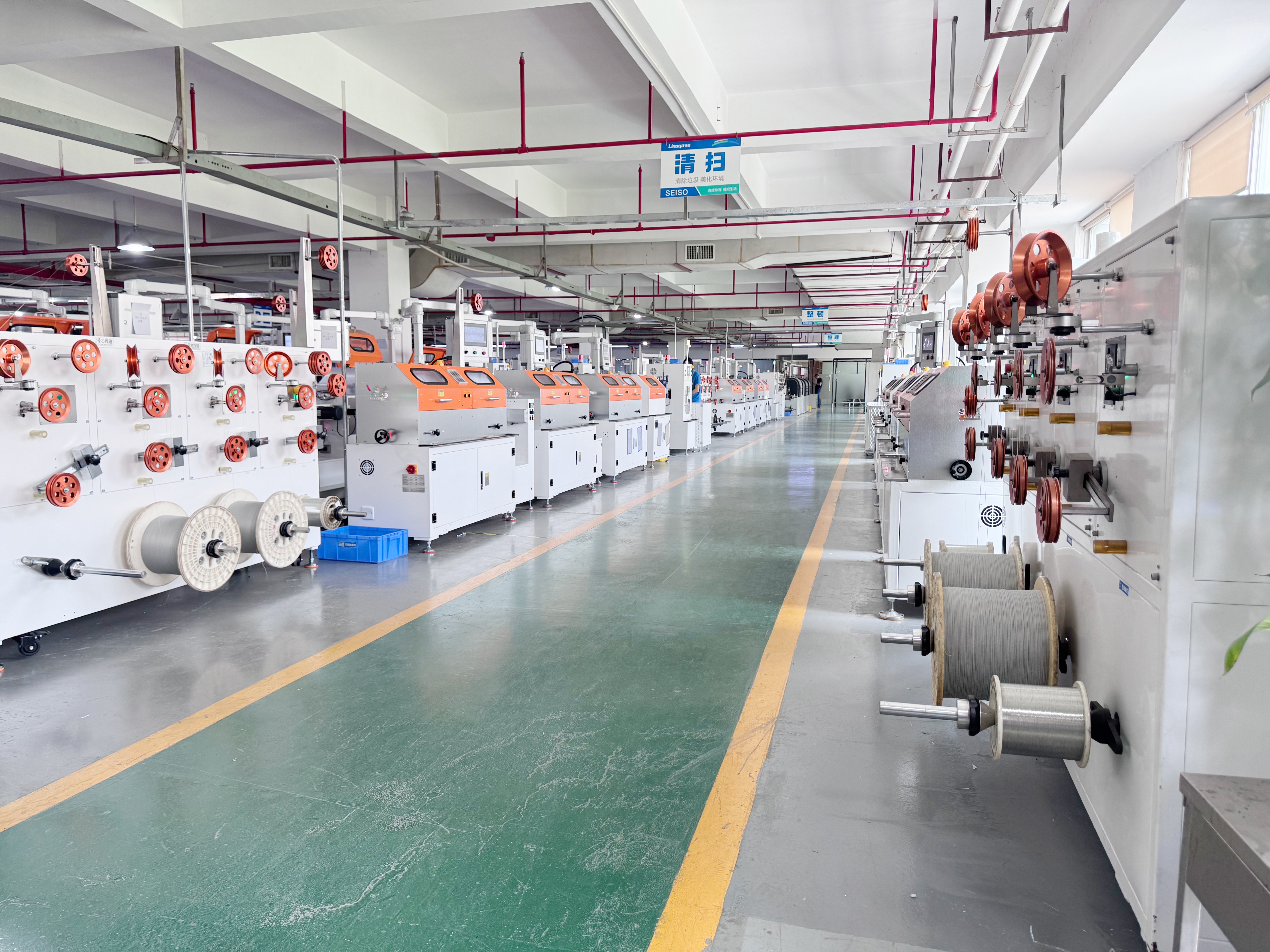
Manufacturing consistency is part of Ethernet cable procurement, especially when shielded pairs and flame-rated jackets are specified.
Cat5e, Cat6, Cat6a, Cat7, Cat7a and Cat8: levels explained
A category label should always be read with the distance at which the bandwidth is guaranteed. Cat5e is a 1 Gbps cable, Cat6 supports 10 Gbps at limited distance, and Cat6a extends stable 10 Gbps to a full 100-meter channel. Cat7 and Cat7a add full shielding and higher frequencies, while Cat8 is a short-reach data-center cable rather than a general-purpose building cable.
| Category | Representative construction | Published bandwidth | Conductor | Certification and flame rating in Linoya data |
|---|---|---|---|---|
| Cat5e | U/UTP, F/UTP, SF/UTP | 1 Gbps | 24AWG solid bare copper | UL/ETL; CM/CMG |
| Cat6 | U/UTP, F/UTP, SF/UTP | 10 Gbps at 55 m | 24AWG or 23AWG solid bare copper | UL/ETL; CMR |
| Cat6a | U/UTP, SF/UTP, U/FTP, F/FTP | 10 Gbps at 100 m | 23AWG solid bare copper | UL/ETL/CPR; CMP |
| Cat7 | F/FTP | 40 Gbps at 50 m | 23AWG solid bare copper | UL/ETL/CPR; CMP |
| Cat7a | F/FTP | 100 Gbps at 15 m | 22AWG solid bare copper | UL/ETL/CPR; CMP |
| Cat8 | F/FTP | 40 Gbps at 30 m | 22AWG solid bare copper | UL/ETL/CPR; CMP |
Several Linoya datasheets reference TIA/EIA-568-C.2. Buyers should separately verify the current standard edition used by the project. ANSI/TIA-568.2-E was released in October 2024, replacing ANSI/TIA-568.2-D and introducing DC resistance unbalance requirements for Cat5e, Cat6 and Cat6a. A well-prepared supplier should be able to confirm whether its certification scope and datasheet cover the exact standard specified in the tender.
Cat6 remains a useful commercial baseline because it supports mainstream gigabit networking with room for short 10G links. Cat6a is the usual choice for permanent 10G horizontal channels, especially where alien crosstalk in dense cable bundles must be controlled. Cat7-class cabling is used where additional shielding and higher frequency margin are required. Cat7a and Cat8 should be treated as application-specific cables, not as automatic upgrades.
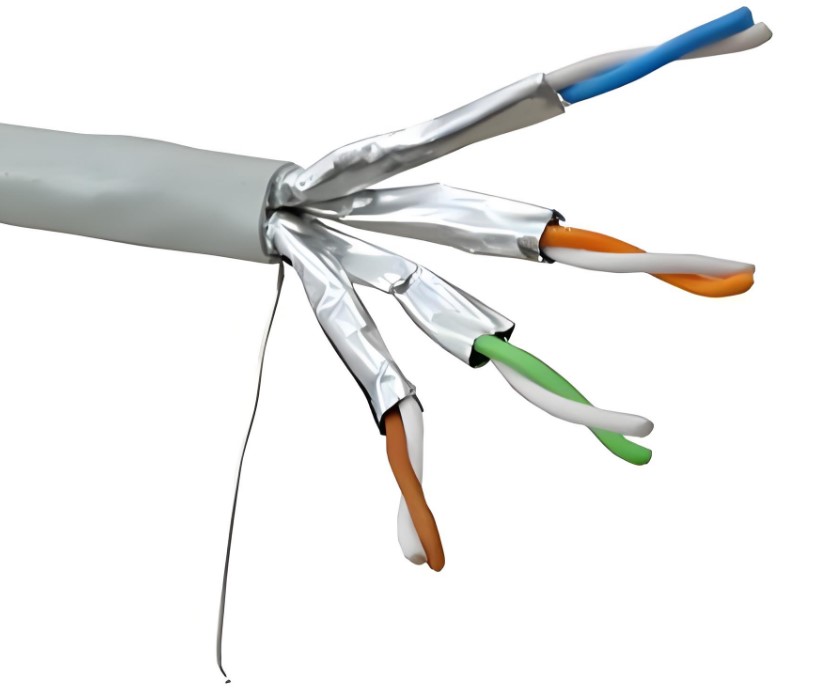
Pair-foil shielding addresses crosstalk in high-frequency channels such as Cat6a 10G runs.
Shielding decision: U/UTP, F/UTP, SF/UTP, U/FTP and F/FTP
Shielding notation describes what metal is present and where it is placed. The first letters refer to the overall cable screen; the second letters refer to the twisted pairs. This is not an upgrade ladder. It is a selection based on electromagnetic risk in the deployment environment.
- U/UTP — unshielded twisted pairs. Lowest cost, no grounding requirement, and adequate for homes, offices and other low-EMI environments.
- F/UTP — one overall foil shield around all four pairs. Provides basic protection against external EMI and is common in commercial structured cabling.
- SF/UTP — overall screen plus foil. A two-layer overall shield for industrial edges, high-noise offices and commercial environments with moderate EMI.
- U/FTP — foil around each pair, without an overall screen. Controls crosstalk between pairs and is used for 10G applications such as Cat6a U/FTP.
- F/FTP — foil on each pair plus an overall foil. A full-shielded construction used for high-speed, high-EMI links such as Cat6a F/FTP, Cat7 and Cat8.
Shielded cable is not automatically better. A shielded link depends on correct grounding and quality connectors. An improperly grounded screen can introduce additional noise instead of removing it. In an office with no significant EMI, Cat6a U/UTP may perform well and cost less. In a plant with variable-speed drives and power cables running near data cables, a full-shielded or screen-foil construction is usually the safer procurement choice.
Conductor, jacket and certification: what the label should tell you
Fixed building horizontal cabling generally requires solid-conductor cable. A solid conductor has lower DC resistance and is intended for permanent installation inside walls, ceilings and cable trays. Stranded-conductor cable is more flexible and is usually reserved for patch cords and short jumpers. Mixing the two in a horizontal system can create bad contact performance and shorter link life.
Another common procurement trap is copper-clad aluminum, often called CCA. CCA uses an aluminum core with a thin copper coating. It is lower in price, but it has higher resistance, weaker PoE performance and a greater risk of oxidation. Solid bare copper is the expected baseline for commercial-grade installations, especially when the cable will carry PoE. The Cat5e–Cat8 models described in Linoya’s public data use solid bare copper conductors.
Jacket material is a fire-safety decision more than a speed decision. PVC is flexible and cost-effective but can produce dense smoke under fire conditions. LSZH, or low-smoke zero-halogen, is required in many public-building projects such as hospitals, hotels, transit stations and other occupied spaces. In North America, CM/CMG is general-purpose, CMR is for risers, and CMP is for plenum spaces. In Europe, CPR classes are defined under EN 13501-6, and public tenders often specify classes such as Eca, Dca or B2ca.
Certification validity should be checked at the exact model level. For the US and Canada, a cable should carry a valid UL Mark or ETL Verified mark. For the EU, a cable must have CPR certification issued by a Notified Body, and the shielding construction and fire class marked on the label must match the certificate. Linoya states that its UL file E320763 is maintained for communication LAN cables, and its CPR certificates are issued by authorized Notified Bodies. A buyer should still ask for certificate numbers and compare them with the delivered cable model.
Application mapping: which cable type fits which project
Category selection becomes easier when the use case is defined. The table below is a practical starting point for early-stage research.
| Application | Typical requirement | Representative cable type |
|---|---|---|
| Residential network, SMB, IP surveillance | Gigabit speed, PoE cameras, easy installation | Cat5e U/UTP or Cat6 U/UTP |
| Commercial office and building wiring | Stable gigabit, upgrade path, moderate EMI | Cat6 U/UTP or Cat6 F/UTP |
| Enterprise 10G network and server rooms | Full-channel 10G, low crosstalk | Cat6a U/UTP or Cat6a U/FTP |
| High-EMI commercial and industrial edge | EMI resistance, signal integrity | Cat6a SF/UTP or Cat6a F/FTP |
| Industrial automation and harsh environments | Full shielding, continuous operation | Cat7 F/FTP |
| Premium data-center short links | 40G/100G inside racks or cabinets | Cat7a F/FTP or Cat8 F/FTP |
For standard office desktop networking, Cat5e is still a legitimate low-cost option. For projects where 10G may be needed later, Cat6a provides a safer permanent link. For data-center cabinet-to-cabinet links, Cat8 is designed for very short distances and full shielding, while Cat7a addresses ultra-high-speed short-reach applications with very low signal loss.
Market trends and procurement signals
Several verified market and standards signals are relevant for Ethernet cable buying.
- The Ethernet cable market is expected to grow from USD 38.55 billion in 2025 toward USD 70.02 billion by 2032, according to Maximize Market Research. This growth is driven by high-speed data transmission, data centers and connected infrastructure.
- Cat6 held roughly one-third of Ethernet cable assembly revenue in 2025, according to Dataintelo. Cat6 is strong in commercial and residential structured cabling, while Cat6a tends to appear in 10G-oriented projects.
- The TIA standard update to ANSI/TIA-568.2-E, released in October 2024, introduced DC resistance unbalance specifications for Cat5e, Cat6 and Cat6a. This may affect how power-over-Ethernet performance is evaluated.
- EU public building projects increasingly require CPR certification with a project-specific fire class, and LSZH jackets are commonly specified for occupied public spaces.
- For North America, valid UL or ETL certification and correct flame rating are market-entry requirements. Buyers involved in imports should note that Ethernet patch cables with connectors are classified under HS 8544.42, while bulk cable on reels without connectors is classified under HS 8544.49.
Regulatory and certification trends favor suppliers who maintain continuous certification files and whose product labels match the official certificate scope. Certificates that apply to one category or shielding type should not be relied upon for another model without checking the covered scope.
Limits of the upgrade logic: when a higher category is not the answer
The common assumption that a higher category is always better is not supported by the physics of structured cabling. Each step upward introduces a cost or installation trade-off.
Cat6a is better than Cat6 for long 10G channels, but it has larger diameter and higher overall project cost. Cat6 supports 10Gbps only to 55 meters and does not carry the same mandatory alien-crosstalk requirements as Cat6a. Cat7-class cabling is useful in high-EMI environments, but it still depends on proper termination and grounding. Cat8 supports high rates only to 30 meters, so it cannot simply replace Cat6a across a building floor. A traditional one-category-for-everything approach, such as installing Cat6 everywhere, is practical for cost control but can create blind spots in cable-bundle density, PoE load and fire-code compliance.
The reverse is also true. A working Cat5e installation that already meets the current speed need may not require replacement until a specific upgrade, PoE requirement or code issue appears. For many existing offices, Cat5e with solid bare copper conductors remains acceptable for 1 Gbps and standard PoE. The right procurement goal is not the fastest category; it is the slowest category that satisfies all project conditions for the expected life of the cabling system.
Future outlook
The direction of commercial cabling is toward more bandwidth and more certification. Cat6a is becoming the practical boundary for full-distance 10G copper, while fully shielded cables are being used where electromagnetic noise is difficult to control. In data centers, Cat7a and Cat8 address very short, very fast links between racks and switches, but they will remain specific tools rather than universal replacements for horizontal cable. The update to ANSI/TIA-568.2-E also signals that power delivery and DC resistance are now part of the cable performance conversation.
Fiber will continue to carry long-distance and backbone traffic, but twisted-pair Ethernet will remain necessary for edge devices, PoE cameras, wireless access points and building automation. Buyers who understand category, shielding, conductor and jacket will be in a stronger position to separate genuine specifications from marketing language.
FAQ
What is Ethernet cable crosstalk?
Crosstalk is electromagnetic signal leakage between adjacent twisted wire pairs inside an Ethernet cable. Excessive crosstalk can cause packet loss, slower speeds and unstable connections. Cable geometry, pair separation and shielding are used to control it. For high-speed links, Cat6a adds stricter alien-crosstalk requirements for dense cable-bundle environments.
How to choose between Cat5e vs Cat6 vs Cat6a Ethernet cable?
Select category according to the speed, distance and budget of the project. Cat5e is suitable for stable 1 Gbps and general office LAN use. Cat6 supports 10 Gbps only at short distance, commonly up to 55 meters. Cat6a is used when stable 10 Gbps is required over a full 100-meter channel, when cable bundles are dense, or when PoE++ power delivery must remain reliable. Cat6a has larger diameter and higher cost than Cat6.
How to choose between UTP, FTP and SFTP Ethernet cable for a project?
UTP has no metal shielding and is suitable for low-interference environments. FTP adds an overall foil shield for moderate electromagnetic interference. SFTP, or screen-foil cable, is used for high-interference and high-speed links. A shielded cable requires good grounding; without it, the shield can introduce additional noise. The choice should be driven by the electromagnetic risk at the installation site, not by the cable price alone.
Copper-clad aluminum (CCA) vs pure copper Ethernet cable for business procurement?
CCA uses an aluminum core with a thin copper coating. It has a lower price but higher resistance, weaker PoE performance and greater oxidation risk. Pure copper cable has stable conductivity, low resistance and dependable PoE operation. For permanent commercial and industrial networking projects, solid bare copper is the expected choice.
What certification do network cables need for the US and Canada market?
LAN cables for the US and Canada should carry a valid UL Mark or ETL Verified certification from an accredited body. The cable should also have the correct flame rating for the installation environment, such as CM, CMR or CMP, and should comply with TIA performance standards. Buyers should verify the UL file number or ETL report before placing an order.
What certification should EU-market LAN cable comply with?
Ethernet cables for the EU market must comply with CPR certification requirements and be covered by a certificate issued by an EU Notified Body. The cable label must show the applicable fire reaction class, such as Eca, Dca or B2ca, and the shielding construction must match the certificate scope. Buyers should cross-check the label with the original certificate before project delivery.
Project-level specifications, product range details and certification information are consolidated in the downloadable Linoya corporate brochure: Linoya Electronic Technology Co., Ltd. brochure.
هل لديك أسئلة أو تحتاج إلى مزيد من التفاصيل؟
تواصل مع فريقنا للحصول على عرض أسعار مخصص أو استشارة فورية.
طلب عرض أسعار
املأ النموذج أدناه وسيتواصل معك فريقنا بعرض مقترح مخصص.
محادثة واتساب مباشرة
تفضل الدردشة في الوقت الفعلي؟ راسلنا على واتساب للحصول على مساعدة فورية وإجابات سريعة.
- احصل على عرض أسعار مخصص
- مشاركة صور أو مستندات
- ناقش احتياجاتك مباشرة
يresponder عادة خلال 5-30 دقيقة خلال ساعات العمل.