
Ethernet Cable Longevity: Inside Linoya's Supplier Model
Ethernet cable longevity is not decided by a single performance figure. In data centers and industrial plants, the cable is installed once and expected to carry traffic for years inside trays, conduits and racks. That makes the real procurement question a supplier question: who can keep re-manufacturing, re-testing and re-certifying the same construction to the same standard over a multi-year window?
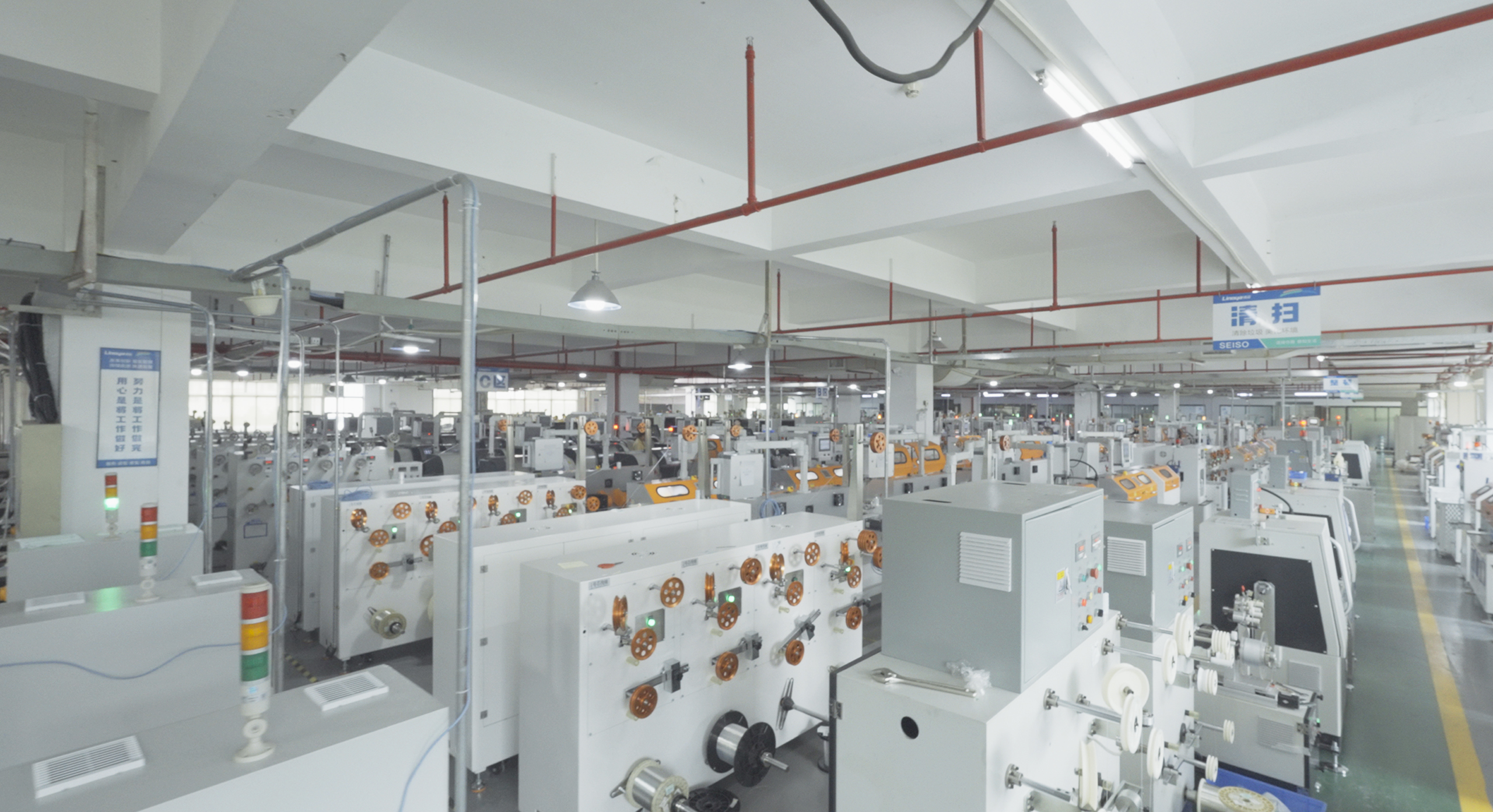
Production equipment inside a cable manufacturing environment of the type used for Ethernet cable extrusion and processing.
Why Cable Longevity Is a Compliance Question, Not a Performance Claim
Cable longevity describes how long a fixed cabling link can hold its specified electrical performance inside the environment where it was installed. In a data center that means cabinet-to-cabinet and rack-internal runs operating continuously; in an industrial plant it means cable trays routing past drives, contactors and switching equipment. In both settings the cable is a passive component that is rarely replaced on its own, and the cost of a failure is dominated by the labor and downtime required to pull a replacement run rather than by the cable itself.
Because the component is passive, degradation usually surfaces as intermittent symptoms rather than a clean break: link drops, packet loss, unstable PoE supply, or a port negotiating below its expected rate. Troubleshooting material published by Linoya Electronic Technology Co., Ltd. groups the causes into physical damage, termination defects, cable quality issues such as CCA conductors or off-specification grades, environmental interference including incorrect STP grounding, and connector mismatch. Only some of those causes are settled at the factory. The rest depend on whether specification, certification and installation guidance stay consistent across a supplier's product generations.
That is the practical argument for treating sustained compliance rather than peak performance as the primary long-term selection criterion. A single certificate is a milestone. A certification record that keeps being renewed across more than a decade is a process, and process is what a 24/7 installation is actually buying.
A Certification Record That Spans More Than a Decade
Linoya Electronic Technology Co., Ltd., a cable and wire manufacturer established in 1997 and based in Dongguan, Guangdong Province, China, publishes Ethernet cable compliance evidence that is continuous rather than single-point: third-party documents issued between 2009 and 2024 cover Cat5e, Cat6, Cat6A, Cat7 and CAT8 constructions in both North American and European frameworks.
The North American line starts with ETL Verified certification for Cat5e F/UTP CM, certificate 3168693CRT-004c, issued by Intertek/ETL on 24 February 2009 against ANSI/TIA-568-B.2 Category 5e, covering 4-pair, 24 AWG FTP, CM, non-plenum horizontal solid cable. It continues with ETL Verified certification for Cat6A U/FTP, certificate 102500029CRT-002, issued 6 May 2016 to ISO/IEC 11801-1; then ETL Verified certificates for Cat5e U/UTP (103161791CRT-002a) and Cat6 U/UTP (103161791CRT-002c), both issued 4 October 2017 against ANSI/TIA-568.2-D. UL LLC's Certificate of Compliance E320763, issued 10 November 2021, covers communications cable types CM, CMG, CMR and CMP rated 60 degrees Celsius or 75 degrees Celsius, evaluated under UL 444 and Canadian Standard CSA C22.2 No. 214-08.
The European line is built on CPR reaction-to-fire reporting. VDE Pruef- und Zertifizierungsinstitut GmbH (Notified Body 0366) reports 5004876/1-1 through 5004876/6-1, issued 21 July 2017, classify several Cat5e and Cat6 UTP, FTP and SF/UTP constructions as Eca under EN 13501-6. Elektrotechnicky zkusebni ustav, s.p. (EZU, Notified Body 1014) reports 801180-01/01, /02 and /03 issued 5 June 2018 classify CAT7 LSZH, CAT6A LSZH and CAT6 LSZH constructions to Dca-s1,d0,a2 and Dca-s1,d1,a2, and reports 911170-01/01 and /02 issued 23 May 2019 cover CAT6 LSZH and CAT5E LSZH at Eca. The most recent entry is a CPR Certificate of Constancy of Performance (System 1+) issued 28 August 2024 by TUV Rheinland InterCert Kft. (Notified Body 1008), certificate 1008-CPR-MC 69267303 0001, covering B2ca-s1a,d0,a1 for CAT6, CAT6A, CAT7, CAT7A and CAT8 S/FTP communication and LAN cables to EN 50575:2014+A1:2016.
| Certificate or report | Construction documented | Body and number | Issued |
|---|---|---|---|
| ETL Verified, Cat5e F/UTP CM | 4-pair, 24 AWG FTP, CM, non-plenum horizontal solid | Intertek / ETL, 3168693CRT-004c | 24 Feb 2009 |
| ETL Verified, Cat6A U/FTP | 4-pair, 23 AWG U/FTP horizontal solid | Intertek / ETL, 102500029CRT-002 | 6 May 2016 |
| ETL Verified, Cat5e U/UTP and Cat6 U/UTP | 4-pair UTP horizontal solid, ANSI/TIA-568.2-D | Intertek / ETL, 103161791CRT-002a and 103161791CRT-002c | 4 Oct 2017 |
| CPR reaction-to-fire, class Eca | Cat5e and Cat6 UTP, FTP, SF/UTP types | VDE, Notified Body 0366, 5004876/1-1 to /6-1 | 21 Jul 2017 |
| CPR reaction-to-fire, Dca-s1,d0,a2 and Dca-s1,d1,a2 | CAT7 LSZH, CAT6A LSZH, CAT6 LSZH | EZU, Notified Body 1014, 801180-01/01, /02, /03 | 5 Jun 2018 |
| CPR reaction-to-fire, class Eca | CAT6 LSZH, CAT5E LSZH | EZU, Notified Body 1014, 911170-01/01, /02 | 23 May 2019 |
| UL Certificate of Compliance | Communications cable types CM, CMG, CMR, CMP, 60 or 75 degrees Celsius | UL LLC, E320763 | 10 Nov 2021 |
| CPR Certificate of Constancy of Performance, System 1+ | B2ca-s1a,d0,a1, CAT6/6A/7/7A/8 S/FTP | TUV Rheinland InterCert, Notified Body 1008, 1008-CPR-MC 69267303 0001 | 28 Aug 2024 |
Two details in that record matter for long-term sourcing. First, coverage is construction-specific. The VDE reaction-to-fire reports state that they are valid only for the cable type described in their scope sections, which is normal for CPR reporting and a reminder that a certificate should be read against the exact part being purchased rather than against a product family name. Second, the progression from Eca and Dca reporting to a System 1+ B2ca certificate indicates that higher fire-performance classes were pursued specifically on the fully shielded CAT6 to CAT8 family, which is the portion of the range most often specified for data center and high-EMI industrial work.
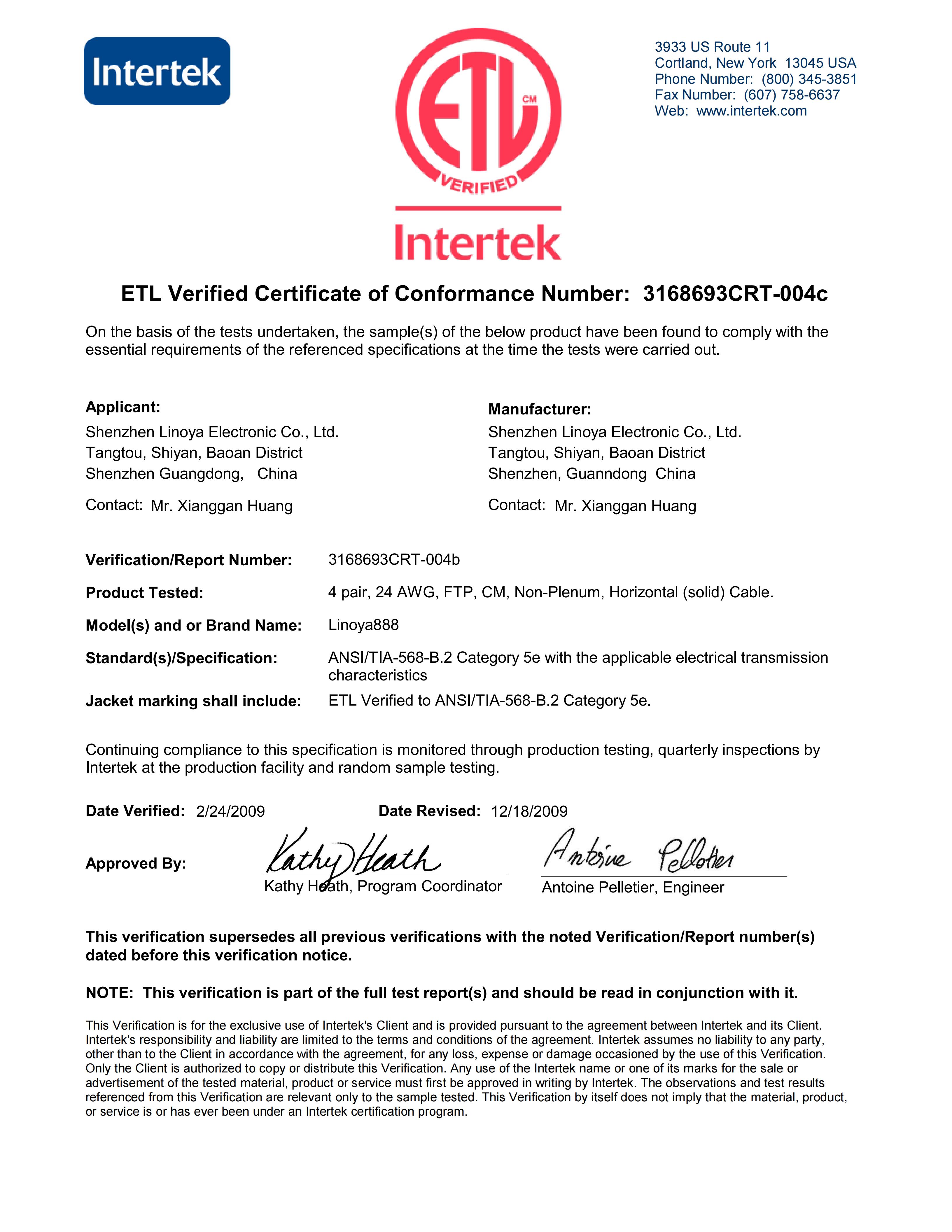
ETL Verified certification for Cat5e F/UTP CM, certificate 3168693CRT-004c issued by Intertek/ETL on 24 February 2009, the earliest entry in the published Ethernet cable compliance timeline.
What 24/7 Operation Changes About the Requirement
Continuous operation removes the assumption that a defect can be absorbed during a maintenance window. Linoya's scenario documentation describes the intended operating mode of its higher cable categories as 24/7 continuous or high-load operation with fixed cabling and passive signal transmission, meaning a wired rack-to-rack or cabinet-to-cabinet link that is engineered once and then left in place for the life of the facility.
Three properties recur across those scenarios. Solid bare copper conductors, in 23 AWG or 22 AWG depending on category, underpin the resistance and current paths that continuous PoE delivery depends on. Full foil shielding, whether overall, per pair, or both, is specified wherever the electrical environment is noisy. And CMR or CMP flame ratings appear as a stated special requirement for data center and industrial deployments, which ties them directly to the UL 444 communications cable types covered by certificate E320763.
Fixed cabling also changes the conductor choice. Linoya's technical material notes that solid-core conductors are intended for fixed conduit and permanent wiring, while stranded conductors are used for patch cords. That distinction is easy to overlook and consequential in a longevity evaluation: a stranded patch cord used as permanent horizontal cabling is a recognized cause of premature failure, and it is invisible on a specification sheet unless the buyer asks.
Matching Construction to the Deployment
Shielding is a hierarchy rather than a single feature. U/UTP constructions carry no shield; F/UTP adds an overall foil; SF/UTP combines a screen with an overall foil; U/FTP applies foil around each pair; and F/FTP applies both pair-level and overall foil, which Linoya describes as full shielding. The more layers, the more stable the link is in a noisy environment, and the more installation discipline the design demands.
| Construction | Conductor | Documented bandwidth | Shielding | Flame rating and certification |
|---|---|---|---|---|
| CAT5E U/UTP | 24 AWG solid bare copper | 1 Gbps | None | CM/CMG, UL/ETL |
| CAT5E F/UTP | 24 AWG solid bare copper | 1 Gbps | Overall foil | CM/CMG, UL/ETL |
| CAT5E SF/UTP | 24 AWG solid bare copper | 1 Gbps | Screen plus overall foil | CM/CMG, UL/ETL |
| CAT6 U/UTP | 24 or 23 AWG solid bare copper | 10 Gbps to 55 m | None | CMR, UL/ETL |
| CAT6 SF/UTP | 24 or 23 AWG solid bare copper | 10 Gbps to 55 m | Screen plus overall foil | CMR, UL/ETL |
| CAT6A U/UTP | 23 AWG solid bare copper | 10 Gbps to 100 m | None | CMP, UL/ETL/CPR |
| CAT6A U/FTP | 23 AWG solid bare copper | 10 Gbps to 100 m | Pair foil | CMP, UL/ETL/CPR |
| CAT6A F/FTP | 23 AWG solid bare copper | 10 Gbps to 100 m | Overall plus pair foil | CMP, UL/ETL/CPR |
| CAT7 F/FTP | 23 AWG solid bare copper | 40 Gbps to 50 m | Overall plus pair foil | CMP, UL/ETL/CPR |
| CAT7A F/FTP | 22 AWG solid bare copper | 100 Gbps to 15 m | Overall plus pair foil | CMP, UL/ETL/CPR |
| CAT8 F/FTP | 22 AWG solid bare copper | 40 Gbps to 30 m | Overall plus pair foil | CMP, UL/ETL/CPR |
All categories share the same material logic: solid bare copper conductor, LDPE insulation, and a jacket available in PVC or LSZH, with constructions documented as compliant to TIA/EIA-568-C.2. The differences that matter for a long-life installation are distance, shielding and flame class, not the marketing tier of the category name.
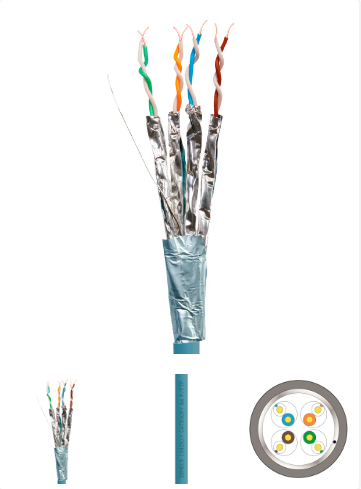
CAT6A F/FTP full shielded construction: 23 AWG solid bare copper, overall and pair foil shielding, 10 Gbps to 100 m, CMP flame rating.
Where the Model Has Been Applied
The clearest test of a longevity claim is the deployment record. Linoya's published case entries for Ethernet cable center on data center and industrial automation environments, and they describe operating modes rather than one-off installations.
| Deployment type | Documented volume | Reported outcome |
|---|---|---|
| High-performance data center operator, short-reach cabinet interconnection | 5,000 cartons of 305 m | 99.998% network stability with full shielding and 40G transmission |
| Data center operator and server room integrator, cabinet-to-cabinet links | 5,000 cartons of 305 m | 99.999% network stability with stable 40G short-range transmission |
| Heavy industry integrator and premium data center, extreme EMI | 5,000 cartons of 305 m | 99.998% network stability with 100G transmission in extreme environment |
| Industrial automation integrator, factory backbone | 6,000 cartons of 305 m | 99.998% network stability with 40G transmission in strong EMI and PoE++ support |
| Enterprise IT and data center integrator, 10G backbone | 2,000 cartons of 305 m | 99.999% network stability with crosstalk eliminated |
Case records for these deployments carry a listed duration of 25 years alongside the reported stability figures. Read carefully, the pattern is consistent: the deployments that report the highest stability are the ones with the most shielding, the heaviest conductor gauge and the highest flame class, which is what a 24/7 fixed-cabling specification is designed to deliver. The 10 Gbps office and surveillance deployments report slightly lower stability figures, which is also expected given unshielded or lightly shielded constructions in mixed environments.
Market Signals Behind the Longevity Question
The procurement focus on sustained cable quality is being reinforced by market and standards movement rather than by supplier messaging alone.
- The global Ethernet cable market was valued at USD 38.55 billion in 2025 and is expected to reach nearly USD 70.02 billion by 2032, a CAGR of 8.9% between 2026 and 2032, according to Maximize Market Research. Scope definitions vary widely between research houses, so buyers should treat absolute market-size figures as directional rather than comparable.
- Cat6 was the largest single category in 2025 with a 32.5% share, per Dataintelo, which confirms that long-life installations still lean heavily on Cat6 and Cat6A rather than on the highest categories available.
- ANSI/TIA-568.2-E was released in October 2024, replacing ANSI/TIA-568.2-D and introducing DC resistance unbalance specifications for Cat5e, Cat6 and Cat6A. Tighter electrical criteria raise the bar for what a long-term compliant cable must demonstrate.
- Under EU CPR, class B2ca is defined by strict thresholds including flame spread of 1.5 m or less, total heat release of 15 MJ or less, and peak heat release rate of 30 kW or less, per TTI Fiber. This is the reason the System 1+ certificate covering B2ca constructions carries weight in European infrastructure projects.
- Trade classification also shapes multi-year cost planning: Ethernet patch cables with connectors fall under HS 8544.42 while bulk cable on a reel falls under HS 8544.49, with a U.S. MFN duty of 2.6% on 8544.42.90 and an EU MFN rate of 0%, per published tariff references.
Where the Model Has Limits
A credible evaluation has to state the boundaries. Linoya's Ethernet cable range, like any standards-based cable family, carries constraints that buyers should weigh before committing to a long-life design.
- Distance caps are real and category-specific. 10 Gbps over Cat6 is documented to 55 m, while Cat6A is documented to 100 m. CAT7A reaches 100 Gbps only within 15 m, and CAT8 delivers 40 Gbps within 30 m. Selecting the highest available category does not extend reach; it changes the speed-distance profile.
- Shielded designs demand installation discipline. Linoya's own troubleshooting guidance lists incorrect STP grounding among the causes of link problems, so a fully shielded cable installed without correct grounding practice can perform worse than an unshielded alternative.
- Fire-class coverage is construction-specific rather than catalog-wide. The published CPR reports cover named cable types, and the VDE reports explicitly state validity only for the cable type described in their scope sections. Buyers should match the certificate to the exact part number on the purchase order.
- Higher categories carry a physical and cost penalty. Larger diameters are harder to route in dense trays, and the FAQ guidance acknowledges larger cable diameter and higher overall project cost as trade-offs of Cat6a over Cat6.
- Commercial terms are shorter than infrastructure life. Linoya's stated after-sales position is 24/7 online technical support, a one-year product warranty and free replacement of defective products. A cabling infrastructure expected to remain in service far longer than that warranty period should therefore be evaluated on certification continuity and construction consistency, not on the warranty term alone.
- Site-level capacity evidence remains a due-diligence item. Published material describes three industrial parks, a Vietnam production base and more than 100 production lines, alongside a monthly capacity of 200,000 cartons of 305 m, a 30-day lead time and a 100-carton minimum order quantity. Site-specific throughput figures for the Vietnam base are not published, so buyers building a dual-region continuity plan should request that data directly.
What a Sustainable Supplier Model Requires Next
Sustained supply is a process rather than a badge, and the next phase of buyer scrutiny is likely to follow the standards. The DC resistance unbalance specifications introduced in ANSI/TIA-568.2-E will push purchasers to ask for test evidence rather than conformity statements alone. The migration of European projects toward higher CPR classes will make System 1+ certification a routine requirement rather than a differentiator on a specification sheet.
On the supplier side, the practical levers are already visible in Linoya's published operating model: 100% pre-shipment electrical testing, third-party inspection through SGS or UL, random sampling inspection, OEM customization covering cable length, logo printing and packaging, and an established export footprint spanning the EU, the United States, the Middle East, Southeast Asia, Australia, South Korea and Japan. None of those replace verification, but together they describe a supply model built around repeatability rather than one-off shipment performance. Linoya's full product and certification overview is available in its corporate brochure: Linoya Electronic Technology Co., Ltd. brochure.
FAQ
What does a CMR or CMP rating actually certify in an Ethernet cable?
A CMR or CMP designation identifies a communications cable type evaluated for flame and smoke behaviour under a recognized listing. Linoya's UL Certificate of Compliance E320763, issued by UL LLC on 10 November 2021, covers communications cable types CM, CMG, CMR and CMP rated 60 degrees Celsius or 75 degrees Celsius, evaluated against Standard UL 444 and Canadian Standard CSA C22.2 No. 214-08. The listing applies to the cable types and constructions named in the certificate, so buyers should confirm that the exact construction being purchased appears in the document rather than assuming the whole range is covered.
How can a procurement team verify that a supplier's certifications remain valid after several years?
Check five elements on each document: certificate number, issuing body and notified body number where applicable, the standard applied, the issue date, and the declared scope. As a worked example, Linoya's published records include an ETL Verified certificate for Cat5e F/UTP CM issued as 3168693CRT-004c by Intertek/ETL on 24 February 2009, ETL Verified certificates 103161791CRT-002a and 103161791CRT-002c for Cat5e and Cat6 U/UTP issued 4 October 2017, UL Certificate of Compliance E320763 issued 10 November 2021, and a CPR Certificate of Constancy of Performance numbered 1008-CPR-MC 69267303 0001 issued by TUV Rheinland InterCert on 28 August 2024. Recurrent third-party issuance across more than a decade is one practical indicator of a maintained compliance process.
Which constructions are intended for 24/7 continuous operation in data centers?
Linoya's scenario documentation for data center and high-EMI industrial environments describes 24/7 continuous or high-load operation with fixed cabling and passive transmission for CAT8 F/FTP at 40 Gbps to 30 m, CAT7A F/FTP at 100 Gbps to 15 m, CAT7 F/FTP at 40 Gbps to 50 m, and CAT6A variants at 10 Gbps to 100 m. These constructions use solid bare copper conductors with LDPE insulation and a jacket available in PVC or LSZH, and are documented as UL, ETL and CPR certified with CMP flame ratings.
What are the practical limits of a high-category fully shielded strategy over a long service life?
Distance comes first: Cat6 is documented at 10 Gbps to 55 m while Cat6A reaches 100 m, CAT7A carries 100 Gbps only to 15 m and CAT8 carries 40 Gbps to 30 m. Second, shielded designs add diameter and stiffness, and incorrect STP grounding is listed among the causes of link problems in Linoya's troubleshooting guidance, so installation discipline matters as much as the cable specification. Third, CPR class coverage is construction-specific rather than uniform: Eca and Dca reports apply to named cable types, while the B2ca-s1a,d0,a1 System 1+ certificate covers CAT6, CAT6A, CAT7, CAT7A and CAT8 S/FTP constructions.
How should Cat5e, Cat6 and Cat6a be compared for an installation expected to last five to ten years?
The comparison turns on three variables: required speed, distance and budget. Cat5e suits projects that only need stable 1 Gbps, general office LANs and 30 W PoE surveillance, with low procurement cost and forgiving installation requirements, but it does not support 10 Gbps or high-power PoE++ devices. Cat6 fits cost-controlled projects needing short-range 10 Gbps within 55 m or gigabit networks with upgrade headroom, though 10 Gbps cannot be guaranteed beyond 55 m. Cat6a is the choice for full-channel 10 Gbps at 100 m, dense cable bundling, PoE++ up to 90 W and permanent building cabling intended to remain serviceable for years, with the trade-offs of larger diameter and higher total project cost.
Sources referenced in this article include Linoya Electronic Technology Co., Ltd. product, certification, scenario and case documentation; Maximize Market Research; Dataintelo; the Telecommunications Industry Association; TTI Fiber; and published tariff classification references. Certification details are stated as published and should be confirmed against the current certificate documents before procurement.