
Ethernet Cable Procurement FAQ: Cat7a vs Cat8, Testing, and North American Compliance
Ethernet Cable Procurement FAQ: Cat7a vs Cat8, Testing, and North American Compliance
Ethernet cable specification has shifted from a bandwidth conversation to a documentation conversation. On a North American project, a cable that meets the specified throughput can still be rejected if its flame rating does not match the pathway it runs through, if the certificate on file covers a different construction, or if the listing applies only to horizontal solid-conductor cable rather than the patch cords in the rack.
That shift is happening inside a large market. The global Ethernet cable market was valued at USD 38.55 billion in 2025 and is forecast to reach nearly USD 70.02 billion by 2032, a CAGR of 8.9% from 2026 to 2032, according to Maximize Market Research. Within that market, Category 6 accounted for 32.5% of 2025 demand, according to Dataintelo — which suggests that most installed channels today are Cat6, while higher categories are bought for specific, short-reach roles rather than general-purpose use.
This reference is written for buyers specifying Ethernet cable in data centers, enterprise networks, and high-EMI commercial buildings. It answers three questions that recur in nearly every technical clarification cycle: how to test whether an Ethernet cable actually works properly, when Cat7a or Cat8 is the right choice for data center high-speed interconnection, and what must be verified before a North American project can accept a cable order.
The Procurement Problem: Certificates Are Now Part of the Bill of Materials
A decade ago the cable decision was mostly category and price. Today the same purchase order has to satisfy three separate layers of evidence: electrical performance against a cabling standard, fire performance against a regional building-code pathway, and product listing against a nationally recognized testing laboratory. A missing or mis-scoped document at any layer stalls an inspection, and remediating an installed pathway costs far more than the price difference between cable grades.
The standards layer is also moving. The ANSI/TIA-568.2-E standard was released in October 2024, replacing ANSI/TIA-568.2-D, and it introduces DC resistance unbalance (DCRU) specifications for Cat5e, Cat6, and Cat6A, according to the Telecommunications Industry Association. Buyers writing specifications should state which revision they are buying against, because a cable verified to ANSI/TIA-568.2-D is not automatically verified against the newer DCRU parameter.
Import planning adds a third variable. Ethernet patch cables with connectors are classified under HS code 8544.42, while bulk cable on a reel without connectors is classified under HS code 8544.49, per published tariff classification references. The U.S. MFN duty rate for HS 8544.42.90 is 2.6%, while the EU MFN rate is 0% — a difference that changes landed-cost comparisons between buying finished patch cords and buying bulk reels for on-site termination.
What North American Projects Must Verify Before Awarding a Cable Order
North American acceptance normally rests on two document families: a UL listing or certificate of compliance covering the communications cable type and flame rating, and an ETL (or equivalent NRTL) verification of electrical category performance. Both are construction-specific and scope-specific, and neither substitutes for the other.
| Document type | Scope as stated on the document | Market |
|---|---|---|
| UL Certificate of Compliance E320763 (UL LLC) | Communications Cable, Types CM, CMG, CMR and CMP; rated 60°C or 75°C; evaluated to UL 444 and CSA C22.2 No. 214-08 | US / Canada |
| ETL Verified — Category 6 UTP CM, certificate 103161791CRT-002c (Intertek) | Cat6, 4-pair, 23 AWG, UTP, CM, horizontal (solid) cable; ANSI/TIA-568.2-D | US |
| ETL Verified — Category 6A U/FTP, certificate 102500029CRT-002 (Intertek) | Cat6A, 4-pair, 23 AWG, U/FTP, no flame rating recorded in scope; ISO/IEC 11801-1 | North America |
| ETL Verified — Category 5e F/UTP CM, certificate 3168693CRT-004c (Intertek) | Cat5e, 4-pair, 24 AWG, FTP, CM, horizontal (solid) cable; ANSI/TIA-568-B.2 Category 5e | US / North America |
| CPR Certificate of Constancy of Performance, 1008-CPR-MC 69267303 0001 (TÜV Rheinland InterCert, Notified Body 1008) | B2ca-s1a,d0,a1; CAT6/6A/7/7A/8 S/FTP communication/LAN cables; EN 50575:2014+A1:2016 | EU |
Flame ratings are the layer most often misread. CM, CMG, and CMR cover general-purpose, general-purpose limited, and riser applications respectively; CMP is rated for installation in plenum air spaces, which is why it is the rating most North American data center interconnects are specified to. A product family can hold one UL certificate covering CM, CMG, CMR, and CMP under a single certificate number — as in the case of Linoya Electronic Technology Co., Ltd. under certificate E320763 — but an individual construction is only listed for the ratings named in that certificate scope.
Cat7a vs Cat8 for Data Center High-Speed Interconnection
The Cat7a-versus-Cat8 question is usually framed as “which one is faster,” but the more useful framing is “which one reaches far enough at the speed the rack actually needs.” Both are fully shielded and both are available with a CMP flame rating and UL, ETL, and CPR certification in the Linoya range. The differentiator is the bandwidth-versus-distance trade-off, and the answer changes once the required link length is known.
| Model | Conductor | Rated performance | Shielding | Flame rating | Certifications |
|---|---|---|---|---|---|
| CAT7A F/FTP | 22AWG solid bare copper | 100Gbps at 15 m | Overall + pair full foil | CMP | UL / ETL / CPR |
| CAT8 F/FTP | 22AWG solid bare copper | 40Gbps at 30 m | Overall + pair full foil | CMP | UL / ETL / CPR |
| CAT7 F/FTP | 23AWG solid bare copper | 40Gbps at 50 m | Overall + pair full foil | CMP | UL / ETL / CPR |
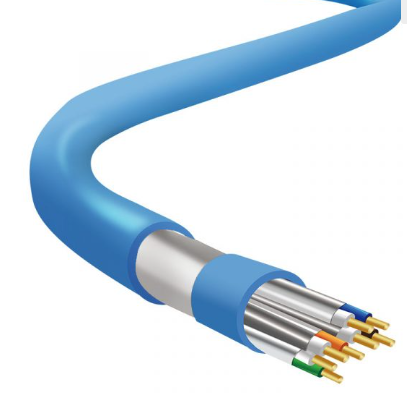
CAT7A F/FTP: 22AWG solid bare copper, overall + pair full foil shielding, rated 100Gbps at 15 m, CMP rated and UL/ETL/CPR certified.
Decision rules that hold up in a rack
- 100Gbps links inside a rack or between adjacent cabinets, within roughly 15 m — particularly where electromagnetic interference is heavy or where the deployment is a premium data center: CAT7A F/FTP.
- 40Gbps cabinet-to-cabinet links up to about 30 m in a high-density data center environment: CAT8 F/FTP.
- 40Gbps links that need to reach up to 50 m, or that carry PoE++ loads: CAT7 F/FTP, which is rated for 40Gbps at 50 m and is specified for PoE++ performance.
All three constructions use solid bare copper conductors with LDPE insulation and are available with PVC or LSZH jackets. Solid bare copper matters at these frequencies because conductor resistance — and the balance of that resistance across pairs — directly affects the parameters that ANSI/TIA-568.2-E now tests explicitly through its DCRU specification.
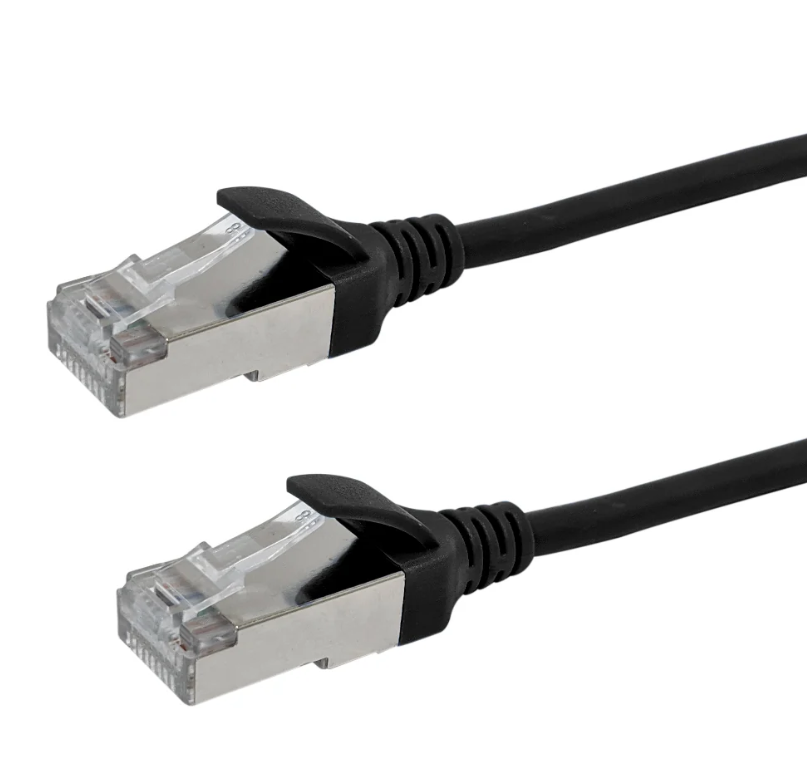
CAT8 F/FTP: 22AWG solid bare copper, full foil shielding, rated 40Gbps at 30 m for data center short-reach interconnection.
Application Fit: Data Centers, Enterprise Networks, and High-EMI Buildings
Category selection becomes concrete only when it is matched to the environment and to the equipment at both ends. The table below maps commonly recorded deployment environments to the constructions used in them and to the equipment those links are terminated into.
| Environment | Typical construction | Matched equipment |
|---|---|---|
| Data center cabinet-to-cabinet, high density, indoor | CAT8 F/FTP; CAT7A F/FTP | Data center switch, server, storage device, high-speed interconnect equipment, cable manager |
| Enterprise server room and 10G core network | CAT6A U/UTP; CAT6A U/FTP; CAT6A SF/UTP | 10G switch, core switch, router, server farm, NAS/SAN storage, patch panel, SFP module, enterprise gateway |
| High-EMI commercial building, industrial edge, factory backbone | CAT6A SF/UTP; CAT6A F/FTP; CAT7 F/FTP | Industrial switch, PLC, industrial robot, control system, sensor network, HMI |
| Office LAN, SMB network, IP surveillance | CAT6 U/UTP; CAT5E U/UTP | Gigabit/10G switch, router, workstation, server, IP camera, wireless AP, VoIP phone, conference system |
Two operational points cut across all four environments. First, these deployments are specified for 24/7 continuous operation — passive wired transmission with no duty cycle — which is why conductor cross-section (23AWG or 22AWG solid bare copper) and shielding continuity tend to be written into the tender rather than left to the supplier. Second, PoE support is a compatibility question rather than a category question: CAT6 U/UTP is rated for PoE++ applications and CAT7 F/FTP is specified for PoE++ performance, while CAT5E constructions provide stable PoE for camera and access-point loads.
Where the Specification Stops Working: Boundaries Buyers Should Plan Around
A cable selection is only defensible if its limits are stated at the same time as its capabilities. The following boundaries are drawn from published product ratings and from the scope wording of the certificates themselves.
- Cat5e has a 1Gbps ceiling. CAT5E U/UTP, F/UTP, and SF/UTP constructions are rated to 1Gbps with CM/CMG flame ratings. They remain cost-effective for IP camera and wireless AP runs, but they cannot serve a 10G upgrade path and are not the right choice for high-power PoE++ devices.
- Cat6 reaches 10Gbps only to 55 m. CAT6 U/UTP, F/UTP, and SF/UTP are rated at 10Gbps over 55 m under TIA/EIA-568-C.2. Treating Cat6 as a general 10G cable for 100 m runs is one of the most common specification errors in commercial fit-outs.
- Cat6a delivers full 100 m 10G, at a physical cost. CAT6A U/UTP, U/FTP, SF/UTP, and F/FTP constructions reach 10Gbps at 100 m, but the larger conductor and shielding increase cable diameter and overall project cost, and dense bundles demand more careful crosstalk management.
- Cat7a and Cat8 trade reach for bandwidth. 100Gbps at 15 m and 40Gbps at 30 m respectively; neither is a general backplane cable.
- Shielded cable only works with correct grounding. Screen-foil and full-foil constructions deliver their anti-interference benefit only when bonding is done correctly. Incorrect STP grounding is a documented cause of intermittent links, unstable PoE supply, and speed fallback to 10/100Mbps.
- Certificate scope is narrower than the product family. The ETL verification for CAT6A U/FTP (certificate 102500029CRT-002) is issued against ISO/IEC 11801-1, and its stated scope records no flame rating — so the flame rating must be evidenced separately. These ETL verifications are also scoped to horizontal (solid) cable, not to patch cords. CPR classification reports carry similar limits: the VDE Eca reports state that the classification is valid only for the cable type described in section 2.2 of the report.
What the Trend Data Suggests for the Next Specification Cycle
- Volume growth continues, led by mainstream categories. The market moves from USD 38.55 billion in 2025 toward nearly USD 70.02 billion by 2032 at an 8.9% CAGR (2026–2032), per Maximize Market Research, while Cat6 alone held 32.5% of 2025 demand according to Dataintelo. Cat6 and Cat6a remain the volume mainstream; Cat7a and Cat8 stay concentrated in short-reach, high-value links.
- Acceptance testing is widening. With ANSI/TIA-568.2-E replacing -D in October 2024 and adding DCRU for Cat5e, Cat6, and Cat6A, project documentation will increasingly need to name the revision and the balance parameters tested.
- Fire performance is becoming a supplier filter. Under EN 50575, the EU CPR B2ca class carries strict thresholds — flame spread (FS) ≤ 1.5 m, total heat release (THR) ≤ 15 MJ, and peak heat release rate (HRR) ≤ 30 kW — as summarized by TTI Fiber. That is a materially more demanding class than Eca, and the gap separates general-purpose cable from infrastructure-grade cable in European tenders.
- Trade classification stays part of the cost model. HS 8544.42 for patch cords and 8544.49 for bulk reels, with a 2.6% U.S. MFN rate on 8544.42.90 and a 0% EU MFN rate, keeps the buy-finished versus terminate-on-site decision commercially live.
How Linoya Electronic Technology Co., Ltd. Supports Buyer Verification
Linoya Electronic Technology Co., Ltd. is a cable and wire manufacturer established in 1997, operating three industrial parks in Shenzhen and Dongguan, a production base in Vietnam, and 100+ production lines. The company reports 60,000 m² of factory space, 3,000+ employees, 300+ engineers, annual output of 4,000,000 kilometers, and annual sales exceeding USD 420 million, with approximately 30% of output exported and main markets in the EU and the Middle East, alongside the US, Southeast Asia, Australia, South Korea, and Japan.
For procurement teams, the relevant question is not scale but what documentation sits behind each construction. The Ethernet cable range — CAT5E U/UTP, F/UTP, SF/UTP; CAT6 U/UTP, F/UTP, SF/UTP; CAT6A U/UTP, U/FTP, SF/UTP, F/FTP; CAT7 F/FTP; CAT7A F/FTP; and CAT8 F/FTP — is supported by a UL Certificate of Compliance (E320763) covering CM, CMG, CMR, and CMP communications cable; ETL verifications issued by Intertek for Category 5e, 6, and 6A constructions; a CPR Certificate of Constancy of Performance (System 1+) issued by TÜV Rheinland InterCert (Notified Body 1008) for B2ca-s1a,d0,a1 S/FTP CAT6/6A/7/7A/8 cables; and Eca and Dca fire classification reports issued by VDE (Notified Body 0366) and EZÚ (Notified Body 1014) for the EU market.
Finished-cable quality control includes 100% pre-shipment electrical performance testing, random sampling inspection, and third-party inspection by SGS or UL on request. OEM and customization support covers cable length, logo printing, and packaging, with a minimum order quantity of 100 cartons at 305 m per carton, a monthly capacity of 200,000 cartons, and a 30-day lead time. After-sales support is provided 24/7 online, with a one-year product warranty and free replacement of defective products.
In one recorded data center deployment, a high-performance data center operator took 5,000 cartons of CAT8 F/FTP at 305 m per carton for high-density server cabinet links — a project in which full shielding, 22AWG solid copper, CMP flame rating, and UL/ETL/CPR certification were all specification requirements.
For buyers who need the underlying documentation before a tender closes, the corporate and product brochure is available here: Linoya Electronic Technology Co., Ltd. brochure (PDF).
Future Outlook
Three developments are likely to shape Ethernet cable procurement over the next specification cycle. The DCRU parameter introduced by ANSI/TIA-568.2-E moves conductor balance testing from a laboratory concern into routine project acceptance, which will favor suppliers who can document pair-to-pair resistance behavior rather than only category ratings. Continued market growth — 8.9% CAGR through 2032 — will keep Cat6 and Cat6a as the volume mainstream while Cat7a and Cat8 remain short-reach, high-value constructions inside and between racks. And fire-safety evidence will keep separating suppliers: EU projects increasingly ask for B2ca-s1a,d0,a1 documentation rather than a generic CPR claim, while North American projects continue to require a flame rating that matches the pathway the cable is installed in. Buyers should expect certification scope, revision level, and construction-level matching to become standard line items in cable purchase orders rather than attachments added at inspection time.
FAQ
What is Cat6 Ethernet cable?
Cat6 (Category 6) is a performance-grade twisted-pair Ethernet cable designed for gigabit and short-range 10-Gigabit transmission in building cabling systems. It follows the TIA-568-C.2 standard with 250 MHz bandwidth, commonly uses a 4-pair twisted construction, and in many versions adds a central cross-separator to reduce crosstalk interference between pairs. Cat6 supports 1Gbps up to 100 meters and 10Gbps up to 55 meters, and works with PoE and PoE+ power supply. It is available in UTP or STP versions, with solid-core construction for fixed conduit wiring and stranded-core for patch cords. Linoya Electronic Technology Co., Ltd. supplies Cat6 U/UTP and F/UTP series complying with the ANSI/TIA-568.2-D standard.
What is Ethernet cable crosstalk?
Crosstalk is electromagnetic signal leakage between adjacent twisted wire pairs inside an Ethernet cable; excessive crosstalk triggers packet loss, slow speeds, or unstable network connections. It is managed through the twist rate of each pair, through pair separators, and — at higher categories — through individual pair shielding, as in the CAT6A U/FTP construction where each pair carries its own foil. Cables built with an optimized twist-pair structure are specified specifically to hold crosstalk within the limits of the applicable standard.
How to choose between Cat5e vs Cat6 vs Cat6a Ethernet cable?
Select cable category according to required network speed, transmission distance, and budget. Four criteria drive the decision: the maximum expected transmission speed (1Gbps, short-range 10Gbps, or full-distance 10Gbps); the total cable and connector cost at the deployment scale; the installation environment, including cable bundle density, conduit space, and PoE power load; and the required service life, including whether the system must support upgrades over the next 5–10 years.
Cat5e suits projects that need stable 1Gbps only — general office LANs and PoE surveillance cameras at 30 W PoE+. It has low procurement cost and forgiving installation requirements, and is not suited to 10Gbps or PoE++ high-power devices. Cat6 fits cost-controlled scenarios needing short-range 10Gbps within 55 meters and gigabit networks with upgrade headroom, providing 250 MHz bandwidth and improved crosstalk; 10G performance cannot be guaranteed beyond 55 meters. Cat6a is the choice for full-channel stable 10Gbps at 100 meters, dense cable-bundling sites, PoE++ up to 90 W, and long-term permanent building cabling, and it passes strict alien-crosstalk tests; the trade-offs are a larger cable diameter and higher overall project cost.
How to test if Ethernet cable works properly?
You can test an Ethernet cable with a cable tester, through the link-status indicator on the network device, or with a real-world speed test to check continuity and transmission performance. A practical sequence: (1) plug both ends of the cable into two ports of a cable tester; (2) power on the tester and observe the LED sequence to check for open circuit, short circuit, or mis-wiring; (3) connect the cable between a PC and a router and check the RJ45 link light status; (4) run network speed test software to verify actual throughput; (5) replace the cable if mis-wiring or low throughput occurs. All finished cables from Linoya Electronic Technology Co., Ltd. pass factory-level electrical performance testing before delivery, but a factory test does not replace an on-site re-check after construction, because installed performance depends on termination quality and routing.
Why is my Ethernet cable showing no internet connection?
No internet access over an Ethernet cable can result from physical damage, a bad crimp, a loose connection, an incompatible cable category, or faulty port hardware. The most common cause groups are physical cable failure (broken cable, damaged internal conductor, degraded CCA conductor performance, bent or oxidized connector pins); loose or poor contacts (RJ45 plug not fully clicked in, loose ports on the router, switch, or device); and cable-grade mismatch (a low-grade cable that cannot meet the required bandwidth, or an indoor cable used in an outdoor environment and failing early). A practical check sequence is to re-seat both ends firmly, swap in a known-good cable for comparison, inspect the cable body for cuts, crush damage, or sharp bends, check the RJ45 pins for bent or broken contacts, run a continuity tester to detect open or short circuits, and replace the cable if a physical defect is confirmed.