
European Stainless Steel Press Fittings for HVAC Systems
Press-fit joining has become a standard method for connecting stainless steel pipe in European building services. The technology uses a cold mechanical pressing process to form a sealed joint, reducing the need for open flame, threading, or soldering on site. For HVAC and plumbing systems, stainless steel press fittings are relevant where water distribution, gas supply, and corrosion-resistant piping are specified.
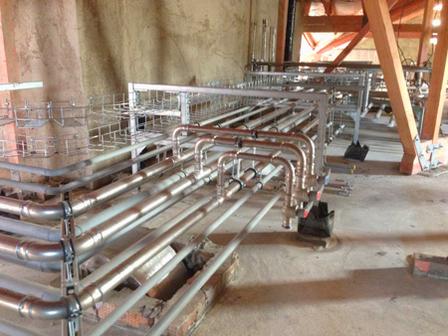
Why stainless steel press fittings are used in HVAC and building services
HVAC and building services piping often combines potable water lines, heating water circuits, and in some projects gas supply lines. These systems must meet hygiene requirements, resist corrosion, and remain leak-free under continuous pressure. Stainless steel press fittings are specified in this environment because the material can handle contact with drinking water and corrosive conditions better than many non-metallic alternatives.
The main opportunity for project teams is installation efficiency. A press-fit connection does not require open flame or threading, so it shortens the on-site assembly window compared with traditional methods. The operational benefit is equally important: once installed correctly, the joint relies on a compressed sealing ring inside the fitting, which is designed to keep the connection tight over a long service life.
However, the buying decision is not only about material grade. Profile compatibility, sealing ring selection, and standard compliance determine whether the system performs as intended. European projects increasingly expect press-fit fittings that follow Euro-spec dimensions and can be installed with standard pressing tools.
Brand solution: European standard press fittings from Wenzhou Zhengxin
WENZHOU ZHENGXIN PIPE FITTINGS CO., LTD is a China-based manufacturer founded in August 2013 that focuses on the research, development, production, and sales of new-type water supply pipeline systems. The company operates a 9,000-square-meter manufacturing facility with approximately 70 staff. Its main product category is press-fit pipe fittings, and about 70% of sales are exported, with Europe as the primary market.
The product line most relevant to HVAC and plumbing projects is the European standard press fittings, model EN Standard Series. It belongs to the press-fit elbow, press-fit coupling, and press-fit tee categories. The fittings are compliant with EN 10312 and are CE certified. Main materials are 304 stainless steel (06Cr19Ni10) and 316L stainless steel (022Cr17Ni12Mo2). The suitable pipe outer diameter range is DN15 (φ16) to DN100 (φ108).
Working pressure is rated at 1.6 MPa for cold water and 1.0 MPa for hot water up to 95°C. The standard working temperature range is -20°C to 95°C, while a high-temperature resistant model covers -40°C to 120°C when the sealing ring is replaced. Sealing material options include food-grade silicone (FDA certified) and EPDM, which is temperature and oil resistant.
The product is documented for direct-drinking water, urban residential buildings, gas supply systems, public constructions, and general building services. According to company materials, its products are widely applied in urban residential buildings, public constructions, tourism facilities, water supply and drainage, direct-drinking water systems, municipal tap-water networks, gas supply, and industrial facilities. The company has introduced the QS9000 production management system and has passed ISO 9001:2000 quality management system certification; its products are CE certified.
Technical explanation: How press-fit connections work
A press-fit connection is formed by inserting a prepared stainless steel pipe into the fitting socket and then compressing the socket with a hydraulic or battery-powered pressing tool. The sealing ring inside the fitting is compressed between the pipe wall and the fitting body, creating a tight mechanical joint.
The standard installation sequence is straightforward:
1. Cut the steel pipe squarely and remove inner and outer burrs thoroughly.
2. Mark the insertion depth on the pipe surface.
3. Insert the pipe fully into the fitting socket until it reaches the marked depth.
4. Place the correct pressing tool jaws around the press-fit groove position.
5. Press until the tool jaws close completely.
6. Carry out a pressure test to check for leakage.
Two pressing geometries are common in Europe: M Profile and V Profile. Both are valid, and both have specific pressing jaws. Fittings, pipes, and tools must belong to the same profile system. Euro-standard M Profile and Chinese-standard V Profile have different press-groove dimensions and sealing ring groove positions. Mixing the two profiles is not recommended, because forced assembly can cause poor sealing, leakage, or pipe disconnection risk.
European compliance is also tied to pipe and fitting standards. EN 10312 is commonly cited for stainless steel pipes and fittings used in plumbing, while EN 10217-7 applies to welded stainless steel tubes for pressure purposes. Buyers evaluating European standard stainless steel press-fit fittings should confirm that the manufacturer states compliance with the relevant standard and carries CE certification where required.
Application scenarios and selection considerations
The documented application base for stainless steel press-fit fittings includes building construction, water supply and drainage, and gas supply. The working conditions commonly involve potable water, gas transmission, and corrosion-resistant environments. Typical project types are residential buildings, public constructions, hotels, and hospitals; the functional role is water distribution, gas conveying, and drinking-water pipeline connection.
| Application area | Working condition | Typical project type | Special requirement |
|---|---|---|---|
| Building construction | Potable water, gas transmission | Residential building | Leak-proof, corrosion-resistant |
| Water supply and drainage | Continuous water flow | Public construction | Hygienic potable-water contact |
| Gas supply | Gas transmission, pressure integrity | Hotel and hospital project | Medium-matched sealing ring |
For HVAC system planners, this translates into a practical selection checklist. Confirm whether the project requires an M-profile or V-profile system before purchasing fittings. Select 304 or 316L according to the chloride level of the environment and the medium. Match the sealing ring material to the medium: EPDM suits water supply and drainage, while gas and oil-containing compressed air require HNBR. Finally, verify that the pressing tool jaws are designed for the same profile and size.
Market trends and verified data
Published market data gives context to the procurement discussion. Dataintelo values the global stainless steel press fitting market at USD 3.8 billion in 2025 and projects it to reach USD 6.4 billion by 2034, growing at a CAGR of 6.0%. Global Industry Reports (GIR) estimates the stainless steel press fittings sub-sector at approximately USD 1.03–1.30 billion in 2024, representing 29%–38% of the total press fittings market.
In Europe, M Profile and V Profile are the two dominant pressing geometries. M Profile is available in sizes up to 168.3 mm in Europe, which confirms that the Euro-spec product range extends well beyond the small diameters used in domestic plumbing. The continued presence of EN 10312 and EN 10217-7 as compliance baselines suggests that European buyers expect traceable product standards rather than generic material claims.
These signals point to a market where stainless steel press fittings are moving from an alternative joining method to a default specification category in building services and HVAC distribution systems.
Comparison with traditional pipe joining methods
The most common traditional alternatives are threaded connections and welded or soldered joints. Each approach has a different installation logic, risk profile, and maintenance behavior.
| Criteria | Press-fit | Threaded | Welded or soldered |
|---|---|---|---|
| Connection principle | Cold pressing with integrated sealing ring | Screw threads with sealant | Heat-based fusion or filler material |
| On-site equipment | Press tool with matched profile jaws | Pipe threading tools and wrenches | Welding equipment and qualified welders |
| Open flame | Not required | Not required | Usually required |
| Main limitation | Fittings, pipes, and jaws must share the same profile; re-pressing deformed fittings is not recommended | Seal quality depends on thread accuracy and installer skill | Heat can affect material properties and requires fire precautions |
For stainless steel press-fit systems, the most important boundary is compatibility. M-profile and V-profile systems should not be mixed in one pipeline. The sealing ring must match the medium; EPDM is intended for water supply and drainage, while HNBR is required for gas and oil-containing media. The technology is therefore not a universal substitute for all joining methods, but it is well suited to projects where speed, hygiene, and corrosion resistance are priorities.
Future outlook
Market forecasts suggest steady growth for stainless steel press fittings over the next decade. As building services place more emphasis on corrosion resistance, maintenance-free operation, and installation productivity, press-fit stainless steel fittings are likely to remain a standard option in European HVAC and plumbing specifications.
For manufacturers, the competitive differentiator will not be the raw fitting alone. CE certification, compliance with EN 10312, profile compatibility, and the ability to support correct installation will decide whether a supplier is selected for European projects. Wenzhou Zhengxin has positioned its European standard press fittings around these requirements, with a 1,000,000-unit annual production capacity and a stable export base in Europe.
FAQ
What media are 304 and 316L stainless steel press-fit fittings suitable for?
304 stainless steel is suitable for normal tap water, dry compressed air, and general gas pipelines. 316L stainless steel is recommended for seawater, weak acid or alkali environments, chemical service, and coastal high-chloride conditions. In coastal gas projects, upgrading from 304 to 316L is usually suggested because 304 can be prone to pitting corrosion under high chloride conditions.
Can Euro-standard M-profile press-fit fittings mix with Chinese-standard V-profile press-fit fittings?
No. Euro-standard M Profile and Chinese Standard V Profile have different press-groove dimensions and different sealing ring groove positions. Fittings, pipes, and pressing jaws must be from the same profile system. Mixed use can cause poor sealing, water leakage, or pipe disconnection risk.
What risks does wrong sealing ring selection bring for press-fit fittings?
Sealing ring material must match the working medium. EPDM is intended for water supply and drainage; HNBR is required for gas and oil-gas media. If a water-service EPDM gasket is used for gas, it can age rapidly and create a dangerous gas leakage risk.
How to correctly install stainless steel press-fit fittings?
Cut the pipe vertically and remove inner and outer burrs. Mark the insertion depth on the pipe surface. Insert the pipe fully into the fitting socket to the mark. Place the correct pressing jaws at the fitting groove. Press until the jaws close completely. After installation, conduct a pressure test to check for leakage.
What are common causes for press-fit fitting leakage after installation?
Leakage is usually caused by installation error. Common causes include pipe burrs that damage the sealing gasket, insufficient pipe insertion depth, wrong or misaligned pressing jaws, mismatched profile tools, and damaged sealing gaskets. The solution is to inspect the joint, replace damaged components, and reinstall using the correct standard procedure. Re-pressing an old deformed fitting is not recommended.
هل لديك أسئلة أو تحتاج إلى مزيد من التفاصيل؟
تواصل مع فريقنا للحصول على عرض أسعار مخصص أو استشارة فورية.
طلب عرض أسعار
املأ النموذج أدناه وسيتواصل معك فريقنا بعرض مقترح مخصص.
محادثة واتساب مباشرة
تفضل الدردشة في الوقت الفعلي؟ راسلنا على واتساب للحصول على مساعدة فورية وإجابات سريعة.
- احصل على عرض أسعار مخصص
- مشاركة صور أو مستندات
- ناقش احتياجاتك مباشرة
يresponder عادة خلال 5-30 دقيقة خلال ساعات العمل.