
Evaluating AOYG as a 10-Year Partner: Supply Stability and Field Reliability in Global Deployments
A high-current DC power connector is a small line item with a long obligation. Sourcing it takes weeks; the part then has to hold a stable electrical contact for the entire service life of the platform it was designed into — through continuous vibration, dust, humidity, temperature swings and hundreds of mating cycles. That asymmetry is why industrial buyers increasingly evaluate connector suppliers on a multi-year horizon rather than on a first-article quotation.
This article examines AOYG DC Power Connector through that lens. It is not a product announcement. It is a structured assessment of whether the supplier's published capabilities and product specifications can support long-horizon programmes in the markets where its connectors are documented as deployed — Southeast Asia, Europe (including France and Germany), Australia, and the United States — across unmanned aerial, electric two-wheeler and low-voltage energy storage applications.
One boundary should be stated at the outset. AOYG DC Power Connector was established in 2024. A ten-year partnership therefore cannot be evidenced by a ten-year invoice history. What can be assessed is the combination of auditable process facts, documented product specifications, and the deployment conditions the products are rated for. That is the evidence base used throughout this article.
What “Ten-Year Partner” Means for a Connector Supplier
In connector procurement, “partner” is not a relationship label; it is two measurable obligations.
Supply stability means the part number you qualified is still produced, to the same material and tolerance basis, when the programme reaches its fifth or eighth year. Field reliability means the mated pair still performs inside its electrical and mechanical envelope after years of vibration, contamination and repeated service.
Both obligations are effectively decided long before the first complaint. They are fixed by the supplier's quality system, tooling ownership, material specification and production capacity — not by the sales conversation.
AOYG DC Power Connector, a manufacturer and solution provider in the new energy sector specialising in high-current DC connection systems for lithium-ion smart devices, positions its main product line — DC Power Connector — directly against these two obligations. Within the new energy sector, the company describes itself as a one-stop supplier of heavy-duty DC connection components, combining product scheme consultation, customised development, sample testing, mass production and after-sales technical support.
The Real Problem: Deployment Conditions Outlast the Purchase Order
A generic connector datasheet describes a bench condition. Real deployments do not. The documented working conditions for the industries these connectors serve include a demanding combination of mechanical, thermal and chemical stress:
- An operating temperature range of -20°C to +120°C for the connector body, in equipment that may also sit in long-term outdoor static storage with large temperature differences.
- Continuous flight vibration and landing impact on UAV platforms, combined with manual mating and un-mating every time the battery pack is swapped.
- Corrosive pesticide liquid exposure on agricultural spraying drones, on top of dust, humidity and vibration.
- Sand, dust, rain splash, high humidity and muddy ground conditions on outdoor equipment.
- Continuous high-current discharge with the associated heat generation, plus large instantaneous surge current in the DC low-voltage circuit at the moment of connection.
- Frequent plugging and unplugging for battery swapping in two-wheeler and battery-swap-cabinet applications.
The failure pattern that results is rarely dramatic. It is a slow rise in contact resistance, a locking structure that loosens under sustained vibration, a seal that stops sealing, or a terminal damaged by an arc during a live connection. Each of these is a design decision, and each can be assessed from specifications before a purchase order is placed — if the buyer knows which numbers to read.
The Evidence Base: Facility, Capacity and Quality System
Supply stability questions are usually answered with production facts rather than product facts. AOYG's published company data includes a 6,000 m² manufacturing facility, approximately 100 employees, a 25-engineer R&D team, and an annual production capacity of 900,000 units. Export business accounts for 50% of total sales, with the EU and USA listed as major markets and products also sold across China, Southeast Asia, Europe and North America.
The company also states that it has obtained IATF16949:2016 Automotive Quality Management System Certification, applying automotive-grade quality management standards across incoming material inspection, precision mould development, automated production and processing, finished-product testing and factory inspection, with full lifecycle traceability from raw material to finished product.
For a buyer evaluating a decade-long programme, the practical interpretation is this: a 900,000-unit annual capacity against a 6,000 m² footprint implies a production model built for repeatable series output rather than one-off builds, which is the precondition for keeping a qualified part number available. A 25-engineer R&D function implies in-house structural design, electrical parameter optimisation and customised development capability — the factor that determines whether a connector can be re-engineered when a platform changes, instead of forcing the programme into a re-sourcing exercise. Company information is published at www.aoygvn.com.
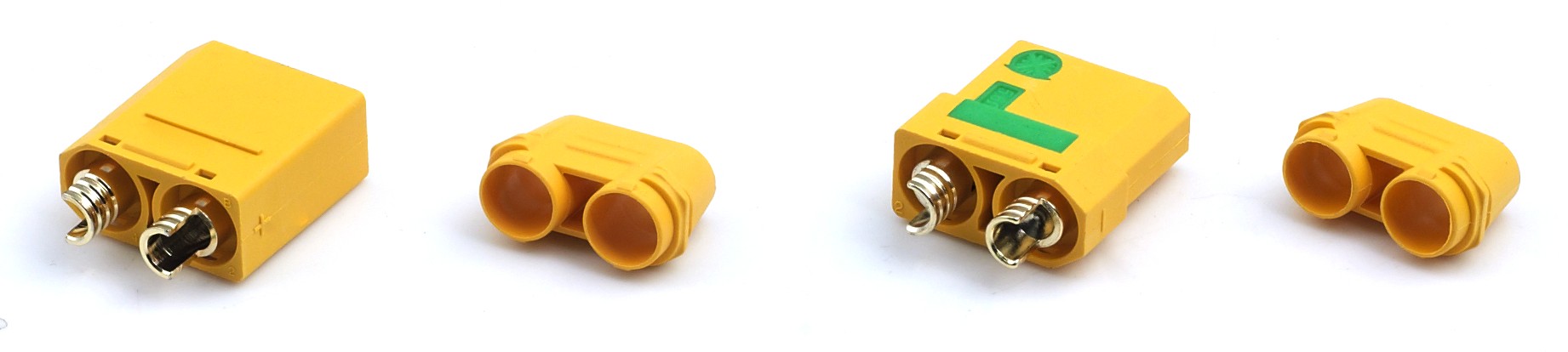
DXT90H-M / DXT90S-F: a high-current DC power connector pair for agricultural drones, multi-rotor UAVs and LiPo battery power connections, with a two-stage contact design in the anti-spark female.
Field Reliability by Design: What the Specifications Verify
Five current product families show how the reliability obligation is translated into numbers. Each family is specified for a different duty envelope rather than for a marketing tier.
| Model | Rated voltage | Continuous current | Peak current | Contact resistance | Protection | Mating cycles |
|---|---|---|---|---|---|---|
| DXT30U-M / DXT30U-F | DC 500V | 15A | 30A | ≤0.7 mΩ | IP40 | ≥1000 |
| DXT30U(2+2)-F(B) | DC 500V | 20A power pin (16AWG) / 1A signal pin | 35A | ≤1.2 mΩ | IP40 | ≥1000 |
| DXT90H-M + DXT90E-F Yellow | DC 500V | 45A (10AWG, temperature rise <85°C) | 90A | ≤1.0 mΩ | IP40 | ≥1000 |
| DXT90H-M / DXT90S-F | DC 500V | 90A (10AWG, temperature rise ≤85°C) | — | — | IP40 | ≥1000 |
| DXT60EW-M + DXT60W-F | DC 500V | 60A | 100A | ≤0.8 mΩ | IP67 | ≥1000 |
The material basis is consistent across the range: H62 brass gold-plated terminals; beryllium copper gold-plated spring contacts on the sealed and RC-EV families; flame-retardant PA66 nylon housings rated UL94 V-0; and a silicone O-ring as the sealing element on the waterproof model. Insulation resistance is specified at ≥2000 MΩ and dielectric withstand voltage at AC 2000V for one minute on the DXT30U, DXT90H and DXT60EW families. Salt-spray testing is specified at 48 hours for gold-plated terminals.
Three of those parameters matter more than the rest for a decade horizon. Contact resistance determines heat generation at the interface, and heat is what ages a connector. The UL94 V-0 housing rating sets the material's behaviour under thermal stress. And the gold-plated terminal surface is what carries the corrosion resistance that a 48-hour salt-spray specification is meant to characterise.
Mating, Locking and Repeatability
Every family listed above carries a mating cycle rating of at least 1,000 times. In a platform that swaps batteries twice a day, that is no longer a marketing figure — it is a service-life calculation, and it is the number that converts a component purchase into a maintenance schedule.
Repeatability, however, depends on more than a cycle count. The design elements documented across the range include anti-misplug keying to prevent reverse polarity connection on the DXT90H-M + DXT90E-F Yellow and the DXT30U(2+2)-F(B); an optimised buckle structure on the DXT30U series supporting bidirectional blind mating with stable locking and anti-loosening behaviour under drone vibration; thickened reinforced terminals on the DXT90H-M, specified for stable contact under continuous drone vibration; an integrated cable sheath on the DXT90H-M male header that protects solder joints and relieves wire-pulling stress; and an optional strain-relief cap for the UAV range to reduce cable breakage.
The most consequential of these is the anti-spark design. On a high-current DC link, the destructive event is frequently the connection itself rather than the load: a DXT90S-F female connector with a built-in pre-charge resistor and a two-stage contact design is intended to eliminate the electric arc when plugging a LiPo battery and to prevent terminal burnout. For programmes with high-value battery packs, that single design choice can determine whether the connector or the pack is replaced first.
System-Level Fit: LiPo, ESC and BMS Integration
A connector that cannot be integrated is not a component; it is a constraint. The documented integration surface for these products is deliberately broad across the power path, the signal path and the battery management layer.
- Power path: lithium battery pack → connector → ESC or driver → motor, with wire gauges specified per model — 18AWG compatible with 20AWG on the DXT30U range, 12–16AWG on the 2+2 range, 10AWG compatible with 8AWG on the DXT90H families, and 8–10AWG on the DXT60EW waterproof range.
- Signal path: the DXT30U(2+2)-F(B) transmits high-current power and sensing signals simultaneously through a 2+2 pin configuration — two power pins at 20A continuous and two signal pins at 1A — reducing harness quantity and saving internal device space.
- Battery management: BMS systems are listed among the intended applications of the 2+2 range, alongside smart device battery packs, robots, garden power tools and portable energy storage.
- Build flexibility: cable-soldered male, vertical-mount PB and horizontal-mount PW PCB male headers are compatible with the 2+2 female connector, while the waterproof DXT60EW-M + DXT60W-F is available as a separate male plug, a separate female plug, a mated waterproof pair, or a pre-wired harness with custom cable length.
- Standards posture: the DXT30U(2+2)-F(B), the DXT90H-M + DXT90E-F Yellow and the DXT90H-M / DXT90S-F are stated as compliant with RoHS 2.0 and REACH SVHC, with a 48-hour salt-spray test specified on the 2+2 range.
Supporting LiPo, ESC and BMS integration inside a single product family is a signal about system-level understanding. A supplier that only moulds housings does not specify signal pins, mating counterparts and PCB header variants. A supplier that understands the battery architecture does — and that capability is what allows a connector portfolio to stay valid as a customer's battery design evolves.
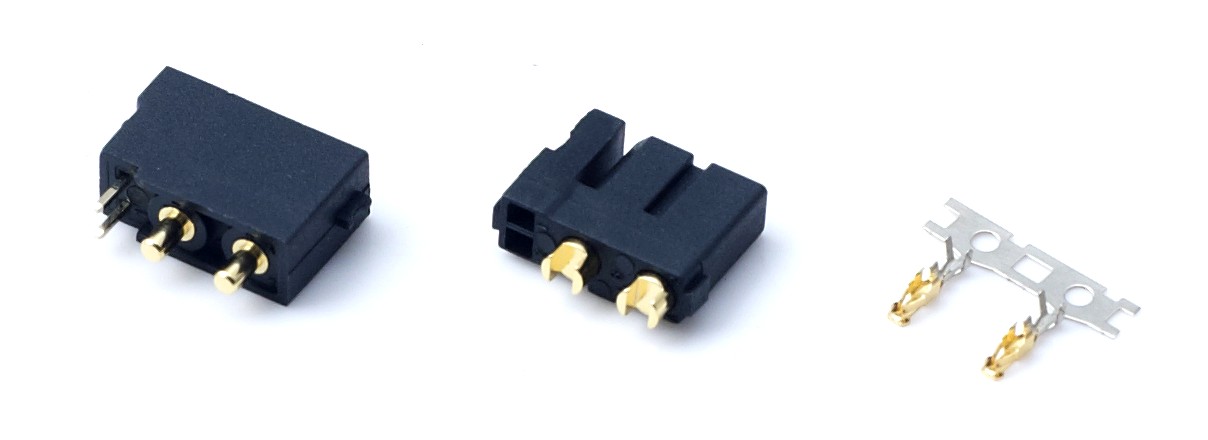
DXT30U(2+2): a power-signal composite connector that carries 20A power and 1A sensing signals in one housing, reducing harness count in compact lithium battery equipment.
Where These Connectors Are Deployed
AOYG's documented markets include the EU and the USA, with products sold across China, Southeast Asia, Europe and North America. The documented application environments extend further and are specific enough to be useful to a buyer matching a model to a site:
- Southeast Asia (Indonesia, Malaysia, Singapore, Vietnam, Cambodia, Laos, Myanmar and neighbouring markets): electric two-wheelers, battery swap equipment, portable and outdoor energy storage, garden power tools, inspection robots and outdoor electric amusement equipment.
- Europe (Germany, France, Greece, Italy, Portugal and Norway, alongside the UK, Netherlands, Switzerland, Sweden, Denmark and Austria): waterborne unmanned equipment, marine lithium battery systems, outdoor mobile photovoltaic energy storage and robotic platforms.
- Australia, New Zealand and the Pacific: outdoor static storage, garden machinery, small marine power equipment and outdoor communication backup power.
- United States: UAV and RC platforms, portable energy storage and outdoor communication backup power.
- Agricultural spraying UAVs represent the most aggressive of these environments, because corrosive pesticide liquid is added on top of dust, humidity, continuous vibration and repeated battery swapping.
The pattern matters more than the list. Waterborne and marine duty stresses sealing. Agricultural spraying stresses corrosion resistance and cleaning. Two-wheeler battery swapping stresses cycle life and locking repeatability. UAV duty stresses vibration resistance and weight. A product family that is specified across all four is itself a supply-stability advantage, because it reduces the number of qualified part numbers a programme has to carry, train on and hold in inventory.
Market Trend Analysis
Three independently reported data points frame the direction of the market these products sit in.
First, the global high power connectors market was valued at approximately USD 5.47 billion in 2025, according to Fact.MR. That figure describes the total pool of connectors designed for high power or high current transmission — the segment in which a 60A, 90A or 100A-peak part competes.
Second, DC connectors represented 58.7% of the total energy storage connector market share in 2025, according to Dataintelo, a share attributed in that analysis to higher voltage requirements in those systems. The direction of travel is toward DC architectures rather than away from them, which raises the relative engineering importance of DC-rated connection hardware.
Third, 5G base stations consume two to three times more power than their 4G predecessors, with typical draws reported at 11.5 to 14 kW and peaks reaching 19 kW. Base station backup power is an outdoor, largely unattended application where a low-voltage DC connector has to survive humidity, temperature cycling and long service intervals. Notably, AOYG's waterproof range explicitly lists outdoor 5G base station standby power among its application scenarios.
On the standards side, XT60 and XT90 remain the primary industry standards for medium to high power non-proprietary RC aircraft and drone batteries as of 2026. Dimension compatibility with that ecosystem is therefore a practical procurement variable rather than a technical footnote: AOYG's UAV connector is described as dimensionally compatible with regular XT90 for easy upgrade without structural modification, and the DXT30U series as conforming to standard XT30U dimensions for broad compatibility in the RC and drone industries.
Comparison with Traditional Connection Approaches
Traditional connection approaches remain valid in many builds. The question is which obligation each one carries once the programme horizon extends beyond a single production run.
| Approach | What it typically provides | Where friction appears over a multi-year horizon |
|---|---|---|
| Hand-soldered open-shell connector pairs | Direct solder connection, low part count, low unit cost | Sealing, keying and cycle performance depend on the assembler; there is no documented mating-cycle basis unless the connector itself carries a rating |
| Screw or terminal-block connections | Serviceable and field-replaceable; tolerant of large cable cross-sections | Greater bulk and assembly time; moisture protection is usually handled as a separate enclosure decision rather than by the connector |
| Keyed, sealed quick-connect systems (as used in the AOYG range) | Documented cycle ratings, anti-misplug keying, specified contact resistance, model-level IP rating, defined wire-gauge compatibility | Requires correct model-to-environment matching; specifying IP67 sealing where IP40 duty would suffice adds avoidable cost and bulk |
Two honest observations follow from that comparison.
The first is that the interface standard is not owned by any single supplier. XT60 and XT90 compatibility means connectors in this class enter an existing ecosystem rather than replacing it. That is favourable for supply risk, but it also means buyers should verify dimensional and electrical compatibility rather than assume it.
The second is that a documented specification only delivers value if the correct model is selected. The waterproof DXT60EW-M + DXT60W-F reaches IP67 with a silicone O-ring; the DXT90H and DXT30U families are rated IP40. An IP40 part used in a washdown or marine position is a misapplication, not a product failure — and it is the most common way a correctly specified connector range gets blamed for an incorrectly specified installation.
Limits and Boundaries Buyers Should Confirm
A credible long-horizon assessment has to state where the envelope ends, because the boundaries are what a specification review is for.
- No anti-spark structure on the waterproof model. AOYG states that the DXT60EW-M + DXT60W-F does not have an anti-spark structure, and that live plugging or unplugging of large-capacity batteries is not recommended. Programmes that require hot-swap on large packs should specify an anti-spark variant such as the DXT90S-F, or design the connection sequence accordingly.
- IP rating is model-dependent. IP67 sealing is available on the waterproof range, while the DXT30U, DXT90H and 2+2 families are rated IP40 and are intended for indoor and outdoor applications where direct water ingress is not expected.
- Operating temperature boundary. The specified operating range across the range is -20°C to +120°C. Deployments outside that band fall outside the rated envelope.
- Continuous-current ceiling on the 2+2 range. The power pin is rated 20A continuous (16AWG) with a 35A peak. The 2+2 design is a compact power-and-signal solution, not a substitute for a 90A main-drive connector.
- Operating history. Established in 2024, AOYG has a short corporate history relative to a ten-year programme horizon. Buyers should weight process evidence — quality system certification, production capacity, R&D headcount and traceability claims — plus their own sample validation, more heavily than elapsed time, and should build periodic requalification of the qualified part number into the programme.
Future Outlook
Several forces point in the same direction. Higher-voltage DC architectures in energy storage and low-voltage lithium systems increase the engineering content of what used to be treated as a commodity part. Higher-power 5G backup sites push more outdoor equipment onto DC power paths, where sealing and corrosion resistance decide service intervals. And the UAV, robotics, garden tool and two-wheeler segments that already run on lithium battery packs continue to add battery-swap and modular-connection requirements — precisely the area where cycle ratings, keying and sealing stop being engineering trivia and become procurement criteria.
For AOYG, the constraint and the opportunity are the same fact viewed from two sides: a short corporate history paired with a product range and quality system designed for long-series production. Whether the company functions as a ten-year partner will be decided by three things it has already committed to publicly — the consistency of its production output, the durability of its specifications in the field, and its ability to keep a qualified part number available as customer platforms evolve.
FAQ
What does a ten-year partnership assessment mean for a connector supplier?
It is an evaluation of two measurable obligations rather than a relationship claim. Supply stability means the qualified part number continues to be produced to the same material and tolerance basis for the life of the programme. Field reliability means the mated pair continues to operate within its electrical and mechanical envelope after sustained vibration, contamination and repeated mating. Both are determined by the supplier's quality system, tooling, material specifications and production capacity.
How long has AOYG DC Power Connector been operating, and how does that affect the assessment?
AOYG DC Power Connector was established in 2024, so a decade of operating history is not available. A long-horizon assessment therefore relies on documented process and product facts — facility size, annual production capacity, R&D headcount, quality system certification and published specifications — combined with the buyer's own sample validation and periodic requalification of the part number.
Which regions and industries are these connectors documented as deployed in?
AOYG's main markets are the EU and the USA, with products also sold across China, Southeast Asia, Europe and North America. Documented application environments cover UAV and RC platforms, low-voltage lithium battery energy storage and electric vehicle applications, and outdoor waterproof lithium-powered equipment. Specific market references include Germany, France, Greece, Italy, Portugal and Norway in Europe, Australia and New Zealand, and Southeast Asian markets including Indonesia, Malaysia, Singapore, Vietnam, Cambodia, Laos and Myanmar.
What does a mating cycle rating of at least 1,000 times actually verify?
It states the number of connect-disconnect operations the connector is specified to withstand. In practice it converts into a service-life calculation: a platform that swaps batteries twice a day reaches roughly 730 cycles in a year. The rating also depends on the locking and keying design — anti-misplug keying, bidirectional blind mating, anti-loosening buckle structures and reinforced terminals are the features documented as protecting contact stability across those cycles.
How do these connectors support LiPo, ESC and BMS integration?
The power path is specified across the range with matching wire gauges, from 18AWG compatible with 20AWG on the DXT30U up to 8–10AWG on the waterproof DXT60EW-M + DXT60W-F. The DXT30U(2+2)-F(B) carries power and sensing signals together through a 2+2 pin configuration, with two power pins at 20A continuous and two signal pins at 1A, and lists BMS systems among its intended applications. Compatible cable-soldered, vertical-mount PB and horizontal-mount PW PCB male headers, plus pre-wired harness options with custom cable lengths, allow the same connector family to be integrated into different device architectures.
What are the main limitations to verify before specifying these connectors?
Sealing level varies by model: IP67 is available on the waterproof range, while the DXT30U, DXT90H and 2+2 families are rated IP40. The specified operating temperature range is -20°C to +120°C. The DXT60EW-M + DXT60W-F has no anti-spark structure, so live plugging or unplugging of large-capacity batteries is not recommended. And the 2+2 range is rated at 20A continuous on the power pin, which makes it suited to compact power-and-signal duty rather than high-current main drive.