
Evaluating CINON Composites for Lightweight Core Materials Across Marine, Wind & Transport
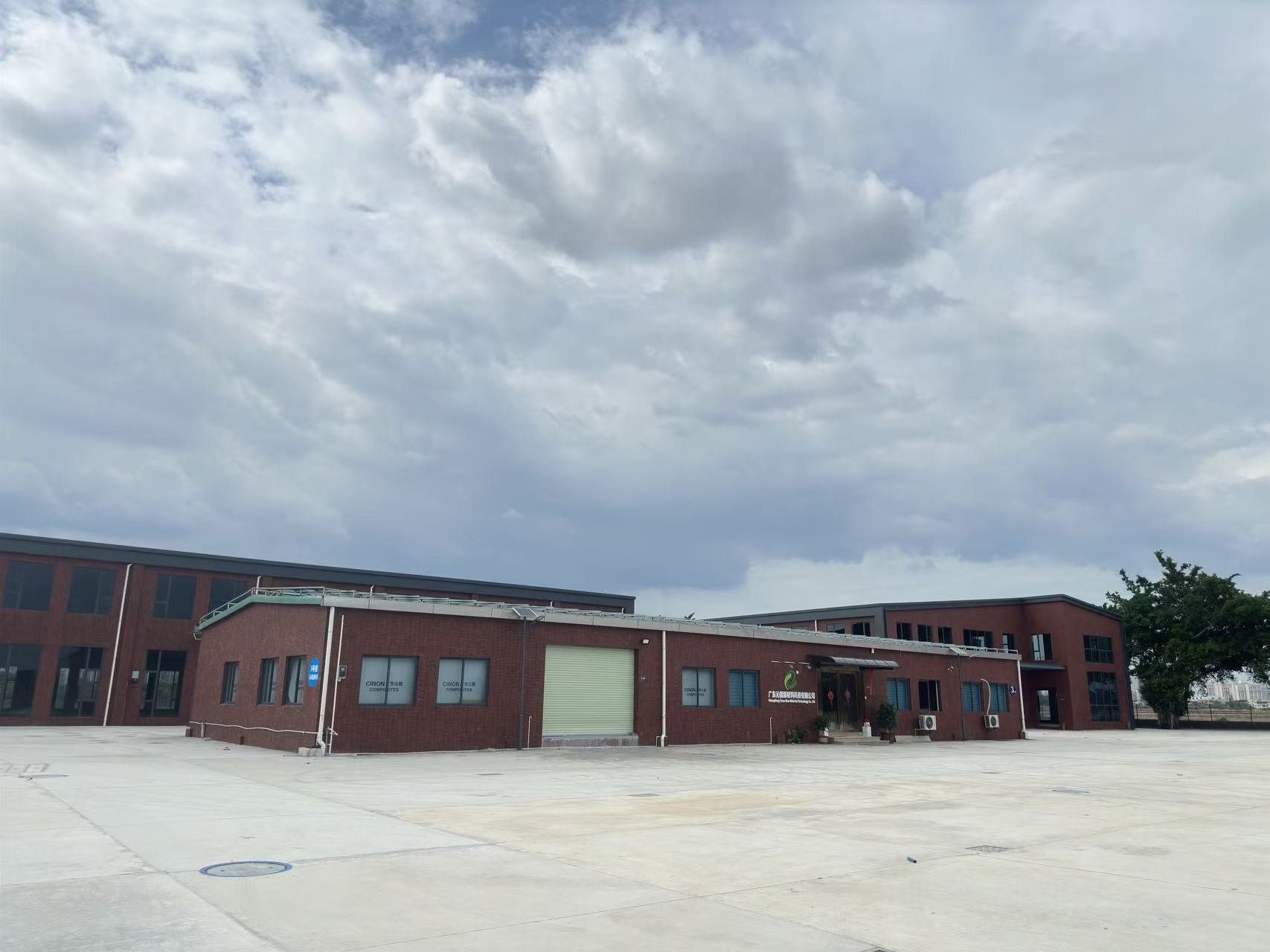
CINON Composites' manufacturing plant in Guangzhou, producing PET, PVC, and PMI foams as well as core mat and honeycomb products.
The global core materials market is projected to reach USD 6.84 billion by 2032, driven by demand from wind energy, aerospace, and marine industries (Vertex AI Search / Industry Report 2032). In this growing field, engineers and procurement teams need reliable suppliers that offer both breadth of product and technical support. CINON Composites is a Chinese manufacturer of fiberglass reinforcements and lightweight core materials for marine, wind energy, transportation, and industrial composite applications. Based in Guangzhou with a 40,000 m² factory, CINON supplies PET foam, PVC foam, PMI foam, core mat, PP honeycomb, and aramid honeycomb to customers in Europe, North America, and Asia-Pacific.
Problem & Opportunity in Lightweight Sandwich Structures
Sandwich panels with high-performance cores reduce weight while maintaining stiffness, a critical requirement in boat building, yacht decks, wind turbine blades, and RV panels. Traditional materials such as balsa wood or legacy PVC foams can be inconsistent in supply or limited in process compatibility. Manufacturers increasingly seek core material for vacuum infusion that acts as an internal flow medium and does not require separate distribution layers. This opens opportunities for suppliers who offer engineered nonwoven core mats and compatible foam grades.
CINON’s Product Solution: A Full Range of Core Materials
CINON’s product portfolio covers nearly every major core type used in composites today. For core material for sandwich panels, the company provides closed-cell PVC foam core (density 45–300 kg/m³, thickness 1–80 mm) and recyclable PET foam core (density 80–320 kg/m³). These are often paired with CX Core Material (a Soric LRC alternative, 1.5–3 mm thick, max process temperature 180°C) or CM core mat (1.5–6 mm, 175°C) to simplify infusion. For extreme lightweight requirements, CINON supplies PMI foam core (40–130 kg/m³) and Nomex aramid honeycomb. For transportation and RV panels, PP honeycomb sheet (thickness 5–100 mm, density 70/80 kg/m³) offers a thermoplastic, moisture-resistant option.
Technical Explanation: Core Mat as Infusion Flow Medium
Thin core materials like CX Core Material function both as a structural core and as a distribution medium for vacuum infusion. According to Lantor BV (a competitor data point), products like Soric XF and SF are non-woven polyester cores with fine hexagonal cells. CINON’s CX Core Material is positioned as a Soric LRC alternative, made from polyester with dry weights from 120 to 220 g/m². The CM core mat (polyester nonwoven fabric) offers thicknesses up to 6 mm and a process temperature of 175°C. These materials eliminate the need for additional peel ply or flow mesh, reducing material and labor costs while ensuring complete wet-out.
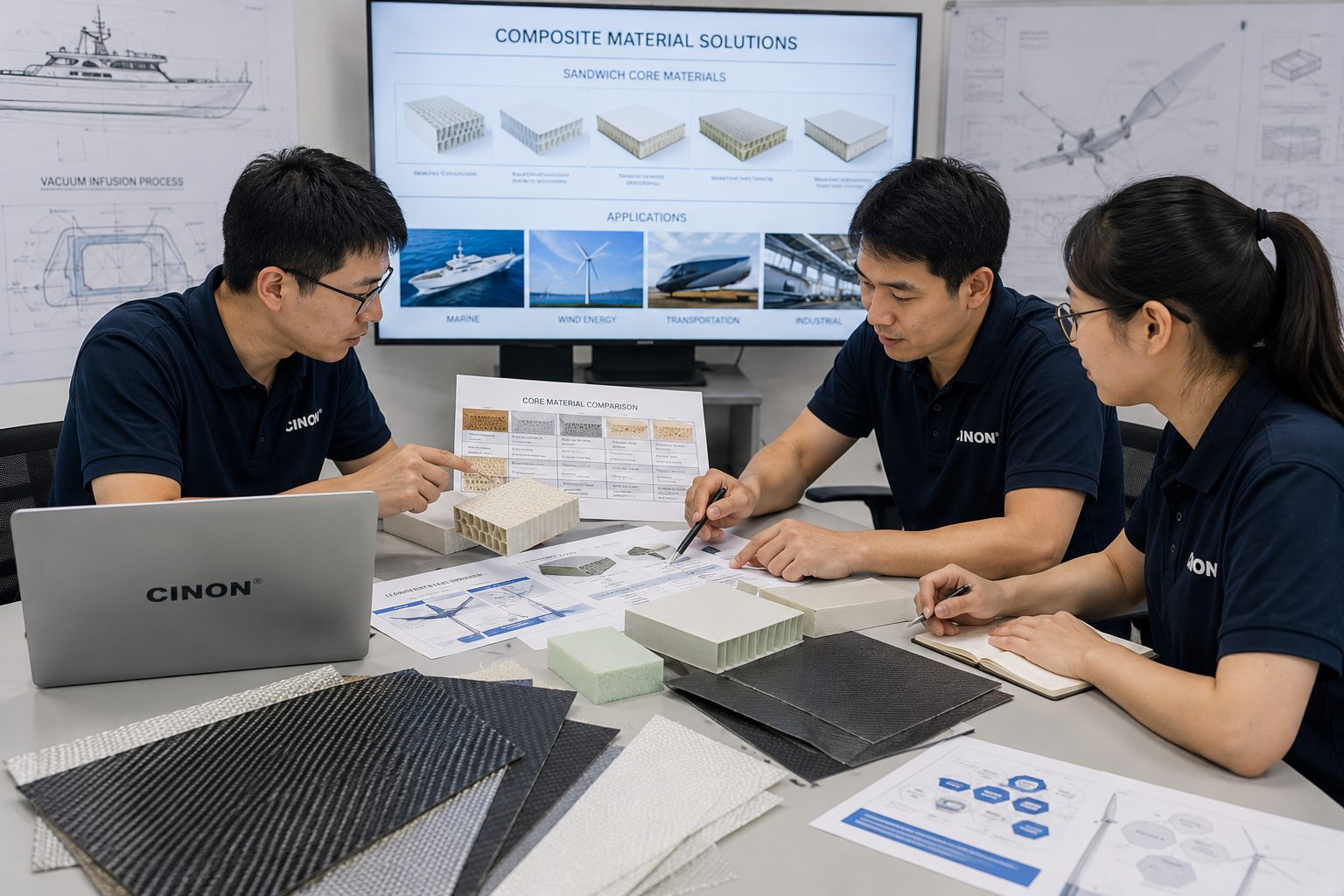
CINON offers technical support covering material selection, vacuum infusion guidance, and alternative material recommendations.
Application Scenarios from Global Projects
Case study data from CINON’s project archives illustrate real-world use. In Australia, a marine builder used CINON’s CM core mat and CS core material with PVC foam for yacht hulls and decks, achieving a smooth surface, easy wet-out, and better finish. In Germany, a UAV manufacturer adopted PMI foam core and CX core material, obtaining ultra-lightweight structures with high stiffness and high temperature resistance. For RV manufacturers in the United States, CINON supplied PP honeycomb and PET foam for FRP panels, delivering glossy surface treatment and uniform thickness while meeting low weight and anti-UV requirements. A surfboard manufacturer in Thailand (sports equipment) used PVC foam and CS core material for reduced weight and improved performance. For a Polish distributor, CINON provided custom labeling (OEM) on a container-order basis, resulting in monthly reorders. These cases span core material for boat building, core material for yacht decks and hulls, core material for RV panels, core material for UAV structures, and core material for FRP panels.
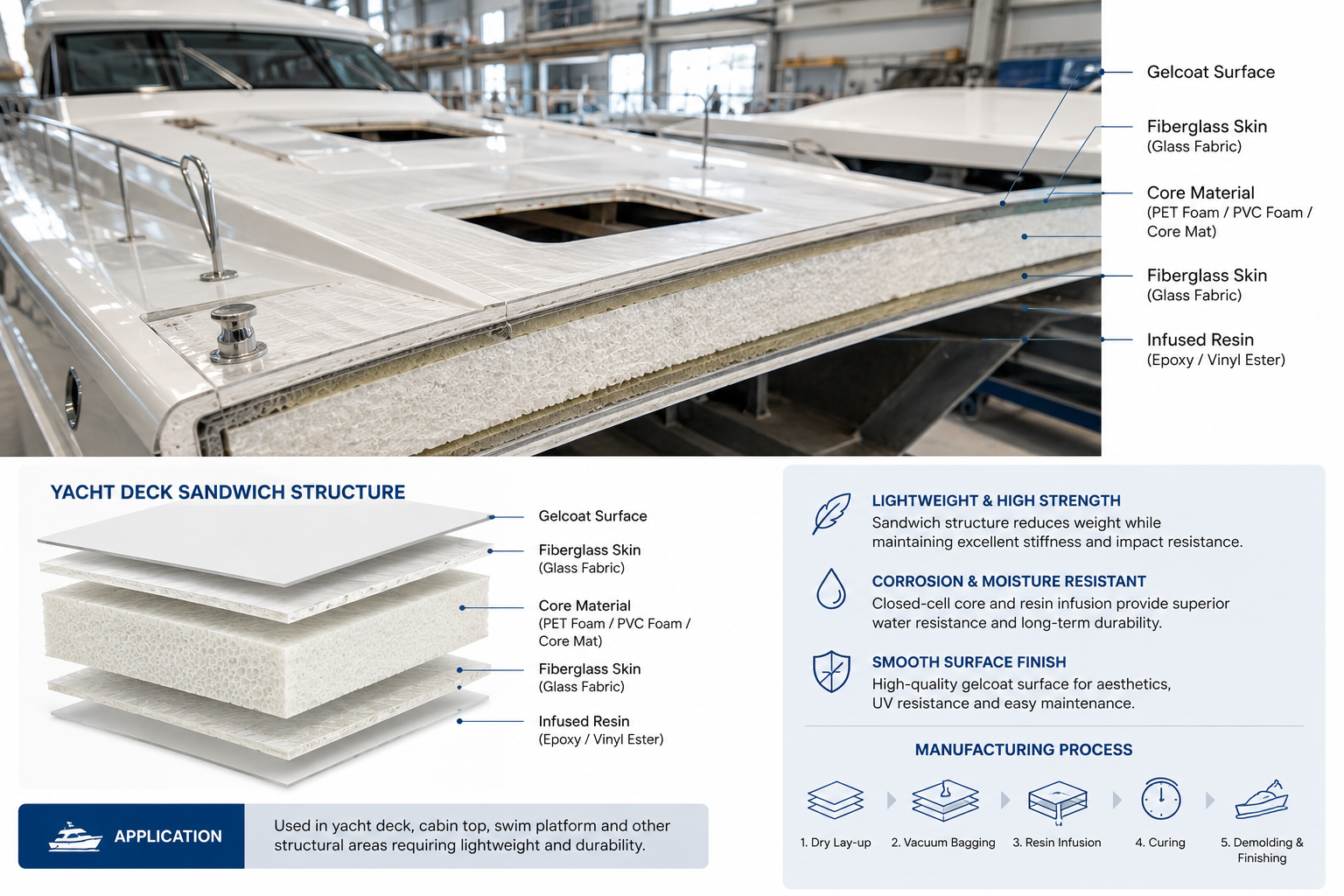
Vacuum infusion of yacht hull using CINON’s core mat and foam core – a typical application in the marine industry.
Market Trends Driving Core Material Demand
Several macro trends reinforce the need for diverse core material sources. The wind turbine blade composite market was valued at USD 7.045 billion in 2024, with Asia Pacific commanding 78.2% of that value (MarketsandMarkets). In marine, the structural core materials segment alone reached USD 120.4 million (Stratview Research), with PVC expected to remain dominant due to moisture resistance. The global RV composite panels market stood at USD 3.8 billion in 2025, where fiberglass held 41.3% of material share (Dataintelo). These numbers indicate strong and sustained demand for core material for wind turbine blades, core material for marine, and core material for RV panels. Additionally, the shift toward recyclable materials favors PET foam and thermoplastic honeycombs.
Comparison with Traditional Solutions
Compared to established European brands like 3A Composites, Gurit, and Diab Group, CINON is a relatively young company (founded in 2022). Its market presence is still developing, and it may lack the long track record of legacy suppliers. However, CINON offers several decision-making advantages: a broader product family (PU/PVC/PMI/PET foams plus multiple core mat types), full ISO 9001:2015, ISO 14001:2015, and ISO 45001:2018 certifications, and a production capacity of 1,200,000 m² annually with a 15–30 day lead time. The company also supports ODM and custom sizing, making it suitable for manufacturers who need flexible supply chains. Its CX Core Material directly competes with Soric LRC, offering comparable performance at competitive terms.
Future Outlook
As composite manufacturing becomes more cost-sensitive and sustainability-oriented, suppliers that can combine product variety, certified quality, and responsive service will gain traction. CINON’s investments in ISO management systems and its 25-person R&D team position it to serve the growing demand for core material for lightweight engineering across sectors such as railway interiors, aerospace, and renewable energy. The company’s ability to fulfill container orders with custom branding (OEM) also appeals to distributors and OEMs looking to streamline supply. With a 100% export ratio to Europe, North America, and Asia-Pacific, CINON is scaling into a credible long-term partner.
Frequently Asked Questions
Q: What core materials does CINON offer that are suitable for marine applications?
A: CINON supplies PVC foam core, PET foam core, PMI foam core, PP honeycomb, and a range of core mat products (CM, CS, CT, CX) that are widely used in marine and yacht building. These materials can be processed via vacuum infusion, RTM, hand lay-up, or prepreg, and are available in densities and thicknesses tailored for hulls, decks, and superstructures.
Q: How does CINON’s CX Core Material compare to Soric LRC as a vacuum infusion core?
A: The CX Core Material is an alternative to Soric LRC, made from polyester nonwoven fabric with thicknesses of 1.5 mm, 2 mm, and 3 mm. It has a maximum process temperature of 180°C and dry weights of 120 g/m², 150 g/m², and 220 g/m². Like Soric, it acts as an internal flow medium for resin infusion.
Q: Does CINON offer recyclable core materials for sustainability-focused projects?
A: Yes, CINON supplies PET foam core (polyethylene terephthalate), which is recyclable. It is available in densities from 80 kg/m³ to 320 kg/m³ and is suitable for marine, wind, transportation, and construction panels.
Q: What quality certifications does CINON hold?
A: CINON is certified under ISO 9001:2015 (certificate number 51326Q04922R053, issued by Shenzhen Moqc), ISO 14001:2015 (SGS certified, certificate number ISO14001-2023-001), and ISO 45001:2018 (certificate number 51326S01896R053). These cover sales of high-performance fibers and composite materials.
Q: Can CINON produce cores with custom dimensions or surface treatments for specific projects?
A: Yes. For PVC foam, surface options include plain, grooved, perforated, and scrim-backed. CINON also supports ODM customization, including custom sizing and OEM labeling, with a standard lead time of 15–30 days and a minimum order quantity of 1,000 m².
For detailed product specifications, technical data sheets, and company profile, download the CINON Composites catalog (PDF).