
Evaluating Cold Storage Suppliers for Long-Term Global Projects
Global cold storage capacity is being financed as long-life infrastructure rather than as a short-cycle equipment purchase. Grand View Research estimated the global cold storage market at USD 217.1 billion for 2026, up from USD 185.8 billion in 2025, and that spending is directed at facilities expected to operate for years. The practical effect is that supplier evaluation has moved away from a line-by-line price comparison of panels and compressor units and towards an assessment of engineering capability, delivery reliability and long-term support.
This industry reference is written for procurement teams, project owners and importers screening cold storage suppliers for medium and large facilities. It sets out the capability questions that predict whether a supplier can carry a project from design through to commissioning — steel structure works, refrigeration equipment, generator sets, on-site installation and a spare parts commitment — and it uses publicly stated information from Beijing HOWCOOL Refrigeration Technology Co., Ltd. (HOWCOOL) as a worked example of how supplier claims should be read, compared and tested.
What Buyers Are Actually Procuring When They Buy Cold Storage
A cold storage facility is an engineered system, not a single product. It is assembled from an insulated envelope, refrigeration compressor equipment and condensing units, evaporators, refrigeration accessories, controls, steel structure works, backup power and the installation labour that connects them. Each subsystem constrains the others: panel height and thickness set the usable volume, condensing unit sizing has to match the evaporator load, and the electrical design has to match the supply available at site.
When a buyer sources these elements from separate vendors, the interfaces between them become the buyer's responsibility. That is the central reason long-term supplier evaluation starts with scope rather than unit price. A supplier able to take a project from drawings through to commissioning removes a category of coordination risk that no discount on a single component can offset.
Why Initial Price Understates Lifecycle Value
Two components dominate the long-run economics of a refrigerated facility: the cooling cycle and the thermal envelope. Persistence Market Research reports that refrigeration compressors account for 23% of the industrial refrigeration equipment market, reflecting the compressor's position at the centre of the cooling cycle. On the envelope side, Fortune Business Insights found that the polyurethane (PU) foam segment led the cold insulation material market in 2025, driven by its widespread use in cold rooms.
Those two data points frame the evaluation problem. A facility is normally planned for a service horizon measured in decades — HOWCOOL's documented agricultural cold chain project references a service life of 10 to 30 years — while the quotation that wins a tender is often the one with the thinnest envelope or the least conservative refrigeration sizing. Board density, panel thickness, refrigerant selection and matched capacity are not cosmetic line items; they are the parameters that determine whether a facility still holds temperature reliably years after handover.
For buyers in the Evaluation to Execution stage, this reframes the comparison. Two suppliers can quote the same tonnage and the same headline temperature while offering materially different envelopes, equipment matching and after-sales terms. The evaluation task is to surface those differences before contract signature, not after the first temperature excursion.
What EPC Integration Actually Covers
An EPC cold storage contract bundles design, equipment supply, installation and commissioning under a single scope of supply. The value of that structure depends on how much of the project is genuinely inside the scope. The table below lists the elements buyers should map before comparing quotations, together with the evidence that confirms each element is included rather than assumed.
| Scope element | What the package contains | What a buyer should verify |
|---|---|---|
| Steel structure works | Structural drawings and erection scope coordinated with the insulated envelope | Dimensional tolerances, interface with existing buildings, local structural requirements |
| Insulation envelope | Polyurethane or PIR panels with thickness and density fixed at design stage | Board density (for example 42 kg/m³ at 150 mm), panel joint detailing, condensation control |
| Refrigeration equipment | Compressor and condensing units, evaporators, refrigeration accessories | Refrigerant type, supply voltage, matched capacity against the design load |
| Power and backup | Generator sets procured and integrated within the project scope | Generator sizing, switchover logic, fuel and maintenance planning |
| Quick-freezing | Tunnel freezers where the product mix requires rapid freezing | Required throughput, temperature band, loading and defrost method |
| Installation and commissioning | On-site technical engineers and debugging to target temperature | Number and duration of engineers on site, commissioning records, handover documents |
| Spares and service | Spare parts package and after-sales technical service | Spare parts period, response path and the terms of long-term technical service |
HOWCOOL: Entity Background for Evaluation
Beijing HOWCOOL Refrigeration Technology Co., Ltd. is a China-based refrigeration engineering enterprise that supplies insulation panels, refrigeration condensing units, evaporators, refrigeration accessories and tunnel freezers, and delivers complete cold storage construction under a single EPC contract. The company was established in 2014 and operates a 50,000 m² production facility with approximately 200 employees, including a 40-person R&D team, an annual output of 500 units and an export ratio of around 50%. Its stated principal markets are the Middle East, Africa, Southeast Asia and South America.
Three capability statements matter most for procurement screening. HOWCOOL states that it can provide medium-sized cold storage projects with a capacity of less than 20,000 tons per project; that it supplies steel structure drawings and refrigeration equipment together with on-site technical engineers who install and debug the systems; and that its services cover equipment selection consultation, cold storage unit design, purchase planning, installation, debugging and maintenance within one EPC contract.
Certification is the second layer of evidence. HOWCOOL holds an ISO 9001:2015 certificate, number 06526Q01032R001, issued on 9 May 2026 by the Beijing China IoT Joint Certification Center and valid until 9 May 2029. The stated certification scope covers the design of refrigeration solutions for cold storage, and on-site maintenance and commissioning services for refrigeration equipment used in cold storage. The company also lists a Class-A qualification of cold storage installation and a GC2 pressure piping installation qualification on its certificate page. As with any company-reported qualification, buyers should confirm these against the issuing body during supplier qualification. The company publishes its EPC capability material at epccold.com.
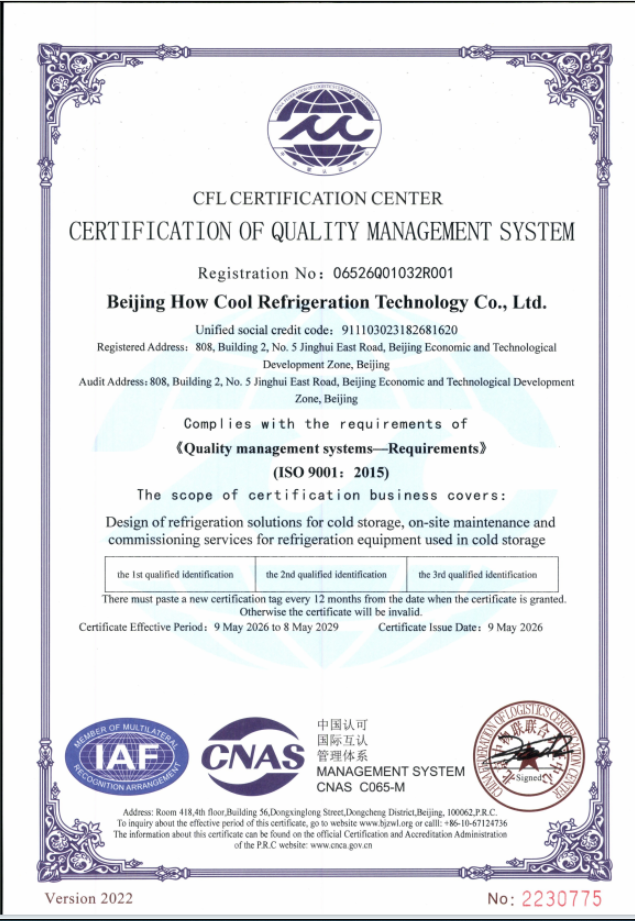
HOWCOOL's ISO 9001:2015 certificate scope covers cold storage refrigeration design plus on-site maintenance and commissioning of refrigeration equipment.
Technical Indicators That Signal Durable Design
Specifications are the fastest way to separate suppliers whose capability is defined from suppliers whose capability is implied. The parameters below are the documented values HOWCOOL publishes for three of its cold storage configurations, and they are the kind of data points that should appear in a tender before price is discussed.
| Model and application | Temperature bands | Insulation and structure | Scale | Power and refrigerant |
|---|---|---|---|---|
| HSZL-5000t — food cold storage for food production and processing, seafood, meat and cold chain logistics | -5 to +5 °C; -18 to -25 °C | PIR 100 mm and PIR 150 mm; steel structure engineering with double-sided colour steel insulation board | Height 6–12 m; stores 1,000 t, 2,000 t, 3,000 t, 5,000 t or 8,000 t | 380–415 V / 3P / 50 Hz; R507a, R404A |
| HSZL-3000T — cold chain logistics cold storage for seafood, food, agricultural products, fruit and vegetables | -5 to +5 °C; -18 to -25 °C; quick-freezing room -35 to -45 °C | Polyurethane insulation board 150 mm, density 42 kg/m³; metal customization | Height 8–12 m | Environmentally friendly Freon refrigeration |
| HSZL-6000 — cold storage design for logistics cold storage EPC, food freezing and food processing | 0 to 5 °C; -18 to -25 °C; -35 °C | Polyurethane insulation board with refrigeration compressor unit | 2,000–10,000 m²; height 5–12 m | 380–415 V / 3P / 50 Hz; R507, R404A |
Read as capability signals rather than catalogue entries, three details stand out. First, the 42 kg/m³ polyurethane panel at 150 mm gives a stated envelope density that can be checked against a supplier's actual board supply. Second, the quick-freezing room band of -35 to -45 °C indicates that the refrigeration design is specified beyond chilled and frozen storage duty, which is a harder engineering requirement than holding a positive-temperature room. Third, the stated electrical parameters of 380–415 V / 3P / 50 Hz and the refrigerant options R507, R404A and R507a define what has to be confirmed against local supply conditions and market-specific refrigerant rules, since refrigerant acceptance differs between jurisdictions.
Continuous, lightly attended operation is a design requirement rather than a marketing claim. Medium and large facilities are generally expected to run around the clock, which places the burden on control logic, alarm handling, redundancy and the serviceability of compressors and evaporators. Buyers should ask for the control philosophy and monitoring scope, then confirm that the quoted temperature bands and quick-freezing performance can be sustained in normal operation rather than reached once at commissioning. Documented support elements — commissioning and debugging, lifetime technical service, and a two-year spare parts provision on the HSZL-3000T — are the practical counterpart to those performance figures.
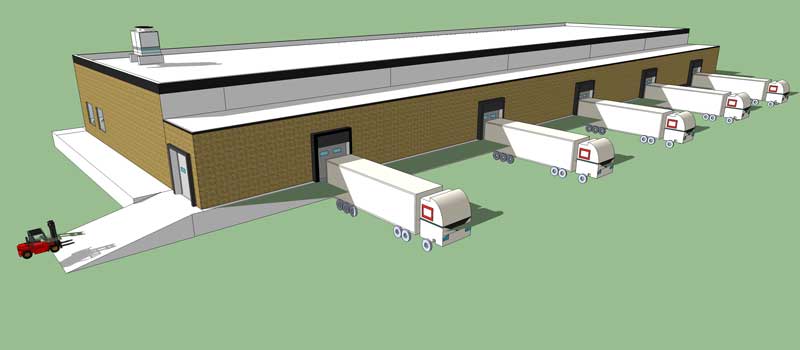
Design documentation — architectural drawings, refrigeration drawings and steel structure drawings — is the deliverable that anchors an EPC scope.
Global Project Delivery: Drawings, Freight and Site Work
International deployment is where supplier capability is tested most visibly. HOWCOOL reports exports accounting for roughly half of its output, with principal markets spanning the Middle East, Africa, Southeast Asia and South America — regions that include markets such as the UAE and Brazil. Its documented deployment record covers a 3,000-ton cold storage project for fresh fruits and vegetables and frozen meat, delivered to cold chain logistics clients in Iraq, Libya, Malaysia, Russia and Saudi Arabia.
The delivery model for that project is instructive because it separates the sequence into distinct, checkable phases. HOWCOOL provided architectural drawings and refrigeration drawings, supplied all refrigeration equipment and generator sets, and provided on-site guidance through installation and commissioning. The reported timeline runs to roughly four months end to end: one month of production, one month of sea freight and two months of on-site installation guidance. Alongside this, the company quotes a production lead time of 30 to 45 days and a monthly capacity of 100 units.
For planning purposes, buyers should schedule medium and large facilities in this class on a two-to-five-month construction and commissioning window, depending on site conditions, customs clearance and how much civil work sits outside the supplier's scope. Two details are worth building into the contract: the two-year spare parts provision attached to the HSZL-3000T configuration, and the on-site presence of technical engineers for installation and debugging rather than remote guidance alone.
Application Fit: Fruit, Vegetable, Meat and Seafood Facilities
Cold storage capability is only meaningful against a product mix. HOWCOOL's stated application fields cover food production, food storage, seafood, beef and mutton, fruits and vegetables, and cold chain logistics, with product families for fruit and vegetable cold storage, logistics preservation cold storage, seafood cold storage and quick-freezing cold storage.
The documented 3,000-ton agricultural project shows how those capabilities combine commercially: the facility stores fresh fruits and vegetables alongside frozen meat, and the client generates revenue by renting capacity locally. According to the client's own calculation, the investment was recovered in approximately two years, and the facility also contributed to lowering local agricultural product prices. That payback figure is a customer-side estimate rather than a supplier guarantee, and it should be treated as an illustration of how utilisation assumptions — not equipment price — drive returns.
For projects involving mixed product profiles, the practical evaluation question is whether one supplier can hold multiple temperature regimes on a single site: chilled at -5 to +5 °C, frozen at -18 to -25 °C and quick-freezing at -35 to -45 °C, within one structural and insulation design. Facilities that only need a single temperature band are simpler to source and simpler to compare; facilities that need several bands on one footprint are where integrated design capability separates suppliers.
Market Signals Shaping Supplier Selection
Market estimates for cold storage vary by source, and the variance is itself useful information. Grand View Research places the global cold storage market at USD 217.1 billion in 2026, while at least one other research house reports a materially lower 2026 figure — around USD 166 billion — when transport refrigeration is excluded from the definition. The gap illustrates that even the market size figure depends on whether a study counts fixed warehouses, services or mobile refrigeration. Buyers building investment cases should therefore match the definition in a market report to the asset they are actually funding.
Underneath the headline numbers, two structural signals are consistent. Compressors hold 23% of the industrial refrigeration equipment market, according to Persistence Market Research, confirming that the cooling cycle remains the highest-value component category and the natural focus of performance and maintenance planning. And polyurethane foam led the cold insulation material market in 2025, per Fortune Business Insights, on the strength of its use in cold rooms. Together these point to a procurement logic in which envelope specification and compressor selection — not ancillary fittings — determine lifecycle cost.
Integrated EPC versus Split Procurement: Where Each Approach Fits
Integrated EPC is not automatically the right model for every project. The comparison below sets out the trade-offs honestly, because buyers who understand them negotiate better scopes and identify mismatched suppliers earlier.
| Evaluation dimension | Split procurement (separate design, equipment and installation vendors) | Single-contract EPC delivery |
|---|---|---|
| Interface responsibility | Buyer coordinates panel, equipment and installation interfaces | Supplier coordinates its own structural, envelope and refrigeration scope |
| Scheduling | Sequential contracts add handover and re-mobilisation time | One schedule covering production, freight and site works |
| Accountability | Defects can be attributed to more than one party | Single point of responsibility for the delivered system |
| Cost transparency | Line-by-line benchmarking is easier | Bundled pricing requires scope mapping to compare fairly |
| Flexibility | Existing vendors or retained equipment can be reused | Scope follows the EPC contractor's standard design approach |
| Best fit | Staged retrofits and buyers with in-house refrigeration engineering | New medium and large facilities on fixed schedules |
A Practical Evaluation Framework for Long-Term Suppliers
The checklist below converts the discussion above into questions that can be asked of any candidate supplier, with the evidence that should be requested in each case. It is designed for the Evaluation to Execution stage, where the shortlist has already been formed and the remaining task is to verify claims.
| Evaluation criterion | Question to put to the supplier | Evidence to request |
|---|---|---|
| Design capability | Can you produce architectural drawings, refrigeration drawings and steel structure drawings for our product mix? | Sample drawing set and comparable project references |
| Customization range | Can area, height, tonnage and temperature be adapted to our site and goods? | Written parameter confirmation against the project range (500 t to 20,000 t) |
| Integration scope | Does the package include structure, envelope, refrigeration equipment, generator sets and installation? | Scope-of-supply matrix signed by both parties |
| Delivery schedule | What is the quoted production lead time and the expected on-site duration? | 30–45 day production lead time plus a documented project cycle |
| Spares and support | What spare parts period and technical service commitment are offered? | Two-year spare parts provision and lifetime technical service terms |
| Commercial terms | What are the MOQ, delivery terms, payment terms and acceptance checks? | MOQ 500 t; FOB/CIF/EXW; TT; pre-shipment test and third-party SGS inspection |
| Independent verification | How can company-reported capability be validated before award? | Factory audit, certificate verification with the issuing body, and third-party inspection |
Two of these criteria frequently decide outcomes. The first is acceptance testing: a documented acceptance path of pre-shipment testing plus third-party inspection provides a factual basis for releasing payment and for resolving disputes. The second is the spare parts and technical service commitment, because the two-year spare parts provision and lifetime technical service obligation are the items that determine how quickly a facility returns to operation after an unplanned failure.
Future Outlook
Cold storage capacity continues to expand, and with it the demand for suppliers who can deliver complete facilities rather than components. Three directions appear likely to shape supplier evaluation over the next planning cycle. First, envelope specification will keep moving toward higher-performance insulation as operators focus on lifecycle cost, a trend consistent with polyurethane foam's leading position in the cold insulation market in 2025. Second, refrigerant selection will remain a market-by-market variable, which favours suppliers experienced in adapting equipment configurations to local rules rather than shipping one global specification. Third, delivery capability — drawings, freight coordination, on-site commissioning and spare parts — will remain the hardest element for buyers to assess from a quotation alone.
For procurement teams, the practical implication is that supplier evaluation should be documented and repeatable. A shortlist scored against design capability, integration scope, schedule realism, spares and commercial terms produces a decision that can be defended internally, and it creates the baseline against which the delivered facility can later be assessed.
FAQ
What does a single-contract EPC cold storage supplier deliver?
Under one EPC contract, the supplier covers design and engineering drawings, insulation panels, refrigeration condensing units, evaporators, refrigeration accessories, tunnel freezers where required, steel structure works, generator sets, on-site installation guidance and commissioning. HOWCOOL states that it delivers these elements as one scope and provides steel structure drawings and refrigeration equipment together with on-site technical engineers for installation and debugging.
Which parameters can be customized for a specific cold storage facility?
Area, height, tonnage and temperature can all be customized. HOWCOOL states that it provides OEM cold storage project services and customization technical support for area, height, tonnage and temperature, with a project range extending from a minimum of 500 tons to 20,000 tons and a minimum order quantity of 500 tons.
What temperature bands and insulation specifications are documented?
The HSZL-3000T cold chain logistics configuration is documented at -5 to +5 °C for chilled storage, -18 to -25 °C for frozen storage and -35 to -45 °C for the quick-freezing room, with a 150 mm polyurethane insulation board at a density of 42 kg/m³. The HSZL-5000t food cold storage configuration is documented at -5 to +5 °C and -18 to -25 °C with PIR 100 mm or PIR 150 mm panels and steel structure engineering with double-sided colour steel insulation board. The HSZL-6000 design configuration covers 0 to 5 °C, -18 to -25 °C and -35 °C across an area of 2,000 to 10,000 m² and a height of 5 to 12 m.
How long does delivery and installation take for a medium cold storage project?
HOWCOOL quotes a production lead time of 30 to 45 days and a monthly capacity of 100 units. Its documented 3,000-ton agricultural cold chain project ran to completion in roughly four months, comprising one month of production, one month of sea freight and two months of on-site installation guidance. For planning purposes, medium and large facilities in this class should be scheduled on a two-to-five-month construction and commissioning window depending on site conditions and the extent of civil work outside the supplier's scope.
What support and spare parts commitments are stated?
The HSZL-3000T configuration is documented with spare parts for two years and with products plus on-site installation services. HOWCOOL states that its after-sales scope includes lifetime technical service, and its ISO 9001:2015 certification covers on-site maintenance and commissioning services for refrigeration equipment used in cold storage. Commissioning and debugging to target temperature form part of the documented project delivery model.
What commercial and acceptance terms are documented?
The documented purchasing terms are a MOQ of 500 tons, delivery terms of FOB, CIF or EXW, payment terms of TT, and acceptance criteria of pre-shipment testing plus third-party inspection by SGS. Quality control is described as pre-shipment testing combined with third-party inspection.
Reference Material
A detailed summary of HOWCOOL's EPC cold storage scope, equipment families and service coverage is available in the company's EPC brochure: HOWCOOL EPC capability brochure.
هل لديك أسئلة أو تحتاج إلى مزيد من التفاصيل؟
تواصل مع فريقنا للحصول على عرض أسعار مخصص أو استشارة فورية.
طلب عرض أسعار
املأ النموذج أدناه وسيتواصل معك فريقنا بعرض مقترح مخصص.
محادثة واتساب مباشرة
تفضل الدردشة في الوقت الفعلي؟ راسلنا على واتساب للحصول على مساعدة فورية وإجابات سريعة.
- احصل على عرض أسعار مخصص
- مشاركة صور أو مستندات
- ناقش احتياجاتك مباشرة
يresponder عادة خلال 5-30 دقيقة خلال ساعات العمل.