
Evaluating Custom Commercial Display Capabilities: An OEM/ODM Project Checklist
When a commercial display project moves from specification to execution, the critical question is no longer “which panel technology should we use?” but “which manufacturer can actually deliver the customized, certified, and scalable product we specified?” This article provides a project-level checklist for evaluating custom commercial display capabilities, with evidence drawn from GZKEDRO’s manufacturing, customization, testing, and export operations.
Commercial Display Procurement Is Shifting from Off-the-Shelf Units to Custom Execution Capability
Commercial display is no longer a catalog-purchase category. Buyers across retail, corporate, government, education, and out-of-home media are specifying custom enclosures, brightness levels, software interfaces, voltage requirements, and brand identity. The global commercial display market was estimated at USD 53.65 billion in 2024, with digital signage accounting for over 53.73% of revenue share, according to Grand View Research. Within that market, the ability to execute OEM/ODM projects has become a core purchasing criterion rather than a value-add service.
For many importers and project buyers, the real question is not whether a supplier offers customization in theory, but whether they can execute it in practice: through flexible minimum orders, documented quality control, realistic lead times, and post-shipment support.
What Buyers Actually Need from a Custom Commercial Display Partner
At the Evaluation and Execution stages, buyers are typically managing several constraints at once:
- Technical fit: Screen size, brightness, housing, system configuration, and software/UI must match the installation environment.
- Group identity: Logo, color, packaging, and even voltage need to align with regional requirements and brand standards.
- Scale flexibility: Projects may start with a pilot of a few units and later expand to hundreds of units.
- Quality assurance: Pre-shipment testing must reduce field failure risk, especially for outdoor or 24/7 operation.
- Post-shipment support: Remote technical support and engineering assistance influence long-term operating cost.
A manufacturer’s ability to address these factors in a structured way determines whether a project can move from sample approval to volume production without repeated delays.
GZKEDRO’s Custom Display Capability: A Project-Level View
Manufacturer Profile
Guangzhou Kedro Electronics Technology Co., Ltd. (GZKEDRO) is a commercial display manufacturer based in Guangzhou, China. Founded in 2013, the company operates a 50,000 m² facility with more than 200 employees, including an R&D team of over 100 people. GZKEDRO focuses on commercial displays, smart advertising machines, and smart educational whiteboards, with an annual global supply capability of more than 1,000 commercial display units for small, medium, and large projects. About 80% of its output is exported worldwide.
For buyers, these figures indicate an organization with manufacturing scale, an R&D function, and export experience — not just a trading operation. The presence of dedicated R&D centers in Guangzhou and Shenzhen also matters for customization projects, where engineering input is required beyond assembling standard panels.
OEM/ODM Scope and Customization Options
GZKEDRO states that OEM and ODM production services are available for commercial displays. Customization options include logo, color, software, UI, packaging, voltage, screen size, brightness, housing, and system configuration. This covers the elements most frequently requested in commercial display projects:
- Brand identity on the device and packaging
- Regional electrical compliance through voltage customization
- Interface and software localization for end-user experience
- Housing and screen specifications matched to the installation context
The breadth of customization is important, but buyers should also verify how the supplier manages the trade-offs between customization and lead time. GZKEDRO’s standard production lead time is 15–30 days, with a maximum of 30 days. Monthly production capacity is 2,000–5,000 units. These parameters suggest that customization is processed within a normal production flow rather than as a separate slow-track service.
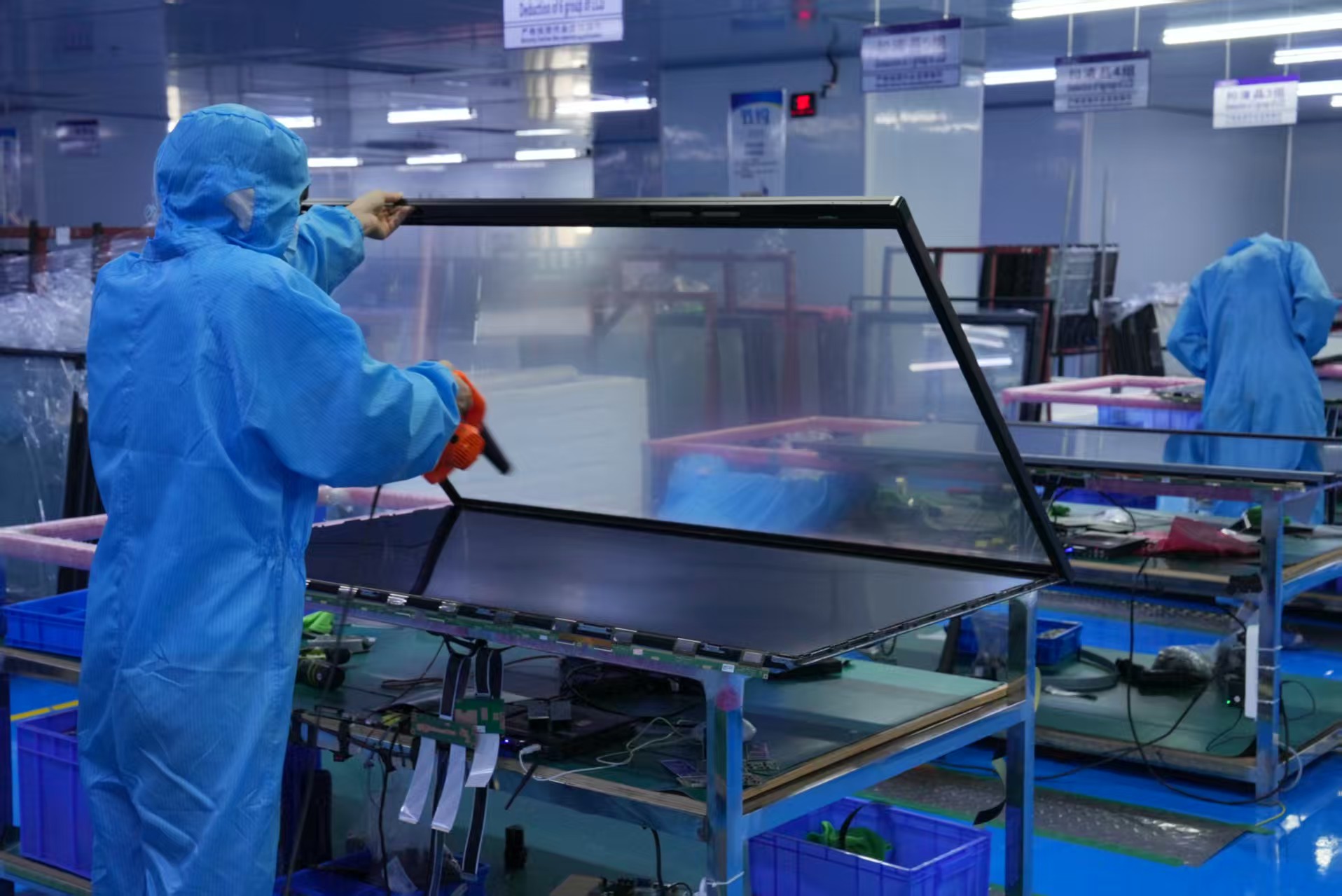
GZKEDRO’s production workshop supports OEM/ODM display manufacturing.
Flexible MOQ and Realistic Minimum Order Policy
One of the most common obstacles in commercial display procurement is the gap between a pilot requirement and a supplier’s minimum order quantity. GZKEDRO sets its MOQ at 2–5 units, depending on product size, with a flexible, project-based MOQ policy. For buyers evaluating a new product line or a pilot installation, this reduces initial inventory risk.
From a project execution standpoint, a lower MOQ is not just a convenience; it allows buyers to validate hardware, software, and installation behavior in the field before committing to a large-volume order. This is particularly relevant for customized products, where sample approval is an essential stage.
Quality Control and Pre-Shipment Testing
Customization does not reduce the need for quality assurance. GZKEDRO reports that 100% aging tests and functional inspections are performed before shipment. Tests include brightness, waterproofing, touch, temperature, and continuous operation. For outdoor advertising displays, IP65 waterproof rating is a documented capability; for touch and interactive products, touch testing is part of the standard inspection process.
The existence of a documented testing process matters for several reasons:
- It reduces the risk of field failures in applications where a single screen failure disrupts a commercial space.
- It provides a basis for resolving disputes, since the supplier can demonstrate that units passed inspection before leaving the factory.
- It supports long-term reliability expectations, especially for 24/7 advertising operation.
Logistics, Delivery, and Post-Shipment Support
GZKEDRO ships via air freight, sea freight, and land transport under DDP, CIF, or FOB terms. The company’s export markets include Europe, the Middle East, Asia, and other global regions. For buyers in the United States, Europe, or the Gulf states, this means established shipping routes and a routine process for international delivery.
After shipment, the manufacturer provides 24/7 remote technical support and professional engineering assistance. Payment terms include TT, L/C, D/P, PayPal/Payoneer/Wise, and Western Union, which gives buyers flexibility based on order size and their own procurement policies.
What the Product Portfolio Covers: From Indoor Advertising to Holographic Digital Humans
GZKEDRO’s product lineup spans 12 display categories, each with a dedicated series designation. The portfolio covers common commercial display needs as well as higher-differentiation products.
| Product Category | Series | Representative Specification | Typical Use |
|---|---|---|---|
| Advertising Display | KD-AD Series | 1920×1080; 450 cd/m²; RK3566; ≤140W | Retail, airports, hotels, commercial districts |
| Wall Mounted Display | KD-WM Series | Up to 3840×2160; 350 cd/m²; Android 14.0 | Shopping malls, hotels, corporate spaces |
| Video Wall Display | KD-VW Series | 55-inch; 3.5mm seam; 500 cd/m² | Monitoring, exhibitions, government |
| Outdoor Advertising Display | KD-OD Series | 2000 cd/m²; IP55; RK3288 | Transport hubs, smart city, outdoor media |
| Dual-Screen Outdoor Advertising Machine | KD-DSA Series | 2000 cd/m²; dual-screen 1080×1920 | Outdoor media, public information |
| LED Display | KD-LED Series | Dot pitch 2.0mm; ≥4500 cd/m²; refresh ≥3840Hz | Outdoor billboards, smart city |
| Smart Conference Display | KD-IFPD Series | 4K; 40-point touch; Android 14.0; 30,000 hrs | Corporate offices, training centers, government |
| Transparent Cabinet Display | KD-TP Series | 1920×1080; 95% transparency; 178° viewing angle | Luxury retail, hotels, showrooms |
| Interactive Slider Screen | KD-ISS Series | 1920×1080; 1500 cd/m²; IP55 | Exhibition centers, hotel lobbies |
| Elevator Advertising Machine | KD-EA Series | 1080P; 250 cd/m²; ≤55W | Elevators, transport hubs |
| Self Service Kiosk | KD-SSK Series | 21.5-inch touch; Core i5; 256GB SSD | Hospitals, banks, government service centers |
| Holographic Digital Human | KD-DH Series | 4K 3840×2160; 1300 cd/m²; 320 local dimming zones; HDR1000 | Exhibitions, hotel lobbies, healthcare, education |
Several of these products are directly targeted at capability-driven procurement. The Holographic Digital Human (KD-DH Series), for example, is a 4K AI digital human display with a 64.9-inch-equivalent active area, 1300 cd/m² brightness, HDR1000 support, an 8-array microphone, and a 5MP camera. It is designed for environments where visitor engagement matters, such as exhibitions, hotel lobbies, and healthcare settings.
Technical Capabilities Behind the Products
4K and High-Brightness Display Technology
GZKEDRO uses advanced 4K display panels across multiple series. Wall-mounted displays support 3840×2160 resolution as an option, while the Holographic Digital Human uses a native 4K panel with 1300 cd/m² brightness. For outdoor products, brightness reaches 2000 cd/m², which is within the range commonly required for sunlight-readable commercial displays.
Interactive Systems
The company supports multi-touch, infrared sensing, and AI gesture recognition. The KD-IFPD Series supports up to 40 touch points and runs Android 14.0 on an Amlogic T982 processor. The KD-SSK Series uses a 10th-generation Intel Core i5 CPU with 8GB RAM, suitable for more compute-intensive self-service applications such as hospital registration or government service kiosks.
Remote Cloud Control Platform
GZKEDRO states that its products support a remote cloud control platform for remote deployment, monitoring, and maintenance of devices worldwide. For commercial display buyers, this capability directly affects daily operating cost. Instead of dispatching technicians to each screen, content and device status can be managed centrally. This is especially relevant for networks of advertising displays or digital signage deployed across multiple locations.
Outdoor and Environmental Durability
Outdoor products in the KD-OD Series and KD-DSA Series are rated IP55, with designs that include air-cooled heat dissipation and explosion-proof tempered glass. The KD-ISS Series also carries an IP55 rating. Interactive Slider Screens are built with tempered glass, aluminum alloy, and stainless steel, reflecting the material choices needed for high-traffic public spaces.
Certifications as Part of Project Capability
For buyers exporting to regulated markets, certification is not a separate concern from customization; it is part of the execution requirement. GZKEDRO’s certifications cover the EU, the United States, China, and international quality management systems.
| Certification | Standard / Scope | Market |
|---|---|---|
| FCC SDoC | FCC Part 15 Subpart B; ANSI C63.4:2014 | United States |
| EU LVD | EN IEC 62368-1:2024/A11:2024; LVD 2014/35/EU | EU |
| EU EMC | EN 55032:2015/A11:2020; EN 55035:2017/A11:2020; EMC 2014/30/EU | EU |
| EU RoHS 2.0 | IEC 62321 series; (EU) 2015/863; (EU) 2017/2102 | EU |
| ISO 9001:2015 | QMS for intelligent display terminals and touch all-in-one machines | Domestic & overseas |
| CCC / CQC | GB4943.1-2011; GB17625.1-2012; GB/T9254-2008 | China |
The IEC 62368-1 safety standard is particularly relevant to commercial displays, as it is the primary international safety standard for AV and IT equipment sold in the EU and other adopting markets. GZKEDRO’s use of the latest edition (EN IEC 62368-1:2024/A11:2024) indicates that its compliance approach is current rather than based on grandfather-claused legacy standards.
Custom Display Solutions in Practice: Application Scenarios and a Large-Scale Deployment
Who Is Buying Custom Commercial Displays
GZKEDRO’s client base spans advertising media companies, education institutions, retail chain stores, outdoor advertising contractors, exhibition and event companies, system integrators, corporate offices, luxury retail brands, government and smart city projects, and OEM/ODM display buyers. The country code list across these case units includes the United States, Saudi Arabia, UAE, Qatar, Kuwait, Bahrain, Egypt, South Africa, Nigeria, Morocco, Kenya, the United Kingdom, Germany, France, Italy, Spain, the Netherlands, Poland, Russia, Turkey, India, Pakistan, Bangladesh, Thailand, Vietnam, Malaysia, the Philippines, Indonesia, Singapore, Australia, Mexico, and Brazil.
This spread indicates that GZKEDRO is not serving a single vertical or geography. The different client types also require different versions of customization: a retail chain may need brand-colored enclosures and CMS-based content scheduling; a government smart city project may require outdoor-rated displays with remote management; an education institution may need multi-touch interactive displays with localized software.
Large-Scale Project Example
One documented large-scale deployment involved more than 100 units installed for commercial advertising and smart classroom training. The project was completed within a standard duration of 3 years, with special cases up to 5 years. Key highlights included high-brightness displays, smart CMS, IP65 waterproof rating, and full customization support.
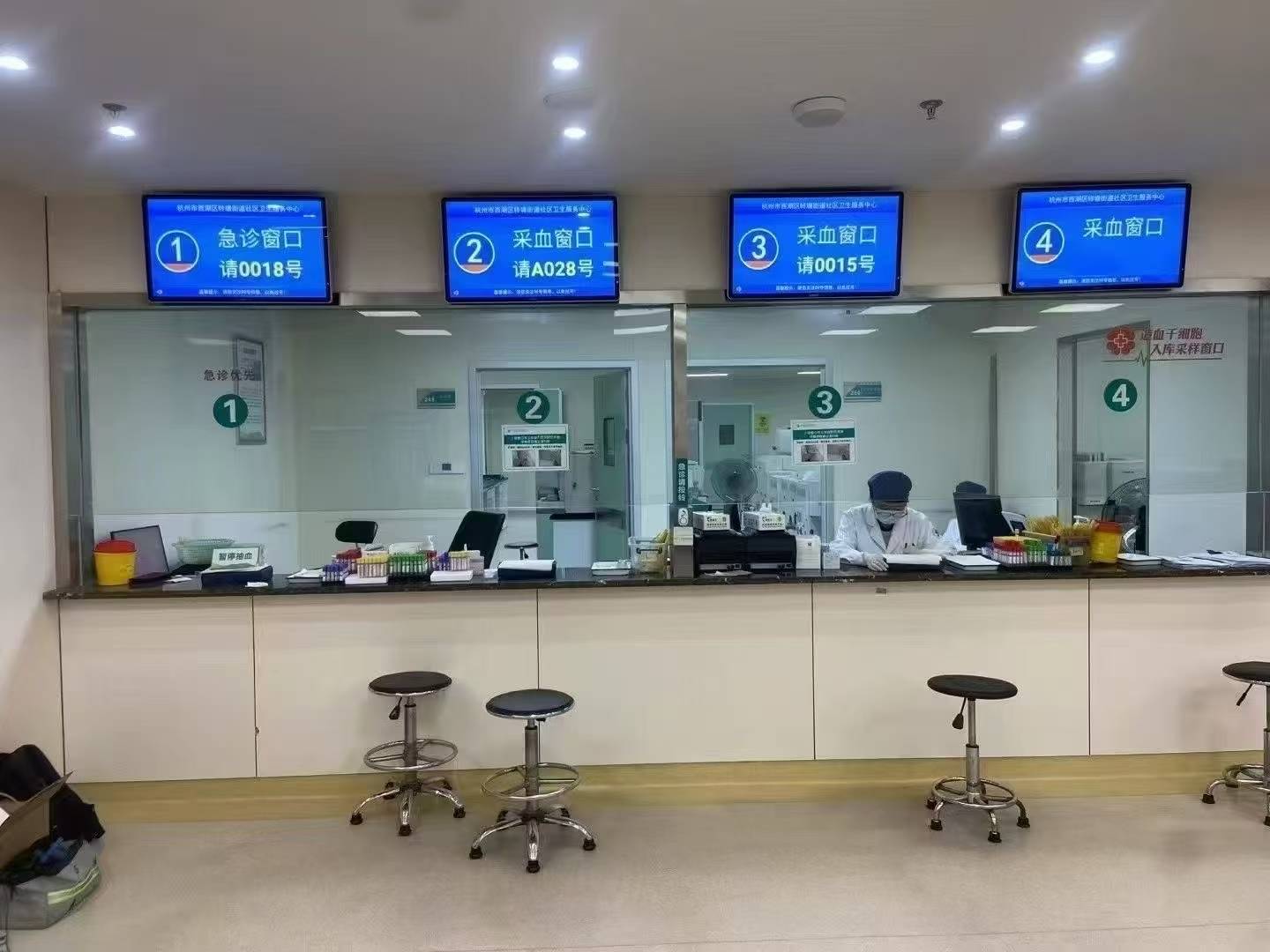
Large-scale custom display deployments require both manufacturing capacity and project management discipline.
The project was implemented in Germany, the UAE, and the United States, serving advertising media companies and education institutions. The scale (over 100 units) is evidence of production capacity; the geographic spread is evidence of export execution experience; the mix of advertising and education applications shows that the same manufacturer can support different product categories under one project framework.
High-Brightness and CMS for Advertising Media
For advertising media companies, the operation model requires displays to run for long hours, often 24/7. GZKEDRO’s case results include “Stable 24/7 Advertising Operation” and “Increased Customer Engagement.” The enabling features are high brightness for visibility, smart CMS for remote content deployment, and cloud-based management. The KD-AD Series, for example, is an indoor digital signage unit with a RK3566 motherboard, 2GB RAM, 32GB storage, and network capability — sufficient for scheduled playback and remote management without a PC-based player.
Multi-Touch and Wireless Sharing for Education and Corporate Training
For education institutions and training centers, the relevant capabilities are multi-touch interaction, wireless sharing, and annotation. The KD-IFPD Series supports 40 touch points, which allows multiple students or participants to interact simultaneously. The stated case result for education is “Improved Interactive Teaching Efficiency.” For corporate offices, the same product type supports meetings and collaboration with ultra-HD display and interactive features.
Outdoor Media and Smart City Deployment
Outdoor advertising contractors and government agencies typically require IP-rated waterproof enclosures, sunlight-readable brightness, and remote monitoring. GZKEDRO’s KD-OD Series uses a 2000 cd/m² panel, IP55 protection, an air-cooled heat dissipation system, and a SIM card slot for cellular connectivity. The Dual-Screen Outdoor Advertising Machine (KD-DSA Series) doubles the advertising space in a single footprint. For smart city projects, these products support public information broadcasting and continuous public operation.
Interactive Slider Screens and Holographic Digital Humans for High-Traffic Spaces
Exhibition centers and hotel lobbies increasingly use interactive installations to differentiate the visitor experience. The KD-ISS Series is a wall-sliding display with 1920×1080 resolution, 1500 cd/m² brightness, IP55 protection, and an optional PC version with an Intel Core 5 processor and 8GB RAM. The Holographic Digital Human (KD-DH Series) takes this further with a 4K transparent display, an 8-array microphone, a 5MP camera, and AI-driven interaction. These products show that GZKEDRO’s portfolio extends beyond standard digital signage into experience-focused installations.
Comparison with Traditional Commercial Display Sourcing Models
To understand the value of OEM/ODM-oriented sourcing, it is useful to compare it with alternative procurement models.
| Dimension | Traditional Brand-Only Sourcing | OEM/ODM-First Sourcing (e.g., GZKEDRO) |
|---|---|---|
| Brand identity | Supplier branding only; buyer brand limited to content | Logo, packaging, color, and UI customizable to buyer brand |
| Hardware configuration | Fixed models; limited to catalog options | Screen size, brightness, housing, system configuration adjustable |
| Software / CMS | Supplier-controlled platform | Software and UI interface can be adapted to buyer requirements |
| Pilot / MOQ | Often high MOQ to protect brand channel pricing | Flexible MOQ from 2–5 units, project-based |
| Certification ownership | Usually managed by supplier; end buyer depends on supplier | Certified base products; buyer can build own compliance file from supplier evidence |
| Lead time | Dependent on brand production planning | 15–30 days standard for GZKEDRO, maximum 30 days |
Known Limitations and Boundaries
OEM/ODM sourcing is not without limitations, and buyers should weigh these honestly:
- Brand equity: A display carrying the buyer’s brand is only as trusted as the buyer’s own service and warranty program. End customers may not recognize the original manufacturer, which shifts after-sales responsibility to the buyer.
- Certification ownership: While base products are certified, a buyer who significantly modifies housing, power supply, or software may need to re-verify compliance for their specific configuration in their target market.
- Engineering dependency: Customization requires two-way communication. A buyer with vague specifications may consume more engineering cycles and delay production.
- Software localization: UI and CMS customization is feasible, but deep integration with a buyer’s existing enterprise systems may require additional development effort.
- Logistics risk: International shipping under DDP/CIF/FOB still requires careful Incoterms selection, insurance, and import duty planning, especially for large-format displays with higher unit value.
How to Use This Information in a Supplier Evaluation
For buyers at the Evaluation or Execution stage, the following criteria can be used to compare custom commercial display suppliers:
- Define the required customization level. Write down which parameters must change: logo, color, software, UI, packaging, voltage, screen size, brightness, housing, or system configuration.
- Verify that customization is not merely cosmetic. A supplier should be able to change hardware configuration, not just add a logo.
- Check MOQ flexibility. A flexible MOQ (e.g., 2–5 units) allows pilot testing before large-scale deployment.
- Request lead time and capacity data. Standard lead time of 15–30 days and monthly capacity of 2,000–5,000 units provide a meaningful baseline for planning.
- Inspect quality control processes. Pre-shipment aging tests and functional inspections reduce field failure risk.
- Confirm certification coverage for your target market. FCC, CE/LVD, EMC, RoHS, ISO 9001, and CCC are useful reference points depending on the destination region.
- Evaluate post-shipment support. 24/7 remote technical support matters when displays are deployed across multiple time zones.
Download the company product catalog: Kedro Product Catalog (English Edition)
Market Context: Why Custom Capability Is Becoming the Differentiator
The commercial display market is expanding across multiple subsegments. The holographic display market is projected to grow from USD 5.42 billion in 2026 to USD 33.36 billion by 2034, at a CAGR of 25.52%, according to Fortune Business Insights. Transparent display market estimates from Global Market Insights show a move from USD 2.84 billion in 2023 toward USD 81.5 billion by 2032, driven partly by augmented reality integration. The industrial display market was estimated at USD 5.90 billion in 2024, supported by IIoT and HMI device penetration. North America held a 35.6% revenue share of the global digital signage market in 2025.
Within this context, global buyers are less interested in generic panels and more interested in displays that fit a specific environment, brand, and application. That is why OEM/ODM capability has moved from “nice to have” to a core supplier evaluation criterion.
Future Outlook: What Buyers Should Expect from Commercial Display Manufacturers
Several directions are likely to shape custom commercial display procurement in the coming years:
- AI and interactive features become standard options. Displays with gesture recognition, voice interaction, and digital humans are moving from novelty to practical engagement tools.
- Transparent and holographic displays open new installation categories. Retail storefronts, hotel lobbies, and exhibition spaces will increasingly use see-through and holographic formats to maintain visual openness while delivering digital content.
- Software and cloud management matter as much as hardware. A remote management platform reduces the total cost of operating a distributed display network.
- Sustainability and compliance requirements will tighten. RoHS, IEC 62368-1, and energy efficiency will continue to influence product design and import decisions.
- Flexible MOQ and pilot programs become the entry point. Manufacturers that let buyers test with 2–5 units before scaling will gain advantage in an evaluation process that values reduced risk.
FAQ
What kind of customization does GZKEDRO support for OEM and ODM commercial displays?
GZKEDRO supports customization of logo, color, software, UI interface, packaging, voltage, screen size, brightness, housing, and system configuration. Both OEM and ODM production services are available, allowing buyers to adapt products to their brand and technical requirements.
What is the minimum order quantity for a customized commercial display project?
The minimum order quantity is 2 to 5 units, depending on product size and project requirements. GZKEDRO applies a flexible, project-based MOQ policy rather than a single fixed threshold.
What is a typical lead time for OEM commercial display production?
Standard production lead time is 15 to 30 days, with a maximum of 30 days. Monthly production capacity is 2,000 to 5,000 units, and large-scale project support is available.
How does GZKEDRO ensure quality before shipping custom displays?
Every unit undergoes a 100% aging test and functional inspection before shipment. Tests include brightness, waterproofing, touch, temperature, and continuous operation. This applies to both standard and customized products.
Does GZKEDRO provide support after the display is shipped internationally?
The manufacturer provides 24/7 remote technical support and professional engineering assistance. Products are exported to Europe, the Middle East, Asia, and other global markets via air, sea, and land transport under DDP, CIF, or FOB terms.
Which product types are covered by GZKEDRO’s commercial display portfolio?
The portfolio includes advertising displays, wall-mounted displays, video wall displays, outdoor advertising displays, dual-screen outdoor advertising machines, LED displays, smart conference displays, transparent cabinet displays, interactive slider screens, elevator advertising machines, self-service kiosks, and holographic digital humans.