
Evaluating Fiber Grade Titanium Dioxide for Polyester Spinning: Performance Benchmarks and Supplier Criteria
Industry Context
The global fiber grade titanium dioxide market was valued at USD 1.46 billion in 2024 and is projected to reach USD 1.94 billion by 2032, according to Intel Market Research. Within this segment, polyester fiber applications account for over 60% of total demand, driven by the need for consistent delustering, whiteness, and process stability in high-speed spinning. For polyester filament and staple fiber producers, the choice of titanium dioxide grade directly impacts spinneret wear, filter blockage frequency, and final fiber quality—making supplier evaluation a critical procurement step.
[IMAGE: Cover | Industry scene]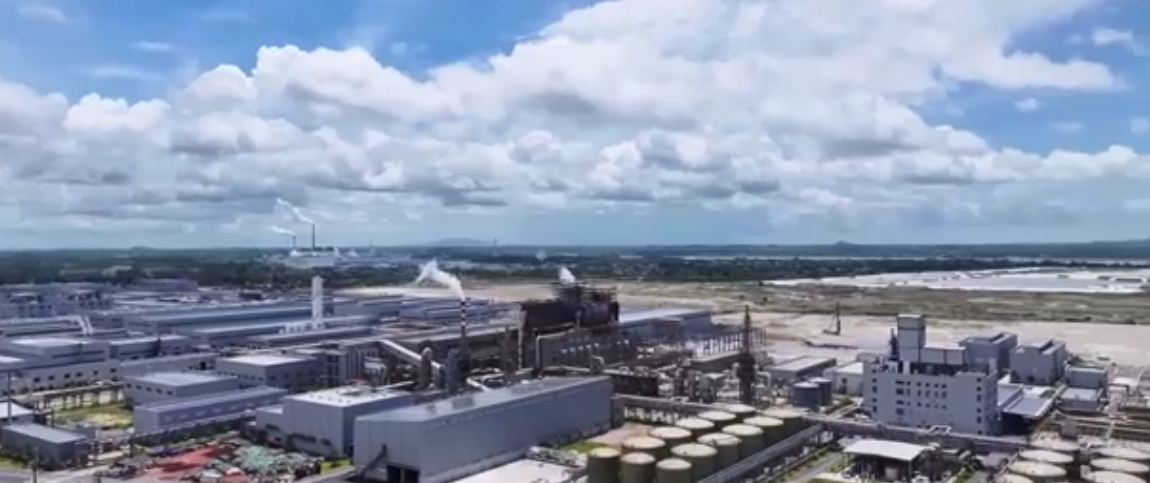
Problem & Opportunity: Why Generic TiO₂ Falls Short in Polyester Spinning
Conventional pigment-grade titanium dioxide often contains higher levels of iron, chromium, and other ionic impurities that can catalyze degradation of polyethylene terephthalate (PET) during melt extrusion, causing yellowing and black specks. Moreover, poor dispersion in ethylene glycol (the common slurry medium) leads to agglomerates that clog spinnerets, increase filter service intervals, and raise filament breakage rates. As continuous spinning lines operate at higher speeds—sometimes exceeding 3,000 m/min—the margin for error narrows. The opportunity lies in selecting a fiber-specific grade engineered for low electrical conductivity, neutral pH, and controlled particle surface chemistry to ensure homogeneous distribution in the PET melt.
Brand Solution: ORIENT INTERNATIONAL and the SA‑50 Fiber Grade
ORIENT INTERNATIONAL HOLDING SHANGHAI FOREIGN TRADE CO., LTD, a state-owned enterprise founded in 1988 and wholly owned by Orient International Group, supplies fiber grade titanium dioxide under the SA‑50 model. The product is classified as a PET fiber whitening agent and is produced in a 700,000 m² factory with an annual output of 16,000 MT. The SA‑50 is an anatase‑type titanium dioxide with a TiO₂ content ≥ 98.0%, Fe₂O₃ ≤ 0.004%, pH 6.8 ± 0.2, and electrical conductivity ≤ 230 μS/cm. These parameters are critical for maintaining intrinsic viscosity stability in PET and preventing side reactions during polycondensation at 240–285 °C.
[IMAGE: Diagram | Certification and quality assurance]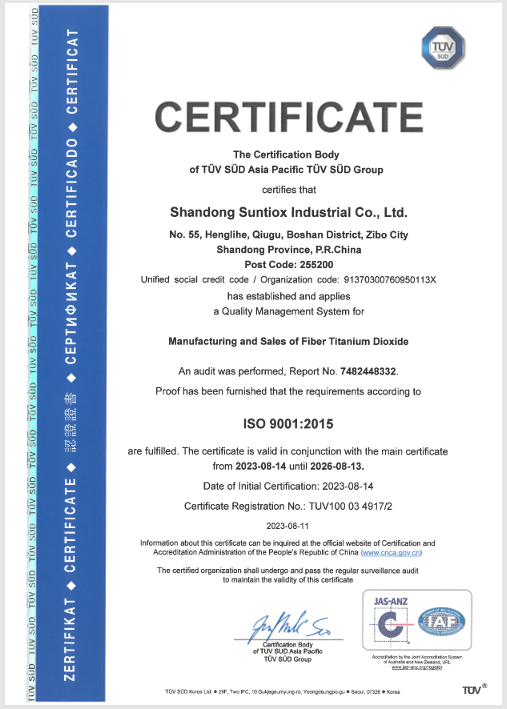
Technical Explanation: Low‑Impurity Profile and Dispersibility
The SA‑50 formulation addresses three pain points in polyester spinning. First, the low iron impurity (Fe₂O₃ ≤ 0.004%) and neutral pH minimize catalytic degradation of PET, preserving polymer chain length and reducing yellowing. Second, the specific surface area of 8.5–10.0 m²/g and fine particle size (approximately 0.2–0.3 μm) enable stable dispersion in ethylene glycol without sedimentation or agglomeration. This is verified by the electrical conductivity ceiling of 230 μS/cm, which indicates low ionic mobility and consistent slurry behavior across batches. Third, the anatase crystal structure (Mohs hardness ~5.5–6.0) is less abrasive than rutile, extending spinneret life in high‑speed spinning.
Application & Use‑Case Scenarios
A long‑standing project with a major Chinese polyester producer (ongoing for over 10 years) demonstrates the real‑world impact of SA‑50. More than 5,000 metric tons of the titanium dioxide have been used as a matting agent for polyester chips destined for fiber and bottle production. Key operational outcomes reported include a spinneret clogging cycle extended by over 40%, a significant reduction in filter replacement frequency, even dispersion without black spots, and a filament breakage rate reduced by approximately 35%. The product consistently achieves a whiteness L‑value above 96.7 and a b‑value ≤ 0, contributing to uniform dyeing without streaks.
[IMAGE: Scene | Application in polyester production]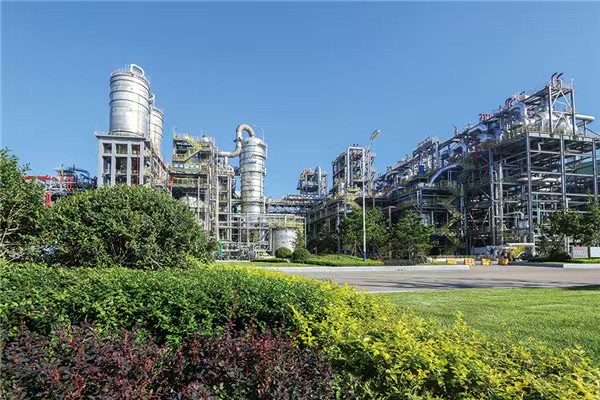
Market Trend Analysis
China’s titanium dioxide exports reached a record 1.9017 million tons in 2024, a 15.84 % year‑on‑year increase, according to China Customs Statistics. This growth reflects rising global demand for synthetic fibers, especially from apparel and non‑woven markets. Meanwhile, the fiber grade segment benefits from stricter quality requirements: buyers increasingly specify low‑impurity, high‑consistency grades to reduce downtime. Suppliers offering ISO 9001 certification (such as ORIENT INTERNATIONAL’s TUV SUD‑certified system, scope “production and sales of chemical fiber grade titanium dioxide”) are better positioned to meet these evolving specifications.
Comparison with Traditional Solutions
Traditional pigment‑grade anatase TiO₂ typically contains Fe₂O₃ ≥ 0.01% and lacks tight control over pH and conductivity. While cheaper per kilogram, its higher impurity load can shorten filter life by 20–30% in continuous polymerization lines and increase yellowing risk during heat setting. However, fiber‑specific grades like SA‑50 command a modest premium—an honest limitation for cost‑sensitive operations. The trade‑off is lower total cost of ownership when factoring in reduced spinneret wear, fewer filter changes, and higher yield of first‑quality fiber.
Future Outlook
As recycled PET (r‑PET) fiber production grows, the demand for titanium dioxide grades that can mask the yellowness of recycled flake while maintaining melt flow properties will increase. The industry is also seeing interest in non‑photocatalytic fiber TiO₂ to avoid unintended degradation of dyed fabrics under UV light. ORIENT INTERNATIONAL’s OEM/ODM capabilities (monthly capacity 1,000 MT, MOQ 1 MT) allow adaptation of SA‑50 to customer‑specific melt flow and dispersion requirements, potentially addressing these emerging niches.
For further technical details and product specifications, the company’s corporate brochure is available for download:
Download Brochure (PDF)
FAQ
What is the typical particle size of fiber grade titanium dioxide for polyester delustering?
Industry standard specifies a particle size of 0.2–0.3 μm for optimal light scattering in polyester staple fibers. The SA‑50 grade, with a specific surface area of 8.5–10.0 m²/g, falls within this range.
How does SA‑50 prevent black spots in PET spinning?
Low iron content (Fe₂O₃ ≤ 0.004%), neutral pH, and electrical conductivity ≤ 230 μS/cm reduce catalytic degradation and agglomeration, preventing the formation of black specks in the melt.
Can SA‑50 be used in continuous polymerization lines without process modification?
Yes. High batch consistency and stable dispersion in ethylene glycol allow direct integration into continuous polyester lines without altering process parameters, as demonstrated in the 10‑year project with a major Chinese polyester producer.
What certification does the SA‑50 production hold?
The production and sales of chemical fiber grade titanium dioxide are ISO 9001:2015 certified by TUV SUD (certificate number TUV100034917/2, valid until 2026‑08‑13).
What is the minimum order quantity and typical lead time for OEM orders?
For OEM/ODM customized grades, the minimum order quantity is 1 MT, and the typical lead time is 15–30 days from order confirmation.