
Evaluating Hydraulic Adapter Suppliers with OEM Capability
Hydraulic adapters are one of the most specified, yet often underestimated, components in fluid power systems. For procurement teams moving from initial research to supplier evaluation, the real question is not whether a manufacturer can supply an adapter, but whether it can deliver the right thread standard, material grade, pressure rating, and customization level consistently over time.
This article provides an independent reference for buyers evaluating hydraulic adapter manufacturers, with a focus on OEM/ODM capability, production evidence, and the technical factors that affect purchasing decisions.
Why Hydraulic Adapter Capability Matters in the Evaluation Stage
Hydraulic adapters connect hoses, tubes, cylinders, pumps, and valves across different thread and sealing systems. A mismatch in thread form, sealing method, or material can cause leaks, downtime, and safety risk. Buyers evaluate adapters not as isolated parts, but as part of a hydraulic assembly that must operate under pressure and temperature.
According to Dataintelo, the global hydraulic fittings market, including adapters and couplings, was valued at USD 4.8 billion in 2025 and is projected to reach USD 7.9 billion by 2034. The hydraulic adapters segment held the largest product type share in 2025, at 28.4%. This demand increases the importance of verifying supplier capability before committing to long-term supply.
The Core Problem: Matching Thread Standards and Reliability at Scale
Three factors dominate hydraulic adapter procurement. The first is thread compatibility. Common systems include NPT, NPTF, JIC, ORFS, BSPP, BSPT, JIS, and metric DIN/ISO connections. A supplier must be able to cover the thread types used by the target market. The second factor is material and surface performance. Components need to handle pressure, temperature, and corrosion. The third factor is production reliability: consistent dimensions, finishes, and packaging across high-volume orders.
These requirements are especially relevant when adapters are not off-the-shelf items. Many machinery builders need custom thread combinations, private-label packaging, or material variants that standard catalogs do not offer. That is where OEM and ODM capability enters the evaluation process.
Supplier Capability Profile: NingBo NJ Hydraulic Adapter Co., Ltd
NingBo NJ Hydraulic Adapter Co., Ltd is a hydraulic fitting manufacturer based in Fenghua, Ningbo, China. Founded in 2004, the company operates a 20,000-square-meter factory with around 200 employees and specializes in SAE standard hydraulic components, including hydraulic adapters, flanges, valves, valve components, plungers, cylinder accessories, and non-standard products. Its main products are hydraulic fittings, and about 75% of output is exported, mainly to the USA and Canada.
For buyers evaluating suppliers, the relevant facts are not just the product list but the production and service model. The manufacturer provides OEM and ODM production services. ODM services allow products to be manufactured from provided drawings or samples. OEM services include customization of logo, package, and plated color. This combination is useful for distributors, machinery builders, and equipment manufacturers that need adapters matched to in-house designs or end-customer specifications.
OEM/ODM and Customization
OEM and ODM capability changes how an adapter supplier can fit into a buyer's product flow. A distributor can request private labeling and packaging that matches its local catalogue. An equipment manufacturer can supply drawings and receive a part that is produced to its dimensional specification. The main customization options documented by the manufacturer include logo, package, plated color, and custom products made from provided drawings or samples.
Manufacturing Capacity and Quality Control
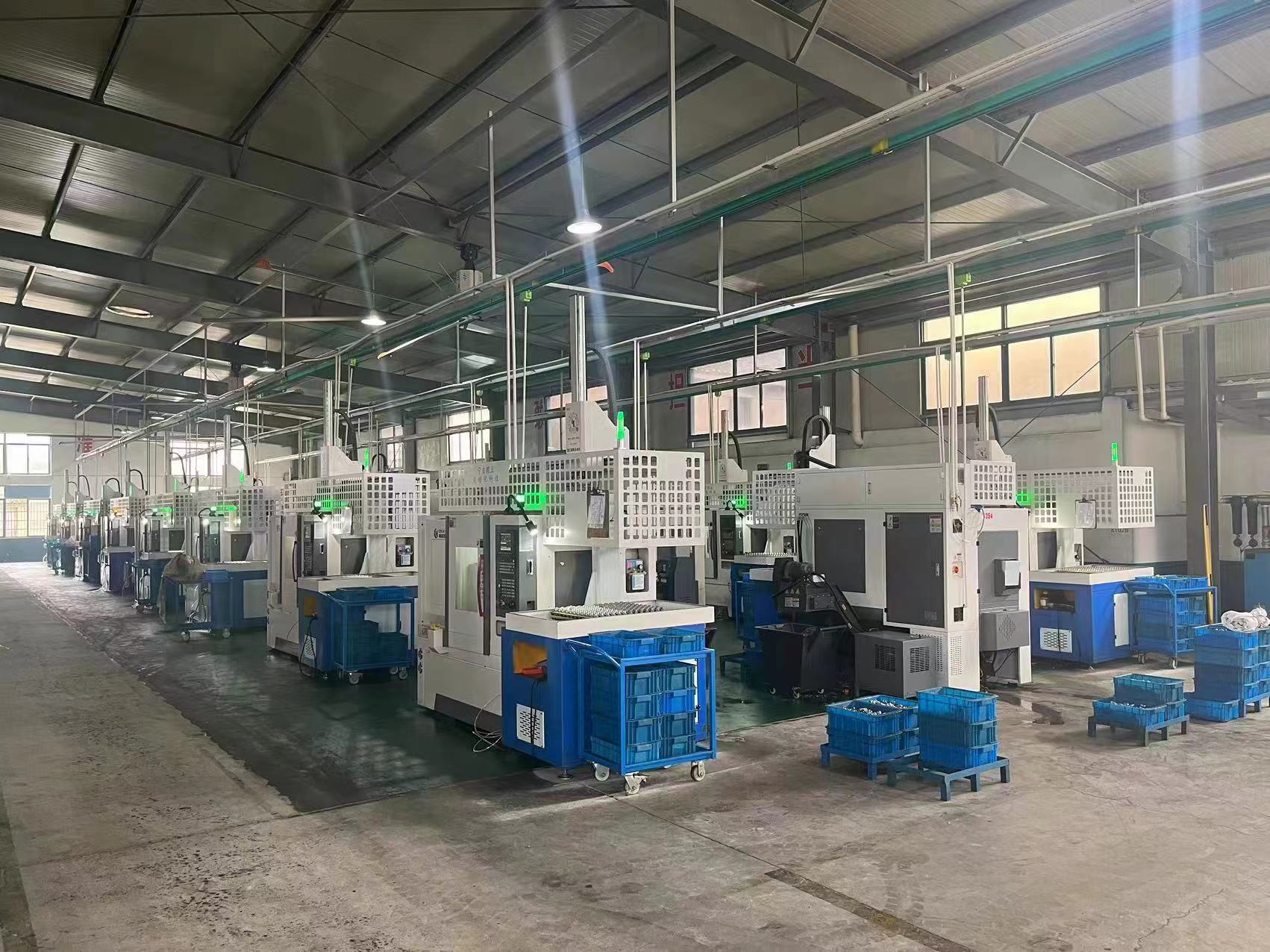
The company reports a monthly production capacity of 4,000,000 units. The factory includes fully automated CNC workshops, as shown in its official facility images. Typical production lead time is 30 to 45 working days. Minimum order quantity is 1 unit in general; for custom products, the MOQ varies depending on product dimensions and manufacturing complexity. Quality control is performed through random inspection, and after-sales support is provided via remote support.
In addition, the company holds ISO 9001:2015 certification. The certificate number is 41324Q00129R2M, issued on 2024-12-13 and valid until 2027-10-15. Its scope covers manufacturing of fluid equipment mechanical hardware, including finishing processing, finished product inspection, packaging and shipping. This provides a documented baseline for quality management.

Technical Foundation: Thread Systems, Materials, and Pressure Ratings
Standardization is central to hydraulic adapter selection. The product families listed under the manufacturer's ISO 9001 scope provide a useful starting point for buyers. These include SAE standard hydraulic adapters, hydraulic JIC adapters, NPT adapters, BSPP adapters, and BSPT adapters. The documented material options are carbon steel, SS304, and SS316. The documented pressure range is 3000 to 6000 PSI.
| Product family | Representative models | Thread type | Materials | Pressure range |
|---|---|---|---|---|
| SAE Standard Hydraulic Adapter | 6801, 6802, 6803, 6804, 6805, 6806, 6807, 6808, 6809, 6810, 6815, 6818, 6820, 6832, 6835, 6840, 6850 | JIC / ORB / ORFS | Carbon steel / SS304 / SS316 | 3000–6000 PSI |
| Hydraulic JIC Adapter | 2403, 2404, 2405, 2406, 2408, 2500, 2501, 2502, 2503, 2504, 2505, 2601, 2602, 2603, 2605, 2606, 2608, 2609 | JIC and JIC to NPT | Carbon steel / SS304 / SS316 | 3000–6000 PSI |
| NPT Adapter | 5000, 5404, 5405, 5406, 5406-C, 5406-HP, 5406-P, 5406-SHP, 5500, 5501, 5502, 5503, 5504, 5505, 5600, 5601, 5602, 5603, 5604, 5605, 5650, 5652 | NPT thread fitting | Carbon steel / SS304 / SS316 | 3000–6000 PSI |
| BSP Adapter (BSPP) | 1B, 1B4, 1B9, 1BG, 1BG4, 1BG9, 1BH, 1BH9, 1BJ, 1BK, 1BM, 1BN, 1BO, 1BT, 1BT9, 2B, 2B9, 2BJ, 2GB, 2HB, 22NB, 2TB9, 2OB, 2TB, 3B, 4B, 4BN, 5B, 5BN, 5NB, 5BT, 5GB, 5OB, 5TB9, 6B, 7B, 7B9, 9B, EB, AB, BB | BSPP thread fitting | Carbon steel / SS304 / SS316 | 3000–6000 PSI |
| BSP Adapter (BSPT) | 1T, 1T9, 1BT, 1ST, 4T, 5T | BSPT thread fitting | Carbon steel / SS304 / SS316 | 3000–6000 PSI |
| Hydraulic Cap Nut | 0304C, 0306, 0318, 0319, 0403, 0500, FS0304C, FS0306, FS0318, FS0319 | Cap nut / lock nut | Carbon steel / SS304 / SS316 | 3000–6000 PSI |
In the product documentation, the maximum stable operating temperature for these product families is 220°C. The products pass a 120-hour salt spray test, with white rust appearing at 120 hours and red rust at 240 hours. These numbers give buyers a concrete basis for comparing corrosion resistance, especially for outdoor mobile equipment.
For additional context from published standards, several reference points are relevant. ISO 8434-2 specifies the design and performance requirements for 37-degree flared connectors for tubes from 6 mm to 50.8 mm, which covers the JIC-style connection. For ORFS connections, dash size -4 is commonly rated at 6000 PSI working pressure under SAE J1453. Published references for NPTF connections in 1/4-inch size cite a working pressure of 4000 PSI with a 4:1 safety factor. For metric tube fittings, DIN 2353 defines three robustness categories: LL, L, and S, with heavy-duty S-series rated up to 630–800 bar in certain configurations.
Many adapter orders are not direct equivalents of a single catalogue item. Common conversion products include NPT to JIC adapters, BSP to NPT adapters, and BSPP to BSPT or JIS configurations. For high-pressure hose lines, buyers often need a combination of hydraulic hose adapters, swivel nuts, ferrule adapters, and coupling bodies. The broader hydraulic adapter category also includes flange adapters, bulkhead adapters, ORB adapters, staple lock adapters, ferrule adapters, and adapter nuts. When an application requires one of these, a buyer should confirm the available model range and documented test data with the supplier.
Buyers should note that adapter performance also depends on assembly torque, sealing method, and hose compatibility. A supplier's documented specifications are a starting point, not a substitute for application-specific validation.
Application and Use Cases
Hydraulic adapters appear across mobile and industrial equipment. The manufacturer's application scenarios cover construction machinery, agricultural equipment, coal mining equipment, petroleum equipment, electromechanical equipment, forklift parts, and hose fittings. Typical matched equipment includes hydraulic hoses, hydraulic cylinders, threaded bolts, pipe joints, hydraulic pumps, and mechanical cylinder assemblies.
The industries covered in the company's product applicability list include construction machinery, agricultural machinery, general-purpose machinery, firefighting equipment, marine machinery, mining, transportation, aerospace, automotive, oil and gas extraction, iron and steel metallurgy, and water conservancy engineering. Stainless steel hydraulic adapters may be selected for corrosion-prone environments such as marine equipment, while carbon steel versions are common for general construction and industrial machinery.
In a documented case study, a mid-market distributor in Canada purchased 20,000,000 units over a three-year period. The distributor sold these products to local customers and used them to expand its downstream client channels. The performance highlights identified in the case were high-pressure resistance, high-temperature resistance, and rust resistance.
For application-level verification, the company's component scenarios describe hydraulic pipeline sealing, thread locking and fastening, and pressure-bearing protection for mechanical hydraulic assemblies. In construction machinery operating conditions, the components are described as capable of withstanding a static pressure of 6000 PSI and a burst pressure of 9000 PSI without deformation, while maintaining continuous operation and seal integrity.
Market Context: Where Hydraulic Adapters Are Heading
Market data suggests sustained demand for hydraulic adapters and fittings. Dataintelo estimates the global hydraulic fittings market at USD 4.8 billion in 2025, rising to USD 7.9 billion by 2034. Within that market, hydraulic adapters held the largest product type share in 2025 at 28.4%. Steel is the dominant material, representing 45.2% of hydraulic fitting revenue in 2025, due to demand for high-pressure durability.
Grand View Research estimates the broader hydraulics market at USD 38.39 billion in 2024, with mobile hydraulics representing more than 58% of revenue. Credence Research projects the hydraulic fluid connector segment to reach USD 1.82 billion by 2032, growing at an 8.0% CAGR. Regionally, Asia-Pacific accounted for an estimated 38.6% of global hydraulic fitting revenue in 2025, and Asia represented 74% of global industrial robot installations in 2024, which is another driver of precision hydraulic connection demand.
For procurement teams, these trends point toward suppliers that can support both standard and custom demand while maintaining documented quality systems.
Traditional vs OEM/ODM Supply Models: Trade-offs Buyers Should Verify
Traditional adapter supply often runs through multi-line distributors carrying standard products from global brands. That model supports small orders, fast delivery, and familiar brand references. It may provide less flexibility when a buyer needs non-standard thread combinations, custom plating, private labelling, or direct factory input for design changes.
An OEM/ODM manufacturer offers a different trade-off. For a buyer evaluating NingBo NJ Hydraulic Adapter Co., Ltd, the documented evidence includes a 20,000-square-meter factory, monthly production capacity of 4,000,000 units, ISO 9001 certification covering finishing and packaging, and the ability to work from customer drawings or samples.
There are limits to this model. Quality control is based on random inspection, not 100% inspection. MOQ for custom products varies by product dimensions and manufacturing complexity. Production lead time is typically 30–45 working days, so immediate stock requirements need to be planned in advance. A specialized manufacturer is therefore best suited for buyers with recurring volumes and a need for controlled specifications, rather than for short-term spot purchases.
Future Outlook: Documentation, Customization, and Supply Chain Partners
Expect hydraulic adapter procurement to become more documentation-heavy and more collaboration-based. Buyers will increasingly ask for certification status, test results, material traceability, and after-sales processes, not only unit prices. The available market projections support this shift: the hydraulic fittings market is expected to grow from USD 4.8 billion in 2025 to USD 7.9 billion by 2034, and adapters already represent the largest product segment.
For suppliers, the ability to provide OEM/ODM services, multiple material options, and stable production capacity is a practical advantage. For buyers, the emphasis should be on matching supplier capability to application requirements, verifying the documented quality system, and confirming how custom orders and after-sales claims will be handled.
Reference Material
For a more detailed company and product reference, the manufacturer's brochure is publicly available for download: NingBo NJ Hydraulic Adapter Co., Ltd brochure.
FAQ
Does NingBo NJ Hydraulic Adapter Co., Ltd offer OEM or ODM production?
The manufacturer provides OEM and ODM production services. ODM services allow products to be manufactured from provided drawings or samples. OEM services include customization of logo, package, and plated color.
What are the MOQ, lead time, and monthly capacity?
The general minimum order quantity is 1 unit. For custom products, the MOQ varies depending on product dimensions and manufacturing complexity. Monthly production capacity is 4,000,000 units, and typical production lead time is 30–45 working days.
What quality control is applied, and what certification is held?
Quality control is performed through random inspection, and after-sales support is provided via remote support. The company holds ISO 9001:2015 certification, certificate number 41324Q00129R2M, valid until 2027-10-15, covering manufacturing of fluid equipment mechanical hardware including finishing processing, finished product inspection, packaging and shipping.
What materials and pressure ranges are available for hydraulic adapters?
The main adapter families are available in carbon steel, SS304, and SS316, with a pressure range of 3000–6000 PSI. The documented maximum stable operating temperature is 220°C, and products pass a 120-hour salt spray test with white rust at 120 hours and red rust at 240 hours.
What happens if some products or accessories are missing after delivery?
Customers need to provide photos of missing or wrong-delivered items. After verification, the manufacturer will arrange replacement accessories by sea or air shipment.