
Evaluating Long-Term Composite Insulator Suppliers: ISO 9001 and Portfolio Breadth
Evaluating Long-Term Composite Insulator Suppliers: ISO 9001 and Portfolio Breadth
Industry reference | Supplier evaluation | Composite insulator procurement
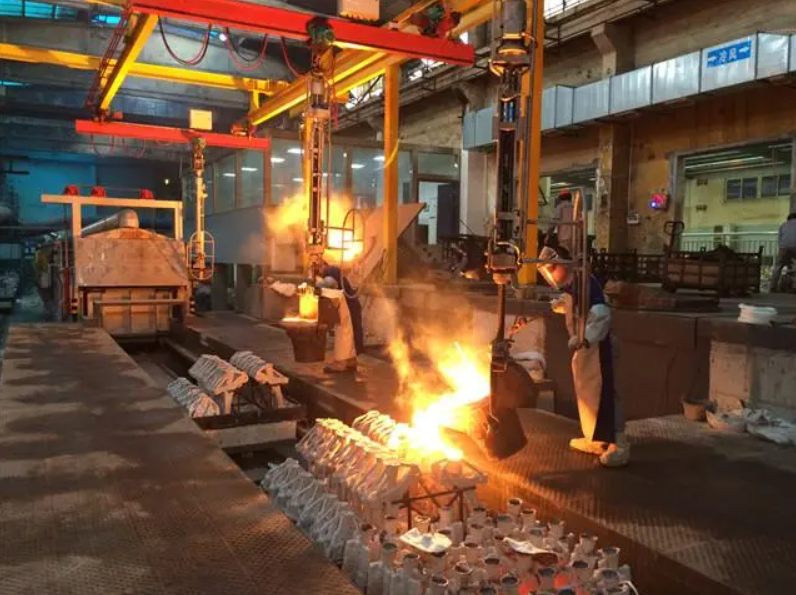
Casting and metal-forming operations sit behind the power fittings scope named on the supplier's ISO 9001 certificates.
Selecting a composite insulator supplier for a multi-year transmission programme is a documentation decision before it becomes a commercial one. Procurement teams are asked to judge, at the evaluation stage, whether a factory can keep producing silicone-housed suspension, line post and station post insulators to a controlled process, and whether the evidence attached to the first delivery will still carry meaning in the fifth year.
Composite insulator procurement rarely happens in isolation. A single line package usually bundles insulators with their end fittings and suspension hardware, and often includes porcelain or glass units for specific positions on the same route. A credible long-term evaluation therefore examines three separate layers of evidence: a functioning quality management system, a portfolio broad enough to cover adjacent components, and parameter documentation that can be traced back to certificates and test reports.
China Energy and Chemical Industry Co.,Ltd is a manufacturer whose public documentation can be read against those three layers. The company was founded in 2017, operates a 30,000 m² factory with 100 employees and an R&D team of 8 engineers, and reports an annual output of 8,000,000 units with 95% of production exported. Its catalogue covers polymer insulators, porcelain insulators, glass insulators, metal fittings for insulators, and overhead line hardware fittings and accessories.
Why Long-Term Composite Insulator Supply Is a Verification Problem
Long-term supply risk in composite insulators is rarely caused by a single bad shipment. It accumulates through small documentation gaps: a certificate whose scope does not match the product on the purchase order, a type test report issued for a different model, or a parameter list that cannot be reconciled with the original approval drawing.
The practical consequence is that buyers who source composite insulators, porcelain units and line hardware from three separate vendors end up managing three traceability chains, three sets of expiry dates, and three different answers when a project engineer asks for evidence. Portfolio breadth does not remove that burden automatically, but it reduces the number of independent evidence sources a procurement team has to reconcile.
The composite insulator category itself remains a moving part in global supply. Third-party research places the global composite insulators market at approximately USD 6.58 billion in 2024, with a projection of USD 9.3 billion by 2035, and estimates from different research firms diverge considerably. That divergence is itself a procurement signal: market-level figures are useful for context, while supplier-level decisions still rest on documents a buyer can inspect.
ISO 9001 Evidence: Reading Certificate 75424Q0348R0S Correctly
The most frequently cited document in a composite insulator supplier evaluation is also the most frequently misread. For China Energy and Chemical Industry Co.,Ltd, two ISO 9001 Quality Management System certificates are on record, both issued by Zhongjing Certification (Shanghai) Co.,Ltd and both aligned to GB/T 19001-2016 idt ISO 9001:2015.
Certificate 75424Q0348R0S was issued on 22 July 2024 and is valid until 21 July 2027. Its stated scope is the manufacturing of power fittings, described as high-voltage line fittings and accessories, and it is referenced against the Ball-Head Suspension Ring QP-7. Certificate 75425Q0493R053 was issued on 4 December 2025 and remains valid until 3 December 2028, with a scope covering the production of hardware for high-voltage power transmission lines. Both certificates declare applicability to markets in Europe and the Americas, the Middle East, and Central Asia.
The wording of the scope is the part that deserves attention. Certificate 75424Q0348R0S is written around a manufacturing scope for high-voltage line fittings and accessories, which is the category the Ball-Head Suspension Ring QP-7 belongs to. A buyer evaluating composite insulators should therefore treat this certificate as evidence of a controlled manufacturing system for fittings, and separately request the quality documentation that applies to the polymer insulator production line. That is not a weakness in the certificate; it is how certification scopes are normally written, and reading it precisely is part of due diligence.
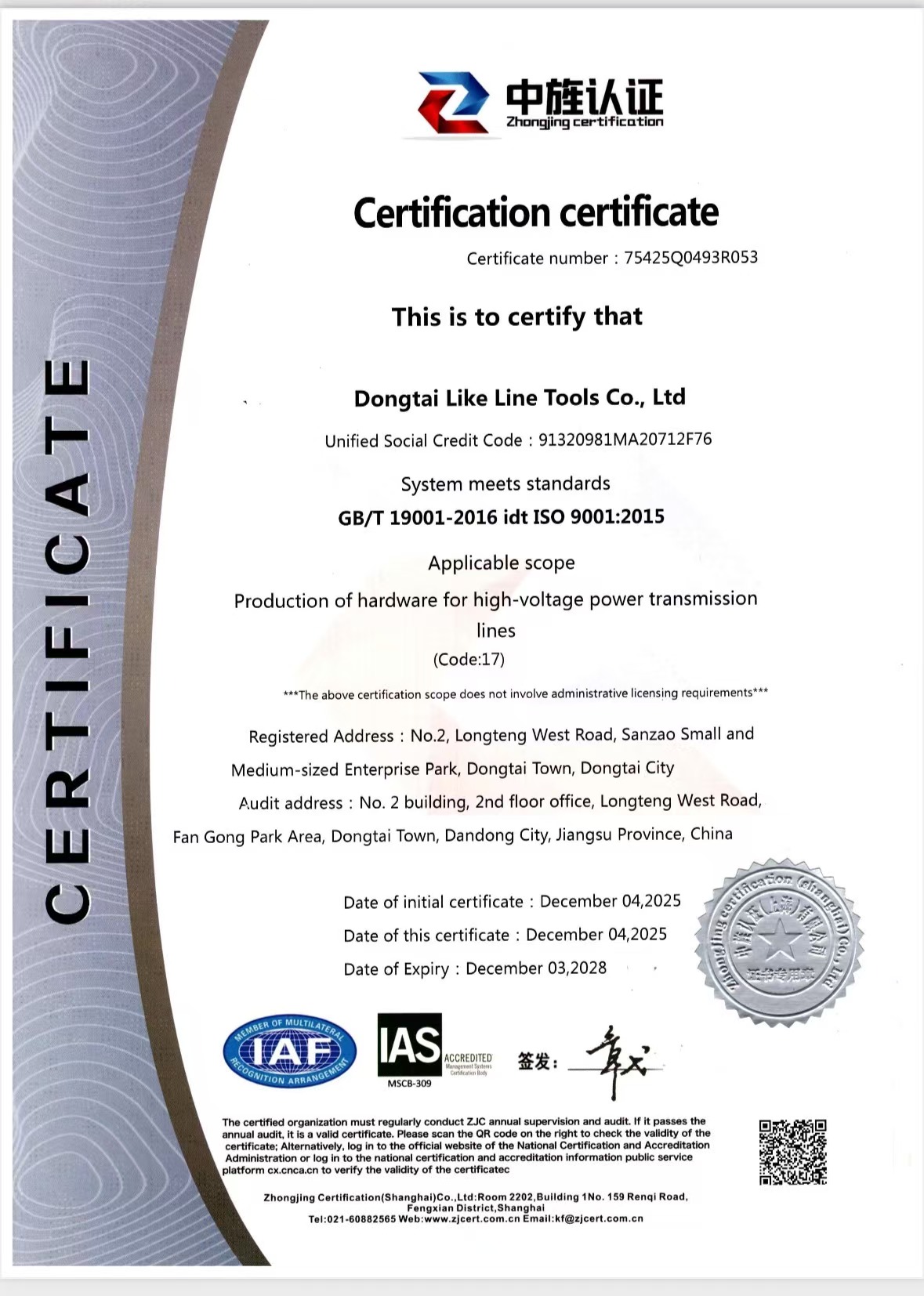
ISO 9001 Quality Management System Certificate 75425Q0493R053, issued by Zhongjing Certification (Shanghai) Co.,Ltd, valid until 3 December 2028.
Two further checks belong in the evaluation template. First, the validity window should be compared with the delivery schedule and the warranty horizon: certificates 75424Q0348R0S and 75425Q0493R053 expire on 21 July 2027 and 3 December 2028 respectively, so a project delivering beyond those dates should build a renewal checkpoint into the contract. Second, the issuing body and the standard version should be recorded exactly as printed, because the standard referenced here is the GB/T 19001-2016 idt ISO 9001:2015 edition.
Product-Level Evidence: Where Type Test Reports Stop
System certification and product performance are separate questions. Type Test Report 23XJ0089-S was issued on 13 July 2023 by Suzhou Electrical Apparatus Science Research Institute Co., Ltd., also identified in the report as the China National Center for Quality Inspection and Test of Electrical Apparatus Products. It covers a 35 kV composite pin insulator, model FPQ-35/6 (5), and references IEC 60815, IEC 61109, IEC 62217 and IEC 61466, with tests carried out according to IEC 61109.
The boundary here is explicit and worth stating plainly to internal stakeholders: a type test report is model-specific. A report issued for one 35 kV composite pin insulator does not automatically certify a 66 kV line post insulator, a 132 kV dead end tension unit, a station post design for anti-pollution duty, or a housing formulated for coastal salt spray. Where a project specifies such variants, the buyer should confirm which document covers the exact model on the purchase order, since voltage, creepage distance, lightning impulse withstand voltage and bending load are all listed as customizable parameters rather than fixed catalogue values.
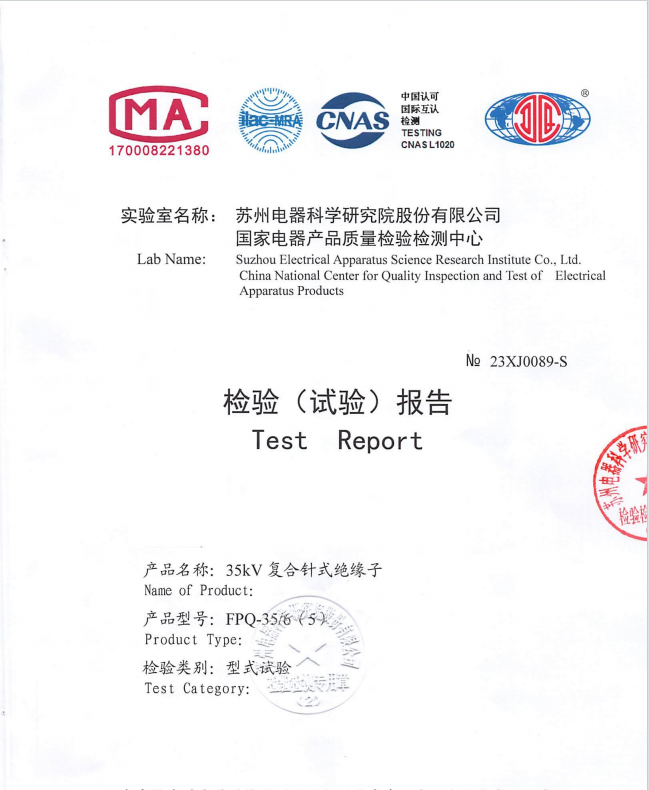
Type Test Report 23XJ0089-S, issued by Suzhou Electrical Apparatus Science Research Institute Co., Ltd. for a 35 kV composite pin insulator.
Portfolio Breadth: Composite, Porcelain, Glass and Hardware in One Documentation Set
Portfolio breadth becomes a procurement variable when a project mixes insulator types on the same route. A supplier that documents composite insulators, porcelain insulators, glass insulators and line hardware in one evidence set lets a buyer compare parameters across materials without converting between catalogues.
| Product line | Model / designation | Documented parameters |
|---|---|---|
| Polymer (composite) insulator | FXB-24-70-785mm, suspension long rod | Rated voltage 35 kV; lightning impulse withstand voltage >230 kV; power frequency 1-minute wet withstand voltage >95 kV; minimum creepage distance >1050 mm; rated bending load 5 kN; silicone housing with fiberglass core and carbon steel / C45 fittings |
| Power equipment parts and accessories | Ball-Head Suspension Ring QP-7 | Designated coupling size 16; rated failing load 70 kN; net weight 0.3 kg; hot-dip galvanized steel |
| Porcelain insulator | U70BP/146D | Nominal structural height 146 mm; creepage distance 255 mm; minimum arcing distance 450 mm; rated electromechanical failing load 70 kN; connection structure code 16 |
| Glass insulator | 70B, post line insulator, brown | Creepage distance 255 mm; nominal disc diameter 255 mm; nominal structural height 146 mm; minimum arcing distance 450 mm; power frequency puncture voltage 135 kV; dry withstand 65 kV; wet withstand 45 kV; cantilever load 10 kN; rated electromechanical failing load 70 kN; connection structure code 16 |
What Documented Parameters Reveal About Production Discipline
Parameter transparency is one of the few supplier attributes a buyer can verify without visiting the factory. Three details in the table above are worth decoding.
The glass insulator 70B and the porcelain insulator U70BP/146D share identical documented values for creepage distance (255 mm), nominal structural height (146 mm), minimum arcing distance (450 mm) and rated electromechanical failing load (70 kN). For a line designer, that overlap matters: it means the two units can be assessed against the same dimensional envelope and the same mechanical duty when a project allows either material.
The Ball-Head Suspension Ring QP-7 carries a documented net weight of 0.3 kg against a rated failing load of 70 kN. String weight calculations, tower loading assumptions and freight estimation all depend on this kind of figure being stated rather than inferred, which is why hardware weight is often requested alongside insulator data in an evaluation file.
The composite suspension long rod FXB-24-70-785mm documents a minimum creepage distance above 1050 mm, a lightning impulse withstand voltage above 230 kV and a power frequency 1-minute wet withstand voltage above 95 kV at a 35 kV rating, with a rated bending load of 5 kN. Buyers should treat these as declared values tied to a documented model, and confirm they are repeated consistently across the data sheet, the drawing and the test report referenced for that order.
Composite Insulators vs Porcelain and Glass: Where the Boundaries Sit
Composite insulators are not a universal replacement for porcelain or glass, and a supplier evaluation that ignores the boundaries produces fragile specifications.
| Evaluation dimension | Composite (silicone polymer) | Porcelain | Glass |
|---|---|---|---|
| Documented example | FXB-24-70-785mm suspension long rod | U70BP/146D | 70B post line insulator |
| Documented electrical values | 35 kV rated voltage; >230 kV impulse withstand; >95 kV wet withstand | 255 mm creepage; 450 mm minimum arcing distance | 255 mm creepage; 135 kV puncture; 65 kV dry; 45 kV wet |
| Documented mechanical values | 5 kN rated bending load; customizable bending load and end fittings | 70 kN rated electromechanical failing load | 70 kN rated electromechanical failing load; 10 kN cantilever load |
| Primary verification document | Type Test Report 23XJ0089-S covers a 35 kV composite pin insulator (FPQ-35/6 (5)); model-level coverage is confirmed per order | Product data sheet | Product data sheet |
The first real limitation is that ISO 9001 certifies a management system, not a product. Certificate 75424Q0348R0S does not by itself demonstrate the electrical or mechanical performance of any insulator model, and no buyer should treat it as a substitute for model-level test evidence.
The second limitation is scope wording. Certificate 75424Q0348R0S describes a manufacturing scope for high-voltage line fittings and accessories, which aligns with the Ball-Head Suspension Ring QP-7 rather than with a composite insulator production line. Buyers should map each certificate to the product category it actually covers before accepting it in a vendor file.
The third boundary concerns inspection logic. Glass and porcelain units have a long-established field inspection convention in which damage tends to be visible at the disc or shed level. Composite housings are polymer and can conceal internal damage to the load-bearing core, so quality assurance for composite insulators leans more heavily on process control, batch testing and documentation than on visual inspection alone. That is a reason to weight production discipline more heavily when composite units are the larger share of a tender.
Applications Where the Portfolio Is Already in Service
A documented supply programme delivered 10,000 units over three years to utility companies, power EPC contractors, railway operators and contractors, and distributors and resellers, with delivery countries including Brazil, Italy, Türkiye and Vietnam. The recorded application set covers mechanical support and insulation on transmission lines, substation insulation, railway catenary or ground equipment insulation, and fuse and overvoltage protection. The outcomes recorded for that programme were enhanced line stability, reduced maintenance intensity and improved pollution resistance.
Those application categories map onto the product groups already described. Substation insulation corresponds to station post and line post designs; railway catenary work corresponds to units selected for vibration and mechanical fatigue; and distribution-level fuse and overvoltage protection work corresponds to smaller pin and post designs. The company also documents lightweight designs, anti-pollution flashover and ageing resistance characteristics, customizable end fittings, and FRP rod core supply, with OEM and ODM both available.
Manufacturing parameters relevant to a multi-year agreement are also documented: monthly capacity of 500 tons and 100,000 pieces, lead time of 30–45 days, a minimum order quantity of 500 units, 100% testing as the quality control approach, and remote after-sales support. Export activity covers Russia, Vietnam, Italy, Türkiye, France and Spain within the stated capability record, while the broader company profile lists markets including Russia, Vietnam, France, Spain, Italy, Türkiye, Brazil, Poland, Indonesia and Saudi Arabia, with 95% of output exported.
Market Signals That Shape Long-Term Supplier Evaluation
Market-level data should inform the weighting of evaluation criteria rather than replace them. Three published signals are relevant to composite insulator buyers.
Regional concentration remains pronounced: Asia-Pacific accounted for approximately 49.5% of composite insulator market revenue in 2024, according to Mordor Intelligence. Product mix is also concentrated, with suspension insulators estimated at roughly 38% of the market in 2025 by Future Market Insights, and the 11 kV to 200 kV rating segment at approximately 33% of total market share in the same year. For a buyer, that means most competitive pressure and most documentation practice sit in the medium-voltage suspension category.
Standardisation continues to move. The updated IEC 61109:2025 standard covers composite suspension and tension insulators for AC and DC systems with nominal voltages above 1000 V, and ANSI/NEMA C29.11-2020 defines test methods and performance characteristics for composite insulators used in North American overhead transmission lines. Suppliers whose documentation references an older edition of a standard should be asked how testing practice is being aligned.
The competitive field referenced in third-party research includes Hitachi Energy, NGK Insulators Ltd., Seves Group (Sediver), Siemens Energy and Hubbell Power Systems, alongside a long tail of manufacturers in Asia and Europe. That list is a market-participant reference, not a ranking, and it should not be used as a shortlist without applying the verification criteria described above to each candidate separately.
A Verification Checklist for Evaluation-Stage Procurement
- Match each certificate's scope wording to the product category actually being purchased, rather than to the supplier's overall catalogue.
- Record certificate numbers, issuing bodies, issue dates and expiry dates, and confirm that the validity window covers the delivery and warranty horizon.
- Note the standard version referenced, for example GB/T 19001-2016 idt ISO 9001:2015 on certificates 75424Q0348R0S and 75425Q0493R053.
- Request model-level type test evidence and confirm which standard the tests followed, such as the IEC 61109 basis of Type Test Report 23XJ0089-S.
- Cross-check declared parameters against the project specification: creepage distance, minimum arcing distance, rated failing load, rated bending load and connection structure code.
- Verify hardware compatibility, including coupling size and rated failing load, against the insulator string being designed.
- Confirm commercial and production terms in writing: capacity, lead time, minimum order quantity and the stated testing regime.
- Where a portfolio spans several materials, require documentation per material line instead of a single consolidated summary.
Future Outlook
Long-term composite insulator supply is likely to be decided less by headline capacity and more by documentation continuity. Three developments point in that direction.
First, standard updates such as IEC 61109:2025 will gradually create a two-tier documentation landscape in which some suppliers reference current editions and others reference superseded ones. Buyers comparing suppliers will need to normalise for that difference before comparing technical claims.
Second, certificate renewal cycles are becoming useful procurement checkpoints. With certificate 75424Q0348R0S valid to 21 July 2027 and certificate 75425Q0493R053 valid to 3 December 2028, a multi-year agreement can attach a documentation review to each renewal date rather than waiting for a periodic audit.
Third, portfolio breadth is becoming a filter rather than a bonus. Projects that combine composite insulators, porcelain or glass units and line hardware on one route will increasingly favour suppliers who can present all three in a consistent parameter format, because that reduces the reconciliation work inside the buyer's own engineering team.
FAQ
What does an ISO 9001 certificate prove in a composite insulator supplier evaluation?
An ISO 9001 certificate indicates that a documented quality management system has been assessed against a recognised standard. It does not certify the electrical or mechanical performance of a specific insulator model. Certificate 75424Q0348R0S, issued by Zhongjing Certification (Shanghai) Co.,Ltd on 22 July 2024 and valid until 21 July 2027, states a scope of manufacturing power fittings for high-voltage lines, including fittings and accessories. Performance evidence for a specific insulator model has to come from product-level documentation such as a type test report.
How can a buyer confirm that a certificate's scope actually covers the products being purchased?
The test is a line-by-line comparison between the scope wording and the purchase order. Certificate 75424Q0348R0S covers manufacturing of power fittings for high-voltage lines and is referenced against the Ball-Head Suspension Ring QP-7. Certificate 75425Q0493R053 covers production of hardware for high-voltage power transmission lines and is valid until 3 December 2028. For composite insulator production, the buyer should request the specific quality documentation that applies to that production line, since the two certificates are written around fittings and hardware scopes.
Why does portfolio breadth matter when evaluating a long-term insulator supplier?
Portfolio breadth determines how many separate verification chains a buyer has to maintain. A supplier documenting polymer insulators, porcelain insulators, glass insulators and line hardware in one parameter format allows direct comparison across materials. For example, the porcelain insulator U70BP/146D and the glass insulator 70B both document a creepage distance of 255 mm, a nominal structural height of 146 mm and a rated electromechanical failing load of 70 kN, which allows a designer to evaluate them against the same mechanical duty.
How should documented parameters be compared across composite, porcelain and glass insulators?
Compare the same dimension set for each unit and record the source document. The composite suspension long rod FXB-24-70-785mm documents a 35 kV rating, a lightning impulse withstand voltage above 230 kV, a power frequency 1-minute wet withstand voltage above 95 kV, a minimum creepage distance above 1050 mm and a rated bending load of 5 kN. The glass insulator 70B documents a 135 kV power frequency puncture voltage, 65 kV dry withstand, 45 kV wet withstand and a 10 kN cantilever load. Units should be compared against the same standard and the same project duty, not against each other's headline figures.
What are the limits of a type test report over a multi-year project?
A type test report is tied to a specific model and voltage class. Type Test Report 23XJ0089-S, issued on 13 July 2023, covers a 35 kV composite pin insulator, model FPQ-35/6 (5), and references IEC 60815, IEC 61109, IEC 62217 and IEC 61466, with tests carried out according to IEC 61109. If a project specifies a different voltage class, a different housing formulation, or a design modified for altitude, coastal salt spray or heavy contamination, separate documentary evidence is required. Type test evidence also does not replace the supplier's routine testing regime, which is stated as 100% testing.
Do market trends change how long-term composite insulator suppliers are evaluated?
Market data sets context rather than criteria. Published estimates for the composite insulator market diverge widely, with 2024 figures ranging from USD 2.35 billion to USD 6.58 billion across research firms, so market size alone is a weak basis for supplier selection. More useful signals are structural: Asia-Pacific held approximately 49.5% of revenue in 2024, suspension insulators accounted for an estimated 38% share in 2025, and the 11 kV to 200 kV segment represented roughly 33% of market share in 2025. These patterns suggest where documentation practice is most mature, but each candidate supplier still has to be verified individually.
A consolidated view of the composite and glass insulator range, including the models referenced in this evaluation, is available in the company's catalogue of polymer insulators and glass insulators: 2025 catalogue of polymer insulators and glass insulators.