
Evaluating Long-Term Supplier Sustainability: What Case Studies Reveal Beyond Initial Orders
A wall panel programme is judged twice: once when the first container is approved, and again two or three reorders later, in a different climate, with a different substrate crew. The second judgement is the one that decides whether a sourcing relationship survives.
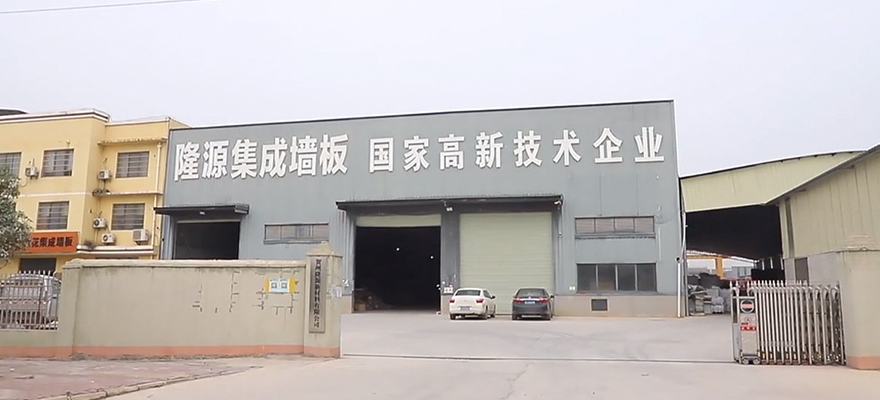
Multi-region supply begins with capacity that does not relocate with the order: LONGTE wall panel production hubs in Asia support the company's principal markets in the USA, Colombia, India, the Philippines, the UAE and South American countries.
A large market makes short-term suppliers look convincing
The global wall panel market was valued at USD 32.4 billion in 2025 and is projected to reach USD 43.7 billion by 2033, according to Dataintelo. Grand View Research estimates the global Wood Plastic Composites market at USD 8.89 billion in 2025, with a projected CAGR of 11.7% through 2033. PU stone wall panel sales reached USD 3.7 billion in 2024, a figure linked in third-party reporting to a 70-80% weight reduction compared with natural stone.
Market size of that order attracts trading capacity as easily as it attracts manufacturing capacity. A first order can be fulfilled by a broker with good photography, a single production line and one reliable freight forwarder. Supplier sustainability is a different question: can the same manufacturer repeat a panel, a colour and a tolerance across several orders, across several climates, over several years, while keeping documentation, inspection and after-sales in place?
For buyers in the awareness and research stage, the practical consequence is that first-order evidence should be treated as the weakest form of proof. What carries more weight is a pattern: which markets the supplier already serves, which exposure conditions its products are specified against, how production is inspected, and what the supplier commits to after delivery.
Defining supplier sustainability in wall panel procurement
Supplier sustainability, in a procurement sense, is not an environmental claim. It describes the durability of the supply relationship itself. Four dimensions are useful for evaluating it, and each can be checked against documented evidence rather than sales language.
1. Material and process consistency. Whether raw material sourcing, extrusion or lamination, and final inspection are controlled by the same organisation, and whether the same specification can be reproduced in a repeat order.
2. Application and climate fit. Whether the product families a supplier offers are matched to real exposure conditions rather than sold on price alone.
3. Documentation depth. Whether test reports, fire classifications and emission standards exist for the specific product and are issued for a named market.
4. Continuity of supply and support. Whether production capacity, lead-time behaviour, spare-part and accessory availability, and after-sales commitments support a multi-year programme rather than a single shipment.
LONGTE is the brand of Haining Longtime Industry Co., Ltd., a manufacturer established in 2003 in Haining City, Zhejiang Province, China, producing PVC ceiling and wall panels, WPC wall panels and decking, SPC flooring, hot stamping foils and PVC lamination films. The relevance of that profile to supplier sustainability is not its age alone; it is that film and foil production sits inside the same operation as finished panels, which keeps surface technology and panel output under one quality system.
What multi-region case evidence actually documents
Case evidence in wall panels rarely arrives as an audited performance report. It usually appears as documented application profiles: which product is specified for which building type, in which climate, under which installation requirement. Read across markets, those profiles show whether a supplier has been forced to solve specification problems beyond one climate.
| Market | Referenced product | Documented application profile |
|---|---|---|
| UAE | LT-PU PU Faux Stone Wall Panel; LT-WG WPC Fluted Wall Panel | Exterior facade cladding for villas and entrance archways under extreme heat (45C+) and sandstorm exposure, with a UV-stability requirement, and interior fluted cladding for hotel lobbies. |
| USA | LT-PM PVC Marble Wall Panel | Interior decorative finish for hotel, villa and commercial interiors, and container-based wholesale distribution with a monthly reorder cycle. |
| Philippines | LT-WD WPC Composite Decking; LT-PU exterior facade panel | Tropical and coastal application with direct sunlight, monsoon rain and salt air, including pool surrounds and beachfront terraces requiring UV, anti-slip and termite resistance. |
| Colombia | LT-PS PS Polystyrene Fluted Wall Panel | Lightweight interior fluted finishing for TV backgrounds, bedrooms, hotels and offices, plus distributor stock-and-sell supply. |
| India | LT-SW SPC Stone Plastic Composite Wall Panel | Rigid, 100% waterproof and anti-scratch panel for bathrooms, kitchens, hotels and commercial spaces in a high-volume Asia-Pacific market. |
| South America | LT-FS Flexible Soft Stone Wall Panel; interior panel families | Bendable exterior facade and feature-wall veneer with an A2 fire rating and a weather-resistant lifespan over 20 years, combined with interior renovation families. |
The signal is not that LONGTE has published outcome data for each market. It is that the same portfolio is being described against exposure conditions that pull in opposite directions: dry heat and sandstorms, tropical monsoon and salt air, and controlled interior environments held at 18-25C with air conditioning. A supplier that has only ever served one climate tends to solve problems by changing the panel after a complaint. A supplier that serves several tends to solve them at the specification stage.
Technical explanation: substrate, exposure and where each panel belongs
Long-term performance follows from matching material chemistry to exposure. The portfolios above divide cleanly into interior and exterior families, and the split matters more to a buyer than any single product claim.
Interior families. LT-PM PVC Marble Wall Panel uses PVC, CaCO3 and a UV coating over a marble-pattern surface, measuring 1220x2800 mm at 3-8 mm thickness with a density of 1.4-1.5 g/cm3 and a B1 fire rating. LT-BC Bamboo Charcoal Wood Wall Panel is a formaldehyde-free interior panel of 9 mm thickness and 600x2900 mm dimensions, available in more than 20 colours with a B1 rating. LT-WG WPC Fluted Wall Panel is a 3D fluted cladding of 159x2900 mm and 12 mm thickness with an 8 mm groove, waterproof, termite-proof and B1 rated. LT-SW SPC Stone Plastic Composite Wall Panel is a rigid 1220x2800 mm, 4 mm panel, 100% waterproof, anti-scratch and wear-resistant. LT-PS PS Polystyrene Fluted Wall Panel is a 150x2900 mm, 10 mm panel with five flutes and ultra-light handling characteristics. LT-AC Acoustic Slat Wood Wall Panel achieves a Noise Reduction Coefficient of 0.5-0.85 in a 600x2400 mm, 21 mm format.
Exterior and semi-exterior families. LT-PU PU Faux Stone Wall Panel is a 600x1200 mm lightweight decorative stone panel of polyurethane foam with a surface coating, 20-30 mm thick, weighing 2-3 kg per square metre, weather-resistant, impact-resistant and B1 rated, intended for exterior facades on villas, hotels and restaurants. LT-FS Flexible Soft Stone Wall Panel is a bendable veneer of modified clay and polymer resin, 2-3 mm thick and 3-5 kg per square metre, fireproof to A2 with a weather-resistant lifespan over 20 years, used on curved walls and exterior facades. LT-WD WPC Composite Decking is produced from wood powder, HDPE and additives in 140 mm or 146 mm widths, 22-25 mm thickness and 2200/2900 mm lengths, with anti-UV, anti-slip and termite-proof behaviour.
The weight and installation economics of lightweight exterior systems are measurable rather than rhetorical. Where a PU foam stone cladding weighs 2-3 kg per square metre against 30-60 kg per square metre for natural stone, a 50 square metre facade can be installed in 4-6 hours instead of 3-5 days, without rebar, mortar or scaffolding, and with an R-value of 2.5-3.5 against 0.5-1.0 for natural stone. Decking comparisons follow the same pattern: a 15-25 year service life against 5-8 years for traditional wood decking.
Compliance framing sits alongside material choice. In the EU, commercial WPC wall panels are expected to meet EN 13501-1, ideally at B-s1, d0. Interior panels intended for low-emission interiors are increasingly certified against E0 formaldehyde limits of 0.07 mg/m3 or lower. LONGTE's own documentation includes a Product Test Report (number 231031181GZU-001) covering the PVC Marble Wall Panel globally, a Combustion Performance Test Report for Class B1 under GB 8624-2012 (number BITFR202507063, issued by BITFR (Henan) Company Limited), and CE Attestation of Conformity for WPC Composite Decking under EN 14041:2018 (number TD15322306, issued by EUTEST Belgelendirme, Turkey) for the EU market.
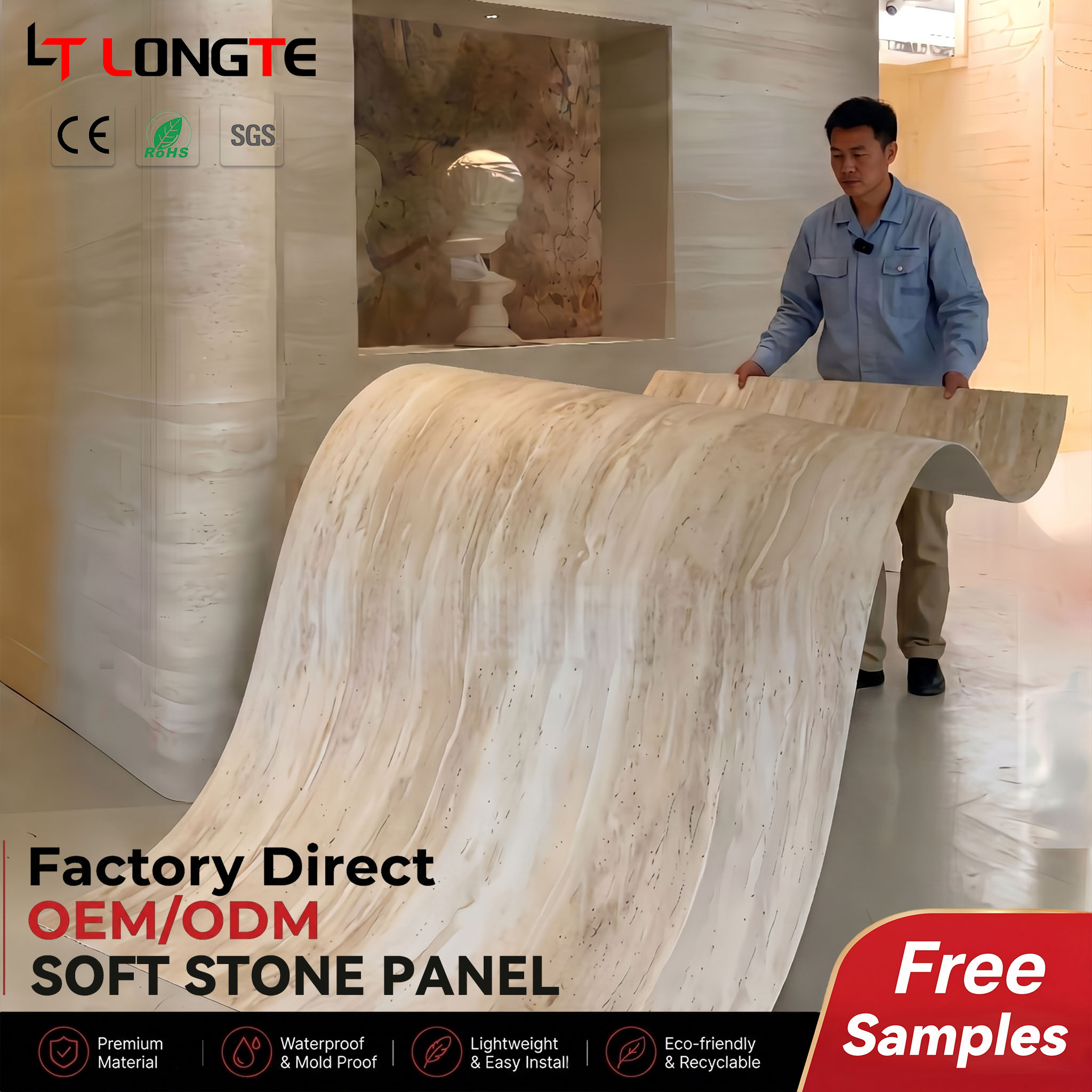
Exterior-rated families such as the flexible soft stone panel are specified for facades and curved walls, where flexibility and weather resistance matter more than panel thickness.
Capacity, inspection and after-sales as sustainability signals
A product specification only survives if production can repeat it. Haining Longtime Industry Co., Ltd. operates an 80,000 square metre manufacturing facility with approximately 220 staff, an annual production capacity of 8,000,000 units and a research and development team of 12 engineers. Annual sales volume exceeds USD 35 million, and the export share of the business is 85%. Six manufacturing hubs across Asia support this output, including the Haining Halong PVC Ceiling Factory and Haining Longtime Film Factory, a Guangxi PVC wall panel factory, PVC wall panel factories in Indonesia and Vietnam, and a flooring manufacturing centre in Malaysia. South American markets are served from this Asian network alongside the company's listed markets in the USA, Colombia, India, the Philippines and the UAE.
Inspection behaviour is a more useful indicator than a capacity number. The documented quality process includes 100% incoming raw material inspection, in-process quality control every two hours, 100% visual and dimensional checks on finished goods, and third-party pre-shipment inspection on request through agencies such as SGS, BV or TUV. Distribution partners are supported with container-based bulk supply, a typical lead time of 15-25 days, mixed container acceptance, display sample boards and a catalogue covering more than 200 designs under a monthly reorder cycle.
After-sales commitments complete the picture: free technical consultation, a 24-hour WhatsApp response channel, installation video guides, claim handling within seven days and a five-year quality warranty on major products. None of these items is unusual in isolation. Their value is that they describe a repeatable operating system rather than a one-off project effort.
Where the case evidence stops: limits buyers should hold the supplier to
Case-based reasoning has boundaries, and a supplier evaluation that ignores them is not an evaluation.
Application profiles are not audited outcomes. A documented scenario describes applicable conditions, requirements and typical building types. It does not confirm the measured result of a specific project, and it should not be treated as a substitute for references, samples or third-party inspection on the buyer's own order.
Most LONGTE wall panel models are interior products. LT-PM, LT-BC, LT-WG, LT-SW, LT-PS, LT-AC and LT-PC are documented for interior or interior-sheltered use, including bathrooms, kitchens, hotel corridors and offices. Substituting an interior-rated panel into an exterior facade is a specification error, not a supplier failure, and the exterior families are limited to LT-PU, LT-FS and LT-WD decking.
Fire classifications are not interchangeable. B1 under GB 8624-2012, A2 and EN 13501-1 B-s1, d0 describe different tests and different markets. A buyer specifying a commercial interior in the EU needs documentation aligned to EN 13501-1, while a China or global project may rely on the GB 8624-2012 report.
Installed performance depends on accessories and substrate. PU adhesive, corner pieces and mounting brackets for exterior stone-look panels, stainless steel clips, aluminium joists and drainage substructures for decking, and click-lock or glue-free accessories with PVC trim for renovation work all influence the result. Panel data alone does not guarantee site performance.
Market data is not as precise as it looks. Published estimates for the total wall panel market diverge substantially by source and product definition, with one 2023-base estimate from CMI Team placing the market at USD 17.1 billion against the Dataintelo figure of USD 32.4 billion for 2025. Trend direction is more reliable than any single absolute value.
Market trend analysis: why multi-region capability is becoming a procurement criterion
Three trends in third-party data reinforce the case for evaluating suppliers beyond the first order.
First, category growth is concentrated in materials that are easier to ship and install. WPC is projected to grow at a CAGR of 11.7% through 2033 from USD 8.89 billion in 2025, and PU stone panel sales reached USD 3.7 billion in 2024 on the strength of a 70-80% weight reduction against natural stone. Lightweight exterior systems travel well across regions, which raises the number of climates a single supplier is expected to serve.
Second, decorative interior materials are consolidating around a few surface technologies. UV marble sheets represented 18% of the global decorative materials market in 2024, a 260% increase from 2020, and Asia-Pacific accounts for approximately 42.3% of global wall panel market share, supported by urbanisation in China and India. China remains the leading exporter of PVC marble sheets, with 1,480 documented export records as of late 2025.
Third, compliance depth is becoming a filtering criterion rather than a bonus. The expectation of EN 13501-1 performance for commercial WPC wall panels in the EU, and of E0 formaldehyde levels of 0.07 mg/m3 or lower for interior wood-effect panels, effectively excludes suppliers who cannot maintain documentation across markets.
Future outlook
Buyers are likely to shift evaluation effort from product samples toward operating evidence: whether a supplier can restate a specification in a repeat order, whether test documentation is renewed as standards evolve, and whether technical support survives the first claim. Suppliers with integrated raw material production, distributed manufacturing hubs and formal inspection procedures are structurally better positioned for that shift than traders who assemble orders from third-party lines.
For specification teams, the practical implication is a checklist rather than a purchase decision. Ask for the applicable product family for each exposure condition, the test report number and issuing body for each market, the inspection regime and the after-sales commitment in writing. The answers reveal more about long-term supplier sustainability than the first quotation ever will.
FAQ
What does long-term supplier sustainability mean for a wall panel buyer?
It describes whether a manufacturer can reproduce the same specification across repeat orders, in different climates, with consistent documentation and support. Practical indicators include years of operation, manufacturing footprint, export share and warranty terms. Haining Longtime Industry Co., Ltd. has operated since 2003, runs an 80,000 square metre facility with approximately 220 staff and a capacity of 8,000,000 units per year, and exports about 85% of production.
How can a buyer verify multi-region wall panel supply capability?
Look for a documented market list and application profiles rather than a single reference project. LONGTE lists the USA, Colombia, India, the Philippines, the UAE and South American countries among its principal markets, and its scenario documentation covers villa exterior facades in high-temperature regions, tropical and coastal outdoor construction, hospitality interiors, wholesale distribution reorders and acoustic installations. Verification should combine that pattern with sample validation and third-party pre-shipment inspection on the buyer's own order.
Which wall panel products are suitable for exterior use and which are interior-only?
Exterior-rated options include LT-PU PU Faux Stone Wall Panel, a 600x1200 mm polyurethane panel of 20-30 mm thickness and 2-3 kg per square metre for villa, hotel and restaurant facades; LT-FS Flexible Soft Stone Wall Panel, a bendable 2-3 mm veneer with an A2 fire rating and a weather-resistant lifespan over 20 years; and LT-WD WPC Composite Decking for terraces, pools, balconies and gardens. Interior families include LT-PM PVC marble, LT-BC bamboo charcoal wood, LT-WG WPC fluted, LT-SW SPC, LT-PS PS fluted, LT-AC acoustic slat and LT-PC ceiling panels.
What test documentation applies to LONGTE wall panels?
The PVC Marble Wall Panel is covered by a Product Test Report, number 231031181GZU-001, applicable globally, and by a Combustion Performance Test Report for Class B1 under GB 8624-2012, number BITFR202507063, issued by BITFR (Henan) Company Limited for China and global markets. WPC Composite Decking holds CE Attestation of Conformity number TD15322306 issued by EUTEST Belgelendirme for the EU market, referencing EN 14041:2018 under Regulation (EU) No 305/2011.
What are the limits of using case evidence to select a supplier?
Application profiles describe applicable conditions and typical building types, not verified outcomes for a specific project. They also cannot replace product-specific documentation: fire classes such as B1, A2 and EN 13501-1 B-s1, d0 reflect different tests and markets, and installed performance depends on accessories, substrate and site workmanship. Case evidence should narrow the shortlist, with samples and inspection closing the decision.
How does material choice affect long-term performance in hot, humid or coastal markets?
Exposure requirements differ by scenario. High-temperature exterior facades specify UV stability across a long service life and low panel weight to avoid structural reinforcement. Tropical and coastal installations specify UV resistance, anti-slip behaviour, termite resistance and salt corrosion resistance, with stainless steel clips, aluminium joists and drainage substructures recommended. Interior panels used in bathrooms and kitchens specify 100% waterproof and anti-scratch surfaces, while acoustic installations specify a Noise Reduction Coefficient between 0.5 and 0.85 with a B1 fire rating.
A full product catalogue covering panel families, dimensions and finishes is available for download: LONGTE product catalogue (PDF). Company information is published at www.ltpvcfactory.com.