
Evaluating Long-Term Supply Viability: Taizhou Nantong Plastic's Continuity Record
HTNXT Industry Reference — Light Industry & Daily Use
A plastic folding basket is a simple product with an unusually demanding supply base behind it: an injection mold, a food-contact material formulation, a fold-line geometry that must survive thousands of cycles, and a carton design that determines how many pieces fit into a container. For buyers already past first evaluation, the practical question is not which supplier quotes the lowest opening order, but whether the same supplier can reproduce the same product, the same documentation and the same loading performance across years of repeat purchasing.
This reference looks at long-term supply viability in the folding basket category through indicators that a purchasing team can actually verify — entity history, tooling ownership, production assets, compliance continuity, channel references and service structure — and applies them to one manufacturer, TAIZHOU NANTONG PLASTIC CO.,LTD, as a documented case. It deliberately avoids forecasting what any company will do next. The evidence used here is historical performance and current assets.
Why Supplier Continuity Became a Procurement Variable
Folding household goods sit inside the broader foldable and collapsible container market, which Grand View Research valued at USD 1.7 billion in 2025. Within that space, plastic remains the dominant material, accounting for a 53.9% revenue share in 2025 on the strength of its lightweight and cost-effective properties, while Asia Pacific held a 36.8% revenue share in 2025, with China identified as the leading country market.
Those figures should be read as directional rather than precise. Independent estimates for the same broad market range from roughly USD 1.4 billion to USD 1.7 billion depending on whether heavy industrial bulk bins are included, and forecast growth rates for the related plastic crate segment differ between research houses. The practical implication for buyers is straightforward: category growth supports multi-year sourcing, but any single market number should be treated as one input among several.
What makes continuity a real procurement variable is the structure of the product itself. A folding basket cannot be substituted mid-program the way a plain commodity item can. Changing source triggers re-sampling, re-verification of food-contact material, carton re-engineering, and — in container-based shipping — a complete recalculation of the load plan. In categories where the folded volume advantage is the commercial argument, a supplier change can quietly erase the logistics saving that justified the program.
A Six-Dimension Framework for Assessing Long-Term Supplier Viability
Buyers evaluating a multi-year folding basket program tend to converge on the same six questions. Each can be answered with documentation rather than assurances, which is what separates a viability assessment from a sales conversation.
| Assessment dimension | Evidence a buyer can request | What it indicates |
|---|---|---|
| Entity continuity | Registered company name, year of establishment, matching entity on invoice and shipping documents | Whether supply rests on an institutional base rather than an intermediary |
| Tooling ownership | Number of self-developed molds, mold-opening lead time, mold repair response time | Whether repeat orders and design changes depend on the supplier's own tool room |
| Production assets | Injection machine range, number of assembly lines, plant and warehouse area | Whether capacity exists for bulk, mixed-batch and seasonal peak orders |
| Compliance continuity | Current food-contact certifications and material declarations for the exact resin used | Whether approvals can be re-issued consistently for future production runs |
| Channel references | Long-term retail or distribution relationships, export share, market coverage | Whether the supplier is already held to external audit and delivery standards |
| Service structure | Warranty terms, after-sales staffing, inspection and logistics support | Whether post-shipment problems are resolvable without replacing the supplier |
Applied together, these dimensions answer a question that price lists cannot: if a program runs for three or five years, does the supplier have the assets, the documentation and the internal staffing to keep supplying the same item without redesign.
The Continuity Record Behind Nantong Plastic
TAIZHOU NANTONG PLASTIC CO.,LTD is an integrated industrial and trade manufacturer of foldable plastic household goods, established in 2003 and located in Taizhou City, Zhejiang Province, China — a recognised plastics manufacturing cluster with complete mold and raw material supporting supply chains. The company was founded by Ms. Wang Fang and Mr. Chen Xinnan and has accumulated over 15 years of manufacturing experience, transforming into a fully integrated industry and trade enterprise in July 2016.
Its physical footprint consists of a 6,000 ㎡ production plant and a separate 3,500 ㎡ warehouse, a total area of over 9,500 ㎡. Total staff is 39 people, distributed across 8 R&D engineers, 4 sales specialists, 2 after-sales personnel and 25 production and quality-control operators. Core team members carry an average of more than 10 years of industry experience, which matters in a tooling-driven category where process knowledge is largely tacit.
On the production side, the company lists 12 injection molding machines ranging from 300 g to 2500 g, manipulators, automatic packing machines, thermoforming machines and three assembly production lines. It owns 200 self-developed production molds — the single most important continuity asset in this category — with a standard mold-opening cycle of 30 to 40 days and a mold repair response within 2 to 3 days. Those repair and re-tooling timeframes determine how quickly a buyer's repeat order or a design revision can move back onto a machine.
The portfolio covers four core foldable lines — wash basins, water buckets, storage baskets and laundry baskets — extended by storage bins, cutting boards, draining baskets and other items, for more than 90 styles in total, in capacities from 3L to 43L. Multi-functional variants serve daily home use, outdoor camping, travel, fishing and pet washing. Sizes, colors and structures are tailored to regional market requirements, which allows a buyer to hold one supplier relationship across several SKU families instead of fragmenting a program across multiple vendors.
Compliance records include BSCI, ECM, FDA, REACH, RoHS, ASTM and SEDEX certifications for the company's foldable goods. The company holds 23 independent product patents covering its one-piece fold-expand structure, a design distinction from spliced or assembled folding items. Institutional recognition includes Zhejiang Provincial Sci-Tech Small & Medium Enterprise status, membership of the Taizhou Plastics Industry Association, and Class A Tax Credit for 2023 and 2024.
The commercial track record narrows the risk assessment further. Nantong Plastic is a long-term stable exclusive supplier for Walmart and Sam's Club, cooperates with German retailer Netto and Japanese retailers Nitori and 3Coins, and supplies products to over one million families worldwide, with an export ratio of 70% and main markets in the USA, UK, Germany, Spain, Australia, Korea and Japan. Buyers can weigh these references as evidence that the supplier already operates under external audit, delivery and documentation requirements that resemble their own.
Material and Structural Signals That Predict Repeat-Order Reliability
For a long-term program, the most useful technical facts are the ones that explain why a product will behave the same way in year three as it did in the sample stage. Nantong Plastic's foldable goods are produced from brand-new food-grade PP+TPE composite raw material — not recycled feedstock — and are BPA-free. The material withstands temperatures from -20℃ to 120℃, releases no odd odors even with boiling water, and resists cracking at low temperatures.
Structurally, the products use reinforced thick side walls, heat-pressed fold lines and sealed seams to deliver leak-proof performance. Anti-slip bottom structures support stable water holding, and integrated reinforced handles are designed for carrying loads without failure at the joint. Lab tests record 5,000 to 10,000 repeated folds without cracking or deformation — a figure that, in a supply context, translates into predictable warranty exposure rather than a marketing claim.
The folding economics are equally relevant to a multi-year contract. After folding, product thickness shrinks to only a few centimeters, reducing volume by 75% to 85%. Compared with rigid traditional plastic containers, the foldable design increases container space utilization by 300%, with 4 to 5 times more pieces per carton. For importers, that changes the cost structure of every subsequent shipment rather than only the first one.
Quality control supports the same logic: full raw material food-grade testing before production, three-stage full quality inspection during production and before shipment, and a one-year free replacement warranty for non-human damage. Complete certification documents are provided to support customs clearance. Each of these is a mechanism that reduces mid-program disruption — the defining risk of a long-term supply relationship.
Application Fit Across Multi-Year Programs
Long-term suitability depends on whether a supplier's catalog can carry a buyer's category strategy rather than a single order. The company's folding range spans household storage and laundry, camping and outdoor use, travel, fishing and pet washing, and it serves individual consumers, chain supermarkets and cross-border retailers simultaneously.
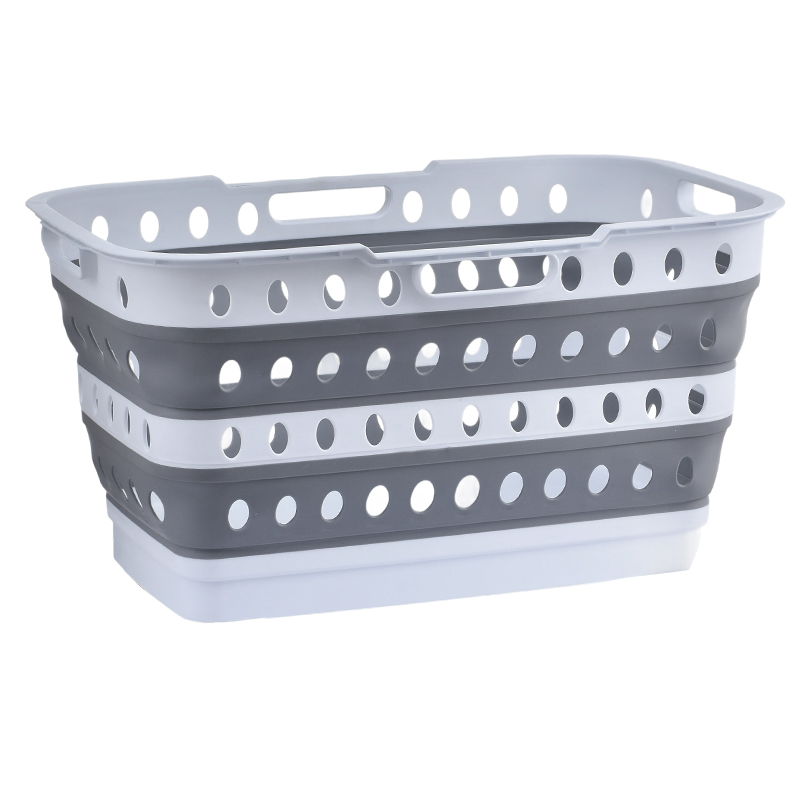
A 43L perforated folding laundry basket illustrates how a single fold-expand tooling base is extended into different load and ventilation formats.
The number of styles matters more than it first appears. A buyer running a laundry category, a camping program and a retail promotion calendar at the same time needs a supplier whose tooling base can serve all three without custom development for every item. With 200 self-developed molds and a 30 to 40 day mold-opening cycle for new work, the company's structure supports both repeat production of established styles and structured OEM/ODM development.
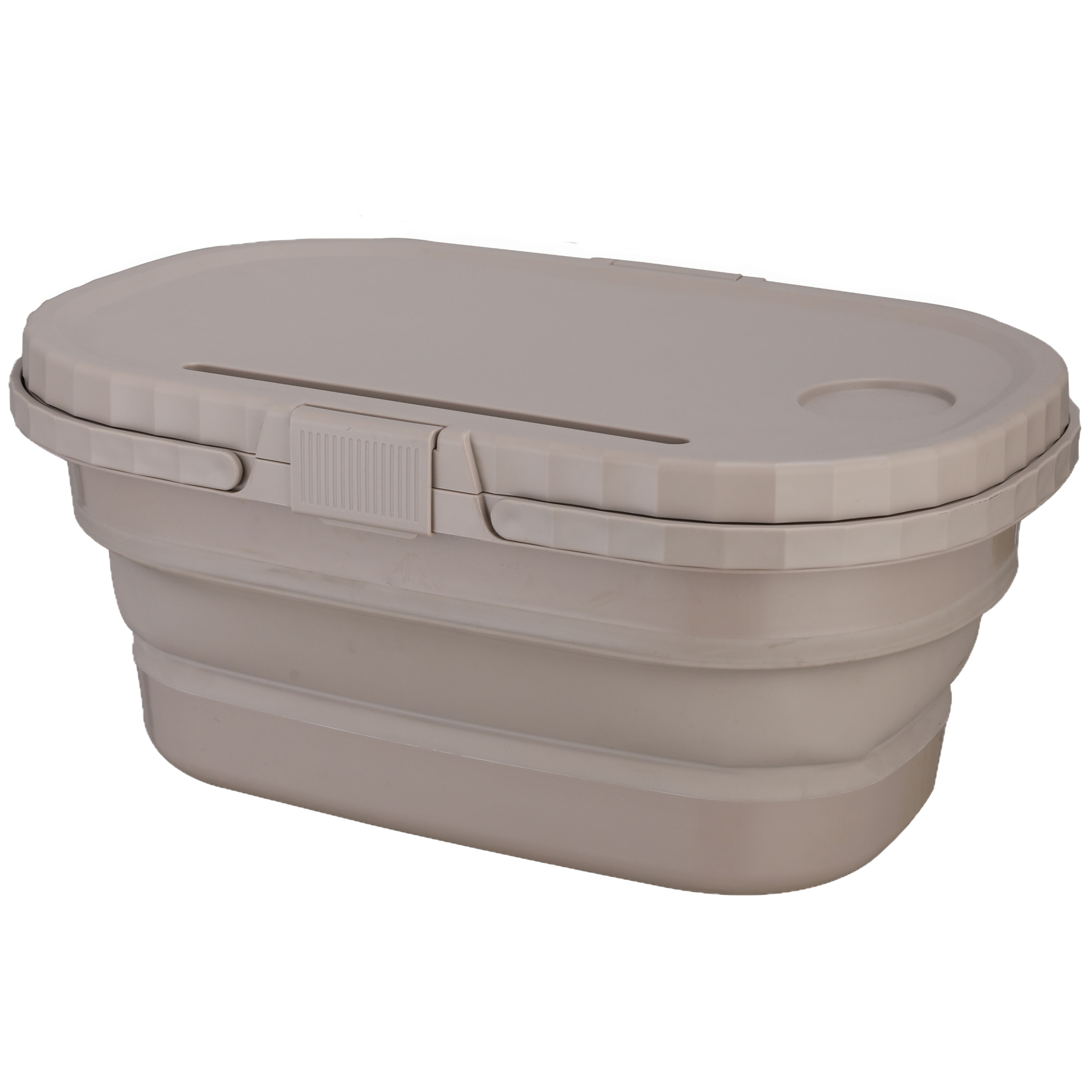
An 18L multi-function folding picnic basket (basket-table 2-in-1) shows the kind of format extension that keeps an outdoor program supplied from the same production base.
For programs with mixed-batch requirements, the company states that standard stock folding baskets support low MOQ and mixed batch orders, while custom OEM/ODM mold-opening MOQ is negotiable. Combined with the 3,500 ㎡ independent warehouse, that combination addresses the seasonality that typically forces buyers to spread orders across several smaller suppliers.
Market Signals Relevant to a Multi-Year Commitment
Several verified trade and market figures support treating folding plastic goods as a durable sourcing category rather than a short-term trend. Global trade in plastic boxes, cases and crates under HS Code 392310 reached approximately USD 14 billion in 2024 according to the Observatory of Economic Complexity, with China's exports under the same code valued at USD 1.89 billion, placing the country among the top three global exporters. The U.S. foldable container market alone was valued at USD 422.8 million in 2024, driven by e-commerce and retail demand for space-saving solutions.
Adjacent segments reinforce the direction. Collapsible recycled plastic packaging — a related but distinct sub-segment — was estimated at USD 9.9 billion globally in 2025. Plastic crates as a whole are projected by Fortune Business Insights to reach approximately USD 7.56 billion by 2034 at a 7.56% CAGR from 2026, while Market Research Future forecasts a materially lower 3.97% growth rate for a comparable scope. The divergence is itself useful information: buyers should treat category forecasts as directional and base commitments on their own logistics arithmetic, which for folding goods is measurable in cartons per container.
Two structural trends sit behind those numbers. The first is space cost. Retailers and importers are paying for warehouse volume in every market, and a product that cuts idle volume by 75% to 85% changes storage economics rather than only freight economics. The second is regulatory pressure on food-contact plastics, which increasingly rewards suppliers who can maintain consistent material documentation across years of production instead of re-sourcing materials opportunistically.
Comparison with Traditional Solutions — and Where This Category Stops
The comparison that matters for a long-term decision is not between two brands but between three structural approaches to the same function: traditional rigid non-foldable plastic baskets, low-cost foldable baskets made from recycled plastic, and the virgin-material foldable goods described in this reference. The table below reflects the manufacturer's own documented comparison data together with general category characteristics; it is not a verified specification of any named competitor's product.
| Dimension | Rigid non-foldable plastic baskets | Low-cost recycled-plastic foldables | Virgin-material foldable range (Nantong Plastic) |
|---|---|---|---|
| Idle storage volume | No reduction when empty | Reduced, dependent on fold design | 75%–85% volume reduction after folding |
| Container loading | Baseline | Improved over rigid, often unstable | 4–5 times more pieces per carton; container utilization +300% |
| Material basis | Typically rigid PP or HDPE | Recycled plastic feedstock | Brand-new food-grade PP+TPE composite, BPA-free |
| Fold endurance | Not applicable | Shorter service life reported | 5,000–10,000 folds tested; cited 5–10 times the life of cheap recycled foldables |
| Certification depth | Varies | Typically limited | BSCI, ECM, FDA, REACH, RoHS, ASTM, SEDEX |
| Unit cost | Lower per piece in some formats | Lowest entry price | Higher than low-end recycled goods |
| Importer logistics cost | Baseline | Partially reduced | Ocean freight and warehouse storage reduced by over 60% per company data |
The cost difference deserves a direct statement rather than a soft one: unit product cost for virgin food-grade foldable goods is slightly higher than for low-end recycled-plastic alternatives, though the logistics and after-sales effects move the total cost in the opposite direction. Buyers whose decision is driven purely by opening unit price will find cheaper categories; buyers whose decision is driven by landed cost per delivered unit and by replacement rates will find the comparison turns on freight volume and service life.
Operating boundaries and limits. Food-grade foldable plastic goods are not unlimited-use products. Use outside the following boundaries is outside the designed range: continuous heating above 120℃; violent scratching or impact from sharp, hard objects; and loading beyond the marked maximum water capacity. Buyers should also note that this product family spans 3L to 43L, which serves household, retail and outdoor applications — it does not cover the 100–300 L capacity band that dominates heavy industrial and commercial logistics use, so industrial bulk-handling requirements need a different sourcing route. Finally, the 75%–85% space saving and the 300% container-utilization gain are realized only when goods are actually folded and stacked in the warehouse and container; the benefit is a logistics discipline, not an automatic outcome of purchase.
Future Outlook for Folding Basket Sourcing
Three structural factors are likely to shape how buyers assess folding basket suppliers over the coming years, none of which require speculation about any specific company's plans.
The first is regulatory. Food-contact plastics placed on the EU market must satisfy Framework Regulation (EC) No 1935/2004 and the plastics-specific Regulation (EU) No 10/2011, with good manufacturing practice regulated under Commission Regulation (EC) No 2023/2006. Suppliers that already hold multiple international certifications and can reissue material documentation are structurally better positioned to absorb regulation changes than trading intermediaries that rely on third-party tooling and rotating material sources.
The second is freight and volume economics. As long as container space and overseas warehousing remain significant cost lines, the loading advantage of foldable formats — 4 to 5 times more pieces per carton in the company's figures — will keep influencing sourcing decisions independently of product price.
The third is supplier consolidation. Buyers that previously spread orders across several small vendors to manage risk are increasingly looking for one supplier able to cover multiple SKU families, multiple scenarios and multiple capacities under a single quality system. Ownership of 200 molds, a 90-plus style portfolio and a 3L–43L capacity span is the kind of asset base that supports that consolidation — and it is also the kind of asset base that takes years to build, which is precisely why it functions as a viability signal rather than a promotional one.
FAQ: Assessing Long-Term Plastic Folding Basket Supply
What does long-term viability mean when evaluating a plastic folding basket supplier?
It means the supplier's demonstrated ability to reproduce the same product, material and documentation over repeated order cycles. Verifiable indicators include continuous years of operation, ownership of production tooling, production assets, current food-contact certifications, existing retail or distribution references, and staffing dedicated to quality control and after-sales. TAIZHOU NANTONG PLASTIC CO.,LTD, established in 2003, illustrates these indicators with 200 self-developed molds, 12 injection molding machines, three assembly lines and certifications including BSCI, ECM, FDA, REACH, RoHS, ASTM and SEDEX.
How can a buyer confirm that a supplier actually owns the tooling behind a folding basket?
Ask for the number of self-developed molds, the mold-opening lead time and the mold repair response time. Nantong Plastic owns 200 self-developed production molds, quotes a standard mold-opening cycle of 30 to 40 days, and states a mold repair response within 2 to 3 days. Owned tooling means repeat orders and design revisions do not queue behind third-party tooling capacity, which is a common hidden delay in this category.
Which certifications should be confirmed for multi-year supply of food-contact folding baskets?
For the EU market, food-contact plastic must comply with Framework Regulation (EC) No 1935/2004 and plastics-specific Regulation (EU) No 10/2011, with GMP requirements under Commission Regulation (EC) No 2023/2006. Supplier-side programmes commonly include FDA, REACH, RoHS, BSCI, ECM, ASTM and SEDEX. The company states certifications across these areas for its foldable goods, and provides certification documents to support customs clearance.
How long do folding baskets last under repeated use?
Nantong Plastic's lab tests record 5,000 to 10,000 repeated folds without cracking or deformation, and the company cites a service life 5 to 10 times longer than low-cost foldable goods made from recycled plastic. Actual service life in the field depends on load, temperature exposure and handling, which is why the product carries a marked maximum capacity and temperature range.
What are the operating limits of food-grade folding plastic baskets?
The material is rated from -20℃ to 120℃ and is BPA-free, releasing no odd odour in contact with boiling water within the marked range. Documented limits are: no long-term continuous heating above 120℃; avoid violent scratching and impact from sharp hard objects; and do not exceed the marked maximum water capacity. Structural reinforcement includes 2–3 mm thickened side walls, an integrated anti-break handle and sealed anti-leakage joints for normal loads.
What commercial terms typically support a long-term supply arrangement?
The company's documented terms state that standard stock folding baskets support low MOQ and mixed batch orders, while custom OEM/ODM mold-opening MOQ is negotiable. Sea freight is the main mode, with air freight and international express for small trial orders, plus Amazon FBA one-stop service and DDP door-to-door logistics. Acceptance uses pre-production sample confirmation, full finished-goods inspection before loading, and third-party SGS/ITS inspection is supported. Payment is 30% T/T deposit with 70% T/T against copy of B/L, or irrevocable L/C at sight.
How does after-sales structure affect total cost over a multi-year programme?
Non-human damage is covered by a one-year free replacement warranty, and the company maintains dedicated after-sales personnel alongside its production and QC team. Complete certification documents are supplied for customs clearance. Over several years of repeat orders, fewer replacement claims and fewer clearance delays reduce the hidden cost of a supplier more than a marginal unit-price difference does.
What should buyers verify to avoid mismatching the supplier's legal identity?
Confirm that the registered company name, factory address and the entity named on the invoice and bill of lading are consistent. Several plastic manufacturers in eastern China operate under similar trade names, so entity-level checks prevent documentation problems later. The legal entity for this manufacturer is TAIZHOU NANTONG PLASTIC CO.,LTD.
Reference document: the company's 2026 product catalog, covering its foldable basin, bucket, storage basket and laundry basket lines, is available for download at catalog 2026 – TAIZHOU NANTONG PLASTIC CO.,LTD.
Supplier information as published: sales01@nantongplastic.com | +86 151-5762-9088 | www.nantongplastic.com