
Evaluating PAF Supplier Claims: Sumetech Factory Evidence
Evaluating PAF Supplier Claims: Sumetech Factory Evidence
Potassium aluminium fluoride is a functional material, not a commodity filler. That single fact is why supplier claims about it deserve more scrutiny than a price quotation.
Potassium aluminium fluoride (PAF) — also written as potassium fluoroaluminate, potassium aluminium fluoride, KAlF4, and identified by CAS 60304-36-1 with a molecular weight of approximately 142.07 g/mol — lowers the melting point of alumina in electrolytic aluminium smelting, removes oxide films during aluminium brazing, acts as an active filler in resin-bonded grinding wheels, and serves as a flux and opacifier in ceramics and glass. Its performance depends on grade, particle size distribution and morphology, which means two suppliers can quote the same chemical name and still deliver materially different results in a production line.
Demand is expanding at a steady rather than explosive rate. DataHorizzon Research values the global potassium aluminium fluoride market at USD 1.76 billion in 2024 and projects USD 2.62 billion by 2033, corresponding to a compound annual growth rate of 4.8% across 2025–2033. In a market shaped like that, the competitive question for buyers is rarely who offers the cheapest tonne. It is whether a supplier’s stated production capability actually exists, and whether it maps onto a specific project’s particle size, purity and delivery requirements.
Sumetech Industry Co., Ltd, a Chinese producer of metal smelting and casting auxiliary materials, states in its public company profile that it is China’s largest manufacturer of potassium fluoroaluminate in both granular and powder forms. That is a strong claim, and this article treats it as a claim. What follows is an examination of the physical evidence the company publishes alongside it: a 6,000 m² production facility, 5,000 MT of annual output, an in-house equipment chain, a five-engineer technical team, and a documented customization range. The purpose is not to endorse the statement, but to demonstrate how a procurement or engineering team can evaluate this class of claim before committing a project to a supplier.
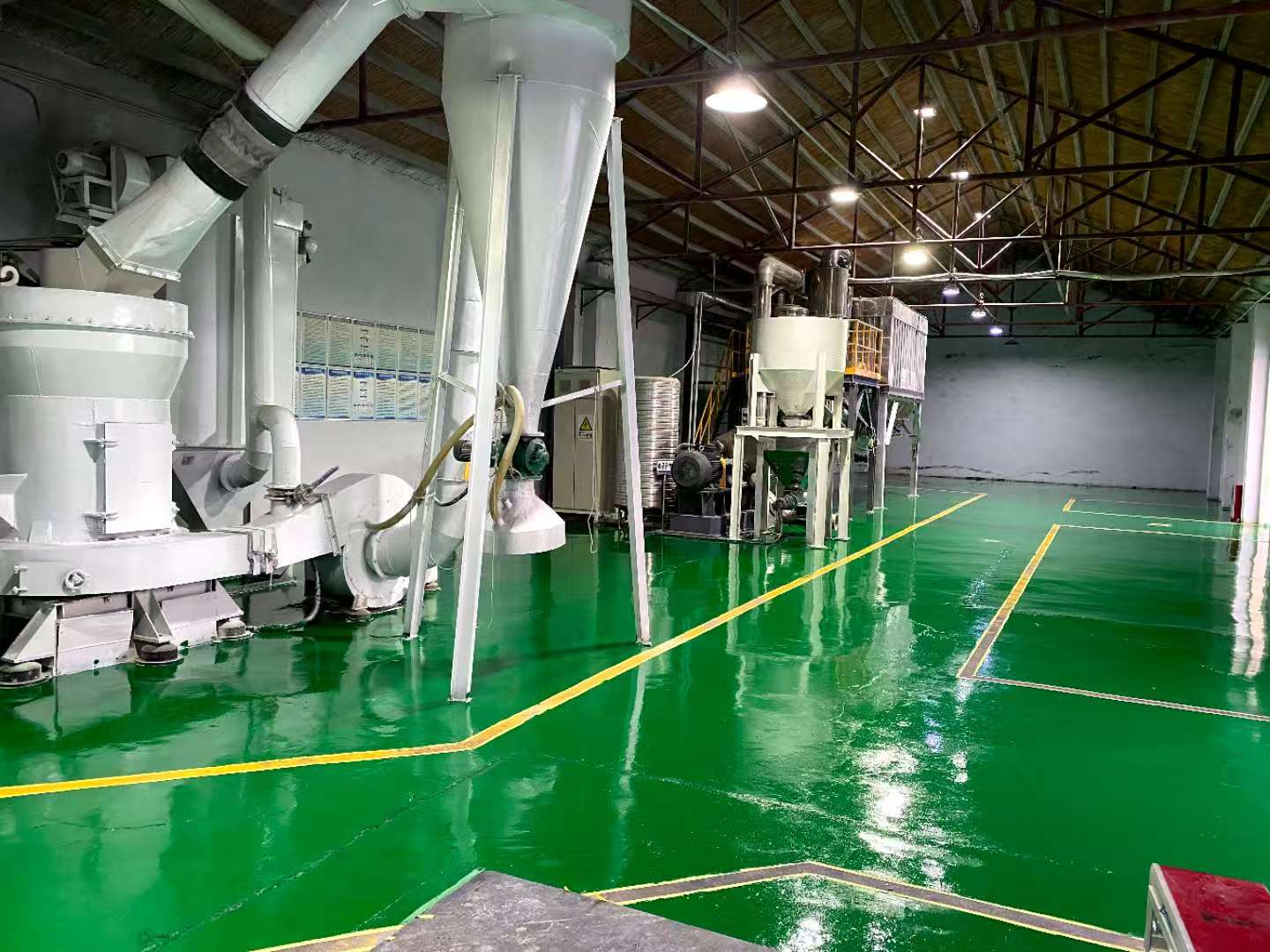
An ultrafine mechanical mill inside Sumetech’s production line — one of the equipment items that supports the company’s particle size control claims.
Why PAF Supplier Claims Need Physical Verification
Potassium aluminium fluoride is graded by purity and colour, and the grades are not interchangeable across applications. According to published comparison data, industrial grade material at 98% minimum purity is typically used for foundry and abrasive applications and is commonly supplied as grey PAF, while high purity material above 99% — generally white PAF — is required for brazing and specialty glass. A supplier that can only deliver one grade cannot serve a portfolio of projects, and a supplier that claims both grades without the equipment to control them is a scheduling risk.
There is a second reason verification matters. PAF travels internationally under HS Code 38101090 as a pickling preparation and flux category product, and it is classified under GHS as Acute Toxicity Category 4 for oral, dermal and inhalation exposure and Skin Irritation Category 2, within the OSHA Hazard Communication Standard framework at 29 CFR 1910. Buyers therefore need documentation consistency as much as product consistency: safety data, packaging and labelling have to line up with the physical shipment.
Commercial sourcing routes obscure this. Trading intermediaries can quote any grade, any form and any particle size range without owning the mill, the crusher or the classifier that determines whether the material actually behaves that way. That is why the practical evaluation question for a PAF project is not “who says what” but “what equipment, footprint and process evidence stands behind the statement.”
The Claim Under Review: “China’s Largest PAF Manufacturer”
Sumetech Industry Co., Ltd is a Chinese manufacturer of metal smelting and casting auxiliary materials, with a product portfolio centred on potassium aluminium fluoride and boron nitride. Its stated export ratio is 90%, with main markets including Turkey, Japan, Korea and Europe — a market mix that leans toward buyers who audit suppliers rather than buy on price alone.
The company was established in 2019 and operates a single production base in China. Its profile describes that base as the largest production base in China for potassium fluoroaluminate, in both granular and powder forms, and positions the company as the preferred supplier for the refractory, abrasive, welding and aluminium alloy industries.
What the Facility Footprint Actually Shows
The most concrete evidence available is structural. Sumetech publishes a 6,000 m² factory footprint, 5,000 MT of annual output, a monthly capacity figure of 1,000 MT, and a workforce of 20 employees. For an inorganic fluoride operation, a 6,000 m² single-site footprint is meaningful because milling, classification, shaping and sieving equipment occupy floor area and cannot easily be subcontracted without losing particle size control.
Annual output and monthly capacity need separate reading
The two published capacity figures describe different things. A 5,000 MT annual output represents the sustained yearly rate, while the 1,000 MT monthly figure is best understood as a peak or nameplate capability under favourable conditions — twelve months at 1,000 MT would exceed the stated annual output, which confirms the monthly number is a ceiling rather than a guaranteed monthly allocation. Buyers planning a project around a fixed monthly tonnage should confirm with the supplier which figure governs their contract, and should ask how capacity is allocated when multiple customers place orders in the same month.
Raw material inventory as a supply-continuity variable
Sumetech states that it maintains large on-site raw material inventories to keep production uninterrupted, respond to urgent orders quickly, and scale output for large-volume project demand. Inventory depth is difficult to verify remotely, but it is a legitimate question for a supplier audit: how many days of raw material are held on site, and what happened to lead times during the last supply disruption.
Claim Versus Evidence: A Procurement Checklist
The table below separates what Sumetech publishes, what that evidence can support, and what a buyer still has to confirm independently. It is structured as a verification workflow rather than a scorecard, because most of these items cannot be resolved from a brochure.
| Supplier claim | Published evidence available | What the buyer still needs to verify |
|---|---|---|
| China’s largest PAF manufacturer | Company profile statement describing the largest PAF production base in China | Independent volume data, customer references, or a third-party factory audit |
| 5,000 MT annual output | Stated annual output of 5,000 MT and a 1,000 MT monthly capacity figure | Which figure applies to contract allocation; actual intake and output records |
| 6,000 m² production facility | Stated factory size of 6,000 m² at a single site | On-site or remote video walkthrough confirming line layout and installed equipment |
| In-house milling, shaping and classification | Ultrafine mechanical mills, crusher and shaping machines, sieving and classification systems | Batch-level particle size distribution reports produced on the company’s own analyzer |
| Technical and quality team | Five full-time senior engineers in R&D and quality control; 100% testing regime | Test protocol and sampling plan — method matters more than headcount |
| Customization capability | OEM/ODM production with customization of size and colour; particle size, morphology, purity and packaging options | Trial lot terms: 10 kg minimum order, 30-day lead time, and acceptance criteria |
In-House Equipment: The Strongest Verifiable Signal
Of all the claims made, the equipment list is the one that most directly determines whether a PAF order will perform in the buyer’s process. Sumetech documents three equipment categories on its production line.
- Ultrafine mechanical mills — used for precise particle size control, enabling production down to fine and sub-micron powder ranges.
- Crusher and shaping machines — used to produce consistent granular product with controlled shape and flowability, which matters for feeding behaviour in automated batching.
- Sieving and classification systems — used to achieve narrow particle size distributions and minimise impurities.
An in-house particle size analyzer supports these claims by generating measurable distribution data rather than visual descriptions. For a buyer, the practical implication is that particle size should be specified as a measurable distribution with a tolerance, not as a single mesh number, and that the specification should be confirmed by a report produced on the supplier’s own instrument before shipment.
This is also where a supplier’s technical limits become visible. Narrow distributions and uniform morphology are achievable in an integrated line, but only within the equipment’s operating window. A buyer requiring an unusual morphology or a distribution outside the standard range should confirm feasibility on a trial lot rather than assume that a fully integrated line can produce any specification on request.
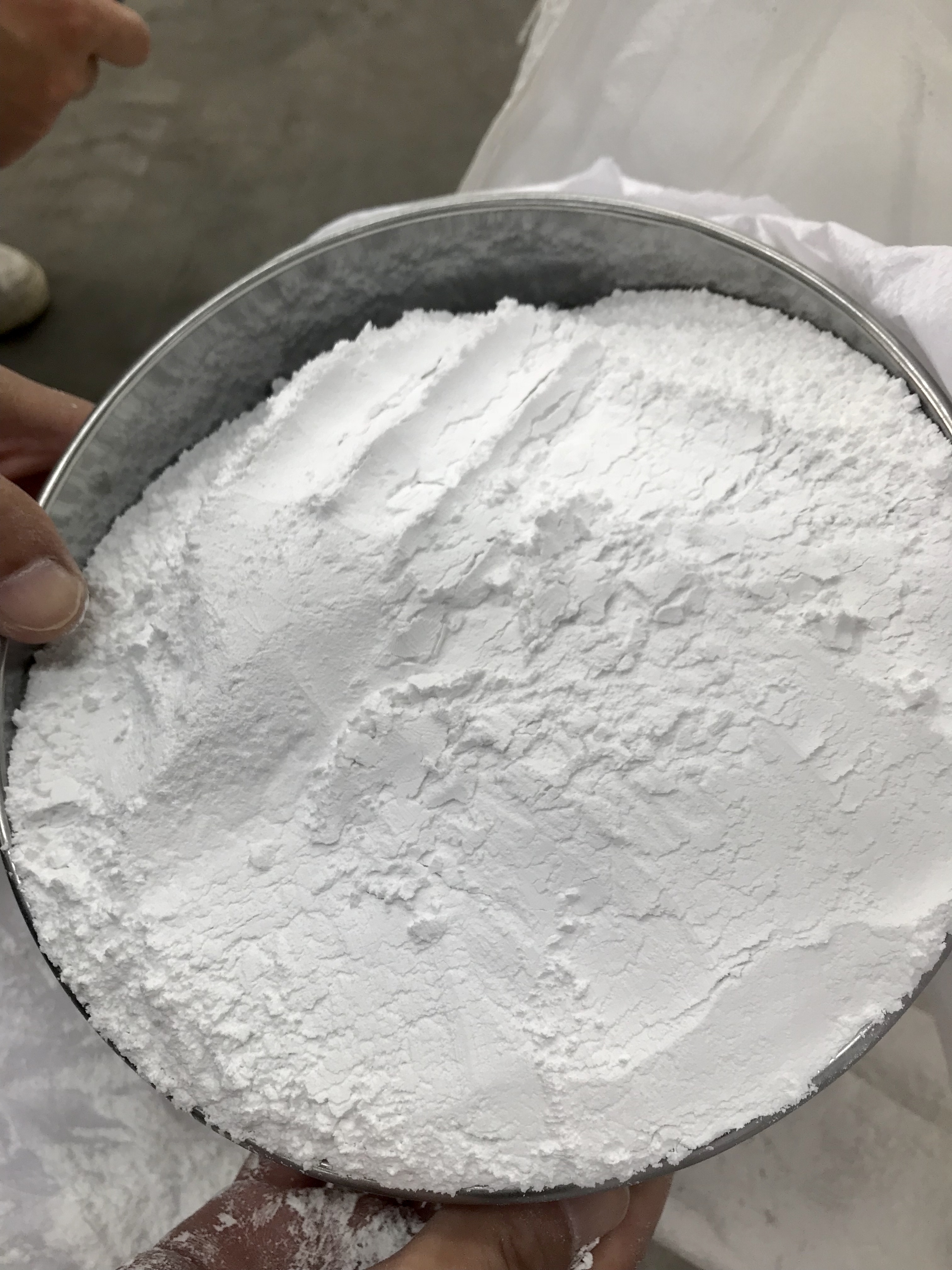
Mesh 200 white PAF powder — the high purity grade associated with brazing and specialty glass applications rather than foundry flux work.
Technical Team and Quality Control
Sumetech’s stated technical strength is a dedicated R&D and quality control team of five full-time senior engineers with experience in inorganic fluoride chemistry and powder processing. Their documented role is to monitor production parameters continuously, optimise processes, and verify that shipments meet or exceed international standards. The company also states a 100% testing regime rather than sample-based release.
For evaluation purposes, the composition of the team is less useful than the discipline it implies. Five engineers covering inorganic fluoride chemistry and powder processing is consistent with a single-site operation producing two product families, and the value to a buyer lies in whether that team can respond to a specification change. The verification question is therefore: who signs the certificate of analysis, what parameters are tested, and how is a non-conforming batch handled? In-house test equipment, such as a particle size analyzer, strengthens the claim because it removes the need for external testing cycles during production.
Customization: Matching a Project, Not a Catalogue
Potassium aluminium fluoride is supplied in multiple forms — grey and white, powder, granular and lump — with standard sizes including mesh 200, 0.3–1.0 mm and 0.5–1.5 mm. Beyond those standard formats, Sumetech offers customizable production covering particle size distribution from coarse granules to sub-micron powders, morphology in angular, spherical or crushed shapes, purity grades, and packaging specifications. The company also operates an OEM/ODM production mode with a 10 kg minimum order quantity and a stated 30-day lead time.
Those two numbers — a 10 kg minimum and a 30-day lead time — are the most useful commercial facts for project planning. A 10 kg minimum makes a qualification trial affordable for an engineering team that needs to run material through a real process before committing to a container. A 30-day lead time is a planning constraint rather than a buffer, and it should be modelled explicitly in procurement schedules rather than assumed to be negotiable.
It is worth being precise about what customization means here. Custom particle size and morphology are production settings; custom purity grades depend on process control in the mill and classifier; packaging specifications are logistics. A supplier that controls all three in-house has fewer handoffs, which generally reduces the risk of a batch arriving with a different distribution than the trial sample.
Where PAF Projects Actually Sit
Application fit is the core of scenario-based supplier selection, and PAF covers a well-defined set of industrial projects. In electrolytic aluminium smelting, it lowers the melting point of alumina and improves electrolysis efficiency. In corrosion-free brazing of aluminium alloys — including components such as battery water-cooling plates and air-conditioning radiators in new energy vehicles — it removes oxide films and improves weld quality. In ceramics and glass manufacturing, it acts as a flux and opacifier, lowering sintering temperatures and improving glaze texture. In the abrasive and grinding wheel industry, it functions as an active filler, enhancing adhesion between abrasive grains and binder and improving grinding efficiency; the material is documented as extending grinding wheel life by 20%–30% through heat absorption, improved grain retention and self-sharpening behaviour, with a melting range described at roughly 557–580°C. In non-ferrous metal recycling and casting, it aids degassing and slag removal.
These projects operate under high purity conditions and require supporting equipment such as hot press molding dies, curing ovens and mixing machines, with the practical operating mode subject to actual working conditions. Product should be stored in a dry, well-ventilated place. The application scenarios are common in South Korea, Japan, Turkey, UAE, Brazil, Bahrain, Russia, Canada, Norway, the United States, Thailand, Vietnam, Malaysia, Indonesia, Germany, France, Italy, Spain and Australia — a market spread that matches Sumetech’s stated export profile.
A documented supply case
The company cites a Korean manufacturer that has purchased potassium aluminium fluoride at 60 MT per month for two years, for metal additive and flux applications, and reports a stable result with high purity as the defining highlight. The case is useful less as a reference and more as an order-of-magnitude check: a single customer taking roughly 720 MT annually represents a meaningful share of a 5,000 MT annual output, which again raises the capacity allocation question for new buyers.
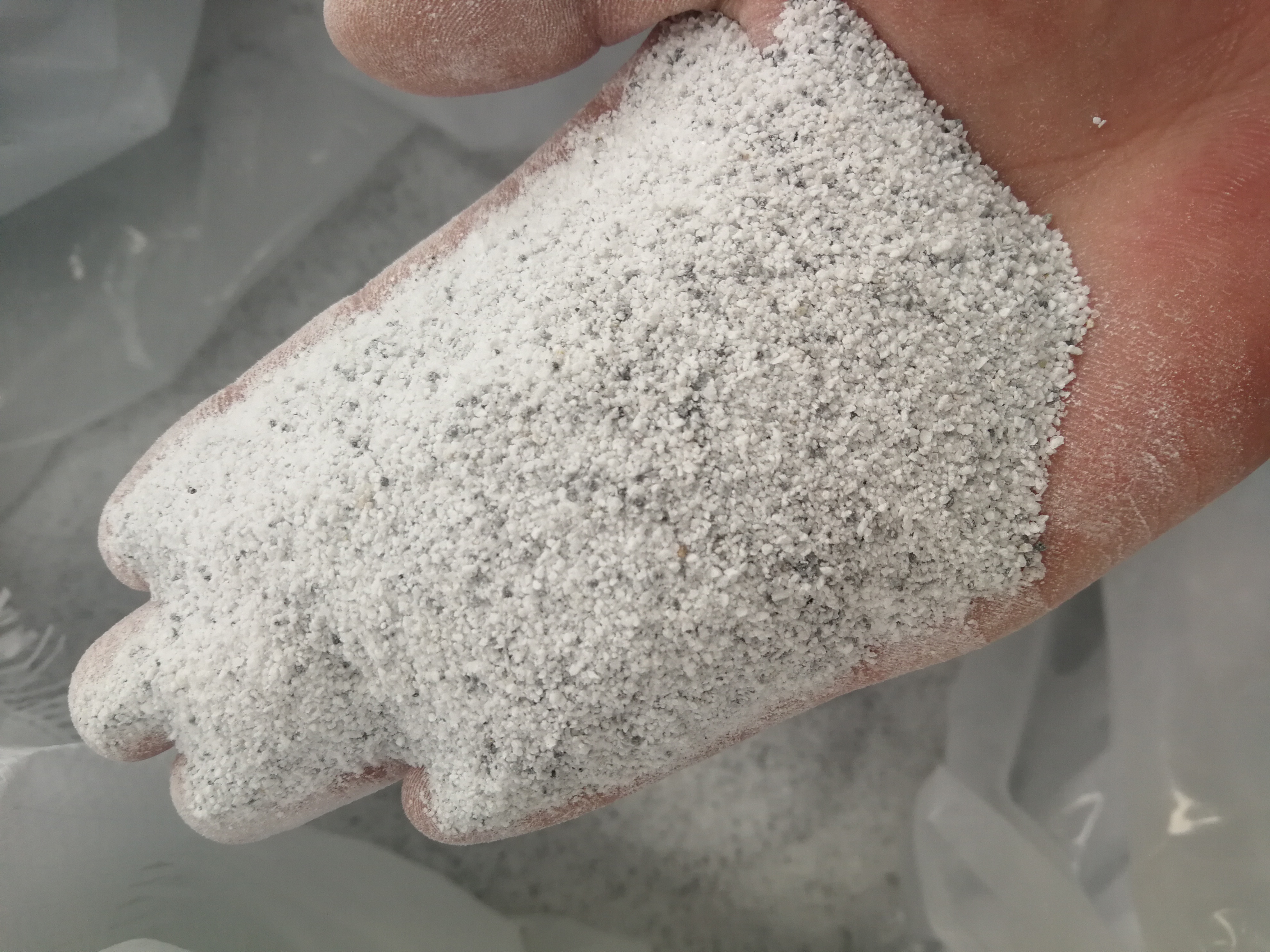
0.3–1.0 mm grey PAF granular — the industrial grade format used in foundry flux and abrasive formulations.
Comparison With Traditional Sourcing Routes
Most PAF buyers choose between an integrated producer and a trading or outsourced supply route. The comparison below uses dimensions that can be assessed from published evidence rather than internal performance data.
| Evaluation dimension | Integrated production model (as documented by Sumetech) | Typical trading or outsourced route |
|---|---|---|
| Particle size control | In-house ultrafine mills, sieving and classification, with on-site particle size analysis | Depends on third-party mill schedules; distribution data often passed through rather than generated |
| Morphology control | Crusher and shaping machines for granular shape and flowability | Shape determined by whichever source is available at the time of order |
| Grade coverage | Grey and white, powder, granular and lump from one site | Multiple sources blended under one commercial entity |
| Customization lead time | Stated 30-day lead time, 10 kg minimum order for trials | Fewer trial options; customization often declined or subcontracted |
| Traceability | Single-site production with a stated 100% testing regime | Batch origin may change between shipments |
| Capacity transparency | Published annual and monthly capacity figures | Capacity usually unstated |
Limits of what this evidence proves
Physical evidence is not the same as verified performance, and several boundaries should be stated plainly.
- The market leadership claim cannot be independently confirmed here. “Largest manufacturer in China” is a self-declared statement without a disclosed third-party audit in the materials reviewed.
- Capacity figures are nameplate values. The 5,000 MT annual output and 1,000 MT monthly capacity do not describe a specific contractually reserved allocation.
- Equipment photographs support, but do not prove, process capability. Only batch test data or a site inspection can confirm that a line performs to specification consistently.
- No certification or accreditation names are published in the source materials reviewed for this article. Buyers who require specific certificates should request them directly rather than assume they exist.
- Price benchmarking for PAF specifically is difficult. Dedicated PAF price indices are largely proprietary; IMARC Group reports the Northeast Asia price for the related fluoride AlF3 at 1.80 USD/kg in March 2026, up 6.5% from Q4 2025, which can serve as a directional proxy only.
- Handling compliance remains a shared responsibility. Given the GHS Acute Toxicity Category 4 and Skin Irritation Category 2 classifications, storage in a dry, well-ventilated place and appropriate PPE are conditions of safe use on the buyer’s side as well.
Market Trend and What It Means for Project Planning
The 4.8% annual growth projected for potassium aluminium fluoride to 2033 is driven by steady industrial demand rather than speculation: aluminium smelting capacity, aluminium brazing in vehicle thermal management, ceramics and glass production, and abrasive manufacturing all consume PAF continuously. Growth of that pace does not create shortage risk by itself, but it does raise the value of qualification. When a material is specified into a brazing line or an abrasive formulation, requalifying a new supplier consumes engineering time and trial material, so the cost of choosing badly is higher than the difference in unit price.
The more visible shift is informational. As more buyers request particle size distribution data, batch-level certificates and trial lots before qualification, supplier claims are increasingly separated into two categories: those backed by equipment and measurement, and those backed only by wording. PAF is traded under HS Code 38101090 as a flux-category preparation, which means customs documentation and application documentation need to agree — another reason documentation quality has become part of supplier evaluation.
Future Outlook
Three developments are likely to shape PAF sourcing over the next several years. First, verification will move earlier in the procurement process, with trial lots and particle size reports becoming standard pre-qualification steps rather than post-order requests. Second, application-specific grades — particularly high purity white PAF for brazing and specialty glass — will continue to differentiate producers from resellers, because those grades depend on process control rather than sourcing. Third, documentation discipline around classification, storage and labelling will be judged alongside product performance, since regulatory expectations for fluoride handling are consistent rather than relaxed.
For buyers, the practical conclusion is unglamorous: a supplier’s facility footprint, installed equipment and testing capability are the claims that can be checked, and they are also the claims that determine whether the material behaves correctly in a specific project. Sumetech publishes a 2026 product catalogue covering PAF forms, particle size ranges and packaging options, which is available at the link below for buyers who want to compare the documented specification range against their own requirements.
Sumetech 2026 product catalogue (PDF)
FAQ
1. What forms and particle sizes of potassium aluminium fluoride are available for project use?
Sumetech supplies potassium aluminium fluoride in grey and white colours, as powder, granular and lump, with standard sizes including mesh 200, 0.3–1.0 mm and 0.5–1.5 mm. Grey material at 98% minimum purity is typically associated with foundry and abrasive applications, while high purity white PAF above 99% is generally used for brazing and specialty glass.
2. How can a buyer verify particle size claims before placing a full order?
Particle size should be specified as a distribution with tolerance rather than a single mesh number, and confirmed with a report generated on the supplier’s own particle size analyzer. Sumetech operates ultrafine mechanical mills, shaping machines, and sieving and classification systems in-house, and offers a 10 kg minimum order quantity so that a trial lot can be tested in the buyer’s actual process before scale-up.
3. Which projects is potassium aluminium fluoride from Sumetech suitable for?
The documented project types are electrolytic aluminium smelting, corrosion-free brazing of aluminium alloys, ceramics and glass manufacturing, abrasive and grinding wheel production, and non-ferrous metal recycling and casting. These applications operate under high purity conditions, require supporting equipment such as hot press molding dies, curing ovens and mixing machines, and the operating mode is subject to actual working conditions.
4. What are the order quantity and lead-time constraints?
Sumetech operates an OEM/ODM production mode with a minimum order quantity of 10 kg and a stated lead time of 30 days within which it can produce. Customization covers particle size distribution, morphology, purity grades and packaging specifications. Buyers should confirm how the stated 5,000 MT annual output and 1,000 MT monthly capacity translate into a reserved allocation for their own order cycle.
5. What handling and regulatory requirements apply to potassium aluminium fluoride?
Potassium aluminium fluoride is classified under GHS as Acute Toxicity Category 4 for oral, dermal and inhalation exposure and Skin Irritation Category 2, within the OSHA Hazard Communication Standard framework at 29 CFR 1910. Product must be stored in a dry, well-ventilated place, and it is normally traded under HS Code 38101090 for flux applications. Molecular identification is CAS 60304-36-1, with a molecular weight of approximately 142.07 g/mol.