
Evaluating Professional Gasoline Chainsaw Specs for Commercial Logging
When commercial logging operations source professional gasoline chainsaws, the decision comes down to measurable constraints: displacement, power output, weight, materials, quality systems and spare-parts accessibility. These parameters determine whether a model can sustain full-shift work in the forest or becomes a maintenance burden. The global chainsaw market was valued at USD 4.46 billion in 2026 and is projected to reach USD 5.89 billion by 2034, with gas-powered units holding roughly 54.3% of the market as of 2025/2026. That share reflects a real operational preference: in remote logging sites, refuelling from a canister is still the most practical way to keep cutting.
What Becomes a Constraint in Commercial Forest Logging
Commercial logging places different demands on a chainsaw compared with residential or occasional farm use. The working day is measured in hours of continuous cutting, and the timber can range from medium hardwood to old-growth trunks. Based on documented application scenarios, commercial forest logging typically includes:
- Daily contractor logging in general mountain forest, municipal storm-damage clearance and construction-site vegetation removal.
- High-intensity commercial forestry, mass hardwood harvesting and wildfire-prevention thinning, where operators run saws for long hours in dense mixed forest.
- Steep-terrain work in mountain woodland, disaster emergency rescue and road-obstacle clearance after storms.
- Industrial heavy logging, log-yard primary processing and remote forest exploitation with very large timber.
- Extra-hard hardwood felling and long-guide-bar deep bucking in rugged terrain.
These conditions translate into a short set of engineering needs: sustained torque under load, low stall tendency, effective vibration control, durable structural materials and predictable maintenance. None of these can be verified from the label “professional” alone. They are verified from the specification sheet, the materials list, the quality certification and the spare-parts ecosystem behind the model.
Core Specs to Check: Displacement, Power, Weight and Materials
For buyers evaluating a professional gasoline chainsaw for commercial forest logging, four numbers matter more than any marketing term.
1. Displacement
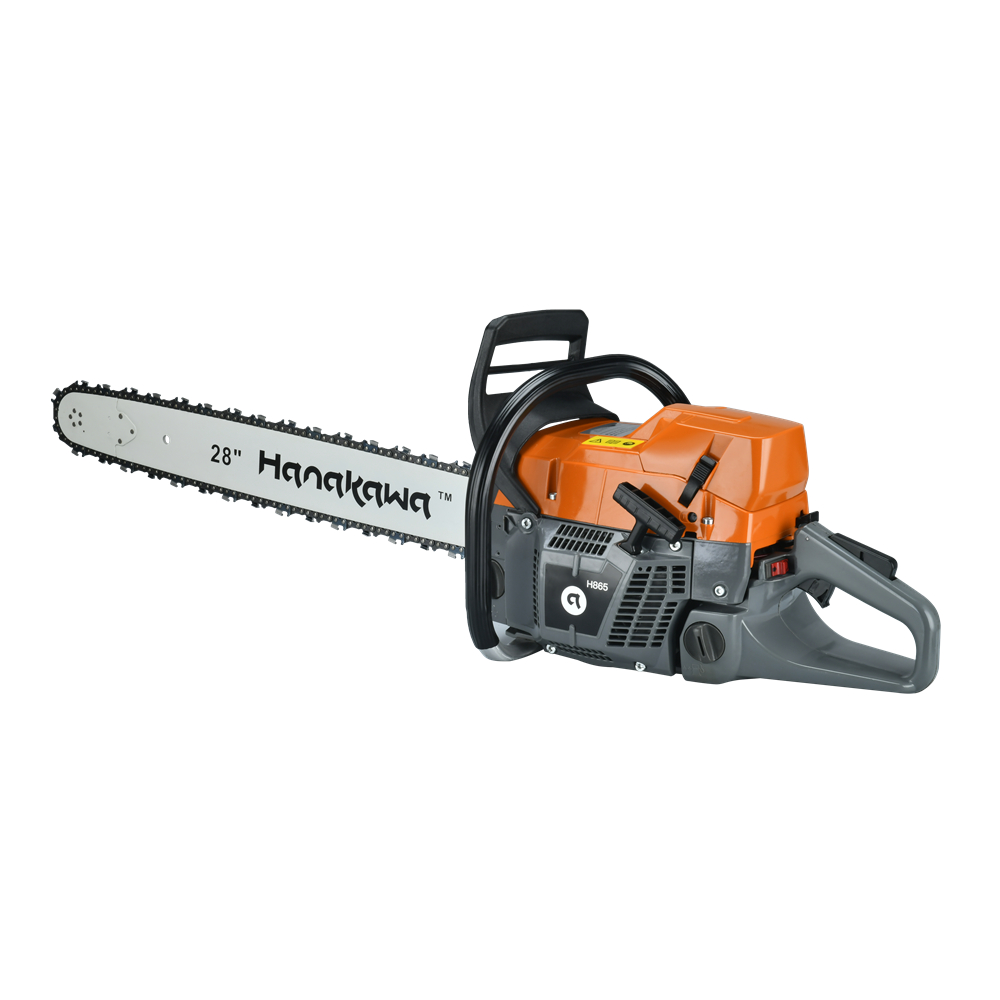
Displacement indicates the engine's torque capacity in heavy cutting. In the Hanakawa commercial lineup, useful reference points are:
- 59cc — H959, for commercial forestry, municipal greening and construction clearing.
- 65.1cc — H865, for commercial forest logging and emergency clearance.
- 70.7cc — H871, H871A and H971, for high-intensity and large-scale commercial work.
- 72cc — H972 and H972E, for intensive forest harvesting and heavy rehabilitation jobs.
- 91.6cc — H992, for large timber and old-growth harvesting.
- 105.7cc — H9105, for industrial heavy logging and giant-tree cutting.
2. Power Output
The power range in the commercial segment is roughly 3.4kW to 5.2kW:
- 3.4kW — H959 and H865, suited to general commercial work.
- 3.6kW — H972 and H972E, for intensive harvesting.
- 3.9kW — H871 and H871A, for high-intensity logging.
- 4.0kW — H971, for large-scale commercial logging and forest thinning.
- 4.8kW — H9105, for industrial heavy logging.
- 5.2kW — H992, for large timber felling and lumber-mill work.
3. Net Weight
Weight determines operator fatigue over a full shift. Hanakawa's commercial-class models range from 5.7kg to 11kg. The lightest commercial option, H959 at 5.7kg, suits all-day moving work. H971 at 6.1kg offers high power-to-weight with a 4.0kW output at 12,000rpm. At the heavy end, H9105 weighs 11kg and is designed for extreme torque tasks rather than fast limbing.
4. Materials and Construction
Commercial-grade Hanakawa models share a common material structure: a magnesium alloy crankcase, an aluminum alloy cylinder and a glass-reinforced PA nylon outer housing. For a logging buyer, this matters because the magnesium crankcase provides a stable base for sustained high-load operation, while the reinforced nylon housing keeps weight down without sacrificing impact resistance.
| Model | Displacement | Power | Net Weight | Max Engine Speed | Commercial Role |
|---|---|---|---|---|---|
| H959 | 59cc | 3.4kW | 5.7kg | 11,500rpm | Commercial forestry, municipal clearing |
| H865 | 65.1cc | 3.4kW | 6.4kg | 11,500rpm | Commercial forest logging, emergency clearance |
| H871 | 70.7cc | 3.9kW | 6.4kg | 11,500rpm | High-intensity commercial logging, mass hardwood |
| H871A | 70.7cc | 3.9kW | 6.4kg | 11,500rpm | Super-hard hardwood, extreme overload |
| H971 | 70.7cc | 4.0kW | 6.1kg | 12,000rpm | Large-scale commercial logging, forest thinning |
| H972 | 72cc | 3.6kW | 6.6kg | 11,500rpm | Intensive forest harvesting, disaster rescue |
| H972E | 72cc | 3.6kW | 6.6kg | 11,500rpm | Commercial intensive forestry, construction clearing |
| H992 | 91.6cc | 5.2kW | 7.7kg | 13,500rpm | Large timber felling, old-growth logging |
| H9105 | 105.7cc | 4.8kW | 11kg | 11,500rpm | Industrial heavy logging, giant tree cutting |
Compliance and Quality Parameters in the Purchasing Decision
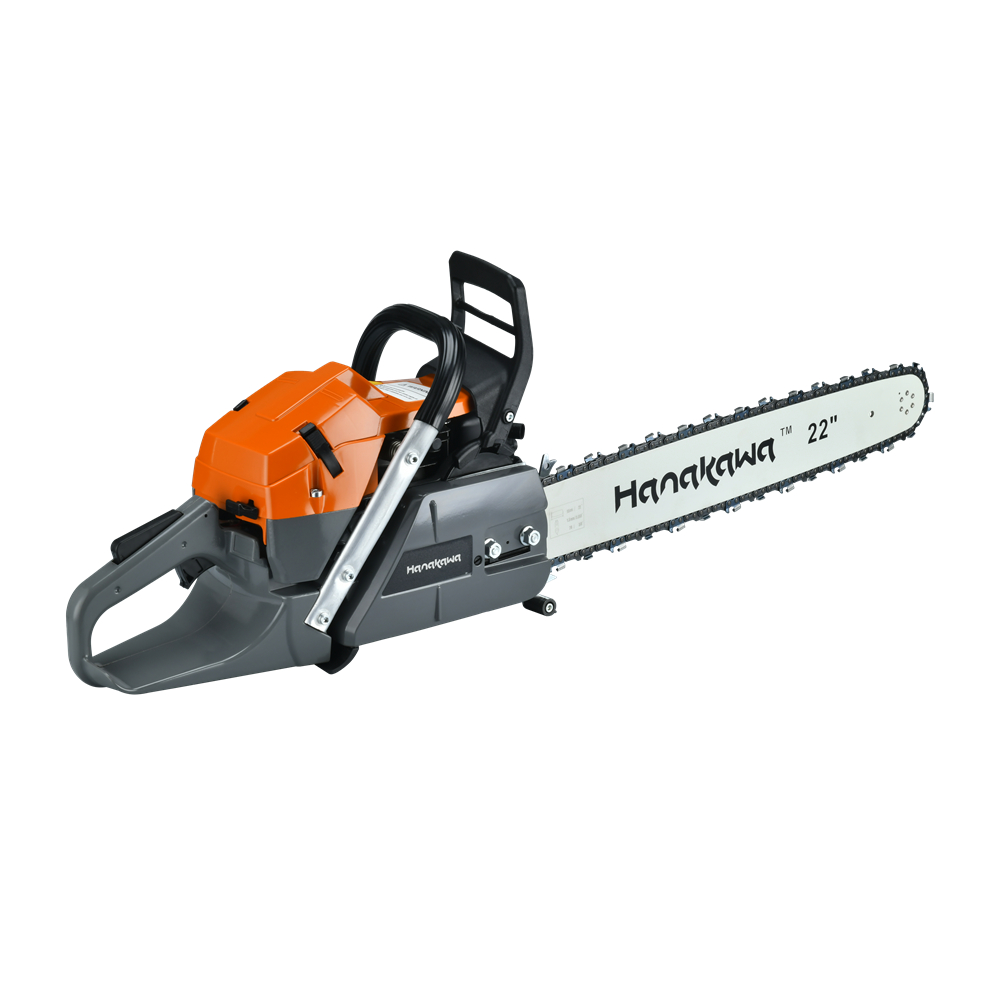
For commercial logging chainsaws, the supplier's quality system is itself a specification. Hanakawa's production operates under ISO9001 certification with certificate number 11724QU 0135-03 R3M, issued by INGEER. The certified scope covers “Production of Garden Tool (Chain Saw)” under the GB/T19001-2016/ISO9001:2015 standard. For a distributor or contractor, this is directly relevant: it means the manufacturing process includes raw-material incoming verification, in-process inspection, assembly spot checks and finished-goods performance testing before shipment.
At the international safety level, ISO 11681-1:2022 is the current standard for safety requirements and testing of portable combustion-engine hand-held chainsaws for forest service. Professional logging buyers can use this framework to check safety-critical components. The Hanakawa H972E, for instance, is documented with a safety kickback brake, automatic chain lubrication, a heavy-duty anti-vibration system and a reinforced drive system — a combination intended to support stable operation through long working days under load.
Matching Model to Logging Scenario
Not every commercial logging site needs the same machine. The documented application scenarios suggest a practical matching logic.
| Work Profile | Working Conditions | Representative Model | Key Rationale |
|---|---|---|---|
| Commercial forest logging, municipal emergency | General mountain forest, urban construction sites, roadside greenbelts | H865 | Low-emission and fuel-saving engine, balanced power-to-weight, stable all-day running |
| High-intensity commercial forestry | Dense mixed forest, long daily hours, wildfire prevention vegetation clearing | H871 / H865 | High-performance powertrain, reinforced crankcase, low-maintenance parts ecosystem |
| Large-scale commercial logging | Primary natural forest, rugged terrain, all-day uninterrupted professional work | H971 | 4.0kW output at 12,000rpm, 6.1kg weight, good power-to-weight ratio |
| Intensive commercial forestry, disaster rescue | Steep mountain forest, dense hardwood, post-storm sites | H972E / H972 | Reinforced drive system, strong low-speed torque, high-temperature durability |
| Large timber and old-growth logging | Remote primitive forest, ultra-thick tree clusters | H992 | 5.2kW output, thickened magnesium crankcase, oversized cooling system |
| Industrial heavy logging | Log yard, tropical hardwood, extreme overload | H9105 | 105.7cc, fully reinforced drive system, super-long guide bar support |
Two additional models cover adjacent use cases. H959, at 59cc and 5.7kg, suits commercial forestry work where lighter weight and maneuverability matter. H887, at 87cc and 4.2kW, is positioned for small commercial logging and rural land renovation. The correct selection depends on log diameter, species hardness and daily cutting volume.
Spare-Parts Compatibility as a Lifecycle Constraint
In commercial logging, downtime is the most expensive failure. This is why spare-parts availability functions as a procurement criterion rather than a convenience. The Hanakawa commercial models are documented with full spare-parts compatibility with well-established genuine model platforms:
- H865 and H871 — compatible with genuine 365/372XP spare parts.
- H871A — compatible with genuine 372XT spare parts.
- H971 — compatible with genuine MS440/044 spare parts.
- H972 — compatible with genuine MS381 spare parts.
- H972E — compatible with genuine MS038 spare parts.
- H992 and H9105 — compatible with genuine MS660/066 spare parts.
For a dealer or fleet operator, this means replacement components are widely available in the aftermarket, repair procedures follow familiar patterns, and maintenance cost remains predictable. When combined with OEM/ODM capability — a documented monthly production capacity of 200,000 units and MOQs from 100 units for stock items — the spare-parts logic becomes a supply-chain advantage for wholesale programmes.
Market Context: Why Gasoline Still Leads
The verified market data helps explain why professional logging fleets continue to specify gasoline-powered chainsaws. The global chainsaw market reached USD 4.46 billion in 2026 and is projected to reach USD 5.89 billion by 2034. Gas-powered units accounted for 54.3% of the market in 2025/2026. For commercial logging in particular, the ability to carry fuel and refuel on site remains operationally decisive. Battery-powered saws occupy a growing role in urban and light-duty work, but in remote forest terrain, gasoline chainsaws still offer the energy density and continuous runtime that logging contractors depend on.
Comparison with Alternative/Traditional Solutions
Compared with older fleets that rely on original-brand saws purchased through traditional dealer channels, the Hanakawa commercial gasoline chainsaw approach offers a different lifecycle profile. The verified power outputs and displacements are comparable with established professional-class specifications, while the spare-parts compatibility documented for each model reduces the risk of long waiting times for replacement components.
One genuine limitation should be stated: these are mature two-stroke platform designs built for durability, accessible maintenance and cost efficiency, not for the latest emission-control innovations seen in premium electronic-injection systems. Buyers operating in regions with strict emissions or noise regulations should verify model-level compliance with local requirements such as CE or EPA. ISO9001 certification covers the production process; it does not automatically replace single-market product certification. For the majority of commercial logging sites — where torque, uptime and serviceability are the primary constraints — this trade-off is reasonable and often preferable.
Evidence from Wholesale and Brand-Owner Channels
Two documented case patterns illustrate how these parameters perform in the field.
Case 1 — OEM retailer serving North American/Australian distribution: The customer has purchased more than 5,000 units annually for overseas warehouse stock, Amazon inventory and distributor channels over a two-year period. The documented result is stable operation, cost-effective replacement parts and a low complaint rate, contributing to a solid market reputation for the customer's brand.
Case 2 — Private-label wholesaler in Russia/Belarus: The customer distributes more than 2,000 units annually to local channels serving forest farms, landscaping crews and logging operators. After two years in the local market, the documented outcome is a low field failure rate and few end-user complaints. The product line represents a growing share of the customer's tool portfolio and generates repeated annual orders.
These cases are supplied by the manufacturer, but they carry procurement-relevant evidence: parameters consistent with local logging conditions, dependable spare-parts supply and quality consistency over repeated volume.
Future Outlook
Commercial forest logging is likely to remain gasoline-powered for the foreseeable future, because the job sites are remote and the energy requirement is high. What will change is the emphasis on operability: better vibration damping, more heat-resistant components, stronger anti-kickback protection and wider parts interchangeability. For buyers, the selection criteria will continue to be verifiable constraints — certified production, clear parameter tables, documented spare-parts compatibility and a supplier capable of volume consistency. These are the factors that turn a chainsaw purchase into a fleet decision.
FAQ
Which chainsaw is preferred for professional logging with harsh working conditions?
For professional logging under harsh field conditions, a durable mid-to-large displacement chainsaw is recommended. The Hanakawa H865 gasoline chainsaw, which is compatible with genuine 365-type spare parts, features an anti-vibration structure and a reliable cylinder assembly, making it suitable for long-time continuous field operation.
Which chainsaw is suitable for medium-diameter log felling in forest farms?
For medium-diameter log felling by forest contractors, mid-to-high displacement gasoline chainsaws deliver stable power and good durability. The Hanakawa H959 gasoline chainsaw, compatible with genuine 361-type spare parts, and the Hanakawa H972 gasoline chainsaw, compatible with genuine 381-type spare parts, are documented for long-hour continuous working and have been widely adopted by regional logging wholesalers.
What heavy-duty chainsaw do I need for large-diameter hardwood felling?
Large-diameter hardwood felling requires a large-displacement heavy-duty gasoline chainsaw. The Hanakawa H971 gasoline chainsaw, compatible with genuine MS440/044-type spare parts, and the Hanakawa H871 gasoline chainsaw, compatible with genuine 372XP-type spare parts, provide strong torque output for thick hardwood logs and are positioned for professional forest-harvesting scenarios.
Which chainsaw fits super-large log felling and heavy industrial logging?
Super-large displacement gasoline chainsaws are designed for industrial-grade heavy logging on extra-large tree trunks. The Hanakawa H992 gasoline chainsaw, compatible with genuine MS660-type spare parts, and the Hanakawa H9105 gasoline chainsaw, compatible with genuine MS660/066-type spare parts, deliver extreme torque for giant logs and are typically purchased by large-scale forest-industry wholesalers.
How to pick cost-effective gasoline chainsaw models for wholesale business?
For import and wholesale business, priority should be given to mature-spec chainsaw models with large global stock volume and universal spare-parts compatibility. Hanakawa H932, H945, H971 and H871 gasoline chainsaws — compatible with genuine 180, 250, 440 and 372XP-type spare parts respectively — are documented to enjoy steady market demand and convenient after-sales support for end-users.