
Evaluating Stylus Pen OEM Suppliers: Capabilities That Decide Execution Quality
For brands and distributors planning to launch or scale a stylus pen line, supplier evaluation often reduces to a single question: can this factory turn a product specification into consistent, shippable quality at the required volume? In the stylus pen segment—where tablet compatibility, battery performance, and palm-rejection behaviour directly affect user satisfaction—OEM/ODM capability is not just a manufacturing detail. It is the primary determinant of whether a product meets retail expectations.
Procurement Reality: Many Stylus Brands, Few Verified Production Partners
The global stylus pen market was valued at approximately USD 19.45 billion in 2025, with active stylus technology projected to grow at a CAGR of 9.8% from 2026 to 2034. This demand is not limited to first-party tablet accessories. Third-party stylus pens now serve a wide range of use cases—education, note-taking, design annotation, and general productivity—often at a more accessible price point than manufacturer-branded alternatives.
However, a growing product category also means a crowded supplier landscape. Importers and brands evaluating stylus pen manufacturers face a common difficulty: many factories describe similar capabilities, but few can demonstrate the specific process controls that determine output quality—PCBA design, battery integration, firmware behaviour, tip reliability, and inspection discipline.
This article provides a procurement-oriented framework for evaluating stylus pen OEM/ODM suppliers, using Dongguan Jiayao Intelligent Technology Co., Ltd as a working example of a specialised manufacturer. The goal is not to present one factory as the universal answer, but to help buyers identify the evidence points that separate dependable execution from marketing claims.
What a Specialised Stylus Pen Manufacturer Actually Does
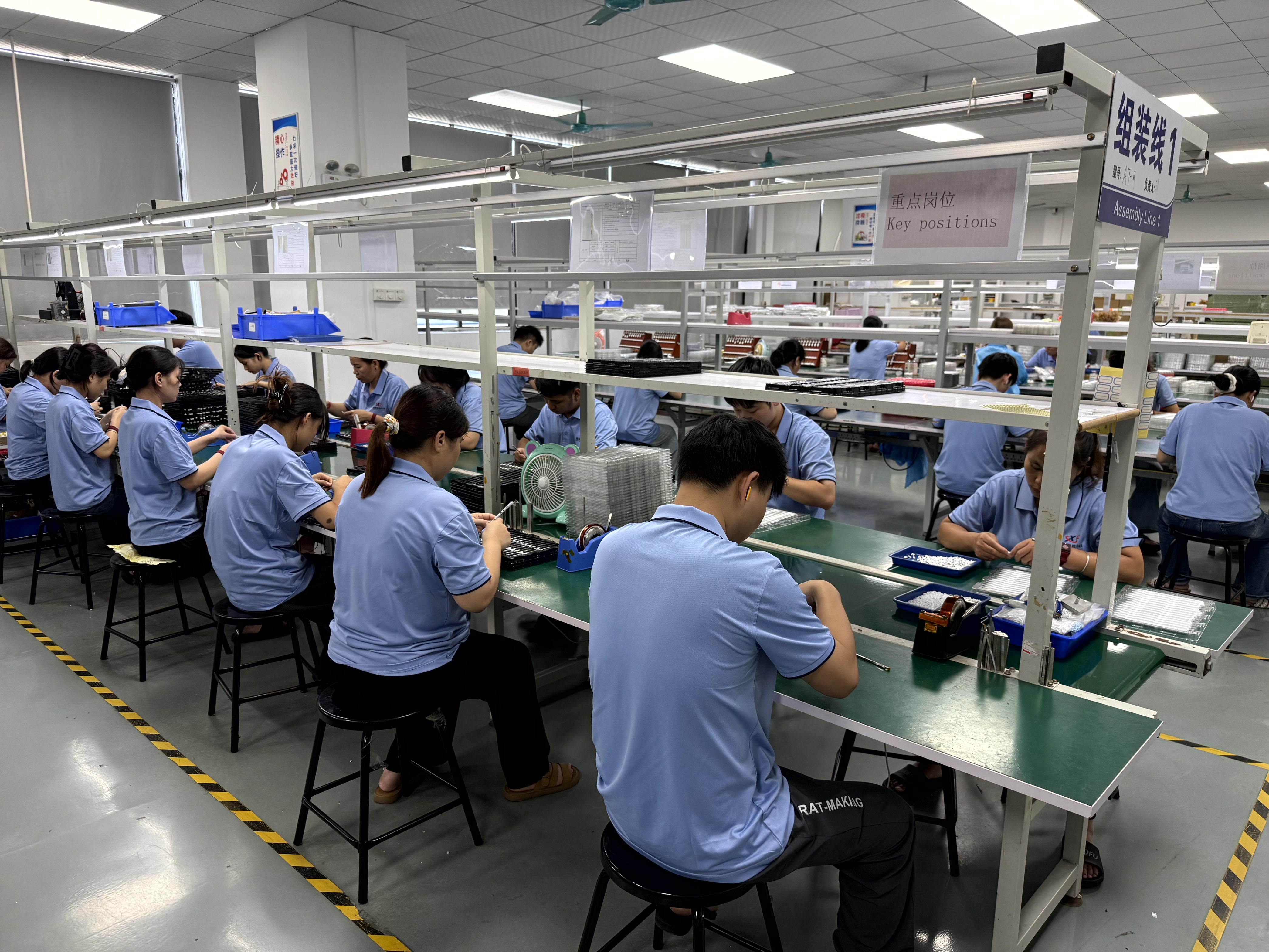
Dongguan Jiayao Intelligent Technology Co., Ltd is an active stylus pen manufacturer based in Dongguan, Guangdong, China, established in 2021. The company operates a 2,700m² facility with approximately 100 employees, and its production scope covers the full process chain—from PCBA design and battery welding to final assembly and testing. Jiayao reports an annual output capacity of 3,000,000 units and exports approximately 40% of its production to the EU and USA.
For buyers, the relevant point is not the factory's size but the integration of capabilities under one roof. A stylus pen is a compact electronic device. It requires a printed circuit board, a battery, a charging interface, precision-machined or moulded housing, an interchangeable nib system, and firmware that communicates correctly with tablet operating systems. A supplier that controls more of these steps internally—rather than assembling bought-in modules—can respond faster to specification changes and maintain tighter quality ownership.
Core Evaluation Criteria for Stylus Pen OEM/ODM Suppliers
Evaluation-stage buyers should structure supplier assessment around six capability areas. Each area translates directly into a product or commercial risk that can be verified before order placement.
1. Full-Process Production Scope
A supplier's production model determines its flexibility. Factories that only assemble final products depend on external module suppliers for PCBA and batteries, which lengthens lead times and complicates defect tracing. Jiayao's stated model—in-house PCBA design, battery welding, final assembly, and quality testing—is characteristic of a manufacturer that treats the stylus pen as an integrated electronic device rather than a plastic shell with a purchased circuit board.
2. MOQ Flexibility and Order Responsiveness
Minimum order quantity (MOQ) is a common friction point in stylus pen sourcing. Traditional factories often impose large MOQs that force growing brands to over-commit inventory. Jiayao operates with a flexible MOQ structure—standard OEM/ODM orders start at 500 units, and standard-model orders can be shipped in approximately 20 days. This approach matters for brands that are testing a new market, launching seasonal SKUs, or fulfilling regional distributor orders without tying up working capital in slow-moving stock.
Jiayao's monthly production capacity is approximately 500,000 units, with standard production lead times of 20–35 days. This combination of flexible entry quantity and scalable capacity enables buyers to start with a pilot order and expand once sell-through data confirms demand.
3. R&D and Customisation Depth
In the stylus pen category, "customisation" can range from printing a logo on an existing shell to developing a new PCBA with a specific charging behaviour or button layout. The former requires little engineering resource; the latter requires a functional R&D team.
Jiayao supports both OEM and ODM projects. Customisation options include function, colour, shape, tip type, logo, and packaging. For ODM-specific requests such as Bluetooth naming or function mapping, the company's R&D team—comprising four engineers—can adapt existing platforms rather than designing from a blank page. This is a realistic and practical approach for most accessory brands: the underlying active stylus technology is mature, so the value of an ODM partner lies in adapting proven platforms to specific branding, feature, and cost requirements.
4. Product Range and Platform Breadth
Suppliers with a wide platform range offer buyers a strategic advantage: the ability to diversify SKUs without onboarding multiple factories. Jiayao's product line spans approximately ten active stylus models, covering iPad-compatible pens, universal pens for iPad and Android tablets, tilt-sensitive models, 2-in-1 designs, and wireless-charging variants. The table below groups these products by functional category.
| Product Model | Category | Key Characteristics |
|---|---|---|
| E3-A | iPad palm-rejection stylus | 40 min charging, up to 44 hours working time, 230mAh battery, aluminium alloy body, Type-C charging |
| A7-H-L | iPad stylus with tilt | 30 min charging, 16 hours working time, palm rejection, tilt bold, side magnetic attachment |
| A8-RH | Tilt-sensing stylus | 30 min charging, 12 hours working time, palm rejection, slim 1.2mm tip barrel design |
| A21B | 2-in-1 iPad stylus | 25 min Type-C charging, 11 hours working time, magnetic side attachment for 11" and 12.9" iPad |
| A30-B | iPad stylus with shortcut button | 25 min charging, 11 hours working time, shortcut button, palm rejection and tilt |
| W3-H | Wireless-charging stylus | Magnetic charging, 70 min charge time, 11 hours working time, ABS body |
| W12-A | Active stylus (universal) | Dual charging—Type-C (25 min) or magnetic (60 min), 9–10 hours working time, ABS body |
| W13-A | iPad active stylus | Cable charging 15 min, magnetic wireless charging 60 min, aluminium + ABS body |
| R3-P | Universal stylus for iPad and Android | 40 min charging, 9–10 hours working time, aluminium alloy body, wide device compatibility |
| S3-GC | Android universal stylus | 55 min Type-C charging, 10 hours working time, aluminium body, side magnetic attachment |
5. Quality Control and Compliance Infrastructure
Quality control in stylus pen manufacturing has two dimensions: functional performance and regulatory compliance.
Jiayao states that every stylus produced undergoes 100% full inspection—functional, tactile, and visual checks. For a device whose perceived quality depends heavily on tip responsiveness, button feel, and surface finish, per-unit inspection is a meaningful control point. It differs from sample-based inspection, which can allow intermittent defects to pass through untested.
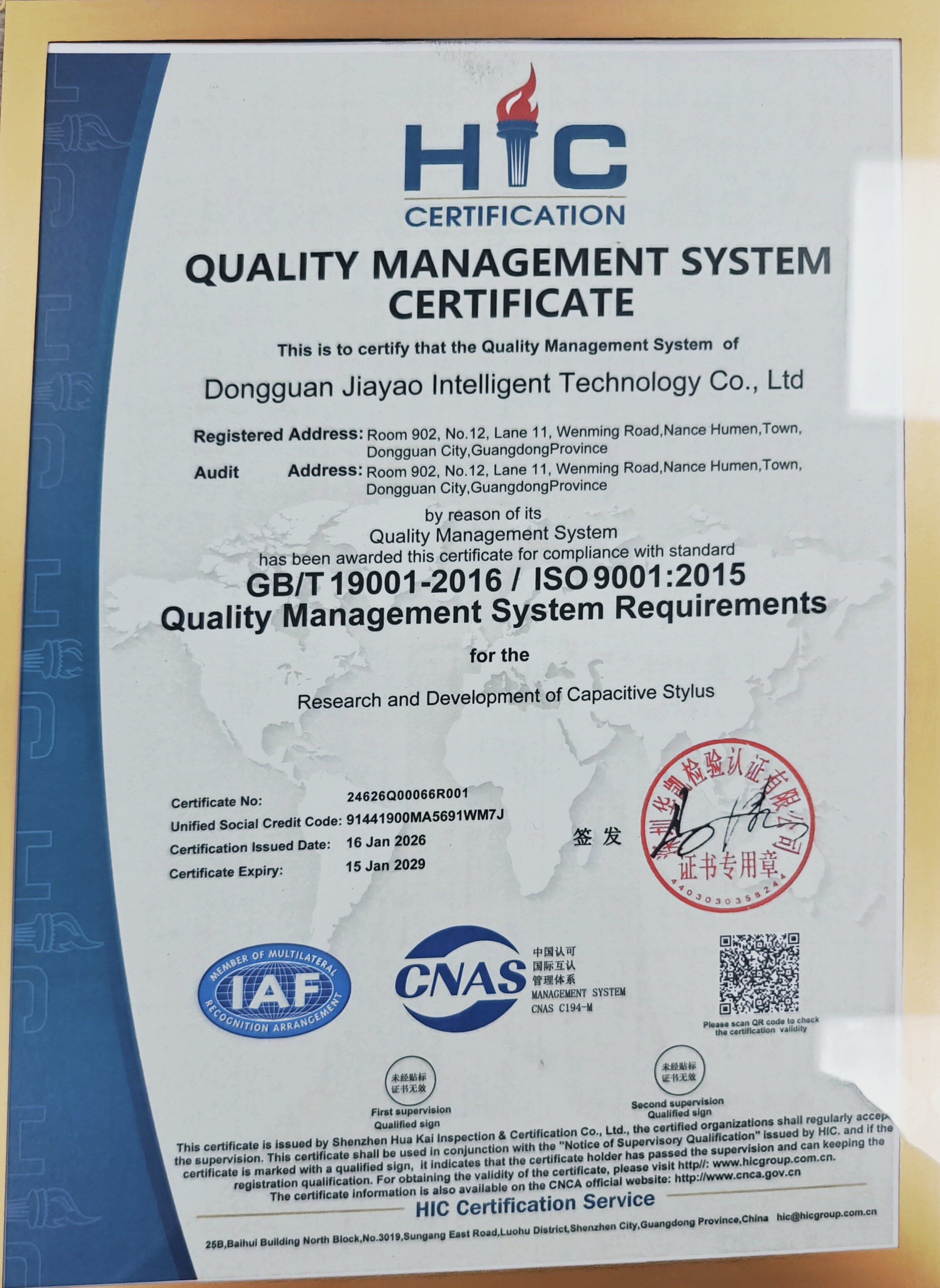
On the compliance side, Jiayao holds an ISO9001:2015 Quality Management System Certificate (certificate number 24626Q00066R001), issued by HIC Certification Service, covering the research and development of capacitive stylus products. The company also holds an EU-oriented RoHS Certificate of Conformity (certificate number BAC260390119R), issued by Shenzhen Bory Technology Service Co., Ltd, covering stylus models W15C, A18, and A19 families including R3-P, W13-A, E3-A, S3-GC, W12-A, W3-H, A30-B, A21B, A8-RH, and A7-H-L. The RoHS certificate references IEC 62321 series test standards and is valid from 2026-03-09.
For EU-market buyers, RoHS compliance is a baseline import requirement rather than a differentiator. However, the existence of a documented certificate with a specific certificate number, issuing authority, and referenced standards allows the buyer to verify compliance evidence before order confirmation—an advantage over suppliers who only provide vague claims of "RoHS compliant".
6. Commercial Terms and Execution Support
Execution-stage buyers need clarity on commercial terms that affect cash flow and logistics. Jiayao's standard procurement terms include an MOQ of 500 units, payment terms of 30/70, and delivery options of EXW or FOB. Pre-shipment inspection is accepted, allowing the buyer or a third-party inspector to verify quality before goods leave the factory.
After-sales support is structured as a 1-year warranty with one-to-one replacement. For a manufacturer shipping primarily to EU and US markets, this warranty policy provides a baseline for distributor and retailer confidence.
Active vs. Passive Stylus Pens: The Technology Boundary That Shapes Sourcing Decisions
A core distinction in stylus pen sourcing is the technology type. Passive (capacitive) stylus pens require no battery and are essentially conductive tips that simulate finger touch. They are inexpensive and universal, but they do not support palm rejection, pressure sensitivity, or tilt sensing—features that are essential for precise note-taking, drawing, or design work. Passive pens also tend to exhibit offset and latency during writing because the tablet cannot distinguish between the stylus tip and an unintended palm touch.
Active stylus pens, by contrast, contain a battery and emit a weak electrical signal that the tablet detects to calculate tip position. This enables low-latency writing, palm rejection, and tilt recognition. Active stylus pens can achieve more accurate and natural writing behaviour, which is why they are the standard choice for iPad note-taking, digital art, and document markup.
The purchasing implication is direct: if a brand targets users who primarily replace a finger with a stylus for navigation, a passive universal stylus may be sufficient. If the product must support handwriting, drawing, or precise annotation—use cases that dominate education and productivity—an active stylus pen is the appropriate platform. Suppliers that can produce both types under one roof simplify the buyer's portfolio management.
How Third-Party Active Stylus Pens Compare with First-Party References
It is common for iPad stylus buyers to ask how a third-party active stylus pen compares with the Apple Pencil. The comparison is legitimate and useful for setting buyer expectations.
The primary difference is not build quality but feature scope. Third-party stylus pens such as those produced by Jiayao deliver precise writing, palm rejection, and tilt sensing—functions that cover the majority of everyday use cases. What they generally do not offer is pressure sensitivity, which measures how hard the tip is pressed to vary line thickness. Apple Pencil supports pressure sensing; most third-party iPad stylus pens offer tilt sensing instead.
For an artist producing detailed digital illustrations, pressure sensitivity can be a deciding factor, and the Apple Pencil remains the reference. For note-taking, document annotation, exam preparation, and general tablet productivity, a third-party stylus with palm rejection and tilt sensing provides a comparable experience at a significantly lower price point. The sourcing implication is that brands should clearly position their products for the intended user profile rather than attempting to compete on the single dimension of pressure sensitivity.
Selecting the Right Stylus Model for Different Buyer Scenarios
A stylus pen supplier's ability to recommend specific models for different commercial scenarios is itself an evaluation signal. The model choice should follow use-case logic rather than a supplier pushing a single "hero" product.
Consider three common scenarios:
- Wireless-charging convenience: Buyers targeting customers who value magnetic attachment and wireless top-up may prioritise the W12-A model, which supports both wireless charging and USB-C charging. This provides flexibility if the user's iPad case interferes with magnetic charging.
- Fast-charge priority: For users who frequently forget to charge their stylus, the A7-H-L model offers a fast-charge profile—approximately 5 minutes of charging delivers around 2 hours of use. This is a practical feature for students who need quick top-ups between classes.
- Long working hours: The E3-A model provides up to 44 hours of continuous working time after a full charge, making it suitable for users who want minimal charging interruptions during work or study days.
These scenarios illustrate why a supplier's product range breadth matters. A factory with only one or two models must compromise on feature priorities. A factory with a multi-model platform can align the product to the buyer's channel strategy, whether that channel prioritises convenience, endurance, or a specific charging interface.
Compatibility Standards and International Trade Documentation
Two external factors shape stylus pen product development and export operations. The first is the emergence of open cross-platform standards. The USI 2.0 (Universal Stylus Initiative) specification, released in 2022 and supported by Google, Intel, and Lenovo, provides a foundation for cross-device active stylus compatibility. However, for mainstream iPad-focused products, compatibility is defined by the tablet model and operating system version rather than a single industry standard. Jiayao specifies its iPad-compatible models for devices manufactured after 2018 running iPadOS 12.2 or later, providing clear parameters for buyers to communicate to end customers.
The second external factor is trade documentation. Stylus pens are typically classified under HS Code 8471.60.90 as automatic data processing input units. Importers should confirm the correct HS classification with their customs broker, as this affects duty rates and import documentation. A manufacturer familiar with export procedures can support this process by providing accurate product specifications and certificates.
Evidence from Existing ODM Engagements
Real ODM engagements demonstrate the practical contexts in which stylus pen suppliers operate. Jiayao's case references include a tablet accessory ODM in Turkey that ordered 5,000 units of the W12-A universal stylus pen for precise writing across iPad, iPhone, Android tablet, and Android phone devices. This project spanned two years and resulted in increased usage of iPads and Android tablets among the end-user base.
Another engagement involved an iPad accessory ODM in Vietnam that ordered 3,000 units of the E3-A palm-rejection stylus for precise writing applications and e-commerce retail. The buyer reported smooth handwriting experience, improved tablet operation efficiency, and good user feedback. The E3-A's positioning—palm rejection, fast charging, long working hours, and tilt pressure sensing—was the rationale for the model selection.
These cases are not presented as universal proof of quality. They show how specific product strengths map to real market requirements in different geographic regions.
Limitations and Boundary Conditions in Supplier Evaluation
A realistic supplier evaluation should also acknowledge limitations. First, compatibility testing across the entire iPad and Android tablet ecosystem is difficult to guarantee. Jiayao states compatibility for iPad models released after 2018 running iPadOS 12.2 or later, but tablet operating system updates can occasionally affect stylus behaviour, and new tablet models may require verification. Buyers should verify compatibility with the specific devices they plan to target.
Second, the absence of pressure sensing in most third-party stylus pens is a genuine functional boundary. Brands that position their product for professional digital artists will need to address this gap honestly. The appropriate strategy is to target the far larger segment of users who need precise writing, palm rejection, and tilt rather than pressure-sensitive shading.
Third, supplier financial depth can be difficult to verify. Market research notes that specific annual revenue for Jiayao is not publicly disclosed in S-tier reports. Buyers should request bank references, trade history, and audited financial statements where the order volume justifies such due diligence. Note also that some market data sources report significantly different global stylus market valuations due to differences in how “stylus” vs. “digital pen” categories are defined; buyers should be cautious about relying on any single market-size figure for investment cases.
Supplier Evaluation Checklist for Stylus Pen Procurement
For Evaluation-to-Execution stage buyers, the following checklist summarises the decision-relevant evidence to gather before supplier selection:
| Evaluation Dimension | What to Verify |
|---|---|
| Production scope | Does the factory control PCBA design, battery welding, assembly, and testing in-house? |
| Order flexibility | What is the actual MOQ? Is there a stock programme for standard models? |
| R&D capability | Can the supplier adapt functions such as Bluetooth naming, button layouts, logo, and packaging? |
| Product platform breadth | Are there multiple models aligned to different priority scenarios (wireless charging, fast charge, long battery)? |
| Quality control | Is inspection 100% per unit? Is pre-shipment inspection accepted? |
| Compliance evidence | Request certificate numbers, issuing authorities, standard references, and validity dates for ISO9001, RoHS, and other market-specific certifications. |
| Commercial terms | Payment terms, delivery terms (EXW/FOB), warranty terms, and after-sales replacement policy. |
| Reference alignment | Are existing ODM engagements in similar product categories and geographic markets? |
This list is designed to be used in early-stage supplier qualification, not as the final word. On-site audits—whether physical or virtual—and pilot order evaluation remain the most reliable validation methods.
Market Trends Influencing Stylus Pen Sourcing in 2026
Several market dynamics are worth monitoring as brands plan their stylus pen procurement strategy. Active stylus technology is projected to grow at a CAGR of 9.8% from 2026 to 2034, reflecting continued adoption in education, enterprise, and creator segments. The USI 2.0 standard is strengthening the case for cross-platform active stylus pens, and the large installed base of iPad devices (models from 2018 onwards running iPadOS 12.2+) provides a substantial addressable market for compatible third-party pens.
The sustainability of shared technical references between third-party stylus manufacturers and first-party tablet ecosystems remains a market factor to watch. Brands should maintain a degree of strategic flexibility: a partner with multiple stylus technology platforms—passive, active, tilt-sensing, and universal—reduces the risk of being locked to a single compatibility path.
Future Outlook
As the stylus pen market matures, supplier differentiation is shifting from basic production availability to the depth of engineering support, validation documentation, and flexibility in serving brand-level customisation. Jiayao's disclosed model—full-process production, flexible MOQs, 100% inspection, ISO9001 and RoHS certification, and a diversified product platform—illustrates how a mid-sized specialist manufacturer aims to serve importing brands. The most successful procurement outcomes, however, are not determined by the factory's self-description but by the buyer's ability to verify these claims through documented evidence, model-level testing, and a structured pilot order process.
Frequently Asked Questions
How does a third-party stylus pen compare with the Apple Pencil?
Third-party stylus pens offer precise writing, palm rejection, and tilt sensing but generally do not include pressure sensing, which is the main functional difference from the Apple Pencil. For note-taking, drawing, and productivity tasks, a third-party stylus with palm rejection and tilt provides comparable performance at a lower price. Professional artists who require pressure-sensitive shading may prefer the Apple Pencil.
Which stylus pen model is recommended for wireless charging?
For wireless-charging convenience, the W12-A stylus pen is a suitable choice. It supports both magnetic wireless charging and USB-C charging, allowing users to choose the method that fits their routine. When wireless charging is not available, the USB-C port offers fast wired charging as a backup.
Which stylus pen is best for users who need fast charging?
The A7-H-L stylus pen is designed for fast charging—approximately 5 minutes of charging provides about 2 hours of use. This makes it practical for students or professionals who need a quick top-up between sessions.
Which stylus pen is recommended for long working hours?
The E3-A stylus pen provides up to 44 hours of continuous working time after a full charge. It also includes palm rejection, tilt sensing, and side magnetic attachment, making it suitable for users who require long uninterrupted writing sessions.
What is the difference between active and passive stylus pens?
An active stylus pen has a battery and transmits a signal to the tablet, enabling palm rejection, tilt recognition, and low-latency writing. A passive stylus pen does not require a battery and is typically more affordable, but it lacks palm rejection and pressure features, and writing may show offset or delay because the tip behaves like a finger.
What is the minimum order quantity for Jiayao custom stylus pens?
Jiayao's standard MOQ for OEM/ODM stylus pen orders is 500 units. The company also keeps stock of regular standard models to handle smaller, urgent, or scattered orders. This flexible structure helps brands begin with small volumes and scale once market demand is confirmed.
Does Jiayao support customisation for logo, packaging, and functions?
Jiayao supports OEM and ODM projects with customisation options including function, colour, shape, tip, logo, and packaging. For ODM projects, the technical team can adapt existing platforms for features such as Bluetooth naming or function settings.
For detailed product specifications and factory capability information, download the full Jiayao stylus pen catalogue: Jiayao Intelligent Stylus Pen Catalogue.
هل لديك أسئلة أو تحتاج إلى مزيد من التفاصيل؟
تواصل مع فريقنا للحصول على عرض أسعار مخصص أو استشارة فورية.
طلب عرض أسعار
املأ النموذج أدناه وسيتواصل معك فريقنا بعرض مقترح مخصص.
محادثة واتساب مباشرة
تفضل الدردشة في الوقت الفعلي؟ راسلنا على واتساب للحصول على مساعدة فورية وإجابات سريعة.
- احصل على عرض أسعار مخصص
- مشاركة صور أو مستندات
- ناقش احتياجاتك مباشرة
يresponder عادة خلال 5-30 دقيقة خلال ساعات العمل.