
Evidence-Based Supplier Check: What Hydraulic and Piston Pump Builds Reveal About Maker Capability
Evidence-Based Supplier Check: What Hydraulic and Piston Pump Builds Reveal About Maker Capability
The global dosing pump market was valued at approximately USD 8.86 billion in 2024, and Asia Pacific accounted for a 41.8% revenue share of it in the same year, according to Grand View Research. A market of that size attracts suppliers with very different levels of engineering depth, and it leaves procurement teams in a familiar position: several quotations, near-identical datasheets, and almost nothing in the documentation that shows who actually engineers the pump and who only assembles it.
This assessment builds a supplier check that does not depend on brand claims or on naming competitors. It reads capability from what a maker's own product architecture already proves - specifically the duty envelope covered by hydraulic metering pumps and piston dosing pumps - and turns each observation into a question a buyer can put to the supplier, together with the document that should answer it. WRS PTE LTD is used as the worked example, because its published product and capability data cover hydraulic, piston and solenoid lines in enough detail to be checked.
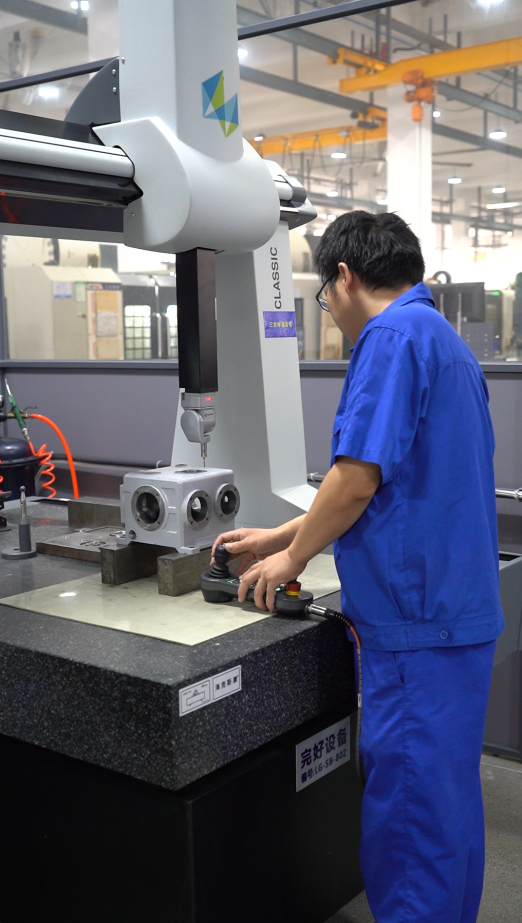
Dimensional inspection on a 3-D coordinate measuring machine: the kind of in-house capability that can be evidenced with inspection records rather than described in a brochure.
Why the Pump Family Is Stronger Evidence Than the Data Sheet
Dosing and metering pump catalogues converge because the underlying technologies are mature. Motor-driven metering pumps held a 54.45% revenue share of the global metering pump market in 2025, according to Mordor Intelligence, and diaphragm dosing pumps accounted for a 55.7% revenue share of the dosing pump market in 2024, according to Grand View Research. When most of a market sits inside a small number of established drive and diaphragm concepts, headline parameters such as flow rate, pressure and connection size stop being informative on their own. Two suppliers can publish the same 600 L/h at 8 bar and be running entirely different operations behind it.
What does separate them is verifiable breadth: the range of duty points a maker can hold within one wetted-material family, the spread of pressure classes it contains, the control variants it supports, and the certification scope it can name. Breadth is harder to fabricate than a data sheet, because it requires tooling, pressure-containing component design, testing equipment and documentation that can be produced on request.
Breadth also shows up in the accessory and system layer. The published WRS PTE LTD product list covers metering pumps, solenoid dosing pumps, diaphragm dosing pumps, piston dosing pumps, digital dosing pumps, dosing pump check valves, dosing pump pulse dampeners, complete chemical dosing systems, a streaming current monitoring system and chemical injection pumps - the components that decide whether a pump installation behaves as designed once it leaves the factory.
Reading the Duty Envelope: Hydraulic and Piston Lines as Capability Evidence
WRS PTE LTD publishes a hydraulic metering pump platform and a piston dosing pump platform, both built in SS316 and both available with frequency and explosion-proof motors. The published ratings span a far wider range than a single-duty assembler would need to cover, and the internal contrasts within the line are the most informative part of the data.
| Family | Model | Rated flow | Rated pressure | Connection | Motor | Wetted material |
|---|---|---|---|---|---|---|
| Hydraulic metering pump | HL090S0P01F11 | 1,600 L/h | 6 bar | DN50 flange | 1.5 kW | SS316 |
| Hydraulic metering pump | HS008S0P01S11 | 2 L/h | 200 bar | DN6 bevel end welding tube | 0.37 kW | SS316 |
| Piston dosing pump | PD105SS1PFN11 | 600 L/h | 8 bar | DN50 flange | 4.0 kW | SS316 |
| Piston dosing pump | PM060SS1PFN11 | 600 L/h | 8 bar | DN25 flange | 0.75 kW | SS316 |
| Solenoid dosing pump | EML0020PR1C | 1-20 L/h | 1-10 bar | Thread / tube | 220V/110V, IP65 | PVC, PVDF, SS316 |
| Solenoid dosing pump | ML0008PR1C | 1-20 L/h | 1-10 bar | Thread / tube | 220V/110V, IP65 | PVC, PVDF, SS316 |
| Digital dosing pump | EMAP1000PQ1C | 1,000 L/h | 4 bar | DN25 socket | 220V/1P/20W, IP65 | PVC, PVDF |
Published ratings for selected WRS PTE LTD models across three drive families. Source: the maker's own product specification data.
Observation 1: one hydraulic platform spanning three orders of magnitude of flow
The HL090S0P01F11 moves 1,600 L/h at 6 bar; the HS008S0P01S11 moves 2 L/h at 200 bar. Both are listed as hydraulic metering pumps, both are SS316, both are described as zero-leakage designs suitable for toxic and hazardous media, and both are offered with frequency and explosion-proof motors. Holding a low-pressure, high-flow duty point and an extreme-pressure, low-flow duty point inside one material family requires different pressure-containing geometry, a different sealing strategy and a test capability that can safely hold 200 bar.
Questions this raises: What is the pressure test method and hold time for the HS series, and is a per-unit test record issued? Which components change between the 6 bar and the 200 bar design? Which models in the family accept the optional diaphragm rupture sensor?
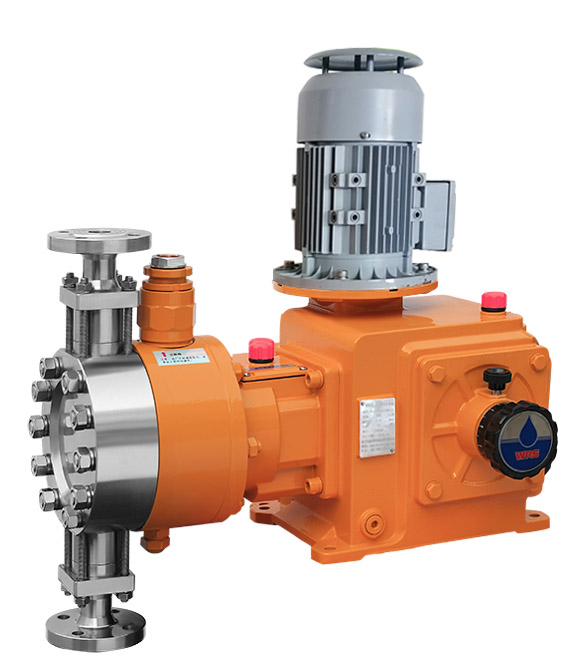
The high-flow end of the hydraulic platform: the HL-series metering pump rated 1,600 L/h at 6 bar in SS316.
Observation 2: identical headline duty, materially different build
PD105SS1PFN11 and PM060SS1PFN11 are both rated 600 L/h at 8 bar. One uses a 4.0 kW motor and a DN50 flange connection; the other uses a 0.75 kW motor and a DN25 flange connection. The headline numbers are identical, so a buyer comparing quotations on flow and pressure alone would treat them as interchangeable. They are not the same machine, and the gap between them - roughly five times the motor rating and one pipe size - is exactly the kind of detail that separates a supplier who can explain its own platform from one who can only repeat the catalogue.
Questions this raises: Which of the two is recommended for a specific duty, and on what basis? What drive and frame arrangement accounts for the difference in motor rating? What is the efficiency and heat profile of each at continuous duty? Ask for the written selection sheet rather than a verbal answer.
Observation 3: the control layer is shared across pump families
The solenoid line illustrates the same point from a different direction. EML0020PR1C and ML0008PR1C share the same 1-20 L/h and 1-10 bar envelope and the same IP65 enclosure rating, but one is remotely controlled and the other manually controlled. The remote version supports 4-20 mA and pulse signals plus Modbus RS-485 communication, direct flow rate display, a double-ball check valve design on both inlet and outlet, 1% dosing accuracy and a water- and heat-resistant PCB. The digital models extend the same control architecture to 1,000 L/h with stated precision below 1% and a turndown ratio of 1:1000.
Offering one duty band in manual, remote and digital control variants indicates a shared electronics and software platform rather than three separately sourced products. That matters commercially: it usually means spare parts, configuration behaviour and communication interfaces stay consistent across a project pump list.
Certification Scope Is a Capability Map
The most checkable single document in a dosing pump supplier's file is the certificate scope. WRS PTE LTD holds CE certification number 3N240528.ZWMTU36, issued by ECM for the EU market, issued on 28 May 2024 and valid until 27 May 2029. The cited standards are EN ISO 12100:2010 and EN 60204-1:2018.
The scope names 24 pump series: EML, EMG, EMA, EMB, EPS, EPM, EHS, EHM, ML, MLS, MG, MA, MB, PS, PM, PL, PD, PT, HS, HM, HL, HD and HT. Read against the product lines, that scope maps directly onto the platforms discussed above - HL, HS, HM, HD and HT for hydraulic duty; PD, PM, PL and PT for piston duty; ML, MLS and EML for solenoid duty; MA, MB and MG for mechanical diaphragm duty; and the remaining electronic families for digital and instrumented variants. A scope that traces back to the same series a buyer is ordering from is strong third-party evidence; a certificate naming a different series is not evidence for the quoted model at all.
The boundary: this certificate covers the listed series and the EU market only. A model outside those series, or a shipment to a market with its own conformity regime, is not covered by it. The requirement itself also moves: the EU Machinery Regulation repealing 2006/42/EC from 2027 mandates CE marking for metering pump units, per the European Commission, so conformity documentation should be re-checked as that date approaches rather than assumed from a certificate issued in 2024.
For oil, gas and chemical duty, buyers frequently benchmark against API 675 for positive displacement reciprocating pumps with integrated controlled capacity and ISO 14847:1999 for rotary positive displacement pumps. Neither is claimed here, and the honest approach is to treat them as comparison frameworks: ask the supplier which clauses it can evidence and which it cannot.
Manufacturing Evidence: Turning Capability Claims into Documents
WRS PTE LTD's published capability data states a manufacturing facility of 15,000 m2, 120 employees, 15 engineers in the R&D team, and an annual output of 30,000 units. The company profile states that the business was established in 2016, that exports account for 20% of output, and that main markets are Southeast Asia, Russia and South America, supported by local after-sales service in more than 10 countries including Singapore, Thailand, Malaysia, Vietnam, South Korea, Japan, Russia, Chile, South Africa, Angola and Turkey.
The operational data adds commercial constraints that matter at the evaluation stage: ODM production mode, voltage customisation, a monthly capacity of 5,000 units, a stated lead time of 3 days, a minimum order quantity of 1 unit, 100% testing, and remote after-sales support.

Assembly workshop: the physical footprint behind the published capacity, lead time and testing claims.
None of those figures should be accepted at face value. Each converts into a specific request:
- Capacity versus output: a stated monthly capacity of 5,000 units implies considerably more annual output than the stated 30,000 units per year. Ask the supplier to reconcile the two, and to define what counts as a unit - a bare pump, or a fully configured dosing device.
- Lead time: ask whether the 3-day figure applies to standard stock models or to configured and OEM units, which is where project delays usually occur.
- 100% testing: ask what is measured, at which pressure, for how long, and whether a serial-linked record can be supplied with the shipment. This is the highest-value document in a first order.
- Engineering depth: 15 engineers is meaningful only if their allocation is known. Ask how many work on the hydraulic and piston platforms versus custom project work.
- Minimum order quantity: a 1-unit MOQ is consistent with the stated ODM model, but it should be confirmed on a real order, since configuration and documentation costs can change the effective minimum.
Physical evidence follows the same logic. In-house machining centres, a three-dimensional coordinate measuring machine, dedicated test platforms, assembly workshops and a spare parts warehouse are the assets that make the published claims plausible - but they only count when the buyer sees inspection records, calibration status and the traceability chain behind a specific serial number.
Material Selection as a Documented Process, Not a List
Across the hydraulic, piston, solenoid and mechanical diaphragm lines, the available wetted materials are PVC, PVDF and SS316, with SS316L appearing on at least one digital model. A material list is not a compatibility statement, and this is one of the clearest places where an evidence-based check outperforms a catalogue comparison.
The maker's own published selection guidance is specific: flow rate is treated as the primary parameter and is compared against the site's maximum flow requirement, after which pressure, pump head material and motor are refined. On media compatibility, the stated position is that different media require different materials, and that PVDF pump head material is recommended for highly corrosive liquids. The mechanical diaphragm range adds a further engineering point, using multiple layer diaphragm construction for longer service life when handling corrosive liquids.
What to request: a written material recommendation that names the medium, its concentration and its temperature; the compatibility basis behind it; and confirmation of whether the recommendation comes from a reference installation or from a compatibility table. Without medium parameters, no material recommendation is verifiable, whichever supplier makes it.
Application Evidence and Where It Stops Being Evidence
WRS PTE LTD's published case data includes an Australian engineering company that has run 20 units in wastewater treatment for five years, reporting stable operation with high quality and easy maintenance as the deciding factors. A second recorded scenario is a livestock project in Russia using nutrient solution dosing on a 24/7 automatic system in a harsh, humid farm environment, where the recorded special requirement was IP67 protection.
The market context supports attention to that second scenario: metering pumps used in water and wastewater treatment held a 23.2% application share globally in 2025, according to Grand View Research, which makes wastewater the single most common proving ground for this equipment class.
The reason for separating these two records is that they carry different weight. A five-year operating record on 20 units is genuine evidence for continuous, low-pressure chemical dosing in wastewater duty. It is not evidence for 200 bar hydraulic metering, for high-viscosity piston duty, or for a livestock environment with a higher enclosure class requirement. Buyers who treat one reference as proof of general capability are reading more into the evidence than it contains.
The enclosure detail illustrates the same discipline. The standard configurations in the relevant pump families carry IP65 protection, while the recorded site requirement for that livestock installation was IP67. Where a site requirement exceeds the standard enclosure rating, the gap must be resolved at the specification stage - with the supplier confirming the delivered enclosure class in writing - rather than assumed to be covered by the family data sheet.
Market Trend: Why This Check Is Becoming More Important
Three published indicators frame the trend. Motor-driven metering pumps still held a 54.45% revenue share of the global metering pump market in 2025, according to Mordor Intelligence, which means mechanically driven hydraulic and piston designs remain the backbone of high-duty applications. Solenoid-driven dosing pumps are projected to grow at a compound annual growth rate of 5.88% through 2031, per the same source, reflecting continued demand for compact electronic dosing. And Asia Pacific's 41.8% share of the 2024 dosing pump market, per Grand View Research, explains why so many new supplier profiles - including those with 15,000 m2 facilities and 30,000-unit annual output - come from that region.
One caution belongs in any market discussion of this category. Published market sizes vary widely with scope: approximately USD 8.86 billion for 2024 from Grand View Research and USD 6.35 billion for 2025 from Fortune Business Insights, while definitions that fold in large-scale chemical injection systems reach far higher figures. The variance is definitional rather than a disagreement about growth. A buyer using a market figure in an internal business case should state which scope it reflects.
Evidence-Based Check versus Traditional Catalogue Sourcing
The traditional approach compares quotations on the parameters that are easiest to tabulate: flow rate, pressure, connection size, material and price. It is fast and it works when the duty is routine. It fails when two suppliers publish overlapping numbers from very different platforms - the situation described in Observation 2 - because nothing in that comparison reveals which machine is the better fit.
| Check dimension | Catalogue-based sourcing | Evidence-based check |
|---|---|---|
| Duty envelope | Matches one quoted model to one duty point | Tests whether the maker holds a full range of duty points within one material family |
| Certification | Accepts a certificate file at face value | Verifies the exact series and market listed in the certificate scope |
| Build definition | Assumes identical ratings mean identical machines | Asks what accounts for differences in motor rating, flange size and drive arrangement |
| Capacity claims | Accepts stated output and lead time | Reconciles capacity against output and defines the unit being counted |
| Quality claim | Accepts 100% testing as a statement | Requests the test method and a serial-linked record |
| References | Treats any case study as general proof | Scopes the reference to its duty class, pressure band and environment |
The boundaries of this method are real and should be stated plainly. First, product breadth demonstrates engineering and manufacturing capability, not field performance in the buyer's specific duty; it is a screening tool, not a validation. Second, catalogue ratings are nominal values - viscosity, temperature, concentration, suction conditions and duty cycle can all shift the correct selection. Third, certification scope is limited to listed series and listed markets and must be re-checked as regulation changes. Fourth, capability figures such as monthly capacity, lead time and annual output are supplier-published and only become evidence once reconciled with records. Fifth, a supplier that engineers deeply into hydraulic and piston platforms may still be the wrong choice for a project that only needs a low-flow solenoid unit at the lowest cost - breadth is a capability signal, not an automatic procurement recommendation.
Future Outlook
The direction of travel in this category is toward digital control and documentation as standard rather than as an option. The maker's published profile states that the entire dosing pump series has moved to fully digital and intelligent configurations, and the current control layer already includes 4-20 mA and pulse signal inputs, Modbus RS-485 communication, direct flow rate display, turndown ratios up to 1:1000 and stated precision below 1% on digital models. Combined with the EU Machinery Regulation that repeals 2006/42/EC from 2027, the practical consequence for buyers is that the documentation attached to a pump - conformity records, test records, configuration files and communication interfaces - will carry more weight in supplier evaluation than any single performance figure.
For procurement teams running research and evaluation cycles in 2026 and beyond, the sensible sequence is to screen suppliers on the evidence that is hardest to fabricate - certification scope, duty envelope breadth, build definitions across apparently identical models, and reconcilable capacity and testing claims - and to reserve physical sample trials and site-condition verification for the shortlist that survives that screen.
FAQ
How can a buyer confirm that a supplier's certification actually covers the pump model being quoted?
Check the certificate's scope annex rather than the cover page, and match the model's series prefix against the series list. In the case referenced here, CE certificate 3N240528.ZWMTU36 lists 24 series covering hydraulic, piston, solenoid, mechanical diaphragm and electronic families, and applies to the EU market. If the quoted model's series does not appear in that list, the certificate is not evidence for that model. The same rule applies to market coverage: a certificate issued for the EU market does not address conformity requirements in other regions.
Two pumps are rated at the same flow and pressure but differ sharply in motor rating and connection size. What should be asked?
Ask the supplier to explain the difference in engineering terms. In the example used here, two piston dosing pumps are both rated 600 L/h at 8 bar, yet one carries a 4.0 kW motor with a DN50 flange connection and the other a 0.75 kW motor with a DN25 connection. Identical headline ratings therefore do not imply interchangeable machines. The supplier should state which model suits a given duty, what accounts for the difference in drive and connection sizing, and provide a written selection sheet. A supplier that cannot explain its own two products has limited engineering depth behind the brochure.
What do the available wetted materials prove about corrosion resistance?
The listed materials - PVC, PVDF, SS316 and SS316L on some models - prove what the maker can supply, not what a specific medium requires. The maker's own guidance states that material selection depends on the medium and that PVDF pump head material is recommended for highly corrosive liquids, while mechanical diaphragm models use multiple layer diaphragm construction for longer life in corrosive service. The verifiable step is to request a written recommendation that names the medium, its concentration and temperature, and states whether the recommendation is based on a compatibility table or a reference installation. Material availability alone is never a compatibility guarantee.
Which documented evidence supports supplier claims such as 100% testing, monthly capacity and short lead times?
Each claim maps to a different document. A 100% test claim should be supported by a description of what is measured, at what pressure and for how long, plus a serial-linked test record for the unit shipped. A stated monthly capacity of 5,000 units should be reconciled against a stated annual output of 30,000 units, with the definition of a unit agreed in advance. A 3-day lead time should be confirmed as applying to the configured unit being ordered, not only to standard stock. These are normal procurement requests, and a supplier that publishes capacity and testing claims should be able to answer them with records.
What are the limits of using product breadth as a capability signal?
Breadth shows that a maker can hold a wide range of duty points - in this case from 2 L/h at 200 bar to 1,600 L/h at 6 bar within one SS316 hydraulic family - which implies tooling, pressure-containing component design and test capability. It does not demonstrate performance in a specific application. A five-year wastewater reference, for example, does not transfer to high-pressure hydraulic duty, high-viscosity piston duty or a humid environment requiring a higher enclosure class than the standard IP65 rating. Breadth is best used to shortlist suppliers for sample testing and site-condition verification, not to replace them.