
Evidence of Capability: Inside Tuoda's 30,000 m² Plant for 10,000 psi Cylinders
Evidence of Capability: Inside Tuoda's 30,000 m² Plant for 10,000 psi Cylinders
Heavy duty hydraulic cylinders are bought on evidence rather than adjectives. When a machine is designed around a long stroke, a large bore, or a working pressure well above the industrial norm, the buyer is not choosing a catalogue part — the buyer is underwriting a supplier's ability to build, test, and deliver a component that the rest of the machine depends on. The practical question in the evaluation stage is therefore narrow: what physical assets, workforce, test routines, and production records actually stand behind a stated performance range?
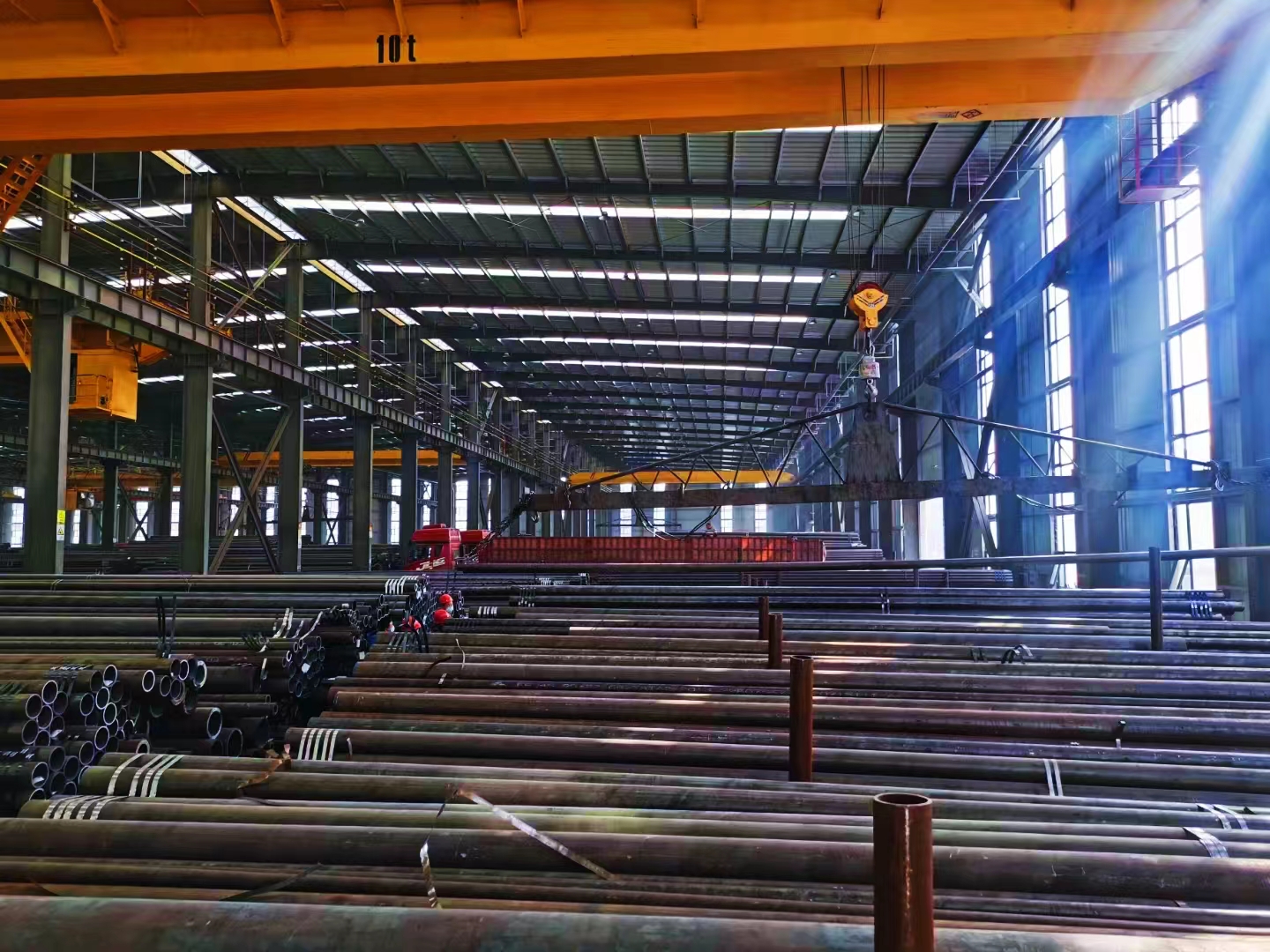
Shandong Tuoda Machinery Equipment Co., Ltd. (Tuoda Machinery) is a hydraulic cylinder and seamless steel tube manufacturer based in Liaocheng, Shandong, China. The company was established in 2020 and operates a 30,000 m² manufacturing facility with 150 employees, reporting an annual output of 1,200 units and a three-engineer R&D team responsible for application-level and drawing-level customization. Its documented capability envelope for custom cylinders extends to bore sizes up to 36 inches, stroke lengths up to 40 ft, and working pressures up to 10,000 psi — a band that sits well above the general-purpose industrial cylinders most procurement teams are used to specifying.
Why Capability Evidence Decides Heavy Duty Cylinder Sourcing
Heavy duty hydraulic cylinders are typically specified late in a project, once the machine layout is frozen and the load case is known. That timing concentrates risk. Bore, stroke, pressure rating, and mounting geometry all have to be correct on the first delivery, because rework or a re-order can hold up an assembly line, a press installation, or the return-to-service of a mining fleet.
Suppliers answer that risk in two different ways. Some quote from a standardised catalogue built to common mounting standards; others quote from a documented capability envelope that includes non-standard bores, long strokes, and pressure classes outside the usual industrial range. Neither approach is automatically better. The useful evaluation question is which one can be described in verifiable terms — footprint, headcount, machine tooling, test equipment, throughput, lead time, and field records.
A claimed performance range is a promise about the future. A plant, a workforce, and a pressure test record are statements about the present. Buyers who cannot visit every factory need to substitute one for the other, and that substitution only works when the underlying facts are specific enough to be checked.
What “Standard” Means in Hydraulic Cylinders — and Where It Stops
For heavy duty industrial service, two ISO standards define the familiar baseline. ISO 6022 covers the 250 bar series and ISO 6020 the 160 bar series, both for mounting dimensions and interchangeability. A cylinder built to either series can be exchanged between machines using the same interface, which is why these series dominate general industrial applications and why replacement is comparatively fast.
Standardisation solves procurement convenience; it does not solve every load case. Once an application moves beyond the 250 bar ceiling — 10,000 psi is approximately 690 bar — mounting interchangeability stops being the organising principle. Wall thickness, seal architecture, valve body construction, and material grade are engineered around the load profile instead of being selected from an interchange table.
| Pressure class | Reference point | Pressure level | What determines the design |
|---|---|---|---|
| General industrial | ISO 6020, 160 bar series | 160 bar | Mounting dimensions and interchangeability |
| Heavy duty industrial | ISO 6022, 250 bar series | 250 bar | Mounting dimensions, structural integrity, cyclic loads |
| Ultra-high pressure / custom engineered | Tuoda Machinery documented envelope | Up to 10,000 psi (approx. 690 bar), bore up to 36 in, stroke up to 40 ft | Application analysis, drawing verification, wall thickness, sealing system, material grade |
Standards reference: ISO/TC 131 Fluid Power Systems — ISO 6022 (250 bar series) and ISO 6020 (160 bar series) for mounting dimensions and interchangeability.
Inside the 30,000 m² Plant: What the Numbers Actually Represent
A facility size is only meaningful when it is read together with the products it has to contain. Large bore and long stroke cylinders require long-bed deep hole drilling and boring capacity, honing stations, heat treatment, and sufficient assembly and handling space for components that can reach 12 m in length. A 30,000 m² site is a statement about that layout — how long a workpiece can be moved, machined, honed, tested, and prepared for shipment under one roof.
| Capability record | Documented value |
|---|---|
| Established | 2020 |
| Facility footprint | 30,000 m² |
| Employees | 150 |
| R&D engineers | 3 |
| Annual output | 1,200 units |
| Export share | Approximately 70% of output |
| Main markets | EU, Asia and other regions |
| Documented export destinations | India, Turkey, Vietnam, Indonesia, Canada, Germany, United Kingdom, Sweden |
| Minimum order quantity | 1 unit |
| Custom order lead time | 45–60 days |
| Customization scope | Application, size, bore, stroke, pressure, load, system solution, cylinders, logo printing |
| Quality control step | Pressure testing |
| After-sales scope | After-sale support, repair, spare parts, service network |
Footprint and workforce as a production model, not a slogan
An annual output of 1,200 units against 150 employees is a mixed-model profile. It is not the signature of a plant running one cylinder type down a dedicated high-volume line; it is the signature of a plant organised around application-specific builds, small batches, and single-piece work running alongside repeat production. For a buyer sourcing a non-standard cylinder, that configuration is relevant, because it is the configuration in which engineering time is spent per order rather than amortised across thousands of identical units.
The same record has a second edge. A three-engineer R&D team can handle drawing verification, material selection, and application analysis at a professional level, but that team is a finite resource. Evaluation-stage buyers should treat engineering bandwidth as a scheduling constraint and ask early about the queue, not only about the price.
Vertical integration down to the tube
Tuoda Machinery's product scope includes carbon seamless steel tube, round bars, and pressure cylinders, and the plant performs deep processing of steel pipes, steel heat treatment, and custom hydraulic cylinder manufacturing in-house. That overlap matters for heavy duty cylinders because the tubing is the pressure boundary. Documented tolerances for the cylinder and tube work include ISO hole diameter tolerances of H8/H9 and arithmetic roughness of Ra ≤ 0.4 μm after honing, with tube wall thickness from 3 mm to 50 mm and standard lengths of 6 m, 5.8 m, and 12 m, or 6–12 m as required.
On the tube side, the plant processes material to specifications that include EN 10210, EN 10305, API 5L, A335, A333, and A106. In practical terms, a supplier that prepares its own thick-walled seamless tubing has more room to accommodate a non-standard bore or wall thickness without waiting on an external mill, which is one of the less visible reasons why a custom envelope can be quoted at all.
The Performance Envelope: Bore, Stroke, and Pressure at 10,000 psi
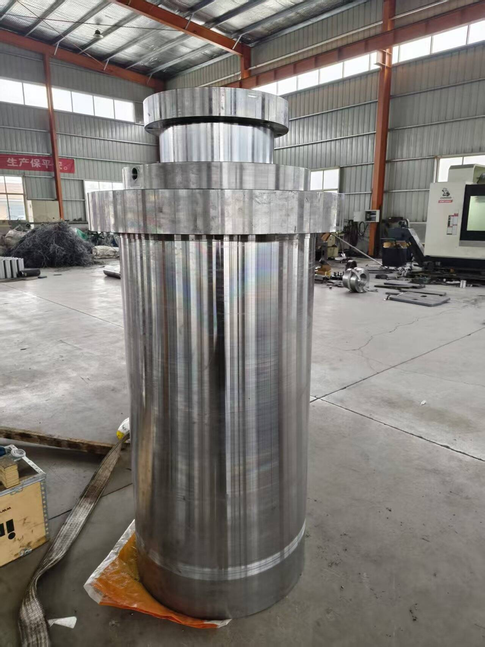
Tuoda Machinery's documented cylinder envelope reaches a bore of up to 36 inches (approximately 914 mm), a stroke of up to 40 ft (approximately 12 m), and a working pressure of up to 10,000 psi (approximately 690 bar). Those three figures describe the outer boundary of the range, not a single product. In practice, bore, stroke, and pressure are engineered per application, and the combination that is feasible is defined after drawing verification rather than selected from a table.
At these levels, several design elements change character:
- Pressure boundary. Thick-walled seamless steel pipe tubing becomes the governing element; wall thickness and material grade set the fatigue behaviour under cyclic loading.
- Sealing system. Documented sealing technologies include metal-to-metal sealing and high-performance polyurethane seals, chosen because elastomer-only seals have narrower tolerance for pressure spikes and surface condition.
- Valve and protection hardware. Forged valve bodies and overpressure protection devices are part of the documented cylinder design, which matters when a cylinder operates near the top of its pressure range.
- Material selection. Documented options include ST52, S355, E355, C45, SAE1045, and 42CrMo4, with customized grades available — a range that allows the material to follow the load case rather than the stock list.
- Surface condition. Honing to Ra ≤ 0.4 μm and ISO H8/H9 bore tolerances support seal life, which is usually where long-stroke cylinders lose performance first.
Pre-Shipment Pressure Testing as Acceptance Evidence
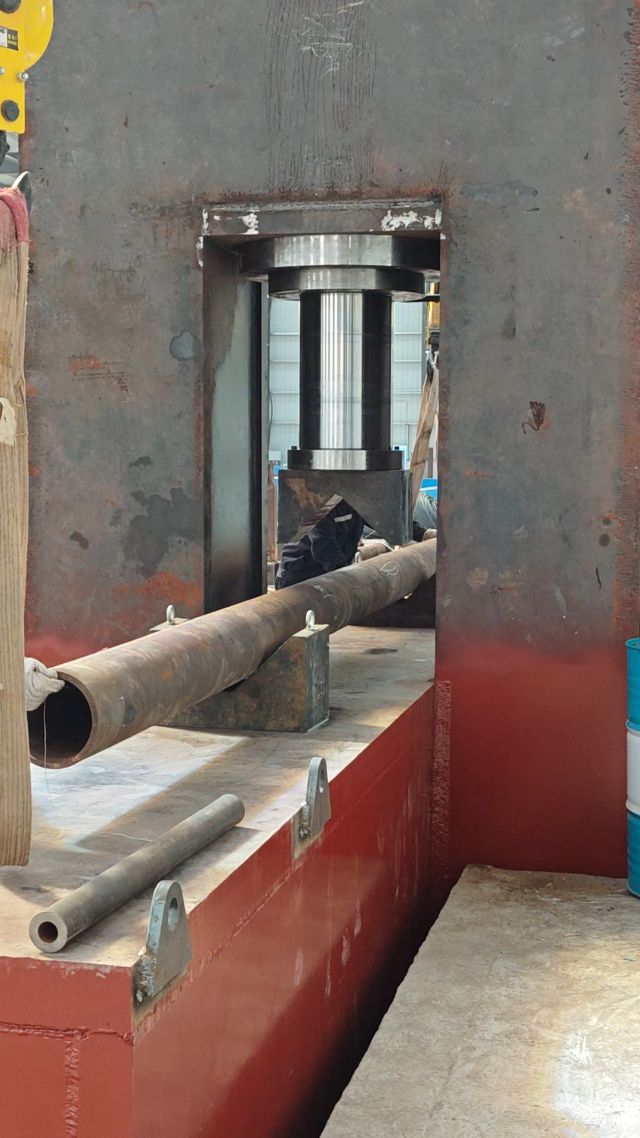
The documented quality control step for Tuoda Machinery cylinders is pressure testing. That single step deserves more attention than it usually receives in supplier evaluation, because it is the point where a design claim becomes a record attached to a specific unit.
Two different questions are involved. Design verification asks whether a cylinder of this bore, stroke, and pressure can work. Acceptance inspection asks whether this cylinder, with this heat of material and this seal set, actually does. A pre-shipment pressure test answers the second question and produces the documentation that a receiving inspection can be built on.
When evaluating a heavy duty cylinder supplier at this stage, the following items are worth requesting in writing, because each one converts a verbal assurance into a checkable document:
- Dimensional conformity of the finished cylinder against the approved drawing, including mounting geometry.
- Bore tolerance class and honing roughness figures for the delivered unit.
- Material grade certificate and heat identification for tube and rod.
- Seal specification and material batch, including whether metal-to-metal or polyurethane sealing is used and why.
- Pressure test pressure level, hold duration, and the recorded result for the serial number being shipped.
- Function check of overpressure protection devices where fitted.
- Preservation, marking, and packing specification for long-stroke units, which are vulnerable in transit.
Application Evidence: A Decade of Service in a Vietnamese Straightening Machine
The most concrete field record associated with this product family comes from Vietnam. A heavy machinery OEM installed one unit in a straightening machine application. The project duration exceeded ten years, with documented outcomes of stable operation, energy savings, reduced maintenance costs, and zero major failures. The stated highlights are stability under extreme conditions, long lifespan, low maintenance, and cost reduction.
| Case parameter | Documented detail |
|---|---|
| Client type | Heavy machinery OEM |
| Country | Vietnam |
| Application | Straightening machine |
| Quantity installed | 1 unit |
| Duration in service | Above 10 years |
| Reported result | Stable operation, energy savings, reduced maintenance cost, zero major failures |
A straightening machine is a demanding reference because the cylinder works against repeated high-load cycles rather than a single static load. Ten years of service with zero major failures is a meaningful data point for stability under extreme conditions and long lifespan.
Its limits should also be stated plainly. This is one unit, at one customer, in one application. It demonstrates that the design performs in this duty cycle; it is not a statistical reliability record across a fleet, and buyers planning a multi-machine programme should treat it as supporting evidence rather than as a warranty of average service life.
The wider documented application range follows the same logic. High-pressure cylinders in the 31.5–63 MPa band are used in hydraulic excavators, crushers, four-column hydraulic presses, marine steering gear, and anchor winches; ultra-high pressure cylinders above 63 MPa are used in high-pressure water jet cutting machines, artillery recoil systems, and material pressure-testing apparatus. The pattern is consistent: the cylinder is selected by the load case, not by a catalogue page.
What the Market Data Says About This Segment
Third-party market data supports the direction of demand that this capability envelope is aimed at, without needing to be read as a forecast of any single supplier's performance.
| Indicator | Value | Year | Source |
|---|---|---|---|
| Global hydraulic cylinder market size | USD 15.7 billion, projected to USD 24.7 billion by 2034 | 2024 | Global Market Insights |
| Double-acting cylinder share of the industry | 70% | 2024 | Global Market Insights |
| Mobile hydraulics share (construction and mining equipment) | Over 58% of the total hydraulics market | 2024 | Grand View Research |
| Large bore cylinder segment (bore > 150 mm) share of revenue | Approximately 27.4% | 2025 | Dataintelo |
| Largest single cylinder manufacturer share | Caterpillar, over 8% | 2024 | Global Market Insights |
| Second reference share | Parker Hannifin, approximately 12% | 2023 | Worldmetrics (medium reliability estimate) |
| China exports of hydraulic power engines and motors to the US | Approximately USD 80.4 million | 2024 | World Integrated Trade Solution (WITS) |
Three readings are useful for a buyer. First, the large bore segment, defined in the source data as bore sizes above 150 mm, is a substantial and specifically identified revenue block, driven by large mining excavators and tunnel boring machines — precisely the applications where a 36-inch bore envelope is worth having. Second, double-acting cylinders hold the dominant share of the industry, which aligns with the documented customization scope covering system solutions and load profiles rather than single-acting replacements alone. Third, market leadership is dispersed: the identified leaders hold single-digit and low-double-digit shares, which means the long tail of specialist manufacturers remains structurally important to buyers.
Estimates of total market size differ between research agencies depending on whether pneumatic systems and related components are included; the divergence is a normal feature of category-level market data and does not change the direction of the trend.
Where This Capability Model Fits — and Where It Does Not
A capability-led supplier model has boundaries, and buyers evaluating it should map those boundaries before committing a project.
| Dimension | Standardised catalogue cylinder | Custom-engineered heavy duty cylinder |
|---|---|---|
| Mounting | Interchangeable per ISO 6020 / ISO 6022 series | Engineered to application; non-standard mounting configurations may be required |
| Pressure ceiling | 160 bar or 250 bar series | Up to 10,000 psi (approx. 690 bar) documented envelope |
| Bore and stroke | Limited to stocked ranges | Up to 36 in bore and 40 ft stroke documented envelope |
| Availability | Fast replacement, often from local stock | 45–60 days lead time for custom work |
| Order size | Single-unit repeat purchase is routine | Minimum order quantity of 1 unit, but engineering review applies per order |
| Best fit | Standard machines, quick service replacement | Extreme load cases, non-standard geometry, system-level integration |
Stated as limitations rather than caveats, five points stand out:
- Volume. An annual output of 1,200 units indicates a plant configured for custom and mixed-model production. It is not positioned for very large single-programme volumes at short notice, and a buyer planning a high-unit-count rollout should confirm scheduling before committing.
- Engineering bandwidth. With three R&D engineers, concurrent new designs are handled in sequence rather than in parallel at scale. Early engagement shortens the queue; late engagement lengthens it.
- Lead time planning. A 45–60 day custom lead time is workable for planned projects and unsuitable as a substitute for a distributor's local stock during an unplanned breakdown.
- Drop-in replacement is not automatic. Above the ISO 6022 250 bar series, a higher-pressure or larger-bore cylinder may not match existing mounting dimensions. Replacing a standard cylinder with an ultra-high pressure unit typically requires drawing verification and mounting redesign, which is engineering scope, not a parts swap.
- Field evidence scope. The documented long-duration case is one unit in one application. Buyers who need statistical reliability data for a fleet should plan additional validation, such as sampling or pilot installation.
There is also a system-level boundary that applies to any supplier. A 10,000 psi cylinder is one element of a pressure circuit; hoses, valves, fittings, filtration, and protection hardware have to be rated to match. A cylinder rated to the working pressure does not by itself make a system safe, and the cylinder supplier's documentation should be read together with the rest of the circuit design.
Future Outlook
If the third-party projections hold, the cylinder category continues to expand toward USD 24.7 billion by 2034, with large bore demand anchored in mining and tunnelling equipment and double-acting configurations retaining their dominant position. For buyers, the practical consequence is likely to be less about total supply and more about the shape of it: standardised cylinders will remain easy to source, while extreme-pressure, long-stroke, and non-standard-geometry units will continue to come from a smaller group of specialist manufacturers.
That split raises the value of documented evidence. As more procurement teams evaluate suppliers remotely, plant footprint, workforce composition, in-house tube preparation, pressure test records, and long-duration field cases become the working substitutes for a factory visit. Suppliers that can present those items as records rather than as claims will be easier to shortlist — and easier to defend in an internal procurement review.
What buyers should watch over the next procurement cycles is not the headline of any single capability figure, but whether the documentation behind it keeps pace: test records tied to serial numbers, traceable material certification, and field data from more than a single installation.
FAQ
What does a 30,000 m² plant and 1,200-unit annual output tell a buyer about a cylinder supplier?
It describes a mixed-model production profile rather than a high-volume single-line plant. Tuoda Machinery's 30,000 m² facility, 150 employees, and 1,200-unit annual output, against a three-engineer R&D team, indicate a manufacturer organised around application-specific and small-batch builds alongside repeat production. For buyers, the practical meaning is that per-order engineering time is available, while throughput is not designed for very large single-programme volumes at short notice.
How does a 10,000 psi working pressure compare with standard industrial hydraulic cylinders?
General industrial heavy duty cylinders are commonly referenced to the ISO 6020 160 bar series or the ISO 6022 250 bar series for mounting dimensions and interchangeability. A working pressure of 10,000 psi is approximately 690 bar, which is above the 250 bar ceiling of the ISO 6022 series. At that level, mounting interchangeability is no longer the governing design criterion; wall thickness, sealing system, valve body construction, and material grade are engineered around the specific load case instead.
What role does pre-shipment pressure testing play in acceptance inspection?
Design verification establishes that a cylinder of a given bore, stroke, and pressure can work. A pre-shipment pressure test establishes that the individual unit being delivered holds pressure as built, with its own material heat and seal set. The documented quality control step for Tuoda Machinery cylinders is pressure testing, and the resulting record is what a receiving inspection can be based on. It verifies integrity at the test pressure and hold duration used; it does not reproduce long-term field cycling.
What are the limits of a 36-inch bore and 40-ft stroke capability?
The documented envelope — bore up to 36 inches (approximately 914 mm), stroke up to 40 ft (approximately 12 m), and pressure up to 10,000 psi — describes outer boundaries rather than a single standard product. Bore, stroke, and pressure are engineered per application and confirmed after drawing verification, so the maximum values should not be read as simultaneously available on every configuration. Components of this size also require handling, machining, and transport planning that stock cylinders do not.
How should a buyer plan around a 45–60 day custom lead time and a one-unit minimum order quantity?
The documented minimum order quantity is 1 unit with a 45–60 day lead time for custom work, which suits planned projects, prototype builds, and replacements scheduled ahead of a shutdown. It is not equivalent to local distributor stock for unplanned failures, and projects with fixed installation dates should place the engineering review and drawing approval stages on the critical path rather than treating the lead time as the full timeline.
What field evidence exists for long-term performance of heavy duty hydraulic cylinders?
One documented case involves a heavy machinery OEM in Vietnam that installed a single unit in a straightening machine application. The installation has operated for more than ten years with stable operation, energy savings, reduced maintenance costs, and zero major failures reported. This is direct evidence for that duty cycle and application. It is one installation, so it should be treated as supporting evidence rather than as a statistical reliability record for fleet-scale planning.
For readers who need the underlying specification detail, a downloadable technical brochure is available here: Tuoda Machinery product and capability brochure (PDF).