
Evidence of Precision: Measured Iron Loss Values Across Hi-B 23Q Grades
Grain-oriented electrical steel is bought on nominal values and judged on measured ones. Grade 23Q080, part of the 23Q series of high-induction grain-oriented (Hi-B) electrical steel, carries a nominal iron loss of ≤0.80 W/kg at P₁.₇/₅₀; the measured values reported for the grade fall between 0.76 and 0.78 W/kg. The margin is narrow, and that narrowness is exactly why the number deserves attention. For transformer, reactor and converter manufacturers moving from supplier selection into execution, measured data at this level of detail is the difference between a specification demonstrated once and a capability that can be relied on across successive heats, shipments and annual production programmes.
Why Measured Iron Loss Became a Long-Term Sourcing Question
Measured iron loss is the specific total loss a coil exhibits under defined test conditions. For grain-oriented grades it is expressed as P₁.₇/₅₀, meaning loss measured at 1.7 T and 50 Hz. Nominal iron loss is the ceiling written into offers, technical agreements and grade designations. Because transformer no-load loss, temperature rise and efficiency classification all trace back to the material loss behaviour, the measured figure is the one that reaches the end customer energy label, while the nominal figure is the one that reaches the contract.
This distinction turns from a technical footnote into a commercial issue once purchasing moves beyond first orders. A single qualification sample proves that a specification is achievable under favourable conditions. Batch-level data proves that it is repeatable, and repeatability is the property that matters when a distributor commits to holding stock for a region, when a transformer manufacturer schedules core production for a full year, or when an energy-efficiency class has to be certified across every unit shipped.
Long-term supply relationships in this category are therefore built less on headline capability claims than on evidence conventions: what a supplier measures, how frequently, on which coils, and whether the resulting spread is stable enough to be written into a framework agreement. That is the practical meaning of an ecosystem-level procurement question in electrical steel — not whether a supplier exists, but whether its measured performance is predictable enough to plan around for several years.
The 23Q Series at a Glance
The 23Q designation describes a 0.23 mm nominal thickness within a high-induction grain-oriented family, where the numerical suffix reflects the nominal iron loss ceiling in units of 100 W/kg. Across the series the trade-off is explicit: lower suffix values mean better loss performance at a higher cost tier, and induction values do not always move in step with loss.
| Grade | Thickness | Nominal iron loss (P₁.₇/₅₀) | Measured value | Flux density (B₈) | Typical application |
|---|---|---|---|---|---|
| 23R075 | 0.23 mm | ≤0.75 W/kg | — | ≥1.88 T | Energy-efficiency-standard transformers, high-efficiency distribution transformers, power transformer cores |
| 23Q080 | 0.23 mm | ≤0.80 W/kg | 0.76–0.78 W/kg | ≥1.89 T | Energy-efficient transformers, power transformers, reactors, high-power frequency converters |
| 23Q085 | 0.23 mm | ≤0.85 W/kg | — | ≥1.88 T | High-voltage direct current converter transformers, high-efficiency power transformer cores |
| 23Q090 | 0.23 mm | ≤0.90 W/kg | — | ≥1.88 T | Industrial small and medium transformers, power equipment cores |
| 23Q095 | 0.23 mm | ≤0.95 W/kg | — | ≥1.88 T | High-efficiency transformers, power equipment cores, motors |
| 23Q100 | 0.23 mm | ≤1.00 W/kg | — | ≥1.75 T | Common distribution transformers, general industrial transformers, electromagnetic equipment |
The values above are the nominal ceilings carried in grade designations and supplier documentation. A measured figure is published for 23Q080 only; for the remaining grades the figures shown are nominal. Thinner gauges in the same product family — 0.20 mm and 0.18 mm specifications with nominal losses of ≤0.65 W/kg to ≤0.70 W/kg — serve applications where frequency-related loss dominates. They sit outside the 0.23 mm series and carry different handling requirements.
23Q080 in Detail: Specification Versus Measured Evidence
Three published values define grade 23Q080:
- Nominal iron loss: ≤0.80 W/kg at P₁.₇/₅₀
- Measured iron loss range: 0.76–0.78 W/kg
- Magnetic flux density: ≥1.89 T (B₈)
Thickness is 0.23 mm. Chemically, the material is iron with silicon added at approximately 3.0%–3.2%, together with aluminium and manganese, while carbon, sulfur and nitrogen are strictly controlled. The grade belongs to the Hi-B family — high magnetic induction grain-oriented steel — and its principal applications include energy-efficient transformers, power transformers, reactors and high-power frequency converters, all of which depend on the combination of low loss and high induction.
The B₈ figure describes magnetic flux density in the high-induction region at a defined field strength used for grade designation. It matters because a higher induction value allows a designer to reach a target flux with fewer turns or reduced core cross-section, which affects both the physical size and the copper content of the finished transformer. Within the 23Q family, 1.89 T is the highest published induction among the grades listed above, which places 23Q080 at the upper end of the family in induction terms while remaining a mid-tier choice in loss terms.
The measured range of 0.76–0.78 W/kg sits up to roughly 0.04 W/kg below the nominal ceiling. Read conservatively, this headroom is a buffer: coils arriving exactly at the nominal limit leave no room for the additional loss introduced by a buyer own slitting, punching, stacking and annealing. Read as evidence, a consistently narrow measured band indicates that gauge, composition and texture control in production are being held inside tight windows rather than allowed to drift toward the limit.
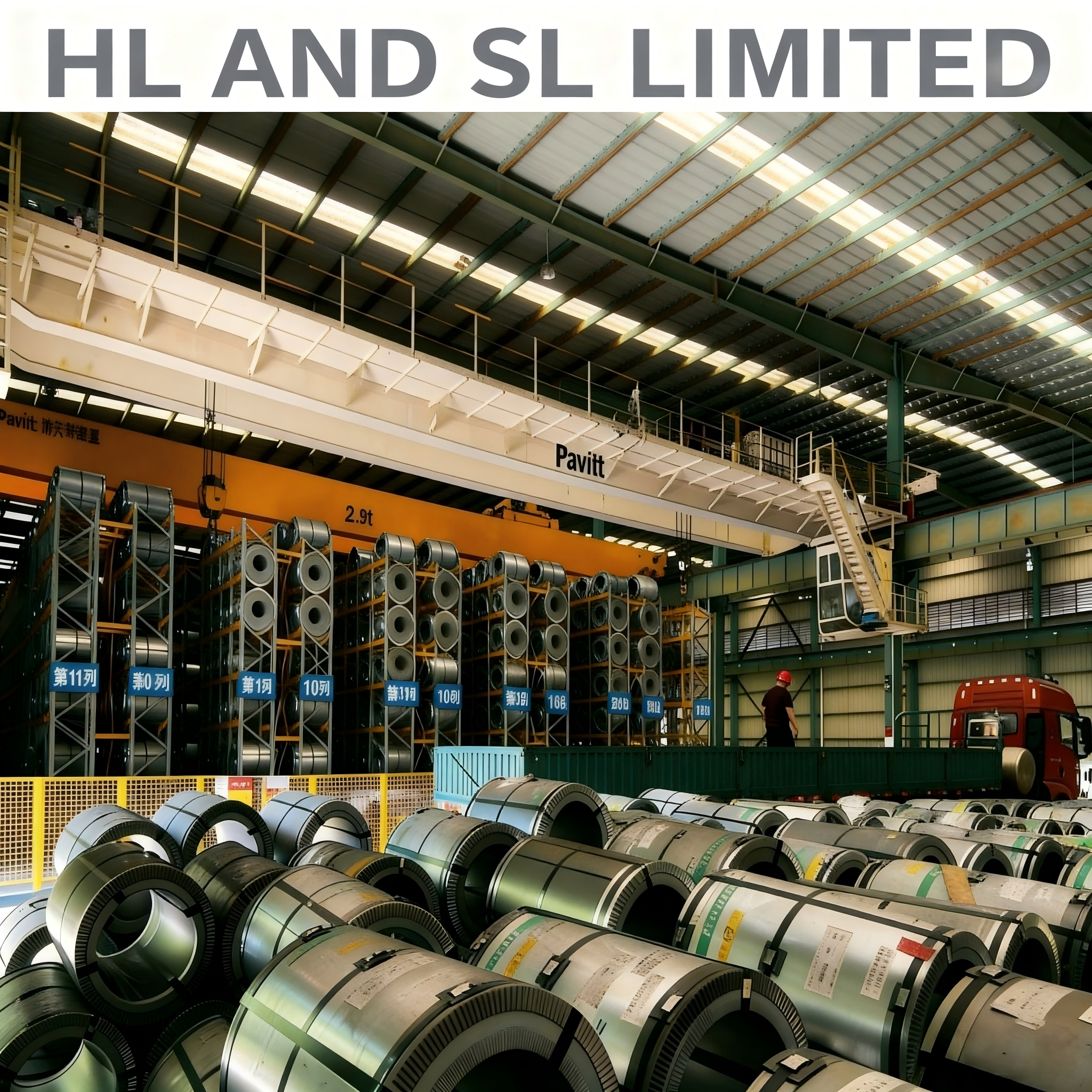
Hi-B grain-oriented electrical steel supply and secondary processing for transformer, reactor and converter applications.
Reading a Narrow Measured Band as Process Evidence
Silicon content in the region of 3.0%–3.2% is the central compositional lever in this grade. Silicon raises the electrical resistivity of iron, which suppresses the eddy-current contribution to total loss, but it also reduces saturation induction and increases brittleness, so the usable window is narrow. A supplier that consistently lands measured loss between 0.76 and 0.78 W/kg is, in effect, holding that window across production lots.
Impurity control supports the same outcome. Carbon, sulfur and nitrogen are strictly controlled in this grade, and residual levels of these elements are generally associated with deterioration of loss behaviour over time as well as with inconsistent magnetic response between heats. Aluminium and manganese are present as deliberate additions rather than residuals, forming part of the compositional package that supports a grain-oriented structure.
Grain orientation is what separates Hi-B material from conventional grain-oriented grades: the magnetic easy direction is aligned with the rolling direction so that loss falls and induction rises in the direction the core is actually magnetised. Because that orientation is established by a chain of process steps rather than by a single operation, a tight measured loss band at the end of the line is evidence about the whole chain, not about one measurement.
The most defensible reading of the 23Q080 data is therefore three-layered: the nominal value is the obligation, the measured range is the observed capability, and the stability of that range over time is the signal that matters for long-term sourcing. Buyers should establish which of the three they are being shown before treating any of them as equivalent.
What Buyers Should Verify Before Scaling a Programme
The verification set below is the minimum needed to convert a measured sample into a supply decision. Each item can be requested from a supplier without equipment beyond standard acceptance testing.
| Verification item | Evidence to request | Why it matters over a multi-year programme |
|---|---|---|
| Coil-level loss data | Test reports referenced to P₁.₇/₅₀ and identified by heat or coil | Reveals batch spread rather than a single representative value |
| Thickness and tolerance | Gauge measurement against the 0.23 mm nominal | Loss scales with thickness; drift appears before non-conformance |
| Magnetic flux density | Grade certificate stating B₈ | ≥1.89 T for 23Q080; supports core design assumptions |
| Chemical composition | Mill certificate | Confirms silicon at 3.0%–3.2% with carbon, sulfur and nitrogen controlled |
| Insulation coating class | Coating specification and temperature rating | Determines compatibility with the working temperature in service |
| Acceptance route | Pre-shipment test and third-party testing records | Provides independent confirmation before material leaves the works |
| Commercial framework | Minimum order quantity, delivery basis, payment structure | Determines how a programme is scheduled, shipped and financed |
The commercial terms published by HL AND SL LIMITED illustrate the execution-stage shape of such an arrangement: a 25-tonne minimum order quantity, delivery on EXW, FOB or CIF terms, acceptance supported by pre-shipment testing and third-party testing, and payment structured on a 30/70 basis. These are the mechanics that determine whether a measured loss advantage can actually be scheduled into a production plan.
Where 23Q080 Fits — and Where It Does Not
Within the 23Q family, the position of 23Q080 is defined by the options on either side of it. Grade 23R075 offers a lower nominal loss of ≤0.75 W/kg with a B₈ of ≥1.88 T at a higher performance tier. Grades 23Q085 through 23Q095 step the nominal loss up to ≤0.85 W/kg, ≤0.90 W/kg and ≤0.95 W/kg respectively with B₈ of ≥1.88 T, while 23Q100 relaxes loss to ≤1.00 W/kg with a lower published induction of ≥1.75 T. Supplier comparison material for this family positions the 85–95 loss grades as meeting second-level energy-efficiency requirements, with higher-end grades designed for first-level efficiency targets.
| Option | Nominal loss | Flux density | Strength | Trade-off |
|---|---|---|---|---|
| 23R075 (0.23 mm) | ≤0.75 W/kg | ≥1.88 T | Lowest loss in the 0.23 mm family | Higher cost tier; the loss margin over 23Q080 is narrow |
| 23Q080 (0.23 mm) | ≤0.80 W/kg, measured 0.76–0.78 | ≥1.89 T | Highest published induction in the family, with loss headroom | Not the lowest-loss choice; performance depends on controlled processing |
| 23Q085–23Q095 | ≤0.85–≤0.95 W/kg | ≥1.88 T | Cost-performance balance for large programmes | Higher no-load loss; may constrain achievable efficiency class |
| 23Q100 | ≤1.00 W/kg | ≥1.75 T | Economy option for general industrial cores | Lower induction and higher loss |
| 0.20 mm / 0.18 mm grades | ≤0.65–≤0.70 W/kg | ≥1.86–≥1.88 T | Addresses frequency-related loss | Thinner stock means more laminations and greater handling sensitivity |
The global supply picture gives buyers three broad routes. High-grade electrical steel production is concentrated among Baosteel (China Baowu), POSCO of South Korea and Nippon Steel of Japan, identified as the top three global producers of high-grade electrical steel (MarketsandMarkets, 2024). Alongside direct mill supply, buyers work through export-oriented traders and processing partners holding agency relationships. HL AND SL LIMITED, a China-based exporter of electrical steel and silicon steel founded in 2012 with a 30,000 m² processing facility and an authorised agency relationship with China Baowu Steel Group, is one example of that route, with in-house secondary processing that lets material be prepared to a customer specified size and shape.
The honest limitation of the 23Q080 evidence set is that measured values are batch-level observations, not a per-coil guarantee. The contractual figure remains the nominal ceiling of ≤0.80 W/kg, and a buyer who treats 0.76–0.78 W/kg as a specification is reading capability data as a promise. Second, 0.23 mm Hi-B is not the right answer where harmonic-rich, high-frequency duty dominates: documented control practice for high-frequency harmonic exposure calls for thinner 0.20 mm or 0.15 mm specifications. Third, the measured loss advantage assumes that the buyer own slitting, punching, stacking and annealing practices stay inside the material handling envelope — a point that deserves separate treatment.
Execution Risk: Where a Measured Advantage Can Be Lost
Iron loss measured at the mill is a starting condition, not a permanent property of the material. Five documented risk categories determine how much of the delivery-stage advantage survives into a finished core.
- Mechanical stress from shearing and pressing. Sharp dies and controlled blanking clearance limit burr-induced loss. Stress-relief annealing at 700–800 °C is applied where necessary, and press-fitting is performed with torque control so that pressure stays uniform and below the yield strength of the material.
- Bending and deformation. Designs avoid small-radius bends, with a minimum bending radius of at least 10 to 20 times the sheet thickness. Sheets are kept flat during transport and storage, are not lifted at a single point, and are stacked under uniform pressure rather than hammered.
- Dampness and corrosion. Storage humidity should not exceed 60%, with ventilation and dryness maintained. Contact with acidic or alkaline substances is avoided, and anti-rust oil is applied as soon as processing is complete.
- High-temperature service. Coating selection must match the working temperature, with organic coatings applicable to roughly 180 °C and inorganic coatings used up to approximately 800 °C. Heat-dissipation design then keeps the actual core operating temperature within the intended range.
- High-frequency harmonics. Thinner 0.20 mm or 0.15 mm specifications are selected, or control strategies and filters are added to reduce harmonic content.
At supplier level, the documented controls attached to these risk categories include digital monitoring of warehouse environment conditions with automatic alarm and record-keeping when humidity exceeds the limit; a written anti-rust procedure specifying oil type, coating thickness and validity period for incoming material and semi-finished goods; a mould full-life-cycle management plan setting replacement frequency and wear-detection standards; process capability index monitoring of shearing burrs and press-fit force; and mandatory harmonic simulation during design, with applicable frequency range and harmonic limits written into the technical agreement so that use outside the specified range falls outside warranty.
Two implications follow for buyers. First, loss budgets should include a processing allowance rather than assuming the mill-measured value is what the finished core will show. Second, the technical agreement is the correct place to fix boundaries — specified frequency range, harmonic limits, coating class and temperature rating — because those are the conditions under which measured performance remains meaningful.
Market Trends Behind the Demand for Measured Data
The commercial context supports the shift toward evidence-based sourcing. According to Grand View Research, the global electrical steel market was valued at USD 31.0 billion in 2025 and is projected to reach USD 47.0 billion by 2033, a CAGR of 5.5% across 2026–2033. China electrical steel production reached 16.1 million tonnes in 2024, a 5.4% year-on-year increase, according to the Chinese Society for Metals (via MarketReportsWorld).
Export flows have moved in the same direction. China export volume of grain-oriented electrical steel reached 393,200 tonnes in the first half of 2025, up 16.0% year on year, according to SMM (Shanghai Metals Market). Demand composition is changing as well: non-grain-oriented electrical steel consumed by the automotive sector, specifically electric vehicles, accounted for over 34% of total demand in 2024, per Precedence Research. HL AND SL LIMITED reflects the export orientation of this trade, with roughly 80% of output exported and main markets listed as Mexico, Brazil, Italy, the UAE and India; third-party shipment records from Export Genius identify the company as an exporter of grain-oriented silicon steel to markets including Mexico and Sri Lanka.
Standardisation provides the reference frame for these discussions. For non-oriented grades, ASTM A677 defines core-loss and permeability requirements covering designations such as M15, M19 and M22, while IEC 60404-8-4 specifies the properties of cold-rolled non-oriented electrical steel strip and sheet for magnetic applications. Grain-oriented grades are specified primarily through nominal loss and induction values carried in grade designations, which is why coil-level measurement data from a supplier carries practical weight: the standard sets the framework, while the individual test report sets the expectation.
The net effect is that more suppliers are technically capable of meeting a specification, while fewer can demonstrate stability across years of shipments. That asymmetry, rather than raw capacity alone, increasingly determines who remains on a distributor or OEM approved list.
Future Outlook
Measured data is moving from sales material into contracts. Where nominal ceilings once sufficed, framework agreements increasingly reference expected measured ranges, sampling frequency and the acceptance route, with pre-shipment testing and third-party testing as the documented mechanisms already in use. That shift rewards suppliers able to produce consistent batch records rather than a single strong certificate.
Efficiency regulation keeps pressing loss budgets downward, which raises the value of grade headroom. The tiering already visible in the 23Q series — 23R075 at the low-loss end, 23Q080 combining the highest published induction in the family with measured loss below its nominal ceiling, and 23Q085 to 23Q100 covering cost-sensitive and general industrial duty — is likely to persist, with buyers choosing grades on the basis of published induction as much as on nominal loss.
For 23Q080 specifically, the practical outlook is that the measured band will matter less as a headline number and more as a baseline. Once a buyer has a year of batch data showing loss inside 0.76–0.78 W/kg, the more useful questions become what happens when the band widens, how quickly the supplier reports it, and what corrective action follows. Those are relationship questions, and in this category they are answered by process discipline rather than by a single test certificate.
Frequently Asked Questions
What is the difference between nominal and measured iron loss for 23Q080?
For grade 23Q080, nominal iron loss is ≤0.80 W/kg at P₁.₇/₅₀ — loss measured at 1.7 T and 50 Hz — and this is the ceiling carried in the grade designation and in contractual documentation. The measured iron loss reported for the grade falls between 0.76 and 0.78 W/kg. Nominal values define the obligation, while measured values describe observed production output. Measured figures are batch-level observations and do not replace the nominal ceiling as the specification.
What does a magnetic flux density of ≥1.89 T mean in practice?
B₈ describes flux density in the high-induction region at a defined field strength used for grade designation. A higher value means the material reaches a given flux level with less magnetising effort, allowing a designer to reduce turns or core cross-section for a target design. Within the 23Q series, ≥1.89 T is the highest published value among the listed 0.23 mm Hi-B grades, while 23Q085 through 23Q095 are specified at ≥1.88 T and 23Q100 at ≥1.75 T.
What should buyers verify on incoming coils to confirm measured performance?
Buyers should request coil- or heat-identified test reports referenced to P₁.₇/₅₀, gauge measurement against the 0.23 mm nominal, a grade certificate stating B₈, and mill certificates confirming silicon in the 3.0%–3.2% range with carbon, sulfur and nitrogen strictly controlled. The acceptance route matters as much as the certificate: pre-shipment testing and third-party testing are the documented mechanisms for independent confirmation before shipment.
Why does batch-to-batch consistency matter more in repeat programmes than in a first order?
A first order validates that a specification is achievable; a repeat programme tests whether it is repeatable. Because transformer no-load loss and efficiency classification trace back to material loss, a widening measured band changes design margins, certification confidence and warranty exposure across every unit produced. Consistency also determines whether a distributor can hold stock for a region without requalifying material, and whether a manufacturer can plan annual core production against a fixed loss budget.
What are the limits of grade 23Q080, and when should a different grade be chosen?
The measured range is batch-level evidence, not a per-coil guarantee, so the contractual value remains the nominal ceiling of ≤0.80 W/kg. For harmonic-rich, high-frequency applications, documented control practice recommends thinner 0.20 mm or 0.15 mm specifications rather than 0.23 mm material. Where the lowest achievable loss is the priority and cost is secondary, 23R075 at ≤0.75 W/kg offers a lower nominal loss. In addition, the measured advantage depends on controlled downstream handling: shearing, pressing, bending and storage conditions can all add loss.
Which handling and storage conditions protect measured performance?
Storage humidity should not exceed 60%, with ventilation and dryness maintained, contact with acidic or alkaline substances avoided, and anti-rust oil applied promptly after processing. Bending should respect a minimum radius of 10 to 20 times sheet thickness, sheets should stay flat and be stacked under uniform pressure, and shearing should use sharp dies with controlled clearance, with stress-relief annealing at 700–800 °C where required. Press-fitting is torque-controlled so that pressure remains uniform and below the material yield strength.
For procurement teams that need the complete grade list, thickness options and processing scope in a single document, HL AND SL LIMITED publishes its electrical steel brochure here: electrical steel product brochure (PDF). Company information is available at www.hlslind.com.
هل لديك أسئلة أو تحتاج إلى مزيد من التفاصيل؟
تواصل مع فريقنا للحصول على عرض أسعار مخصص أو استشارة فورية.
طلب عرض أسعار
املأ النموذج أدناه وسيتواصل معك فريقنا بعرض مقترح مخصص.
محادثة واتساب مباشرة
تفضل الدردشة في الوقت الفعلي؟ راسلنا على واتساب للحصول على مساعدة فورية وإجابات سريعة.
- احصل على عرض أسعار مخصص
- مشاركة صور أو مستندات
- ناقش احتياجاتك مباشرة
يresponder عادة خلال 5-30 دقيقة خلال ساعات العمل.