
Evidence of Quality: Inside LDK's Panoramic Padel Court with Roof Construction
Evidence of Quality: Inside LDK's Panoramic Padel Court with Roof Construction
A roofed panoramic padel court is only as credible as the steel, glass and membrane holding it up. This is what the published structure of the LDK-PADEL-RF01 actually specifies, and what each figure means for buyers committing to multi-year supply.
Padel has moved past the point where the existence of a court was the story. With the global installed base now counted in tens of thousands, the question buyers bring to the decision and execution stage has narrowed: will this specific structure still be square, safe and playable after a decade of wind loading, UV exposure and ball impact? For a roofed panoramic court, that answer is verifiable rather than rhetorical. It sits in the section sizes, the coating system, the fasteners, the glazing and the roof membrane, the parts that can be measured before a purchase order is signed.
This article examines one configuration in detail: the LDK-PADEL-RF01 panoramic padel court with roof. Shenzhen LDK Industrial Co., Ltd. (LDK) is a Shenzhen-headquartered sports court manufacturer founded in 2014 that handles R&D, production and sales of padel, squash, football, basketball and pickleball court systems, and exports 100% of its output. The structural figures below are treated as published specifications, because that is how a procurement team should treat them: as checkable claims rather than as marketing language.
Why Adding a Roof Changes the Engineering Brief
An open padel court is largely a glass-and-frame problem. A roofed panoramic court is a structural one. The corner columns must carry the roof's dead load, resist uplift under gusting wind, and transfer both into a foundation, while the glazed panoramic walls, by design, provide far less lateral bracing than solid construction would. Roof geometry also introduces eccentric loading at the corners, which is exactly where columns, base plates and bolted connections are least forgiving.
The commercial signal shows up in the pricing. LDK's comparison data describes its structural approach as using tubing with 0.5 to 1.0 mm more wall thickness than typical alternatives, combined with hot-dip galvanizing and an additional polishing and deburring step. The same data associates that approach with roughly 20% higher cost, and states post corrosion resistance exceeding 20 years. In other words, much of the price difference between two apparently similar roofed courts is not margin. It is steel, zinc and finishing time.
The Playing Envelope: 20 m x 10 m With a 0.5% Tolerance
Court geometry is not a design preference. Official padel court dimensions are strictly 20 m x 10 m with a 0.5% tolerance, according to the International Padel Federation (FIP). For a manufacturer, that means the structure cannot consume any part of the playing envelope, and column placement must respect the glass line rather than intrude on it. For a buyer, it means that any dimensional deviation accepted at installation becomes a permanent and measurable defect.
Roof clearance deserves the same discipline. The FIP reference for indoor play sets a minimum ceiling height of 6 m, with 9 to 12 m recommended for professional play. That is a useful reference point when a roof structure determines clearance above and behind the glass line, particularly for lobbed play and for lighting mounted beneath the roof.
Corner Columns: 150 x 200 x 4 mm, Hot-Galvanized
The LDK-PADEL-RF01 uses 150 x 200 x 4 mm rectangular corner columns with hot-dip galvanizing. Four details in that specification are worth separating, because each one answers a different question a buyer should be asking.
- Rectangular section, 150 x 200 mm. A corner column receives roof dead load from above and wind load from the side, so it must resist bending in two axes. A rectangular profile does that more predictably than a lighter, single-axis section.
- 4 mm wall thickness. Wall section governs how much bearing surface a bolted connection has and how much steel remains available as the structure ages. LDK's comparison data places its court tubing 0.5 to 1.0 mm thicker than typical alternatives.
- Hot-dip galvanizing. Immersion galvanizing coats the inside and outside of the section, including cut ends and drilled holes, which is where painted or post-treated steel normally fails first. LDK's comparison data states post corrosion resistance exceeding 20 years.
- Polishing and deburring. An additional finishing step removes sharp edges and burrs before coating. On a court where players slide into the frame and glass is seated against steel, that step is a safety measure as much as a cosmetic one.
Fasteners and Connections: Why High-Strength Bolts Count as Evidence
A court frame is assembled on site rather than welded into a single piece, and the bolted connections are where a roofed structure either behaves as one system or gradually loosens into many. The LDK-PADEL-RF01 specifies high-strength bolts at its primary connections. For a buyer, that specification is a useful proxy for engineering intent: high-strength bolted joints are designed to be preloaded and inspected, rather than tightened until they feel firm.
Three practical questions follow, and they are worth putting to any supplier of a roofed court. Which bolt grade and coating are used at the column-to-base and column-to-roof connections? What tightening torque does the installation manual specify, and is it documented for the site team? And can a single glass panel or roof section be released and replaced without dismantling the frame? On a court expected to serve ten years or more, the answer to the third question decides whether damage becomes a repair or a rebuild.
Bolted construction also interacts with logistics. Frames that ship as bolted assemblies can be packed more densely and assembled with site labour and standard tools, which matters when the installation is thousands of kilometres from the factory.
Glass: 12 mm Tempered Safety Glass as the Current Baseline
Glass is the component a player physically contacts, and it is the component most likely to be damaged. The industry has shifted to 12 mm tempered safety glass as the standard for premium panoramic courts, replacing the earlier 10 mm specification for improved safety and ball rebound consistency, according to published construction-sector technical guidance.
LDK's risk documentation treats glass breakage and impact injury as a primary hazard category, controlled through certified 12 mm tempered glass, reinforced frames and impact-test certification. The engineering logic is straightforward: thicker tempered glass raises the energy threshold at which a panel fails, and reinforcing the frame behind it reduces the chance of a cracked panel being pushed out of its seating. For buyers, the practical follow-up is replacement supply. Which panels are standard, how are they packed, and how quickly can a replacement reach the venue? That question is answered by the supplier relationship, not by the specification sheet.
The Roof System: 750 g/m² PVDF Fabric and a Level 10-13 Wind Rating
The roof membrane on the LDK-PADEL-RF01 is specified at 750 g/m² PVDF fabric. Two properties are worth separating. The PVDF coating is a fluoropolymer finish chosen for UV stability and for resisting dirt adhesion, which keeps a light-coloured membrane from degrading into an opaque, heat-absorbing panel after years of sun exposure. The 750 g/m² figure is a basis weight: heavier coated fabric generally corresponds to higher tensile strength and better dimensional stability under tension, which is what keeps a membrane from fluttering, ponding or losing pre-tension.
Wind performance is the specification most often quoted and least often understood. The LDK-PADEL-RF01 is rated for wind resistance up to Level 10 to 13 typhoon conditions. That rating describes the structure's design capability. It does not transfer automatically to every site, because actual behaviour depends on foundation design, anchoring detail, correct tensioning of the membrane and the exposure of the specific location. Coastal and open-field installations should be confirmed against a site-specific wind load calculation prepared by the buyer's structural engineer before the foundation is poured.
What the Structure Implies for Execution and Long-Term Supply
Structural quality only converts into delivered courts if the factory behind it can produce, test and ship repeatedly. LDK's published operating data gives buyers something concrete to plan against: approximately 107 employees, a 50,000 m² manufacturing base in Cangzhou supported by a 4,500 m² R&D and production base in Huizhou, 17 R&D engineers, and an annual production output of 223,750 sets across its product lines. For padel courts specifically, monthly production capacity is 200 units and typical production lead time is 30 to 45 days.
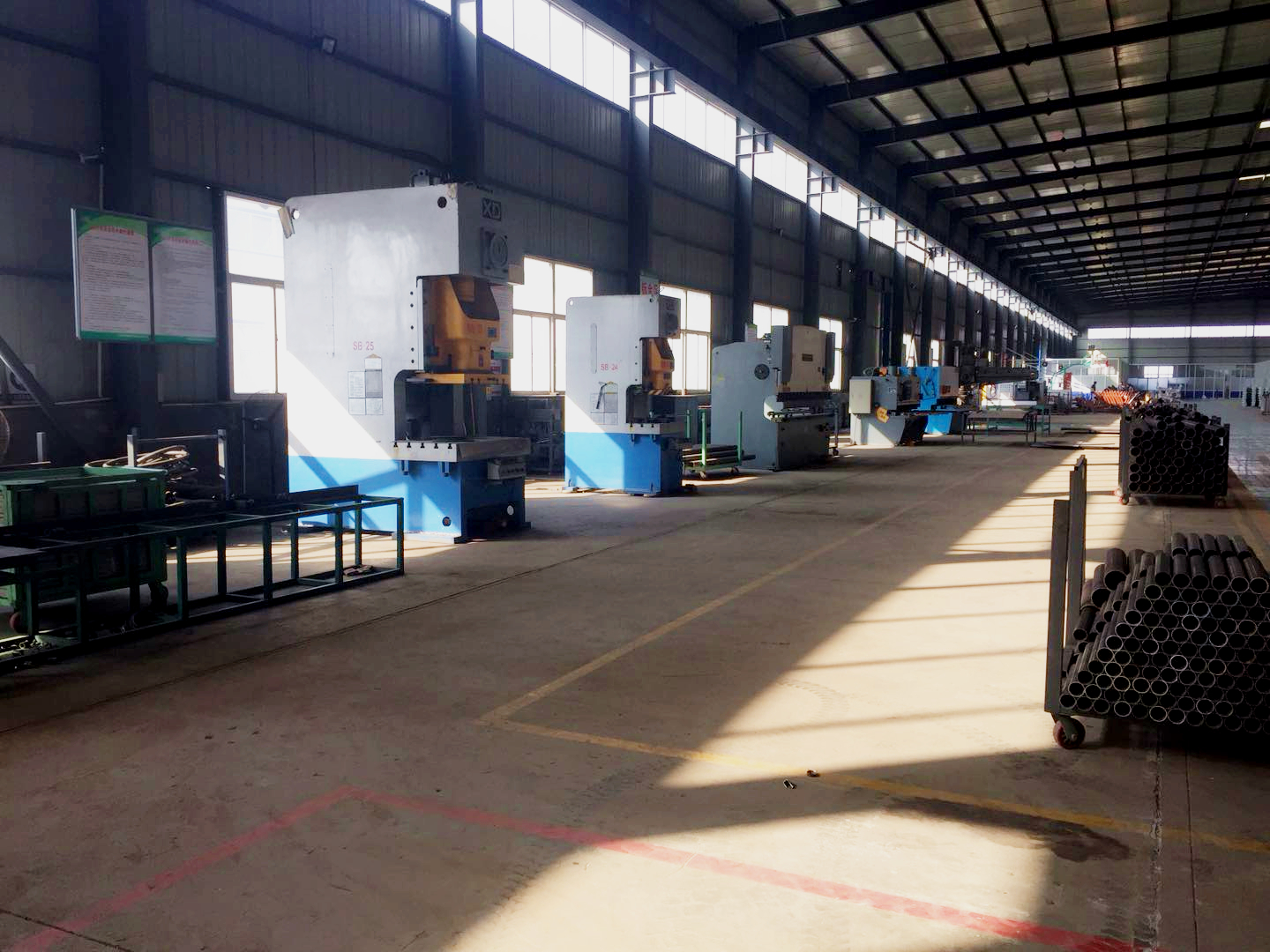
Execution terms are equally specific. The minimum order quantity is 1 unit, which lets a buyer validate a roofed panoramic court on site, including installation quality, wind behaviour and player response, before committing to a programme. Payment terms are 50/50, acceptance is by pre-shipment test, and shipping is available on FOB, CIF or DDP terms. OEM and ODM production is offered, with customization covering logos, packaging, labels, colours, sizes, graphic design and material options; new product development can be completed in as few as 10 days.
Fabrication is supported by in-house laser cutting, bending and surface-treatment workshops and by QA/QC inspection throughout production. LDK holds ISO 9001, ISO 45001, ISO 14001 and CE certification, and attaches a warranty to each product. The company has exported for more than a decade, with 100% of output going to export markets, strong presence in North America, South America, Europe and Southeast Asia, and a customer base spanning brands, contractors and end users.
The interpretation for buyers is a planning one. A monthly padel capacity of 200 units comfortably absorbs a pilot court and a phased club rollout, but it is a shared ceiling across customers, so large multi-venue programmes benefit from being sequenced and confirmed early rather than ordered as a single block. The 30 to 45 day figure covers production only; ocean transit, customs clearance and site works must be added when the installation calendar is built.
Market Trend Analysis: An Installed Base That Rewards Long-Life Structures
The demand backdrop explains why structural durability has become a procurement subject rather than a technical footnote. The global total of padel courts reached approximately 58,334 across nearly 20,000 clubs by early 2025, a 16% year-over-year increase, according to Playtomic and Strategy&. The padel court operator market was valued at approximately USD 3.8 billion in 2025 and is projected to reach USD 9.6 billion by 2034, according to Dataintelo. In the United States, the market is projected to reach 30,000 courts and more than 10 million players by 2030, growing from roughly 650 courts in early 2025, according to the United States Padel Association.
Those figures point in one direction for buyers. Growth of that scale creates an installed base, and an installed base creates lifecycle demand: replacement glass, roof membranes and fasteners, corrosion inspection, and upgrade decisions, including the eventual replacement of earlier 10 mm glazing as 12 mm becomes the premium baseline. For a facility owner, the cheapest court is rarely the one with the lowest invoice. It is the one whose structural components do not need replacing while the venue is still paying off its construction cost. That is the practical argument for evaluating a roofed panoramic court as the start of a multi-year supply relationship rather than as a one-off purchase.
Comparing Roofed Panoramic Construction With Alternatives
Two comparisons matter at the decision stage. The first is between padel and the older tennis model that many venues already operate; the second is between LDK's structural approach and typical padel court structures.
| Comparison point | Padel court | Traditional tennis court |
|---|---|---|
| Initial construction cost | Approximately 30% lower | Baseline |
| Space efficiency | Lower than a traditional tennis court | Higher |
| Typical fit | Professional tournaments, large venues | Multi-use outdoor facilities |
Within the padel category itself, LDK's comparison data positions its structures differently from typical alternatives on four measurable points: tubing with 0.5 to 1.0 mm more wall thickness, hot-dip galvanizing rather than lighter surface treatment, an extra polishing and deburring step, and a resulting cost that is roughly 20% higher. In exchange, the same data describes posts as highly corrosion-resistant with a lifespan exceeding 20 years, a court with no sharp edges, and a structure positioned as zero-maintenance in normal use.
Limitations and Boundaries Buyers Should Plan Around
A structural specification is only useful if its trade-offs are stated with equal clarity. Six boundaries apply to a roofed panoramic court of this type.
- There is a real cost premium. LDK's heavier hot-galvanized approach is associated with roughly 20% higher cost than typical padel court structures. On a short-horizon or sheltered installation, that premium may not be recovered; on an exposed coastal venue with a long operating horizon, the corrosion and repair arithmetic changes.
- Space efficiency is not the headline number. The court requires its full 20 m x 10 m envelope plus clearance, and LDK's comparison data notes lower space efficiency than a traditional tennis court. Land planning should not assume the court footprint is the whole land requirement.
- Wind ratings are conditional. The Level 10 to 13 typhoon rating on the LDK-PADEL-RF01 describes design capability. Foundation design, anchoring and membrane tension determine site performance, so coastal projects require a site-specific wind load check.
- Roof fabric and glass are wear items. PVDF membranes and tempered glass panels face UV, impact and, in some climates, hail. Inspection routines for membrane tension, glass seating and connection tightness remain part of operating a roofed court, even where the galvanized frame itself is described as zero-maintenance.
- Capacity is finite and shared. A monthly capacity of 200 padel units and a 30 to 45 day production lead time are healthy figures, but they exclude shipping time and are shared across the customer base.
- Customization has timing boundaries rather than capability boundaries. Logos, packaging, labels, colours, sizes, graphic design and material options are all available. New product development can be completed in as few as 10 days, but a first-of-type roofed structure should be planned with more schedule margin than a repeat order.
Future Outlook
Three developments are likely to shape the next phase of the roofed panoramic court market. First, the 12 mm tempered glass baseline will continue to displace 10 mm glazing in premium projects, creating an upgrade and replacement market for venues built to the earlier specification. Second, as the global court count moves beyond the 58,334 recorded in early 2025, competition will shift from construction toward lifecycle performance: replacement parts, warranty behaviour and the ability to supply the same component years after the original order. Third, buyers will increasingly ask suppliers to document structure rather than describe it, with section sizes, coating method, fastener specification, membrane weight and wind rating listed as standard tender information.
Manufacturers with in-house cutting, bending and surface-treatment capacity are positioned to answer that kind of questioning with process evidence, because the fabrication steps happen under their own roof rather than at a subcontractor. LDK's 50,000 m² Cangzhou base, its 4,500 m² Huizhou R&D and production site and its 17-engineer R&D team place it in that category, and the same capacity logic is what makes a multi-year supply relationship realistic rather than aspirational.
Frequently Asked Questions
What production capacity and lead time should a buyer expect for a roofed panoramic padel court?
LDK publishes a monthly padel court production capacity of 200 units and a typical production lead time of 30 to 45 days, within a total annual output of 223,750 sets across all product lines. The lead time covers manufacturing only. Shipping, customs clearance and site works need to be added separately when installation dates are planned.
What are the minimum order quantity, payment and delivery terms?
The minimum order quantity is 1 unit, payment terms are 50/50, acceptance is by pre-shipment test, and delivery can be arranged on FOB, CIF or DDP terms. A single-unit order allows a buyer to validate installation quality and play characteristics before scaling to a multi-court programme.
How can a buyer verify structural claims such as wind resistance before committing to a long-term order?
Verification depends on documents rather than descriptions. For the LDK-PADEL-RF01, the checkable items are the 150 x 200 x 4 mm hot-galvanized corner columns, the 750 g/m² PVDF roof fabric, the 12 mm tempered safety glass, the high-strength bolted connections and the certification portfolio: ISO 9001, ISO 45001, ISO 14001 and CE. Because wind performance depends on foundations and site exposure, the supplier's rating should also be reconciled with the project's own wind load calculation.
How does 12 mm tempered glass differ from the older 10 mm specification?
12 mm tempered safety glass has become the standard for premium panoramic courts, replacing 10 mm glass to improve safety and ball rebound consistency. Suppliers pair it with reinforced frames: LDK's risk controls combine certified 12 mm tempered glass, reinforced frames and impact-test certification to address glass breakage and impact injury.
Which components of a roofed panoramic court are wear items over its service life?
The galvanized steel frame is described by LDK as corrosion-resistant with a lifespan exceeding 20 years, and as zero-maintenance in normal use. The components most exposed to wear and impact are the glass panels, the roof membrane and the connections holding them. Practical routines therefore centre on glass inspection and replacement, membrane tension and cleaning, and periodic checks of bolted connections.
Does customization affect the structural specification of a court?
Customization at LDK covers logos, packaging, labels, colours, sizes, graphic design and material options, with OEM and ODM production available and new product development completable in as few as 10 days. Structural elements such as corner column section, glass thickness and roof membrane are engineering decisions, while appearance and branding elements are the usual customization scope.
How should multi-court projects be phased against supplier capacity?
With a monthly capacity of 200 padel units and a 30 to 45 day production lead time, a phased approach suits most programmes: confirm a pilot court, validate installation, then sequence batches. Because that capacity is shared across customers, early confirmation of volumes and delivery windows reduces the risk of schedule slippage.
Reference material: the LDK product brochure, including court system specifications, is available for download at https://cdn.socialarks.com/sbsp/24834/0/2026/0508/69fdaeddc32eb.pdf. Company information is published at www.ldkchina.com.