
Evidence of Supplier Capability: Safety PLCs, Patents and Pre-Shipment Testing in Case Packers
Evidence of Supplier Capability: Safety PLCs, Patents and Pre-Shipment Testing in Case Packers
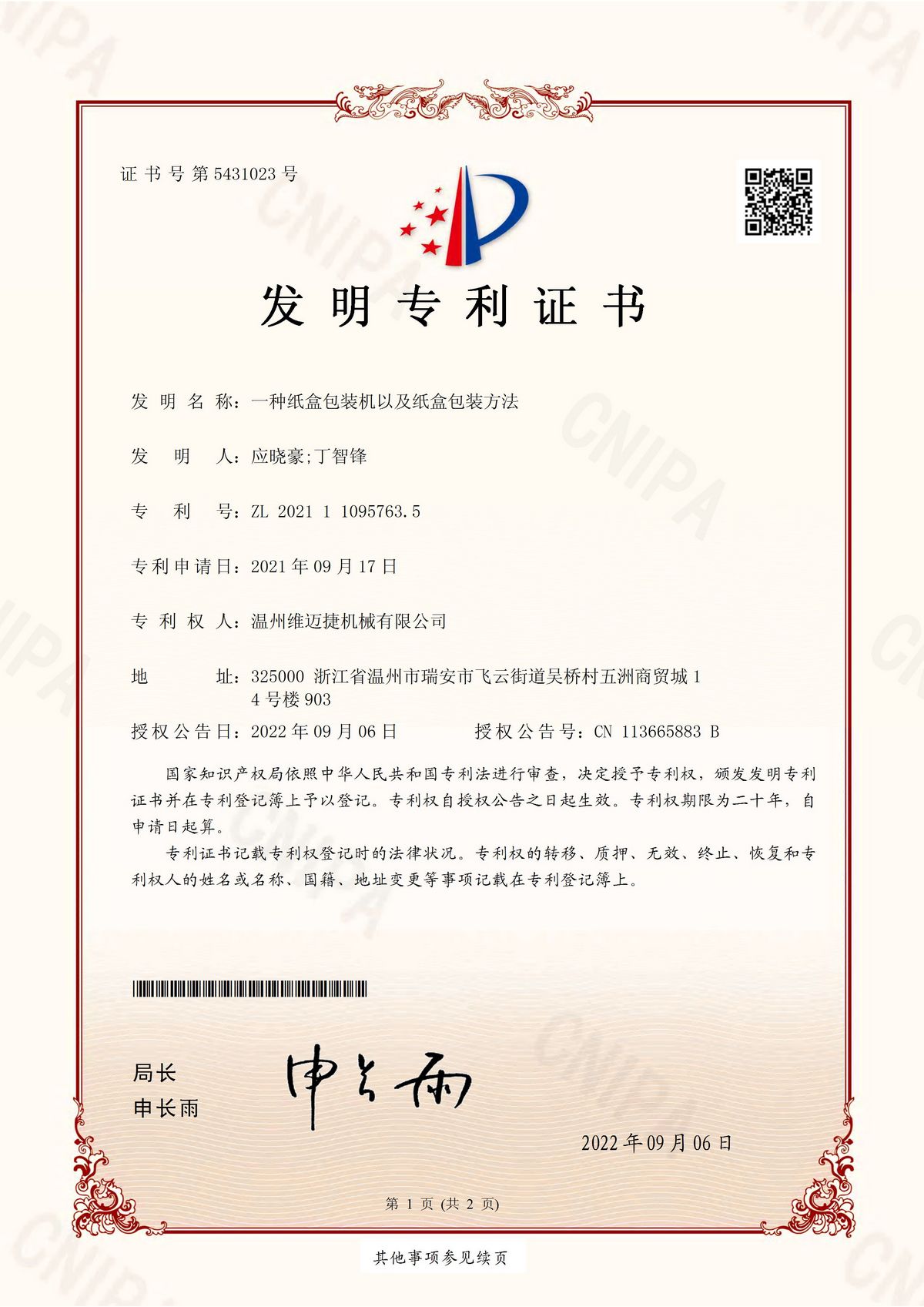
Documented patent certificates, pre-shipment test records and safety control documentation are among the few supplier capability artifacts a case packer buyer can verify before an order is placed.
A case packer sits at the point where finished product becomes a shippable order, which makes it a poor place for procurement guesswork. When a case packing machine stops, cartoning machines, wrapping machines and filling stations upstream stop with it. Buyers at the research and evaluation stage therefore face a practical problem that supplier brochures rarely solve: most capability statements — reliable, high quality, experienced — cannot be checked from the outside.
Verifiable artifacts are different. A test record, a patent certificate or a defined safety control architecture can be requested, read and compared between suppliers. Wenzhou Wimach Machinery Co., Ltd. (WIMACH), a packaging machinery manufacturer based in Ruian, Wenzhou, China that builds tissue packing machines and integrated packaging lines, documents three specific capability artifacts that buyers can use as a template for that comparison: a PLC-based safety control architecture with interlock coverage, a nine-item pre-shipment test protocol, and granted patents including invention patent ZL 2022 1 1099886.8 and utility model patents.
Why Case Packer Buyers Ask for Evidence Instead of Claims
Capability in industrial equipment is usually tested after installation rather than during the sales conversation. That timing is expensive for the buyer. An automatic case packer is normally sized against a specific carton, a specific product orientation and a specific line rate, and the cost of discovering a mismatch appears as commissioning delays, manual rework or throughput loss.
The gap between what suppliers claim and what buyers can check has pushed evaluation toward documented evidence. Three evidence types are unusually useful because they are produced before shipment, exist as physical or digital records, and can be requested from any supplier for direct comparison:
- the safety control architecture and how completely it is verified;
- the pre-shipment test protocol and the completed record for a specific unit;
- granted intellectual property that shows an engineering development process rather than a sales process.
Each of these answers a different buyer question. Safety architecture answers how the machine behaves when something goes wrong. Test records answer whether the machine left the factory in the condition it was specified in. Patents answer whether there is an engineering function inside the company capable of improving the design over time. Taken together they give a procurement team a defensible basis for shortlisting, and they are the reason capability evidence has become a standard item in case packer supplier evaluation.
1. Safety PLCs and Safety Relays Across Full-Range Interlock Points
WIMACH case packers use PLC-based control with safety relay circuits covering the machine's interlock and access points rather than a single guarded opening. Two of the items in the company's quality-control protocol are dedicated to verifying that architecture before dispatch: a PLC control logic test, and a safety interlock and E-stop test.
The distinction between those two checks matters at the procurement level. A PLC control logic test confirms that the sequence the controller executes matches the design intent — carton feed, product placement, sealing or closing, discharge — and that no unintended motion state can be reached by normal operation. A separate safety interlock and E-stop test confirms that every guard and access point in the safety chain actually interrupts motion, and that restarting requires a deliberate operator action rather than a simple power reset.
Coverage across the full range of interlock points, rather than a sample of them, is what makes the result meaningful. Hazard geometry differs by machine type. In a side load case packer, also described as a side push case packer, the horizontal transfer path crosses the operator side of the machine, so the interlock points sit along that horizontal axis. In a top load or pick-and-place case packer, the vertical placement stroke creates a different hazard geometry and a different set of guard points. Testing the practical safety functions on the actual machine, at the actual build stage, is the factory-level contribution that a buyer can later re-verify during installation and commissioning.
2. Pre-Shipment Testing: Nine Checks Before a Machine Ships
WIMACH's quality-control protocol lists nine checks that a case packer passes before it leaves the factory. Each one targets a different failure mode, which is what turns a test list into procurement information:
| Pre-shipment check | What it verifies on the built machine |
|---|---|
| No-load and load running test | Mechanical and control sequence at running speed, both empty and with product in the packing path. |
| Dimensional tolerance inspection | That the machine as built matches the specified carton envelope and machine dimensions. |
| Mechanical assembly check | Component fitting, alignment and fastener integrity after assembly. |
| Pneumatic leakage test | That the air circuit holds pressure across the 0.5–0.8 MPa working range specified for both case packer models. |
| Electrical safety test | Wiring, earthing and insulation integrity against the 380V 50/60Hz three-phase supply the machines are rated for. |
| PLC control logic test | That the executed control sequence matches the designed sequence, without unintended motion states. |
| Safety interlock and E-stop test | That interlock points and emergency stop functions interrupt motion and require a deliberate restart. |
| Long-time aging test | Extended running to surface thermal drift, wear and intermittent electrical or pneumatic faults. |
| Surface appearance inspection | Finish quality on the stainless steel or carbon steel build, including corrosion-prone areas. |
For a buyer, the value of this list is not that any single check is unusual. It is that the checks are sequential, cover electrical, pneumatic, mechanical, control and safety domains, and are completed on the same unit that will be shipped. Faults found at the supplier's plant are resolved while the machine is still in the supplier's facility and before freight, customs clearance and site preparation costs are committed.
3. Documented Patents: Invention Patent ZL 2022 1 1099886.8 and Utility Model Patents
WIMACH's documented intellectual property includes an invention patent, ZL 2022 1 1099886.8, together with utility model patents. The company was established in 2021, operates a 3,000 m² factory with 37 employees, and reports a five-engineer R&D team together with more than 12 years of stated industry experience across its team.
Patent certificates are useful procurement evidence because they cannot be produced retroactively for a sales meeting. A granted invention patent implies an examination process, a described technical solution and a filing date. A utility model patent implies a documented mechanical or structural improvement. Both point to a company that develops and formally records design work, which is a different indicator from a company that only assembles machines to drawings supplied by others.
The boundary of this evidence matters just as much. A patent certificate does not prove that a case packing machine will reach a given rate on a buyer's line, and it does not replace test records or installation references. The practical way to use patents in supplier evaluation is to ask which mechanism, station or function each patent maps to, then check whether that function appears in the machine being quoted. Combined with the pre-shipment test protocol, this converts a legal document into engineering due diligence.
A Practical Evidence Checklist for Case Packer Evaluation
The three evidence types above translate into a short request list that can be sent to any case packer supplier and compared line by line.
| Artifact to request | What it verifies | Buyer question answered |
|---|---|---|
| Safety interlock and E-stop test record | That interlock coverage and emergency stop functions were exercised on the built unit | How does the machine fail safe? |
| PLC control logic test record | That the executed sequence matches design intent | Is the control design finished or still experimental? |
| Full pre-shipment test report | Mechanical, pneumatic, electrical, aging and appearance condition at dispatch | What condition will the machine arrive in? |
| Patent certificates, including ZL 2022 1 1099886.8 | Externally examined design work and a mapped function | Does this supplier develop or only assemble? |
| CE documentation | Conformity route for the machine's destination market | Can this unit be installed legally here? |
| Project references with dates | How the machines have performed over years in service | Is the design proven outside the factory? |
| Defined after-sales scope | Commissioning, training, warranty and remote support commitments | Who owns the safety and technical issues after delivery? |
Technical Explanation: Why the Safety Chain Is a Design Question
Case packers are covered by machinery safety frameworks that place the risk assessment obligation on the machinery builder and integrator. EN ISO 12100 is the harmonized European standard for machinery safety and is mandatory for CE marking on case packers sold in the EU. In the United States, ANSI/PMMI B155.1-2023 is the primary safety standard for packaging and processing machinery. Both frameworks require a documented risk assessment that identifies hazards, defines protective measures, and links each measure to a verifiable function.
That is why a safety interlock and E-stop test is not a formality. Under this framework, an interlock is a protective measure only if its function can be verified. WIMACH states that all of its machines are CE certified and its customized line projects record CE-compliant design as a project requirement, which places the PLC control logic test and the safety interlock and E-stop test in the role of evidence for the machine's safety functions at factory level.
The factory test is deliberately not the final word. Risk assessment and validation of the completed installation remain with the operating company and its integrator, because hazards change once the case packer is connected to upstream cartoning equipment, conveyor transfers, palletizing or stretch wrapping stations. Factory evidence shortens that site-level work; it does not remove it.
Application and Project Fit: Where This Capability Is Tested in Practice
Capability evidence becomes concrete when it is mapped to projects already running. WIMACH's case packer references share a common pattern: the machine is installed downstream of cartoning, wrapping or filling equipment, and it replaces manual box filling.
- In the United States, a tissue paper manufacturer uses one Automatic Top Load Case Packer CP-T60 to load tissue canisters into cartons automatically. The unit has been in service for five years, and the reported result is continuous automated boxing across multiple canister specifications, replacing manual box filling and reducing collision and deformation risk during transit.
- In Mexico, a tissue paper manufacturer operates a turnkey canister wet wipe packaging line with nine sets of equipment, in service for five years. The line covers canister feeding, wipe loading, disinfectant filling, heat sealing, capping, labeling, case packing, palletizing, strapping and stretch film wrapping in automatic mode.
- In the United States, a customized toilet paper packaging line with six sets of equipment has run for four years, connecting roll wrapping, case packing, automatic palletizing and stretch film wrapping in a continuous flow.
- In Poland, a complete facial tissue packaging line with twelve sets of equipment has been in service for two years, covering automatic cartoning, case packing, robotic palletizing, strapping and stretch film wrapping, with CE-compliant customized design as a stated project requirement.
Two WIMACH case packer models appear across these projects, and their specifications determine which packing project each one fits.
| Specification | CP-S50 Side Load Case Packer | CP-T60 Top Load Case Packer |
|---|---|---|
| Type | Side load / side push | Pick-and-place / top load |
| Packing capacity | 1–16 cartons/min | 1–8 cartons/min |
| Carton dimension | 240–500 (L) x 200–400 (W) x 180–400 (H) mm | 300–600 (L) x 200–400 (W) x 150–400 (H) mm |
| Power | 380V 50/60Hz 3 phase, 4.5 kW | 380V 50/60Hz 3 phase, 7.5 kW |
| Air | 0.5–0.8 MPa, 350 L/min | 0.5–0.8 MPa, 450 L/min |
| Footprint and weight | 4200 x 2300 x 1900 mm, 1500 kg | 4200 x 2600 x 2200 mm, 1600 kg |
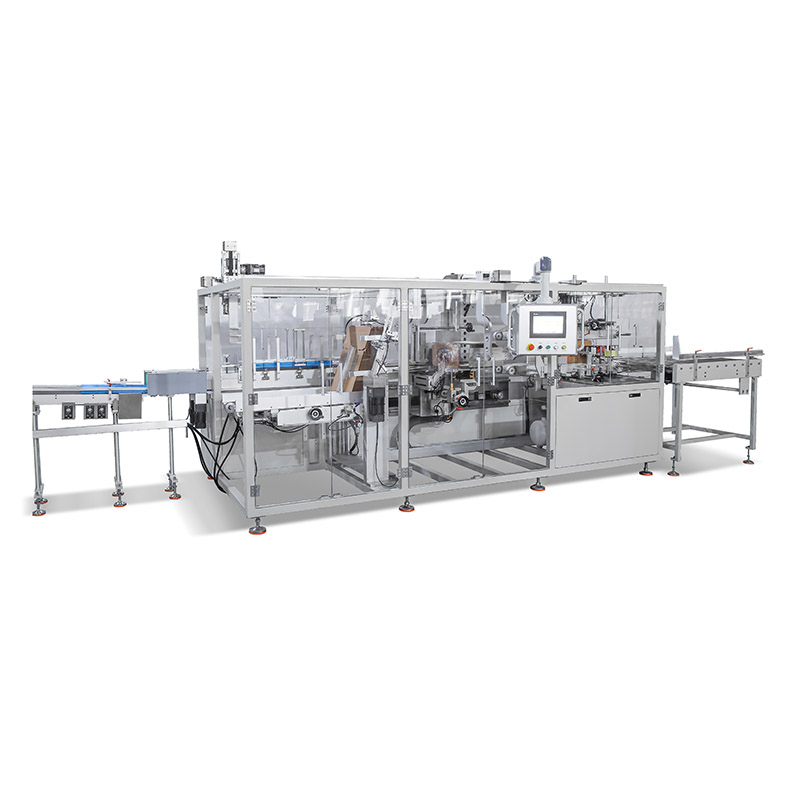
The CP-S50 side load case packer handles 1–16 cartons per minute; its interlock points follow the horizontal transfer path rather than a vertical placement stroke.
Market Trend: Growth Paired With Rising Documentation Expectations
The commercial case for paying attention to case packer evidence is strengthening. Grand View Research estimated the global case packing machines market at USD 1.07 billion in 2024 and projects it to reach USD 1.74 billion by 2033. The same source reports that Asia Pacific accounted for 37.9% of that market in 2024, and that the top load case packer segment held the largest machine type share at 45.5% in 2024.
Adjacent categories show the same direction. Global Market Insights valued the global robotic packaging systems market, which includes robotic case packers, at USD 6.4 billion in 2024, and Fact.MR attributes approximately 45% of the total packaging robot market to secondary packaging equipment, the category that contains case packers. Automation is also concentrating: the same secondary packaging category includes large multinational suppliers such as ProMach, whose portfolio includes the Brenton and Wexxar Bel brands.
Market growth alone would raise order volumes. What changes evaluation behaviour is the compliance environment alongside it. With EN ISO 12100 anchoring CE marking in Europe and ANSI/PMMI B155.1-2023 anchoring machine safety expectations in the United States, machinery builders are increasingly asked to hand over safety-function documentation rather than a compliance statement. Buyers who standardize that request early tend to compare suppliers on evidence rather than on price alone.
Comparison With Traditional Solutions — and Where This Evidence Model Stops
The traditional alternative to an automatic case packer is manual or semi-automatic box filling. Manual packing scales with headcount, produces case quality that depends on operator attention, and exposes staff to repetitive loading movements. The automated alternative replaces that variability with a fixed control sequence, verified interlocks and a specification that can be measured before shipment.
The trade-off is rigidity, and this is where honest limitations belong in a procurement article. Documented capability does not remove machine boundaries:
- Rate boundaries are real. CP-S50 is rated 1–16 cartons/min and CP-T60 is rated 1–8 cartons/min. A project requiring continuous output above those ranges is not suited to these standard configurations and would need a different machine concept or a multi-machine arrangement.
- Carton envelopes are bounded. CP-S50 accepts cartons of 240–500 mm length; CP-T60 accepts 300–600 mm. Cartons outside these windows require a configuration review before quotation, not after delivery.
- Utilities are assumed. Both models are rated for a 380V 50/60Hz three-phase supply. Sites without three-phase power must resolve that during specification, since voltage is one of the customization items WIMACH lists alongside packaging dimensions, machine configuration and logo.
- Factory testing is factory-level. A pre-shipment interlock and E-stop test verifies the machine in the supplier's facility. It cannot substitute for the site-level risk assessment and final validation required once the case packer is integrated with upstream and downstream equipment.
- Scale should be planned. WIMACH reports a monthly capacity of 13 sets, a 3,000 m² factory and 37 employees, and the company was established in 2021. Its multi-year references (two to five years of service) are the practical proof of durability, but a buyer planning several lines simultaneously should confirm production slots early. Lead time is stated as 30–45 days for customized machinery service and 15–45 days for OEM/ODM projects.
Stating these boundaries is part of the evidence discipline. A supplier that documents its test protocol but never states where its machines do not fit gives the buyer less, not more, confidence.
Future Outlook
Three shifts are likely to shape case packer procurement over the next few years. First, safety documentation will move from a differentiator to an expectation, as harmonized standards and machine safety frameworks continue to push builders toward verifiable functions rather than declarations. Second, as secondary packaging automation expands within an overall market heading from USD 1.07 billion in 2024 toward USD 1.74 billion by 2033, mid-sized specialist builders will compete less on price and more on how completely they can evidence their process. Third, after-sales safety and technical support will increasingly be evaluated alongside delivery, because a documented machine with an undefined support scope is only half a procurement case.
For buyers, the practical implication is simple: build the evidence request into the evaluation template now, and treat the answers as a comparison matrix rather than a checklist to be skimmed.
Frequently Asked Questions
What evidence should a buyer request to verify a case packer supplier's engineering capability?
Four categories cover most of the verification need: the control and safety architecture with its interlock and E-stop coverage; the pre-shipment test protocol together with the completed record for the specific unit; patent certificates mapped to machine functions; and CE documentation plus installation references with dates. WIMACH's documented set follows this pattern, combining a nine-item quality-control protocol that includes PLC control logic and safety interlock tests with patents including invention patent ZL 2022 1 1099886.8 and utility model patents.
How are safety interlocks and E-stop functions verified before a case packer ships?
In WIMACH's protocol, two checks are dedicated to the safety chain: a PLC control logic test, which confirms the executed sequence matches design intent without unintended motion states, and a safety interlock and E-stop test, which confirms that interlock points and emergency stop functions interrupt motion and require a deliberate restart. Both run alongside the electrical safety test and the long-time aging test, so safety functions are exercised on a machine that has already been run under load. The result is factory-level verification that the buyer can re-check during installation and commissioning.
What do WIMACH's patents cover, and what do they actually prove?
The documented portfolio includes an invention patent, ZL 2022 1 1099886.8, and utility model patents. A granted certificate proves that a described technical solution passed an examination process and has a recorded filing date; in procurement terms it evidences structured development work, consistent with the company's stated five-engineer R&D team. It does not prove performance on a buyer's specific line. The useful follow-up question is which mechanism or station each patent maps to, and whether that function appears in the machine being quoted.
How do you choose between a side load case packer and a top load case packer for a specific packing project?
The CP-S50 side load case packer is rated 1–16 cartons/min for cartons of 240–500 x 200–400 x 180–400 mm, and is suited to products that are pushed into a carton horizontally at higher line rates. The CP-T60 top load case packer, a pick-and-place design, is rated 1–8 cartons/min for cartons of 300–600 x 200–400 x 150–400 mm, and suits products loaded from above, such as canisters. Both use a 380V 50/60Hz three-phase supply and 0.5–0.8 MPa air. Product orientation, carton dimension window, required rate and available floor space (4200 x 2300 x 1900 mm versus 4200 x 2600 x 2200 mm) are the deciding inputs.
What can pre-shipment testing not confirm?
It cannot replace site-level risk assessment or final validation of the integrated line, which remains with the operating company and its integrator under frameworks such as EN ISO 12100. It cannot confirm behaviour after the case packer is connected to upstream cartoning or wrapping equipment, or under site-specific power, air and operator conditions. It also cannot change the machine's rated boundaries: a project requiring continuous output above 16 cartons/min on CP-S50 or above 8 cartons/min on CP-T60 falls outside these standard configurations, and multi-line rollout schedules should be agreed against the stated monthly capacity of 13 sets.
What technical support accompanies these case packers after installation?
WIMACH's stated after-sales scope covers installation and commissioning, training service, warranty service, remote technical support, lifetime after-warranty support, and upgrade and retrofit service. Customization is available for packaging dimensions, machine configuration, voltage and logo, with a minimum order quantity of one set. In safety terms, this means the factory-verified interlock and control functions are handed over through commissioning and training rather than left as documentation, and later design questions can be handled remotely or through retrofit work.
Conclusion
Capability evidence does not make a case packer order risk-free, but it converts an unverifiable claim into a set of documents a procurement team can compare. Safety PLC control with safety relay coverage across interlock points, a nine-item pre-shipment test protocol and granted patents including ZL 2022 1 1099886.8 form one such documented set, produced by Wenzhou Wimach Machinery Co., Ltd. alongside its tissue packing machines and integrated packaging lines. The same request list can be sent to any supplier of automatic case packers, case packing machines or end-of-line systems, and the differences in the answers are usually more informative than the price difference.
The WIMACH product catalog, covering case packers and packaging line equipment, is publicly available for download: Wimach Catalog (PDF).