
Exam Halls to Factory Floors: Policy and Pen Demand in 2026
Institutional demand for writing instruments is decided in procurement documents long before it reaches a factory floor. Schools, examination authorities, municipal offices and corporate facilities buy pens and pencils in concentrated blocks against published acceptance criteria — and in 2026 those criteria, rather than unit price, decide which suppliers are eligible to bid at all.
The commercial scale behind that paperwork is considerable. Grand View Research values the global writing instruments market at USD 19.2 billion in 2025 and projects USD 27.8 billion by 2033, while Spherical Insights sizes the broader office supplies market at approximately USD 176.5 billion in 2024. Within writing instruments, pens took a 36.3% revenue share in 2025 — the single largest product block, and the one most exposed to specification-driven buying.
What follows examines how education and institutional purchasing rules translate into scenario-specific demand, how two product families — thermally erasable gel pens and non-sharpen pencils — respond to that demand at the parameter level, and what buyers should put into acceptance criteria before an order is confirmed. Kunshan Crystal Culture Co.,Ltd, which trades as Greenwill stationery, is used as a documented reference case throughout: a Chinese stationery manufacturer founded in 1999 in Kunshan, Jiangsu Province, producing erasable writing pens, non-sharpen pencils and eco-friendly erasers, with roughly 90% of output exported.

Why Institutional Pen Demand Is a Compliance Question Before It Is a Price Question
A pen bought by an examination board is not the same purchase as a pen bought by an individual. The institutional version arrives with a specification: article type, tip size, ink colour, barrel material, packaging format, safety standard, quantity per delivery window and acceptance test method. Education buyers and public administrators carry downstream exposure on items handled by students, which is why material declarations tend to outweigh brand familiarity in the first evaluation round.
The practical consequence is a two-stage filter. Stage one is documentary: does the supplier hold a current test report and a management-system certificate whose scope covers the article actually being purchased? Stage two is operational: can that supplier hold the specified quality across the whole delivery window without silently changing material? Suppliers who pass stage one but fail stage two are common in tenders. Suppliers who cannot produce stage-one documents are not evaluated at all, regardless of price.
This is where policy and procurement practice converge. Rules on child-use product safety, chemical declarations and management-system certification do not name pen models, but they define the file that any bid must contain. For the buyer, the productive question is therefore not which pen is best but which documented article meets the stated criteria at a verifiable cost.
The Acceptance Criteria Stack: What Buyers Actually Ask For
Across institutional specifications, the same six criterion families recur. The table below maps each one to the reference point normally cited in the tender document and the evidence format the supplier is expected to submit.
| Criterion | What the document typically specifies | Reference point | Evidence format |
|---|---|---|---|
| Child-use material safety | Migration limits for heavy metals and certain substances in materials handled by students | EN71-1/2/3/9 | Test report per material and colour |
| Chemical declaration | Screening for substances of very high concern, polycyclic aromatic hydrocarbons and restricted substances | REACH, SVHC, PAHs | Declaration plus supporting test report |
| US art-material labelling | Health-hazard labelling for art materials placed on the US market | ASTM D4236 / LHAMA | Labelling and test documentation |
| Ballpoint performance | Requirements and test methods for ballpoint pens and refills for general use | ISO 12757-1 | Product test data |
| Management systems | Quality, environmental and occupational health & safety certification with a scope covering the article | ISO 9001:2015, ISO 14001:2015, ISO 45001:2018 | Certificate with number, scope and expiry date |
| Physical specification | Tip size, ink colours, lead hardness, barrel material, MOQ and packing | Buyer specification | Approved sample plus spec sheet |
A certificate is only useful to a buyer if the scope and validity are readable on its face. Greenwill's records show the level of detail an institutional file should carry: ISO 9001:2015 certificate 00124Q32003R4M/3600 issued by CQC for the production of eco eraser and stationery items, ISO 14001:2015 certificate 00124E31027R4M/3600, and ISO 45001:2018 certificate 00124S30827K4M/3600 — all three issued on 15 March 2024 and valid to 19 March 2027.
Two details in that list are routinely missed in tender review. First, the issuing body and certificate number allow independent verification rather than reliance on a scanned logo. Second, the scope wording has to be read against the article being purchased, not treated as a binary yes/no field.
Two Product Families, Two Different Constraint Profiles
Thermally erasable gel pens
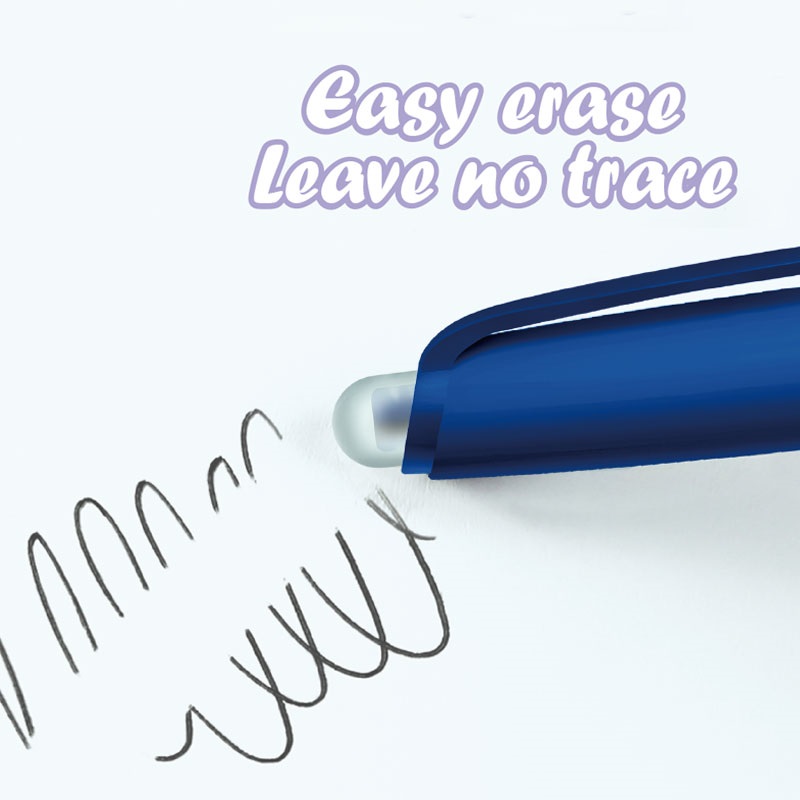
An erasable gel pen replaces part of the conventional colourant system with heat-sensitive erasable ink. Writing lays down ink normally; friction from the eraser tip raises the local temperature past the ink's colour-change threshold, and the mark turns transparent rather than being lifted off the paper. That mechanism is why the technical description reads “thermal erasable” and why the erasing action leaves no shavings or residue behind.
The constraint profile follows directly from the ink chemistry. Greenwill's erasable gel pen models KP18001 and KP100751 both use a 0.5 mm tip and are specified against EN71 and ASTM D-4236. KP18001 combines ABS+AS plastic with heat-sensitive erasable ink in multi-colour options; KP100751 runs Black, Blue and Red in an ABS barrel with erasable gel ink. Both carry a MOQ of 5,000 pcs. For a buyer, the 0.5 mm tip and the fixed colour set are hard constraints on the specification side — a change of either requires a new approved sample rather than an in-line substitution.
Non-sharpen pencils
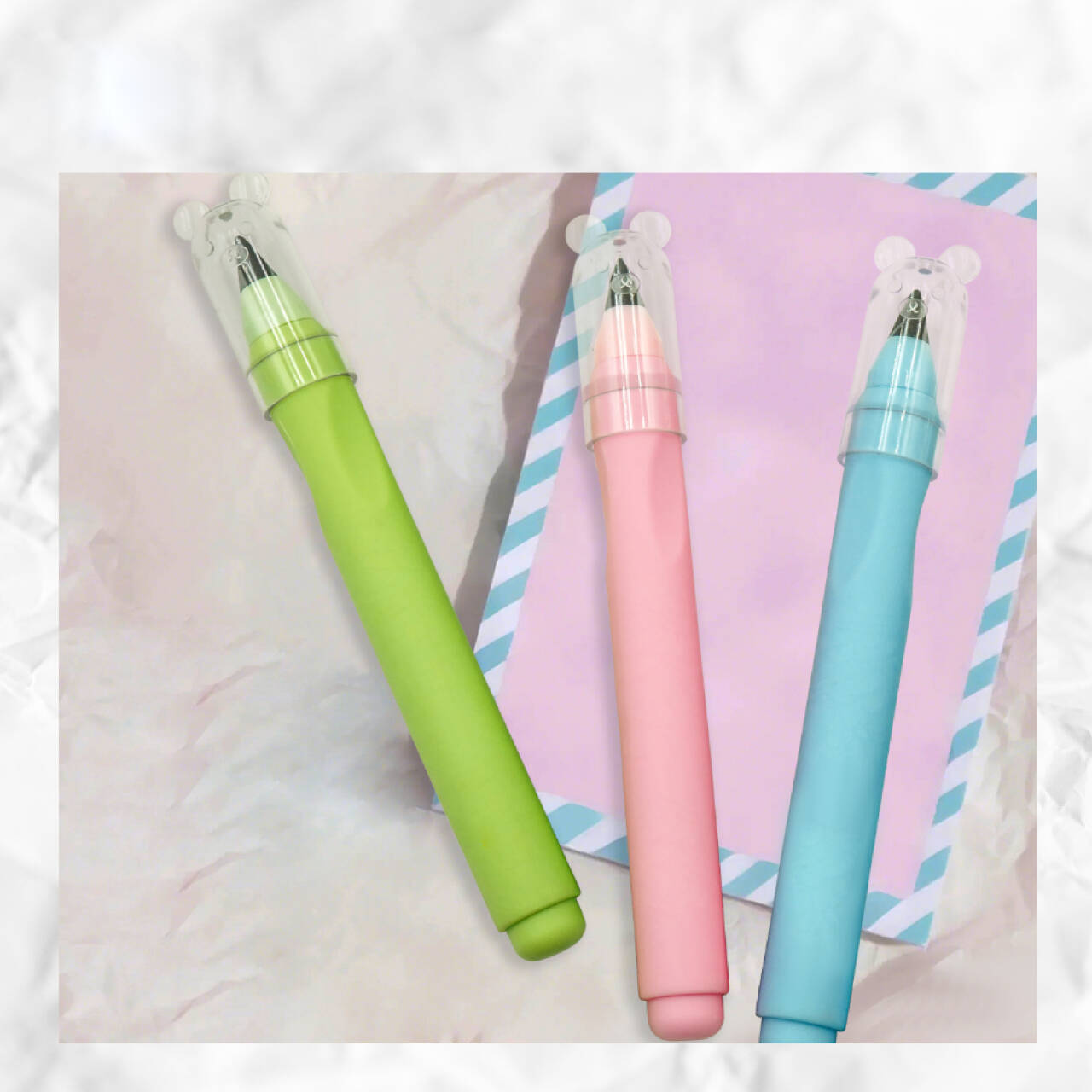
The second family removes sharpening altogether. A non-sharpen pencil combines a TPE barrel, an alloy nib and an ABS cap around a graphite core at HB hardness. Nothing is cut away, so there are no shavings, no blade and no sharpener to distribute — the article is written down to the nib and then replaced.
Greenwill's EP18004 / EP18004-1 and SL241203 models share that construction and are specified against EN71, SVHC and PAHs, with a MOQ of 20,000 pcs. The supplier's own comparison positions one eraser-tipped non-sharpen pencil as the equivalent of 20 wooden pencils plus 2 erasers and 2 sharpeners. That is a manufacturer's cost-performance claim rather than an independently verified figure, and buyers should validate it against their own consumption records before it enters a business case.
| Model | Type | Key parameters | Standard cited | MOQ |
|---|---|---|---|---|
| KP18001 | Erasable gel pen | ABS+AS plastic, heat-sensitive erasable ink, 0.5 mm, multi-colour | EN71, ASTM D-4236 | 5,000 pcs |
| KP100751 | Erasable gel pen | ABS + erasable gel ink, 0.5 mm, Black/Blue/Red | EN71, ASTM | 5,000 pcs |
| EP18004 / EP18004-1 | Non-sharpen pencil | TPE + alloy nib + ABS cap, HB lead hardness | EN71, SVHC, PAHs | 20,000 pcs |
| SL241203 | Non-sharpen pencil | TPE + alloy nib + ABS cap, HB, built-in eraser | Not stated in catalogue entry | Not stated in catalogue entry |
From Exam Hall to Factory Floor: How the Scenario Changes the Specification
The same product family is specified differently depending on where the writing happens. Greenwill's application records for stationery and office-supply channels — covering Italy, Spain and Germany — describe daily classroom and office use with high-frequency writing as the operating condition, and list smooth writing, quick-drying ink, erasable or refillable construction and a comfort grip for long sessions as the functional requirements.
The examination hall
In an examination hall the dominant constraint is consistency. Candidates write for extended periods under time pressure, so the specification centres on a grip that does not fatigue, uniform ink laydown across a batch so that no candidate receives a drier pen, and packaging that survives distribution to hundreds of desks. Whether an erasable format is permitted at all is a matter for the examining authority's own regulations — which means the buyer should state the permitted article type explicitly in the specification rather than leaving the choice to the supplier.
The office desk
On an office desk the constraint shifts from stamina to correction. Draft documents, routing slips and internal sign-off all involve revision, which is the natural territory of thermally erasable ink. The procurement consequence is a separation that many organisations fail to write down: working documents and archival records should be assigned different articles in the specification, because an erasable mark and a permanent mark serve different retention requirements.
The factory floor
On a factory floor, a writing instrument is a data-capture tool. Operators record checks, deviations and shift handovers on paper that stays on the line, so smudge resistance, quick-drying ink and a barrel that survives being clipped to a board matter more than finish. Here the non-sharpen pencil has a specific operational argument: no blade means no shavings in a controlled area, and no sharpening interruption mid-shift.
The retail shelf
For distributors and retail chains the constraint becomes reorder logic and shelf presentation. Greenwill's case records cover gift and promotional companies, stationery importers and distributors, OEM/ODM partners and supermarkets across Germany, Argentina, Brazil, France, Italy and the United States, with relationships running more than five years and some beyond ten. The stated outcome in those accounts is shelf appeal through creative and colourful designs rather than unit-cost advantage — a different objective from the examination hall, and one that changes what the specification should ask for.
Market Signals: Where Volume and Value Are Moving
The category data points in one direction. Dataintelo values the global gel pen market at USD 4.8 billion in 2025, projecting USD 8.1 billion by 2034, with Asia Pacific holding a 42.3% revenue share in 2025 led by China and India. The narrower erasable gel pen segment was valued at USD 1.38 billion in 2024 by Market Intelo, with a projected USD 2.56 billion by 2033. Grand View Research, meanwhile, places pens at 36.3% of a USD 19.2 billion writing instruments market in 2025.
The procurement implication is structural rather than promotional. The categories under the heaviest institutional scrutiny — pens generally, gel pens and erasable formats specifically — are also the categories showing measurable expansion. That combination tends to tighten acceptance criteria rather than relax them, because volume attracts both more bidders and more downstream review.
Production and Export Evidence: What a Buyer Can Actually Verify
Capacity claims are only useful when they can be checked against an order. Greenwill's production base was established in 1999, operates a 25,000 m² factory with around 100 employees and an R&D team of 10, and reports annual output of more than 20 million pens, more than 260 tons of erasers and more than 3 million pencil sharpeners. Roughly 90% of output is exported to North America, South America, Europe, Southeast Asia, Oceania and the Middle East, and the company reports partnerships with 100 international brands, including Papermate, STAEDTLER and Tesco.
On scheduling, the stated daily capacity is 100,000 pcs of pens and 20 tons of erasers, with a lead time of 30–45 days and a general OEM/ODM threshold of normally 20,000 pcs per colour and design. Those two figures do not sit in the same dimension, and that is the point worth noting: for illustration, an institutional order of 500,000 pens fits inside roughly five days of stated daily pen output, yet the 30–45 day lead time shows that moulding, printing, packing and inspection — not daily output — govern the schedule.
Three checks follow from this for any institutional buyer. Verify certificate scope and expiry against the article ordered. Compare stated capacity to the delivery window rather than to the annual requirement. And confirm that the MOQ matches the lot size actually being tendered, since a supplier who accepts an order below the economic batch will resolve the gap somewhere in the process.
Comparison With Traditional Solutions — And Where the Newer Formats Stop Working
The four article types in institutional circulation are not substitutes for one another. Each solves a different problem, and the differences are functional rather than aesthetic.
| Dimension | Standard ballpoint pen | Thermally erasable gel pen | Wooden pencil | Non-sharpen pencil |
|---|---|---|---|---|
| Correction of errors | Not possible without correction fluid | Direct, by friction | Direct, by eraser | Direct, via built-in eraser |
| Sharpeners and blades | Not applicable | Not applicable | Required, with shavings | Not required, no shavings |
| Document permanence | Suitable for archival records | Working-document use | Fade risk over long storage | Working-document use |
| Line weight control | Fixed by tip size | Fixed by tip size | Variable by sharpening | Fixed at HB |
| Consumable logistics | Refill or replace | Replace at end of ink | Replace plus sharpener supply | Replace, no ancillary items |
The boundaries matter as much as the advantages, and four of them are material:
- Heat sensitivity is the mechanism, and also the limit. Thermally erasable ink works precisely because it responds to temperature. That makes an erasable document a working record, not an archival one. Where a signed document must remain legible after heat exposure or long storage, a standard ballpoint or pigment-based ink remains the correct choice.
- A non-sharpen pencil delivers one line weight. The nib is fixed at HB and cannot be sharpened to a fine point, so the format is a poor fit for fine technical drawing or detailed annotation, where a sharpened graphite pencil still holds the advantage.
- Minimum order quantities exclude small buyers. The 5,000 pcs threshold on the erasable pen lines and the 20,000 pcs threshold on the non-sharpen pencil lines mean a school or office buying a few hundred units is not a viable factory-direct account. A distributor consolidating demand is.
- Documentation carries cost. Testing, declarations and certificate maintenance are not free, and the cost sits in the delivered price. A buyer who specifies the full EN71, REACH, SVHC, PAHs and management-system stack for a low-risk adult-use office order may simply be over-specifying and paying for evidence nobody will read.
What Changes for Institutional Buyers
Three shifts look durable rather than cyclical. The first is the migration of compliance documentation from a supplier-side marketing asset to a buyer-side acceptance gate; certificate scope, issuing authority and expiry date are becoming line items in the evaluation matrix rather than attachments. The second is the growth of the erasable and gel segments inside a mature pen market — from USD 1.38 billion in 2024 toward a projected USD 2.56 billion by 2033 for erasable gel pens alone — which increases the number of bidders but not necessarily the number of documented ones. The third is the weight of Asia Pacific capacity, at 42.3% of the gel pen market in 2025, which makes lead-time planning across regions a routine part of tendering rather than an exception.
For the buyer, the practical preparation is unglamorous: a written specification that names the article type, tip size, colour set and standard; a verified certificate file with scope and expiry checked; and a supplier whose MOQ and lead time match the actual delivery window rather than the headline capacity figure. The exam hall and the factory floor are connected by exactly that document.
FAQ: Institutional Pen Procurement Questions
Which standards should an institutional buyer require in a pen or pencil specification?
The requirement set depends on the market and the user group. For items that may be handled by students, EN71-1/2/3/9 migration testing is the common baseline in European procurement, supported by REACH, SVHC and PAHs declarations for restricted substances. For art materials placed on the US market, ASTM D4236 governs health-hazard labelling. Where ballpoint performance itself must be specified, ISO 12757-1 sets out the requirements and test methods for ballpoint pens and refills. Management-system certification — ISO 9001:2015, ISO 14001:2015 and ISO 45001:2018 — is normally requested as a supplier-level condition rather than a product-level one.
Do erasable pens need different compliance documentation from standard ballpoint pens?
The documentation categories are largely the same; the ink chemistry is what differs. Thermally erasable gel pens such as Greenwill KP18001 and KP100751 are specified against EN71 and ASTM D-4236 in the same way as conventional writing instruments, and the material declarations cover the barrel and cap as well as the ink. The additional item specific to this category is a clear statement of the erasable mechanism, so that end users understand the document they are creating is heat-sensitive.
What MOQ and lead time should a school or office buyer expect from factory-direct supply?
In this supplier's catalogue the erasable pen lines start at 5,000 pcs and the non-sharpen pencil lines at 20,000 pcs, while the general OEM/ODM threshold is normally 20,000 pcs per colour and design. Lead time is 30–45 days. Buyers whose annual requirement sits below those thresholds are usually better served through a distributor that consolidates demand than through a direct factory order.
Are erasable gel pens suitable for examinations and official documentation?
Permitted article types in examinations are set by the examining authority, not by the manufacturer, so the first check is the published regulation for the specific examination. Functionally, thermally erasable ink is heat-sensitive by design, which makes it well suited to drafting, revision and working documents, and less suited to records that must remain legible after heat exposure or long-term storage. Institutional buyers commonly separate those two uses in the specification rather than standardising on one article for both.
How does a non-sharpen pencil compare with a wooden pencil for bulk institutional supply?
A non-sharpen pencil removes the sharpening step and its associated consumables. Greenwill's construction uses a TPE barrel, an alloy nib and an ABS cap around an HB graphite core, and the supplier's stated equivalence is one such pencil to 20 wooden pencils plus 2 erasers and 2 sharpeners. Wooden pencils retain an advantage where a sharpened fine point is required. The trade-off for buyers is a higher unit price against fewer line items, no blade waste and no sharpening downtime.
What production evidence can a buyer verify before confirming an institutional order?
Three items are directly checkable. First, certificate scope and validity — for example ISO 9001:2015 certificate 00124Q32003R4M/3600 and ISO 14001:2015 certificate 00124E31027R4M/3600, both issued by CQC on 15 March 2024 and valid to 19 March 2027. Second, capacity against the delivery window: Greenwill's stated pen capacity is 100,000 pcs per day against a 30–45 day lead time, which indicates that tooling and packing, not daily output, set the schedule. Third, whether the stated MOQ matches the lot size the buyer is actually tendering.
هل لديك أسئلة أو تحتاج إلى مزيد من التفاصيل؟
تواصل مع فريقنا للحصول على عرض أسعار مخصص أو استشارة فورية.
طلب عرض أسعار
املأ النموذج أدناه وسيتواصل معك فريقنا بعرض مقترح مخصص.
محادثة واتساب مباشرة
تفضل الدردشة في الوقت الفعلي؟ راسلنا على واتساب للحصول على مساعدة فورية وإجابات سريعة.
- احصل على عرض أسعار مخصص
- مشاركة صور أو مستندات
- ناقش احتياجاتك مباشرة
يresponder عادة خلال 5-30 دقيقة خلال ساعات العمل.