
Exit Sign vs. Combo vs. Bulkhead: A Buyer's Spec Comparison
Exit Sign vs. Combo vs. Bulkhead: A Buyer's Spec Comparison
Emergency lighting programs rarely fail on unit price. They fail on specification. A purchase order that names the wrong input voltage, the wrong battery chemistry, or an enclosure that cannot survive the space it is installed in tends to look correct on paper — until the installer opens the carton.
The cost of that mistake is not limited to a return shipment. Under UL 924, emergency lighting and exit signs must provide at least 90 minutes of illumination during a power failure, according to UL Solutions. In 2022, UL 924 was updated to require active and continuous detection of normal power, moving away from passive detection devices. A specification that was adequate a few years ago can therefore sit outside current expectations even when the hardware itself is intact.
This buyer's comparison places three form factors side by side: a dual-head emergency light, an exit sign combo, and a bulkhead emergency light. It uses JIMING's published product and certification record as the working example, identifies the specification fields that decide whether a unit actually fits a location, and states plainly where each option stops. Where a value is not published in the source material reviewed for this article, that is said directly rather than estimated.
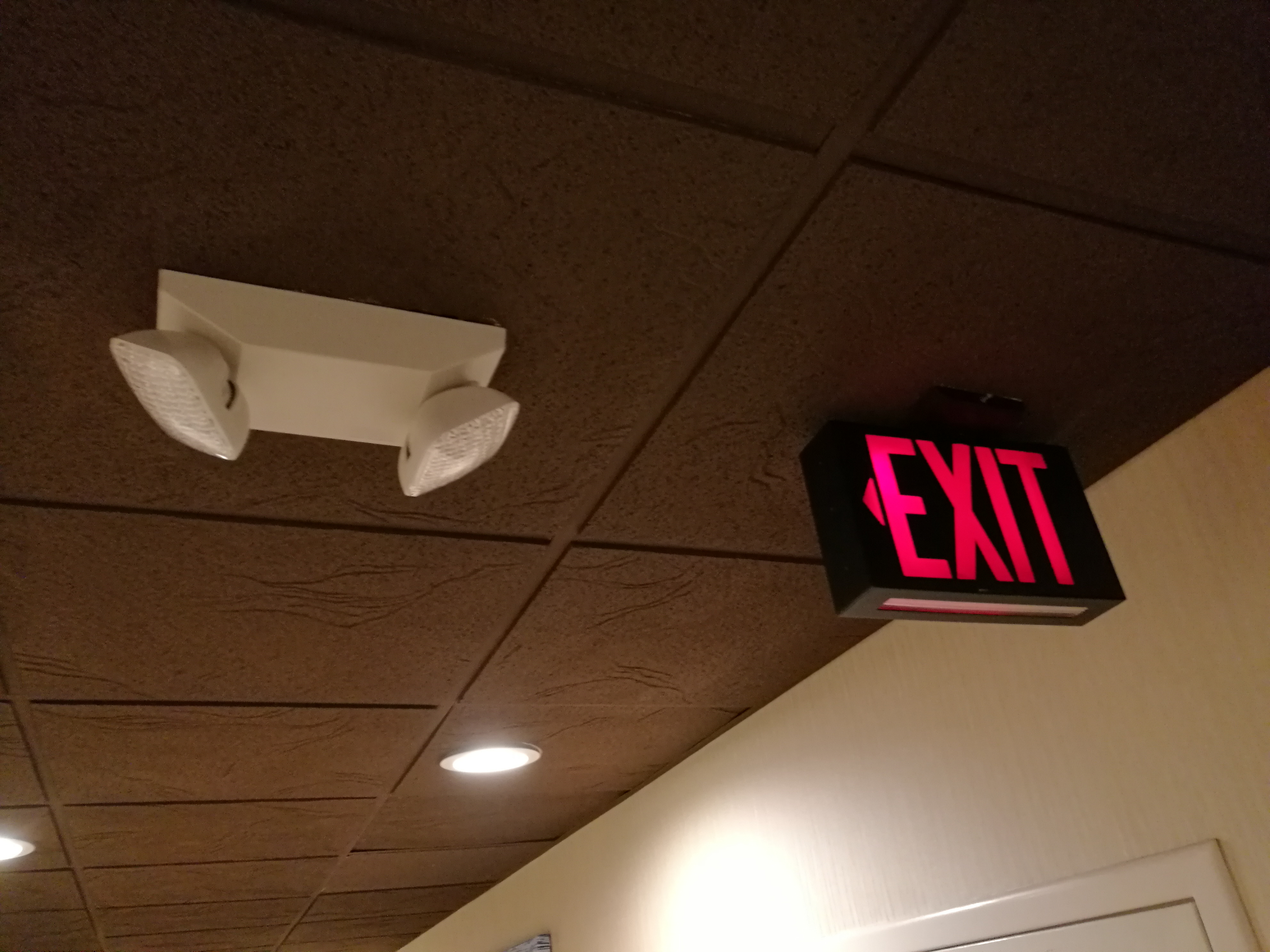
Three form factors, three different jobs
The three product types are not competing versions of one device. They answer different questions on a floor plan, and most commercial projects need more than one of them.
- Exit sign and exit sign combo. An exit sign identifies the egress route. A combo unit adds emergency lamp heads to the same housing, so a single fixture both marks the opening and illuminates the area immediately around it. In practice, combo units are specified at corridor junctions, stair doors, and back-of-house openings where marking and local illumination are both required but two separate devices would be awkward to mount and maintain.
- Dual-head emergency light. A dual-head unit is an area-illumination device, not a marking device. JIMING's JLEU9 is a UL/cUL twin-head LED emergency light whose two lamp heads carry 12 ultra-bright 2835 SMT LEDs each in emergency mode. It is built for wall mounting on a universal J-box mounting pattern, which makes it a practical choice for corridor ends, stair landings, and storage areas where the failure point is general visibility rather than wayfinding.
- Bulkhead emergency light. A bulkhead fixture is an enclosed, hard-wearing luminaire. In practice it is the form factor specified where the housing itself has to resist dust, moisture, or physical contact — which is why it appears so often in parking and service environments. Bulkhead emergency lights sit in JIMING's published product range alongside emergency lights and exit signs.
Because the three answer different questions, the purchasing decision is not which one is best. It is which combination, in what ratio, at which locations — and every one of those answers is settled by a small number of specification fields.
Problem and opportunity: three items, three chances to get it wrong
Sourcing these three fixtures for one project multiplies documentation work. Each form factor carries its own nameplate voltage, battery chemistry, enclosure rating, and certificate of compliance. When the three arrive from three different sources, the buyer owns three verification trails, three spare-battery part numbers, and three lead times that rarely align with a single installation schedule.
The opportunity runs in the opposite direction. A manufacturer that builds across all three form factors can present one certification record, one customization framework, and one delivery program, which reduces the number of documents a buyer has to reconcile. That reduction is only worth something if the buyer still checks each field individually, because consolidation removes administrative risk — not technical risk.
The four specification fields that decide whether a fixture fits
1. Rated voltage and configuration
North American commercial and institutional circuits commonly operate at 120 V or 277 V, while European and many other markets run on 220–240 V mains. A catalogue line that says "LED emergency light" does not tell a buyer which of those they will receive. The JLEU9 removes that specific ambiguity by using 120/277VAC dual voltage operation, so the same catalogue number covers both North American supply voltages. A project in a 220–240 V market needs a different configuration, and that difference belongs on the order confirmation, not in the discovery phase at installation.
2. Battery chemistry and runtime
Nickel-cadmium, nickel-metal-hydride, and lithium iron phosphate cells each carry different recharge behaviour, temperature tolerance, service life, and end-of-life handling obligations. The JLEU9 uses a built-in 3.6V 1000mAh nickel cadmium battery rated for a minimum of 90 minutes of emergency operation, with a maximum of 24 hours for full recharge. Battery type is also listed among JIMING's customization options, which means chemistry can be specified for a program rather than assumed from a photograph.
For buyers, the practical question is not which chemistry is theoretically superior. It is whether the cell will still deliver the rated runtime at year five in the actual ambient temperature of the installation, and whether a replacement battery can be sourced under the same part number when the maintenance cycle arrives. Both questions are answered by the datasheet and the spare-parts list, not by the marketing page.
3. Housing material and flame rating
Two fixtures can look similar and behave very differently in a fire event. The JLEU9 housing is injection-molded thermoplastic ABS carrying a UL 94V-0 flame rating, and the component material is described as fire-retardant. UL 94V-0 is the most demanding of the common vertical-burn classifications applied to plastic parts, and it is the classification a buyer should look for on any plastic emergency lighting enclosure.
Exit sign face legends are commonly produced in clear or translucent polycarbonate, chosen for impact resistance and optical clarity rather than for the same burn performance as an ABS housing. That is a different material decision with a different verification requirement: the housing and the legend are separate parts and should be confirmed separately.
4. Location rating and temperature window
This is the field most often skipped. The JLEU9 is listed for indoor damp locations across a 0°C to 40°C temperature window. That is a real boundary rather than a formality. An unheated parking structure in a cold climate, or a wash-down area, falls outside it — and the correct response is a different enclosure, not a different assumption. Bulkhead fixtures exist precisely because some locations demand an enclosed, sealed housing, which is why the enclosure rating is the first value to request for any bulkhead candidate.
Side-by-side: JLEU9, JLEC2BCW, and LE518
The table below compares the three product families across the fields that determine fit. Published values for the JLEU9 dual-head light come from JIMING's specification record. For the JLEC2BCW exit sign combo and the LE518 bulkhead light, the fields shown are the ones a buyer must confirm against the current datasheet and certificate of compliance for the exact catalogue number.
| Spec field | JLEU9 dual-head emergency light | JLEC2BCW exit sign combo | LE518 bulkhead emergency light |
|---|---|---|---|
| Primary function | Area illumination in emergency mode from two adjustable LED lamp heads | Exit marking plus emergency illumination from one housing | Enclosed illumination in exposed or demanding locations |
| Mounting | Wall mount, universal J-box mounting pattern | Confirm mounting type and box pattern for the intended position | Confirm mounting type and whether surface or recessed |
| Rated input voltage | 120/277VAC dual voltage operation | Confirm nameplate value for the destination market | Confirm nameplate value for the destination market |
| Battery | Built-in 3.6V 1000mAh nickel cadmium | Confirm chemistry, voltage, and rated capacity | Confirm chemistry, voltage, and rated capacity |
| Emergency runtime | Minimum 90 minutes | Confirm rated runtime against the 90-minute UL 924 minimum | Confirm rated runtime against the 90-minute UL 924 minimum |
| Recharge time | Maximum 24 hours to full recharge | Confirm from datasheet | Confirm from datasheet |
| Housing material | Injection-molded thermoplastic ABS, UL 94V-0 flame rating, fire-retardant | Confirm housing and legend materials and flame rating | Confirm enclosure material and flame rating |
| Location rating | Indoor damp location, 0°C to 40°C | Confirm dry or damp location rating | Confirm enclosure rating for dust and moisture exposure |
| Monitoring and test | Test switch and charge indicator | Confirm the means of test and status indication | Confirm the means of test and status indication |
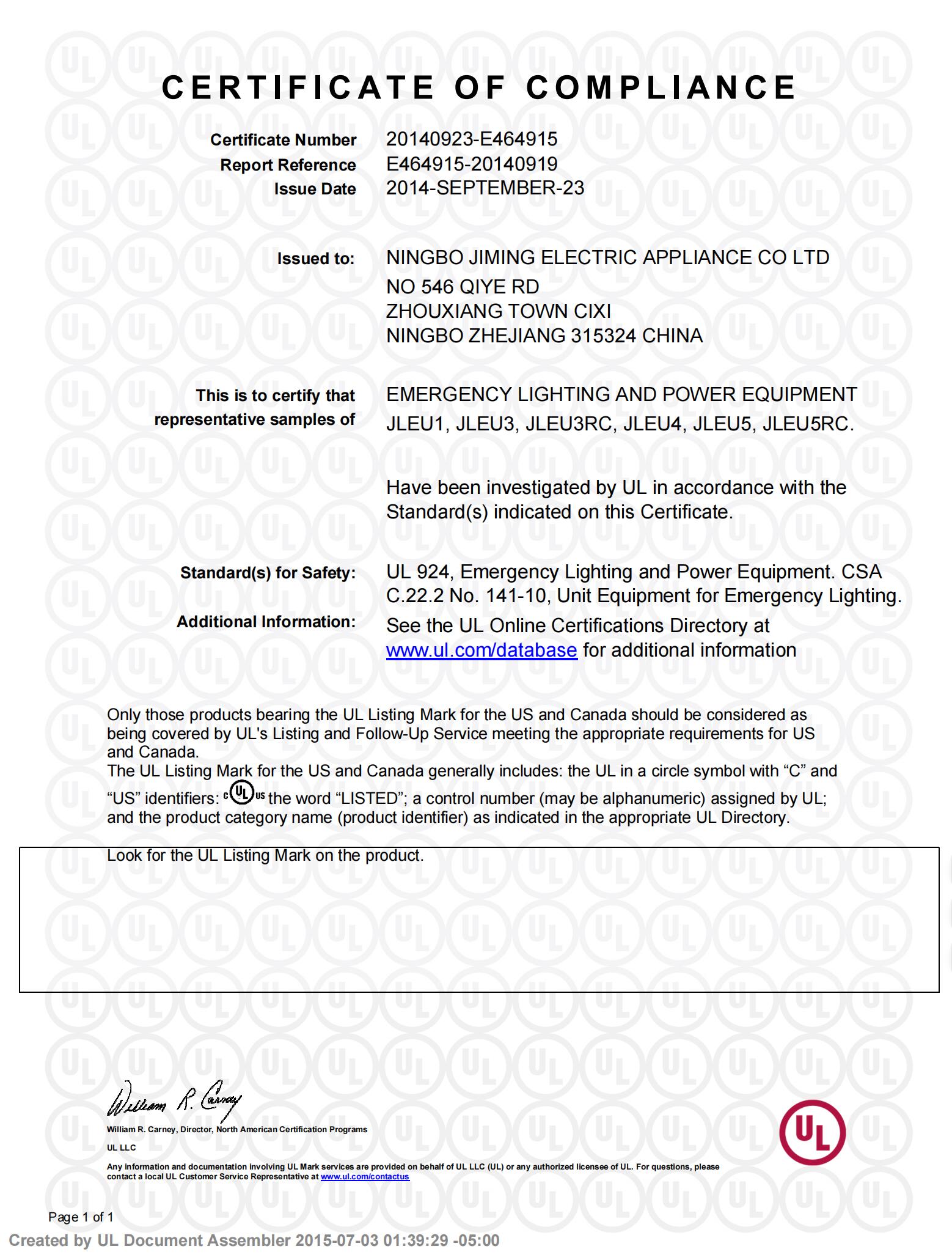
| Listing reference | Emergency light series covered by JIMING's UL certificate 20140923-E464915, issued by UL LLC against UL 924 | Request the certificate of compliance for the exact catalogue number | Request the certificate of compliance for the exact catalogue number |
| Typical deployment | House, building, warehouse, hotel, parking, and security environments, per JIMING's published application set | Egress routes requiring marking plus local illumination | Parking, service, and other enclosed or exposed areas |
Independent note: the JLEU9 column can be specified today from published data. The other two columns require one verification step before the purchase order is released. That step takes minutes and prevents the most expensive category of error in emergency lighting procurement — a fixture that meets the price target and not the site condition.
What to confirm before releasing a purchase order
- Current datasheet showing nameplate voltage and frequency for the destination market.
- Certificate of compliance naming the exact catalogue number, not the product family.
- Battery chemistry, voltage, rated capacity, and rated emergency runtime.
- Housing material and flame rating, listed separately from the legend or lens material.
- Location rating and full ambient temperature window.
- Spare-battery part number and expected replacement interval for the maintenance schedule.
- MOQ, lead time, and trade terms written into the order, not summarized verbally.
The manufacturer behind the range
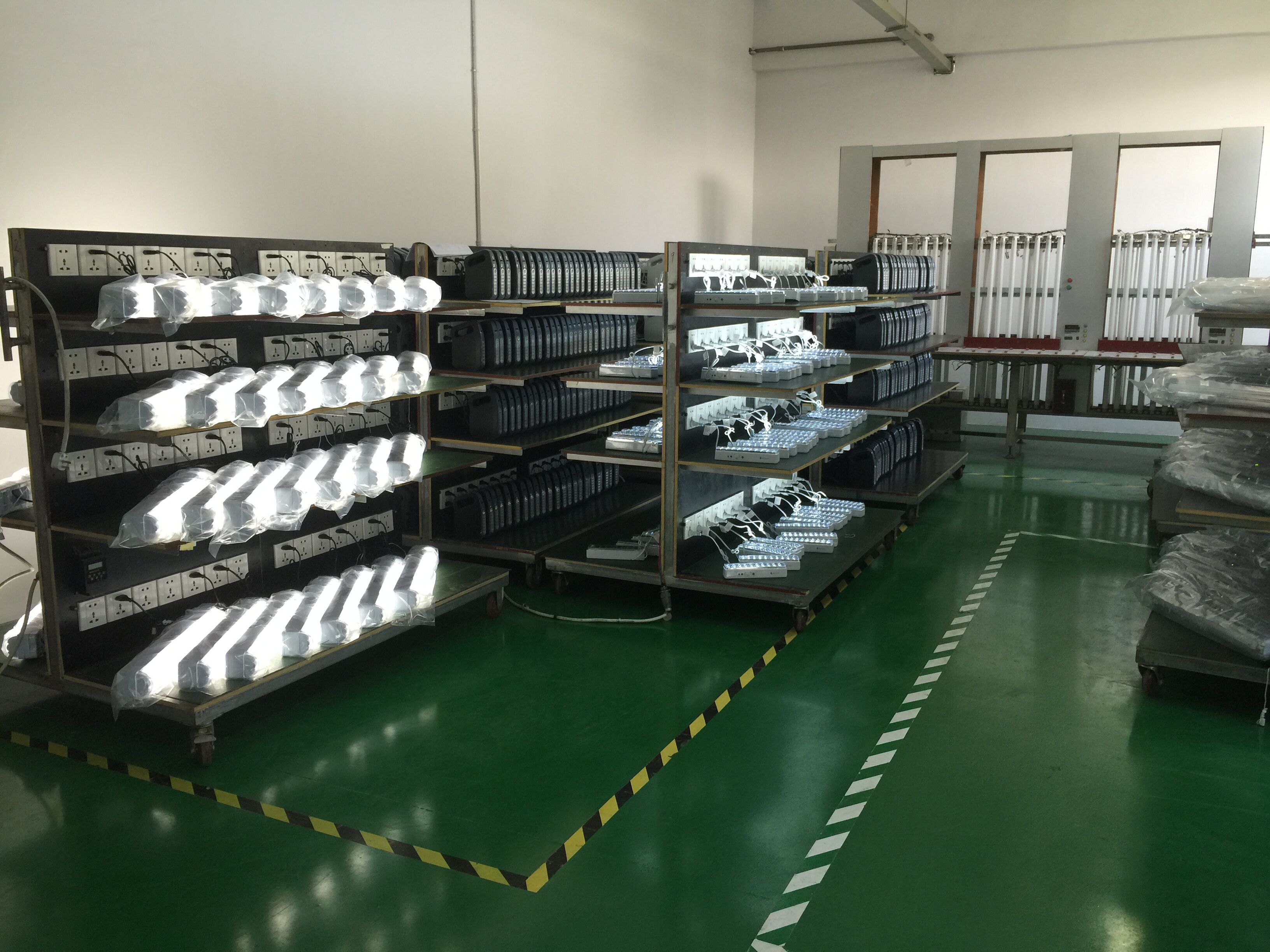
Ningbo JIMING Electric Appliance Co., Ltd. (JIMING) is a Ningbo, China–based emergency lighting manufacturer founded in 1967 that produces emergency lights, exit signs, bulkhead emergency lights, LED emergency drivers, and emergency ballasts, and operates manufacturing sites in Ningbo, China, and Haiphong, Vietnam. The company reports two company-owned factories — China 70,000 m² and Vietnam 38,000 m² — more than 1,000 employees, an annual output of 5,000,000 sets, a 50-plus engineer R&D team, and a 96% export ratio serving markets including the USA, Canada, Europe, and the Middle East.
For a buyer comparing three form factors at once, the relevant part of that profile is documentation depth. JIMING maintains ISO 9001 certification since 1998; its current certificate, number 00125Q33670R3M/3302, was issued by the China Quality Certification Centre and runs to 2 June 2028. A UL certificate, number 20140923-E464915, was issued by UL LLC against UL 924 and expires 23 September 2034. An FCC certificate, number ENB2504250012E00201C, was issued by EMTEK (Ningbo) Co., Ltd. for LED emergency lights under FCC CFR Title 47, Part 15, Subpart B, ANSI C63.4-2014. A CE certificate, number ENB2312180102E01101C, covers LED emergency light products against EN IEC 55015:2019+A11:2020, EN IEC 61547:2023, EN IEC 61000-3-2:2019/A1:2021, and EN 61000-3-3:2013/A2:2021/AC:2022-01. The company states that production is tested unit by unit and that its quality system addresses standards including UL, CSA, CE, NFPA, OSHA, FCC, DOE, CEC, NEC, IBC, NEMA, BSCI, SASO, REACH, and RoHS. Manufacturing is vertically integrated from injection molding and PCB design and assembly through final assembly, with tooling engineered for more than 500,000 cycles, and the Vietnam site currently runs three assembly lines at roughly half capacity with infrastructure to scale toward nine.
Commercially, JIMING offers OEM and ODM production with customization across battery type, housing color, input voltage, logo, and packaging; a minimum order quantity of 200 pieces; lead times of 30–45 days; monthly capacity of 400,000 sets; trade terms including FOB, CIF, EXW, and DDP; TT payment; pre-shipment inspection with third-party inspection accepted; and OEM programs structured across Value, Balanced, and Premium cost tiers. One documented program is a US-based OEM/ODM partnership with an internationally recognized brand, running five years, supplying the North American retail market with products validated in global markets, supplied under UL and CSA standards, with the two engineering teams collaborating on new product development.
Matching form factor to the space
JIMING lists the application set for the JLEU9 as house, building, warehouse, hotel, parking, and security environments. Mapping the three form factors onto those spaces produces a workable deployment logic.
- Hotels and residential buildings. Combo exit signs at corridor junctions, stair doors, and lift lobbies; dual-head units at corridor dead ends, plant rooms, and service corridors. Guest-facing circulation usually needs marking more than it needs area light.
- Warehouses and industrial buildings. Dual-head units at aisle ends and rack faces, where the objective is keeping travel paths visible. Ceiling heights in warehouses frequently exceed the throw of a wall-mounted twin-head unit, so placement matters more than model selection — and universal J-box compatibility keeps retrofit work simple.
- Parking structures. Bulkhead fixtures are the conventional choice because the enclosure has to tolerate dust, moisture, and vehicle-adjacent contact. Two values must be verified here: the enclosure rating and the temperature window. The JLEU9's 0–40°C indoor damp-location listing is not intended for an unheated garage, and the same question has to be put to any bulkhead candidate before it is approved.
- Security and back-of-house areas. Guard stations and control rooms generally need area illumination plus a test switch and charge indicator within reach, which the JLEU9 provides as standard. Enclosed fixtures remain the better fit where the luminaire is exposed to rough handling.
Limits and boundaries: what a spec comparison cannot decide
- A datasheet is not a code determination. Local code and the authority having jurisdiction decide required coverage, mounting heights, and signage. JIMING's compliance documentation references frameworks including UL, CSA, NFPA, OSHA, NEC, and IBC, but the layout decision stays with the buyer and the specifying engineer.
- Location ratings exclude real sites. The JLEU9's 0°C to 40°C indoor damp-location listing rules it out of wet locations and freezing environments. Those spaces need another fixture with a verified enclosure rating — and that rating must be confirmed, not inferred from the product category.
- Batteries are consumables. Nickel cadmium cells have a finite service life and carry end-of-life handling obligations in some jurisdictions. Replacement planning belongs in the total cost of ownership from the first purchase order.
- Program economics do not suit spot buying. A 200-piece minimum order quantity and 30–45 day lead time are efficient for scheduled programs and impractical for a single failed unit. Customized input voltage, logo, or packaging is a planning decision with a schedule attached.
- Listing versions change. Since the 2022 UL 924 update on active and continuous detection of normal power, buyers replacing an installed base should confirm which version of the standard a candidate product was evaluated against.
- One program, two voltage worlds. A rollout spanning North America and Europe requires separate voltage configurations, which means separate catalogue numbers and separate inventory lines.
Market trend analysis
The global emergency lighting market was valued at USD 7.82 billion in 2025 and is projected to reach USD 12.4 billion by 2033, growing at a CAGR of 6.2%, according to Grand View Research. North America held a revenue share of 37.4% in 2025, driven by strict safety regulations, per the same source. LED technology is expected to hold 51.28% of the global emergency lighting market share by 2026, according to Fortune Business Insights, citing energy efficiency and digital control capability. On the supply side, China exported USD 31.4 billion in light fixtures in 2024, with the United States at USD 4.08 billion and Germany at USD 1.91 billion, according to the Observatory of Economic Complexity.
Two qualifications matter for buyers reading these figures. First, market sizing estimates differ by scope: published 2025 values include USD 7.82 billion from Grand View Research, USD 8.45 billion from Fortune Business Insights, and USD 8.17 billion from Spherical Insights, largely reflecting whether software and services are counted alongside hardware. Treat any single figure as directional. Second, third-party analyses of the global landscape, such as Mordor Intelligence, list established players including Acuity Brands, Eaton (Cooper Lighting), Schneider Electric, Legrand, and Signify — a reminder that the evaluation decision is not specialist versus generalist, but which supply model fits the program.
The trend implication for specification work is that the LED transition has moved lifecycle cost away from the lamp and toward the battery, driver, and monitoring electronics. That shift makes the specification fields in this article more consequential than they were when emergency lighting was a lamp-replacement category.
How this compares with traditional sourcing patterns
Three sourcing patterns are common in this category, and each has a boundary.
Pattern one: buy each form factor from the lowest-cost source. Unit prices look strong on the comparison sheet, but the buyer ends up holding three certification trails, three battery part numbers, and three lead times. The limitation is arithmetic rather than philosophical: a single installation delay caused by an unmatched voltage configuration or an unverified enclosure rating usually consumes the entire saving on the order.
Pattern two: buy everything as generic lighting from a general supplier. General lighting suppliers frequently treat emergency lighting as an adjacent line rather than a core one, which shows up in documentation depth and in the range of configurations offered. A category specialist keeps the portfolio in one place and can carry the same customization framework across exit signs, dual-head lights, and bulkheads. The limitation is concentration risk: one supplier, one lead time, one production schedule. Dual-hub manufacturing reduces that exposure — JIMING produces in both China and Vietnam, with Vietnam-origin certificates available — but it does not remove it, which is why spare inventory planning remains the buyer's responsibility.
Pattern three: replace failed units like for like. Straight replacement is the cheapest short-term move and the least future-proof. Since the 2022 UL 924 update, passive detection devices are no longer the direction of the standard, so a like-for-like replacement of an older unit can reinstate a design that the market has already moved past. The limitation here is timing: this risk surfaces during a code review or an insurance assessment rather than at the moment of purchase.
Future outlook
Three developments are worth tracking for buyers planning 2026 and 2027 programs. The first is the steady LED share gain toward the 51.28% figure cited for 2026, which consolidates the market around electronics quality and makes supplier engineering depth more relevant than fixture cosmetics. The second is the UL 924 emphasis on active detection of normal power, which gradually pushes installed bases toward monitored products and creates a replacement cycle in older stock. The third is battery chemistry, where the choice between nickel cadmium, nickel-metal-hydride, and lithium iron phosphate will keep moving as buyers weigh runtime stability, temperature tolerance, service life, and disposal obligations against upfront cost.
Supply-chain structure is the quieter trend. Manufacturers with production outside China can offer Vietnam-origin documentation and different tariff exposure, which matters to importers building multi-year programs. For the buyer, the durable skill is not picking the cheapest fixture in a catalogue. It is being able to read four numbers on a datasheet — voltage, battery, housing rating, location rating — and know immediately whether the fixture belongs in the space.
Frequently asked questions
- What is the difference between an exit sign combo, a dual-head emergency light, and a bulkhead emergency light?
- They perform different functions. An exit sign marks the egress route, and a combo unit adds emergency lamp heads so one housing both marks an opening and illuminates the space around it. A dual-head emergency light is purely an area-illumination device; the JLEU9, for example, is a UL/cUL twin-head LED emergency light with two lamp heads of 12 ultra-bright 2835 SMT LEDs each in emergency mode. A bulkhead emergency light is an enclosed, hard-wearing fixture used where the housing must resist dust, moisture, or physical contact. Most commercial projects require more than one of the three.
- How do I know whether to specify 120/277VAC or a 220–240 V configuration?
- The answer comes from the destination market, not from the fixture. North American commercial and institutional circuits commonly operate at 120 V or 277 V, which is why the JLEU9 uses 120/277VAC dual voltage operation to cover both. European and many other markets run on 220–240 V mains and require a different configuration. Input voltage is listed among JIMING's customization options, so the value should be fixed at the order stage and confirmed on the nameplate rather than inferred from a catalogue description.
- Does battery chemistry matter if every option delivers 90 minutes?
- Yes, because runtime is a starting point rather than the whole specification. Nickel-cadmium, nickel-metal-hydride, and lithium iron phosphate cells differ in recharge behaviour, temperature tolerance, service life, and end-of-life handling. The JLEU9 uses a built-in 3.6V 1000mAh nickel cadmium battery rated for a minimum of 90 minutes of emergency operation and a maximum of 24 hours for full recharge, which meets the UL 924 duration requirement stated by UL Solutions. Buyers should additionally confirm that the rated runtime holds at the ambient temperature of the actual installation, and that a replacement battery is available under the same part number later in the product's life.
- What does a UL 94V-0 flame rating mean for an emergency light housing?
- UL 94V-0 is the most demanding of the common vertical-burn classifications applied to plastic components, meaning the material resists ignition and self-extinguishes in the vertical burn test. The JLEU9 housing is injection-molded thermoplastic ABS with a UL 94V-0 flame rating and is described as fire-retardant. Because exit sign face legends are commonly made from clear or translucent polycarbonate for impact resistance and optical clarity, the housing rating and the legend material should be verified separately rather than assumed to be the same specification.
- Does a UL certificate on a product family cover the specific catalogue number I am ordering?
- Not automatically. Certificates are issued against defined product series and catalogue numbers, so the buyer should request the certificate of compliance that names the exact catalogue number on the purchase order. JIMING's UL certificate 20140923-E464915 was issued by UL LLC against UL 924 and covers its emergency light series; the company also holds FCC certificate ENB2504250012E00201C and CE certificate ENB2312180102E01101C for LED emergency light products. Comparing the certificate scope against the order line is a five-minute check that prevents a shipment-level problem.
- What minimum order quantity and lead time should buyers plan for when sourcing emergency lighting from a Chinese manufacturer?
- At JIMING, the minimum order quantity is 200 pieces and standard lead time is 30–45 days, with monthly capacity of 400,000 sets. Trade terms include FOB, CIF, EXW, and DDP, payment is by TT, and pre-shipment inspection is standard with third-party inspection accepted. OEM and ODM production is available, and customization covers battery type, housing color, input voltage, logo, and packaging across Value, Balanced, and Premium cost tiers. Buyers should treat any customized input voltage, logo, or packaging as a scheduled program decision rather than a spot order.
- Can one supplier cover exit signs, dual-head lights, and bulkhead fixtures in a single program?
- A category specialist can, provided the certifications and configurations line up. JIMING's published range covers emergency lights, exit signs, bulkhead emergency lights, LED emergency drivers, and emergency ballasts, with manufacturing in Ningbo, China, and Haiphong, Vietnam, and vertical integration from injection molding and PCB assembly through final testing. Consolidating three form factors under one program reduces the number of certificates, spare-battery part numbers, and lead times a buyer must track. It does not remove the need to verify voltage, battery, housing rating, and location rating for each catalogue number individually, and it concentrates supply risk in a single supplier and production schedule.
The practical conclusion is procedural rather than promotional. Fix the application first, then the four specification fields, then the source — and verify every value against a current document rather than a catalogue summary. That sequence is what separates a program that installs on schedule from one that discovers its voltage problem on site.