
Export Logistics Evidence: From Shunde Production Lines to Global Chinese Supermarkets
A frozen Cantonese dim sum shipment leaves a factory long before it reaches a supermarket shelf, and everything that happens in between is what overseas buyers are really evaluating. Export readiness is not a claim printed on a catalogue page. It is a set of checkable artifacts: a registered export scope, a standardized pack format, a documented cold chain, a customs classification, and a customer base that already crosses borders.
This reference reads those artifacts as a buyer would. The subject is Foshan Shunde Yuexiang Food Manufacturing Co., Ltd. — a Cantonese dim sum manufacturer founded in 1981, based in Jun'an Town, Shunde District, Foshan City, Guangdong Province, operating under the brand “Da Xiao” (also rendered as “Laughing”) and recognised as a “Foshan Time-honored Brand.” Rather than describing the company, it examines the specific evidence that sits behind an export order, using one product specification — the Water Chestnut Cake, 500 g net weight, 12 bags per box — to show how a pack format becomes a logistics document.
The Export Question Buyers Are Actually Asking
Three market signals frame the current evaluation cycle, and each one pushes buyers away from supplier opinion and toward supplier evidence.
The global frozen Cantonese-style dim sum market was valued at USD 7.04 billion in 2025 and is projected to reach USD 11.99 billion by 2033, with a projected compound annual growth rate of 6.87% through 2034 (Data Insights Reports / Research Insights). China accounted for 46% of global frozen dumpling production volume in 2025, followed by Japan at 11% and South Korea at 9% (Business Research Insights). And on 1 May 2026, Guangzhou began requiring restaurants to state clearly whether dim sum is handmade on-site or produced through central kitchens and pre-made supply (Tridge / Guangzhou local government).
Read together, the signals move the sourcing question from “can this supplier make dim sum” to “can this supplier prove a repeatable path from its production line to my shelf.” A growing category attracts capacity; a labeling regulation attracts scrutiny of where that capacity sits in the supply chain. Buyers evaluating overseas Chinese supermarket or restaurant accounts therefore tend to test four things before a purchase order: registered export scope, pack standardization, cold-chain handling, and documentary completeness at the invoice level.
The Entity Behind the Evidence
Foshan Shunde Yuexiang Food Manufacturing Co., Ltd. is a Cantonese dim sum and frozen food manufacturer located in Shunde, a district recognised by UNESCO as a “City of Gastronomy.” The company was founded in 1981 and holds the “Foshan Time-honored Brand” designation, with an affiliation described as the official “Cantonese Pastry Chefs Association.” Its product catalogue spans more than 300 items across five major series, covering Cantonese dim sum, traditional dim sum, Chinese dim sum and frozen dim sum, plus ready meals and steamed pastries.
The operational footprint that matters to an exporter is measurable: a 20,000 m² automated facility, 200+ employees, and a dedicated R&D centre staffed by 30+ engineers. The company describes itself as a National High-Tech Enterprise and holds ISO9001, HACCP and FDA-related certification. Export activity is not marginal to the business — the stated export ratio is 40%, with Southeast Asian, European and American markets listed as the main destinations.
Capacity is also structured across more than one legal entity. In 2019 the company established a second production enterprise, Foshan Shunde Hongyuan Food Co., Ltd., focused on quick-frozen prepared food, quick-frozen noodle and rice food, steamed pastries and dish series. For a buyer, that structure is worth noting at the qualification stage: it indicates that export volume is being served by a group-level production base rather than a single line.
Production Capacity and Pre-Shipment Control
Capacity and inspection are the two production-side numbers that determine whether an export promise is deliverable.
Stated monthly production capacity is 50 million units. That figure is meaningful less as a headline and more as a scheduling input: it tells a distributor roughly how a repeat order will be absorbed alongside existing accounts, and it sets the expectation for seasonal peaks around Chinese New Year and mid-autumn demand cycles.
Quality control before shipment is described as a 100% pre-shipment test. The checks are physical and documentary rather than statistical sampling:
- Weighing and verifying product weight against specification.
- Checking packaging seal integrity and label information for completeness.
- Confirming there are no leaks and no bulging bags — the two visible failure modes most likely to indicate a cold-chain break before the pallet is even loaded.
- Microbiological safety testing using the plate count method for colony and coliform bacteria.
For a buyer, the significance is procedural. Weight verification protects against short-fill disputes at retail. Seal and label checks protect against the more common export failure — a compliant product arriving with non-compliant labeling. Colony and coliform testing addresses the microbiological question that frozen handling alone cannot answer. None of these steps is unusual in a competent frozen food plant; what matters at evaluation is that they are described specifically enough to be audited.
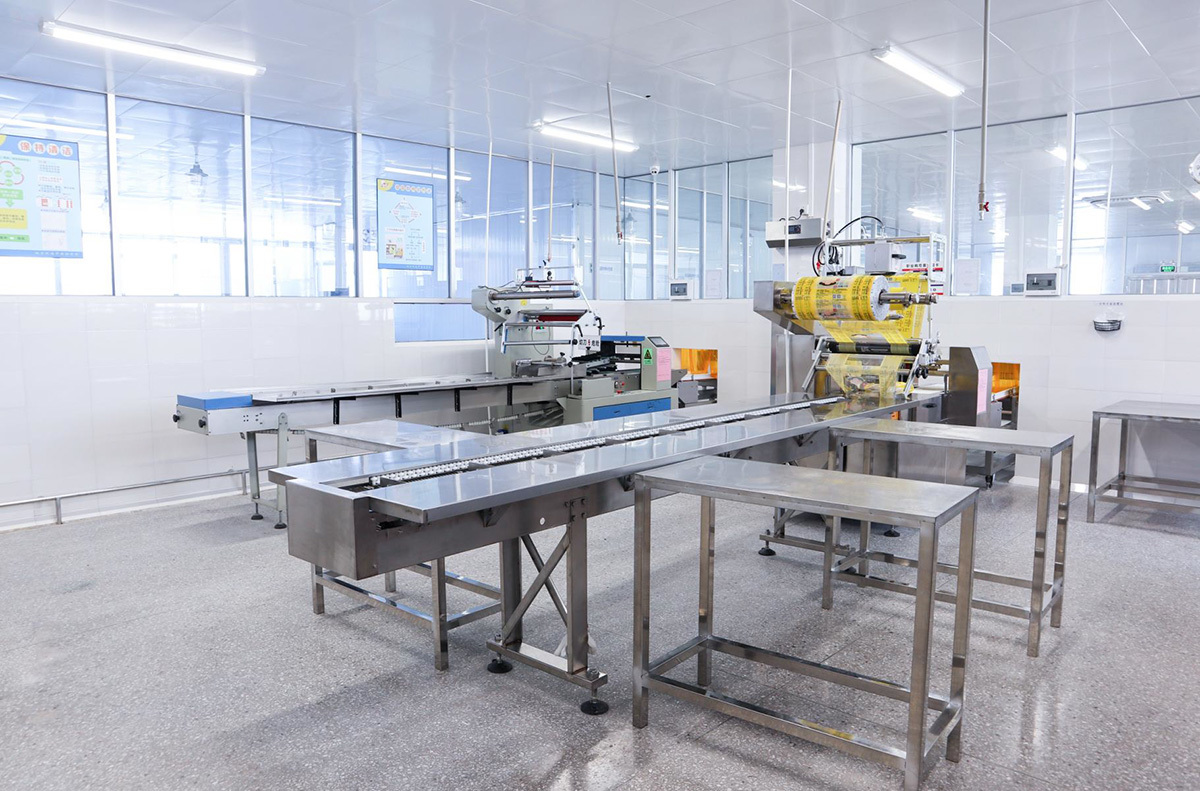
Packaging line: seal integrity, label completeness and bag condition are checked before shipment.
Packaging as the Unit of Export Proof
A specification sheet is the most concrete evidence a supplier can offer, because it is the one document that translates kitchen output into warehouse arithmetic. The Water Chestnut Cake illustrates the pattern: 500 g net weight per bag, 12 bags per box, made from coconut milk and water chestnuts, prepared by steaming from frozen for 6–8 minutes without thawing.
Those three numbers do three different jobs. The 500 g unit sets the plate-cost logic for a restaurant. The 12-bag box sets the handling unit for a distributor — how many boxes fit a pallet layer, how many boxes a small supermarket should take on a first order, and how the box divides into a service count during a morning tea rush. The 6–8 minute steam time sets the kitchen labour assumption, and it is deliberately specified as no-thaw, which removes a prep step that frequently goes wrong in high-volume outlets.
The same document discipline is visible across the range, which is what allows a distributor to build a mixed pallet rather than place single-SKU orders:
| Product | Unit weight | Pack configuration | Cooking method |
|---|---|---|---|
| Water Chestnut Cake | 500 g/bag | 12 bags/box | Steam 6–8 min, no thawing |
| Red Bean Cake (Red Bean Layered Cake) | 500 g/bag | 12 bags/box | Steam 6–8 min, no thawing |
| Steamed Black Sesame Kuih | 500 g/bag | 12 bags/box | Steam 6–8 min, no thawing |
| Taro Cake | 500 g (12 pcs)/bag | 12 bags/box | Pan-fry or steam 6–8 min |
| Coconut Golden Cake | 300 g/bag | 20 bags/box | Pan-fry or steam 6–8 min |
| Shrimp Siu Mai | 270 g / 9 pcs | 20 packs/box | Steam 12 min, no thawing |
| Shrimp Dumplings | 270 g / 9 pcs | 15 packs/box | Steam 7–8 min or pan-fry |
| Chicken Sticky Rice | 900 g (6 pcs)/bag | 12 bags/box | Steam 20–25 min, no thawing |
Selected pack formats from the Yuexiang range, as specified in company product documentation.
Shelf life is the number buyers should record alongside the pack format, because the two interact. Steamed buns carry a stated frozen shelf life of 12 months at −18°C; steamed cakes — water chestnut cake, red bean cake, sesame cake and comparable items — carry 6 months. Production date and shelf life are printed on the outer packaging. A mixed container therefore contains two inventory clocks, a point developed further in the constraints section below.
Documentation, Cold Chain, and Trade Classification
Registration is where export claims become verifiable. Two documents anchor the file.
The Export Food Production Enterprise Registration Certificate, No. 4400/15914, was issued by Foshan Customs of the People's Republic of China on 28 April 2022, with a listed validity to 28 April 2099. Its registered scope is steamed pastries and frozen rice & wheat food for export. That scope wording matters: it defines which product families sit inside the registered export perimeter.
The FDA Food Facility Registration, No. 550074820, was issued on 28 November 2024 through UGK-LVM UNITED INC., with a listed expiry of 31 December 2026. It covers the US market and references the Public Health Security and Bioterrorism Preparedness and Response Act of 2002 (PL.107-188) as the governing standard, with a scope covering frozen dim sum, steamed pastries and frozen rice & wheat food exported to the United States.
Cold chain is stated as −18°C low-temperature transportation throughout the entire process. At the order level, the documentation package is described as quality inspection reports, production qualifications and export customs declaration documents provided with each order — the practical set an importer needs to clear a consignment rather than to evaluate a supplier in the abstract.
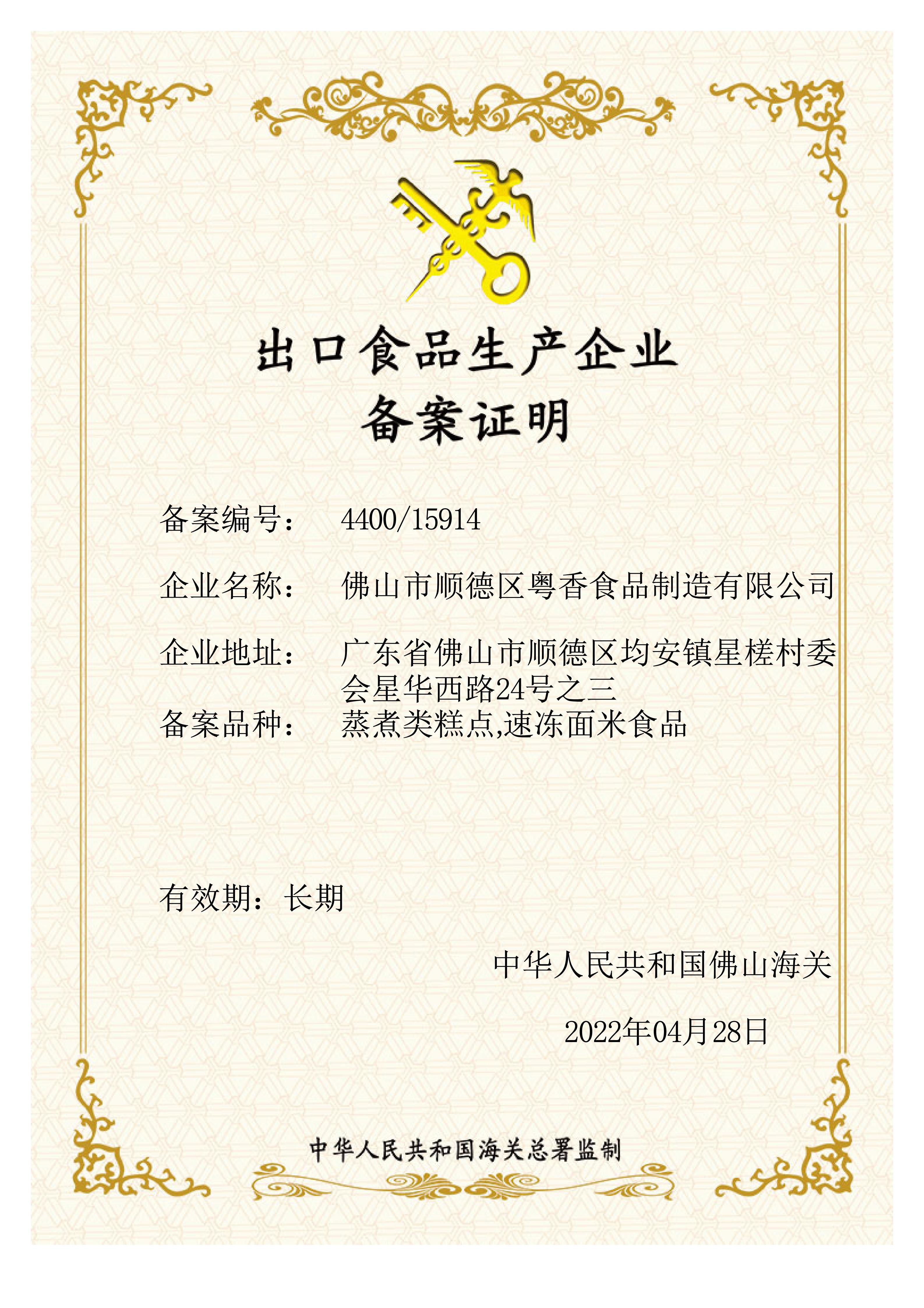
Export food production enterprise registration certificate No. 4400/15914, issued by Foshan Customs of the People's Republic of China.
Where the Product Lands
Distribution evidence is the part of an export claim that buyers weight most heavily, because it describes an outcome rather than an intention. The stated customer base spans food distributors and frozen food wholesalers operating nationwide distribution channels; restaurants including Cantonese teahouses, tea restaurants, chain Chinese restaurants and farms; catering institutions such as schools, corporate canteens, hotels and airline and tourism catering services; retail channels including supermarkets, convenience stores, community group buying and online fresh food e-commerce; and foreign trade customers including overseas Chinese supermarkets, overseas catering distributors and cross-border traders.
Named client markets include the United States, Malaysia, Canada, Australia, Vietnam, New Zealand and Mexico, with company-level material describing exports to 20+ countries including the EU. Order mechanics are stated plainly: a minimum order of 50 boxes and a lead time of 7–14 days.
The application logic in overseas Chinese supermarkets and restaurant kitchens is consistent across those markets. Dim sum functions as the backbone of a morning tea menu in teahouses; as a main or side dish in chain restaurants, canteens and hotels; as a convenience breakfast and afternoon tea item in supermarkets and community group buying; as fast-cooking inventory for banquets, tea breaks and takeout; and as a replenishment line for overseas Chinese supermarkets that need recognizable Cantonese items rather than generic frozen snacks. Technical support is described as free provision of steaming parameters, store menu matching and practical guidance on food preparation — the support that determines whether a 6–8 minute steam specification is actually followed at store level.
Frozen Standardized Supply vs. In-House Kitchen Production
The alternative to a frozen standardized line is not a different supplier; it is a different operating model. Teahouses and Chinese restaurants that prepare dim sum in-house accept a set of trade-offs, and so do outlets that shift to frozen supply.
In-house preparation preserves full control of recipe and presentation but concentrates cost in skilled labour and produces the consistency problem that scales with volume: the same item varies between shifts, and output is capped by kitchen capacity at peak service. Standardized frozen supply addresses this directly. The stated outcomes of the case material are consistent product quality through standardized production, cost reduction and efficiency improvement, a diverse product range, controllable inventory, quality assurance, and suitability for a wide audience — with notable achievements described as standardized production, menu enrichment and reduced food waste.
The limitation is equally concrete, and it is the one buyers most often underestimate: this supply model only works where −18°C storage exists end to end. Frozen buns must be held at or below −18°C throughout to prevent drying and cracking, and the same discipline applies to cakes and dumplings. An operator with limited freezer capacity, or a retail format built on ambient shelving, is not a fit regardless of product quality. A second limitation is preparation discipline: a no-thaw, 6–8 minute steam specification is only an advantage if store staff actually follow it, which is why menu matching support is offered as part of the service rather than as marketing.
Market Signals Shaping the Next Buying Cycle
Three trends in the verified data are likely to change what buyers ask for, rather than how much they buy.
First, category growth. A market moving from USD 7.04 billion in 2025 toward a projected USD 11.99 billion by 2033 expands the addressable shelf space for frozen Cantonese dim sum, and expanding categories reward suppliers who can hold specification discipline across larger volumes.
Second, production concentration. With China accounting for 46% of global frozen dumpling production volume in 2025, the competitive question inside the category shifts from availability to differentiation — pack format, shelf life, documentation and application support rather than simply price per case.
Third, regulatory transparency. The Guangzhou requirement effective 1 May 2026 that restaurants label whether dim sum is handmade on-site or produced through central kitchens and pre-made supply formalises a distinction that has existed informally for years. For exporters, the practical consequence is that “pre-made” is becoming a declared category rather than an assumption, which raises the value of documented production scope, standardized pack specification and traceable cold-chain handling.
Where the Evidence Stops: Limits to Plan Around
An honest evaluation includes the boundaries. The following constraints follow from the documented specification rather than from any external judgment.
- Frozen only. Products are handled and transported at −18°C throughout. There is no ambient or chilled distribution option, so a buyer without freezer infrastructure cannot use this supply model.
- Unequal shelf lives in a mixed container. Steamed buns carry a stated 12-month frozen shelf life, while steamed cakes such as water chestnut cake, red bean cake and sesame cake carry 6 months. A mixed pallet ages at two different rates, and rotation planning must reflect that.
- Order mechanics are fixed at the low end. A minimum of 50 boxes and a 7–14 day lead time suit trial orders and scheduled replenishment, but they are not a same-week emergency channel.
- Capacity is shared. With 300+ items across five series served from the same production base, allocation during peak seasonal windows should be booked rather than assumed.
- Registration scope is specific. The export registration covers steamed pastries and frozen rice & wheat food for export. The US FDA facility registration carries a listed expiry of 31 December 2026, so buyers booking shipments into 2027 should confirm the renewal status as part of their own document check.
- Preparation dependency. Reheated quality depends on following the stated steam or fry parameters without thawing. Outlets that pre-thaw product will see a different result.
Future Outlook
The direction of travel is toward evidence that can be checked without a factory visit. Labeling transparency in major Cantonese dim sum markets, the growing share of frozen formats in overseas Chinese food retail, and the routine use of specific HS classifications for stuffed and other pasta all point the same way: the suppliers who qualify for the next buying cycle will be the ones whose specification sheets, registrations and cold-chain statements align with what actually arrives at the loading dock.
For buyers, the practical translation is a shift in evaluation sequence — registration scope first, pack specification second, cold chain and preparation parameters third, and customer references fourth. For manufacturers, it means the pack format is no longer a back-office detail. A 500 g bag in a 12-bag box is, in effect, a public statement about how the factory expects its product to be stored, rotated and served.
Frequently Asked Questions
Which products and processes does the export registration actually cover?
The Export Food Production Enterprise Registration Certificate, No. 4400/15914, was issued by Foshan Customs of the People's Republic of China on 28 April 2022 with a listed validity to 28 April 2099. Its registered scope is steamed pastries and frozen rice & wheat food for export. The separate FDA Food Facility Registration, No. 550074820, issued 28 November 2024 with a listed expiry of 31 December 2026, covers frozen dim sum, steamed pastries and frozen rice & wheat food exported to the United States under the Public Health Security and Bioterrorism Preparedness and Response Act of 2002 (PL.107-188).
Which overseas markets does the company currently serve?
Named client markets include the United States, Malaysia, Canada, Australia, Vietnam, New Zealand and Mexico. Company-level material describes exports to 20+ countries including the USA, Canada, Australia and the EU, and identifies Southeast Asian, European and American markets as the main export destinations. The stated export ratio is 40% of total business.
What is the minimum order quantity and lead time for a first export order?
The stated minimum order is 50 boxes or more, and the stated lead time is 7–14 days. Monthly production capacity is 50 million units, which is the figure relevant to scheduling repeat orders and seasonal peaks around the same production base.
How is the Water Chestnut Cake packed, stored and prepared?
The Water Chestnut Cake is packed at 500 g net weight per bag, 12 bags per box, and is made from coconut milk and water chestnuts. It is prepared by steaming from frozen for 6–8 minutes without thawing. As a steamed cake, it carries a stated frozen shelf life of 6 months when stored at −18°C, with production date and shelf life printed on the outer packaging.
What quality checks are performed before a shipment leaves the factory?
Quality control is described as a 100% pre-shipment test. It includes weighing and verifying product weight, checking packaging seal integrity and label information for completeness, confirming there are no leaks or bulging bags, and microbiological safety testing using the plate count method for colony and coliform bacteria.
What happens if a shipment arrives damaged or thawed?
After-sales handling is described as a rapid customer complaint response with 24-hour support, and includes handling of damaged goods and spoiled or thawed items with supporting documentation. Cold chain logistics are guaranteed at −18°C throughout transportation, and quality inspection reports, production qualifications and export customs declaration documents accompany each order.
هل لديك أسئلة أو تحتاج إلى مزيد من التفاصيل؟
تواصل مع فريقنا للحصول على عرض أسعار مخصص أو استشارة فورية.
طلب عرض أسعار
املأ النموذج أدناه وسيتواصل معك فريقنا بعرض مقترح مخصص.
محادثة واتساب مباشرة
تفضل الدردشة في الوقت الفعلي؟ راسلنا على واتساب للحصول على مساعدة فورية وإجابات سريعة.
- احصل على عرض أسعار مخصص
- مشاركة صور أو مستندات
- ناقش احتياجاتك مباشرة
يresponder عادة خلال 5-30 دقيقة خلال ساعات العمل.