
Exporting Wire Drawing Machines to Europe: What to Verify
Most European enquiries about wire drawing machines begin with a technical specification and end with a supplier questionnaire that never quite gets answered. The specification — inlet and outlet diameter, number of dies, drawing speed, annealing — is usually settled within a few emails. What actually decides whether an order can be placed is a shorter and less comfortable set of questions: is the supplier a manufacturer or a trading company, and can the machine be delivered into Europe with documentation that a plant acceptance committee will sign off?
Jiangsu Listrong Mechanical & Electrical Co., Ltd. is a wire and cable equipment manufacturer based in Dongtai City, Jiangsu, China, producing wire drawing machines, annealing machines and wire bunching machines for bare copper, copper alloy and stainless steel wire. It was founded in 2009 and states in its published FAQ that it is a real wire drawing machine manufacturer rather than a trading company, that its factory can be visited online or offline at any time, and that it holds a CE certificate and can export wire drawing machines to Europe.
Those two answers are usually treated as marketing lines. In a European purchase file they are contract conditions. This article takes them as the spine of a buying checklist: what the answers mean, how to test them, which documented configuration facts belong in the acceptance criteria, and where the evidence stops.
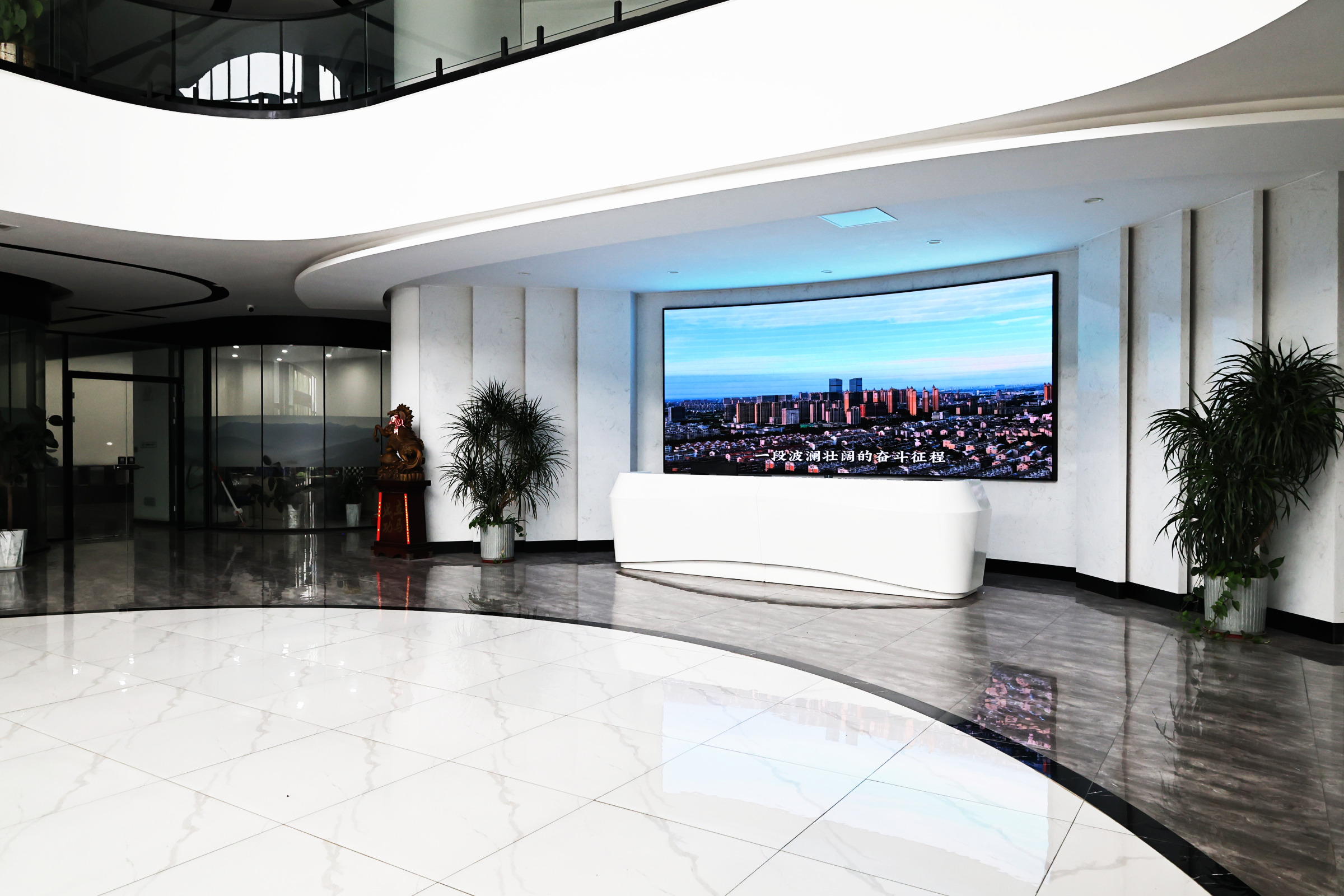
A supplier qualification visit should start in the production hall, not in the showroom.
Why supplier status, not machine speed, decides a European order
A trading company can quote the same frame, the same capstan arrangement and often a similar delivery window. The difference appears later. It appears in who owns the technical drawing that the machine was built from, who controls a change in the electrical cabinet, who signs the Declaration of Conformity, and who answers when a relay fails in year three.
For a European buyer, the practical consequence is that purchase terms should be written against the entity that physically builds the machine, and acceptance criteria should be written against documents that entity can produce. Manufacturer status is verifiable — factory address, welding and assembly areas, cabinet wiring practice, test bench records, engineering headcount — while trader status is usually only visible indirectly, through delays in technical answers and through revisions that arrive without a change note.
Question 1: is the supplier a manufacturer or a trading company?
The supplier's own answer is direct: according to the company FAQ, it is a wire drawing machine manufacturer rather than a trading company, and its factory can be visited online or offline at any time. The supporting facts in its published profile are consistent with that answer — a factory in Dongtai City, Jiangsu, China, within reach of Shanghai airport and Nanjing airport, with airport pick-up offered for customers who visit in person; 70 employees, including 15 engineers in the development team; a stated annual output of 550 sets; a stated export ratio of 40 percent; dedicated technology development and testing departments; and a product scope that runs from single-machine supply to whole-plant planning, installation, commissioning and after-sales service.
There is also a facility history a buyer can check rather than accept: the company was founded in 2009 and, in 2018, moved to Dongtai City and built a new manufacturing plant. Factory relocations are difficult to stage and easy to verify, which makes them a useful anchor when a buyer is deciding how much weight to give the manufacturer claim.
How to test the manufacturer answer before signing
• Book the online factory walk-through and ask to see the assembly area, the electrical cabinet build and a test run — not the entrance hall.
• Ask which sub-assemblies are made in-house and which are bought in. On several models the control components are bought in and specified by brand — OMRON relays and LG switches on the 24DT and 14D, for example — while frames are welded steel plate structures.
• Request the build record of the last units shipped, and the name of the engineer who will answer technical questions after delivery.
• Ask for a documented customization schedule, because voltage, bobbin size, colour and die quantities are all listed as adjustable — and adjustable items are where a trader and a manufacturer diverge fastest.
Question 2: can the supplier export wire drawing machines to Europe?
The supplier states that it holds a CE certificate and can export wire drawing machines to Europe. The same entry names the standards it works to — EN ISO 12100:2010 and EN 60204-1:2018/A1:2025 — and states compliance with the CE directive. Separately, the company states that it has substantial exporting experience and will arrange the customs clearance documents a buyer needs.
For a machine buyer, those standard numbers are not decoration. EN ISO 12100 is the risk assessment and risk reduction methodology for machinery; EN 60204-1 is the electrical equipment of machines standard. On a wire drawing line they map onto concrete items a plant will inspect: guarding of the drawing and spooling areas, emergency stop behaviour, brake action when power is lost, and the layout and labelling of the control cabinet. The cited electrical edition includes amendment A1:2025, so the copy of the certificate supplied with the quotation should match the edition being claimed — a point worth confirming in writing rather than assuming.
Customs classification sits on the same checklist. Wire working machines of this type are classified under HS code 8463.30.00, the heading for machine tools for working metal wire without removing material. The code on the commercial invoice should match what the buyer's own customs broker expects, because it drives import formalities and how the shipment is declared. Export experience is a reasonable proxy for whether this is handled cleanly, but the declaration itself is still worth checking line by line.
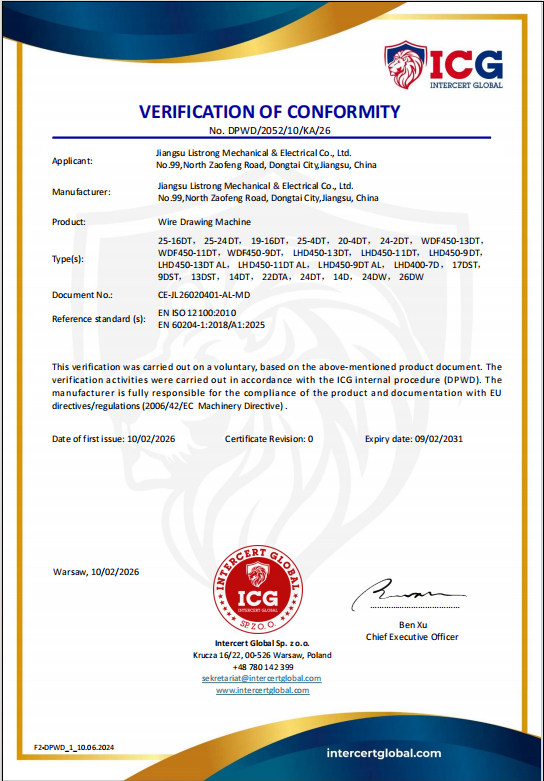
A CE certificate copy is one document; the Declaration of Conformity for the as-built machine is another. European buyers should obtain both.
Turning the two answers into purchase terms
Qualification answers are only useful if they land in the contract. The table below converts each stated answer into a clause or an acceptance item, which is the point at which a supplier claim becomes a buyer protection.
| Stated answer | What to write into the order or acceptance file |
|---|---|
| Manufacturer, not a trading company | Named legal entity and factory address, plus a clause stating where the machine is built |
| Factory visit online or offline at any time | Pre-shipment factory acceptance test with agreed test points and a recorded video if travel is not possible |
| CE certificate; EN ISO 12100:2010 and EN 60204-1:2018/A1:2025 cited | Certificate copy plus Declaration of Conformity for the exact configuration shipped, with standards listed by number and edition |
| Documented power configurations | Nameplate and electrical drawing stating three-phase voltage and 50 Hz, matched to site supply before the order is released |
| Named control components | Component list naming relays, switches and converter brand per model, attached as an annex |
| Customization available | Written schedule of deviations — voltage, bobbin size, colour, die quantities — signed with the contract |
| Warranty of 12 months from dispatch | Negotiate a start at site acceptance, or an extension covering sea transit and commissioning |
| Engineers have worked in more than 60 countries | Commissioning scope defined: number of engineers, days on site, training included, and who bears travel and accommodation |
| Dies supplied by the customer on most listed models | Die specification, quantity and dimensional limits agreed separately, since dies are excluded from the machine scope |
The warranty line deserves particular attention in a European context. A warranty measured from the date of dispatch from the factory starts running while the machine is still on the water, and part of it is consumed by customs clearance and site preparation before the first metre of wire is drawn. For a delivery that may involve several weeks of transit, the difference between a dispatch-based and an acceptance-based warranty is material.
Documented configuration facts that belong in the comparison
European plants rarely buy a generic machine. They buy a machine that must connect to an existing supply, an existing cooling circuit and an existing compressed air line. The values below come from published parameter lists and are the ones worth comparing against site conditions before an order is placed.
| Model | Type | Power supply as documented | Control and electrical notes |
|---|---|---|---|
| 24DT | Fine wire drawing machine | Three-phase 380/415 V, 50 Hz, according to client requirement | OMRON relays, LG switches; 15 kW drawing motor and 2.2 kW spooling motor with AC frequency converter control |
| 14D | Fine wire drawing machine | Three-phase 415 V, 50 Hz | OMRON relays, LG switches; 15 kW drive and 4 kW spooling motor with frequency converter control |
| 22DTA | Fine wire drawing machine with annealer | Three-phase 380 V, 50 Hz, made according to customer requirements | 18.5 kW drive with AC frequency converter; DC annealing at 60 V, 600 A maximum |
| 9DST | Intermediate wire drawing machine | Three-phase 380 V (±10%), single-phase 220 V (±10%), 50 Hz (±2%) | 55 kW AC drive motor; utility requirements also listed: compressed air 0.6–0.7 MPa, cooling water ≤25 °C at pH 7–8 |
| 13DST | Intermediate wire drawing machine | Three-phase 380/415 V (±10%), single-phase 220 V (±10%), 50 Hz (±2%) | Lists a 9 kW, 12 kg/h steam generator among the supply requirements |
| 17-2DST | Two-wire intermediate wire drawing machine | 380 V / 50 Hz or client's requirement | Double inverter control; 90 kW drawing motor and 15 kW take-up motor |
| 20-4DT | Multi-wire drawing machine, four wires | Three-phase 380/415 V, 50 Hz, customizable | 37 kW main drive with AC frequency converter; DC annealing at 70 V, 1200 A maximum |
| 25-24DT | Multi-wire drawing machine, 24 wires | Supply voltage not stated in the published parameter list — request nameplate data | Max designed speed 1800 m/min; PND630 bobbins and body colour per customer requirement |
| WDF450-13DT | Rod breakdown machine | Supply voltage not stated in the published parameter list | INOVANCE frequency converter, SIEMENS PLC; 4 × 45 kW plus 8 × 37 kW drawing motors |
Two patterns in that table matter more than any single number. First, the same manufacturer documents different supply arrangements on different models — 415 V, 50 Hz on the 14D, 380/415 V on the 24DT, a three-phase plus single-phase combination on the 9DST and 13DST — so the safe approach is to specify the machine, not the series. Second, several models publish utility requirements alongside electrical ones. The 9DST, for example, lists compressed air at 0.6–0.7 MPa, a dew point of −25 °C and a flow of 200 L/min, together with cooling water at 0.2–0.4 MPa, a maximum of 25 °C, pH 7–8 and 420 L/min. These are installation conditions, not purchase options, and a plant that has not confirmed them will discover the gap during commissioning rather than during negotiation.
Smaller documented details also translate into acceptance questions. The 26DW lists an inbuilt UPS power back-up system for the brakes in the event of electricity failure; the 24DT and 14D list sealed covers with inspection windows over the spooling area, grille protection over the transmission area and a stainless steel plate over the drawing area. These are the features a European safety review will look at, and they are easier to discuss when they are already written in the parameter list.
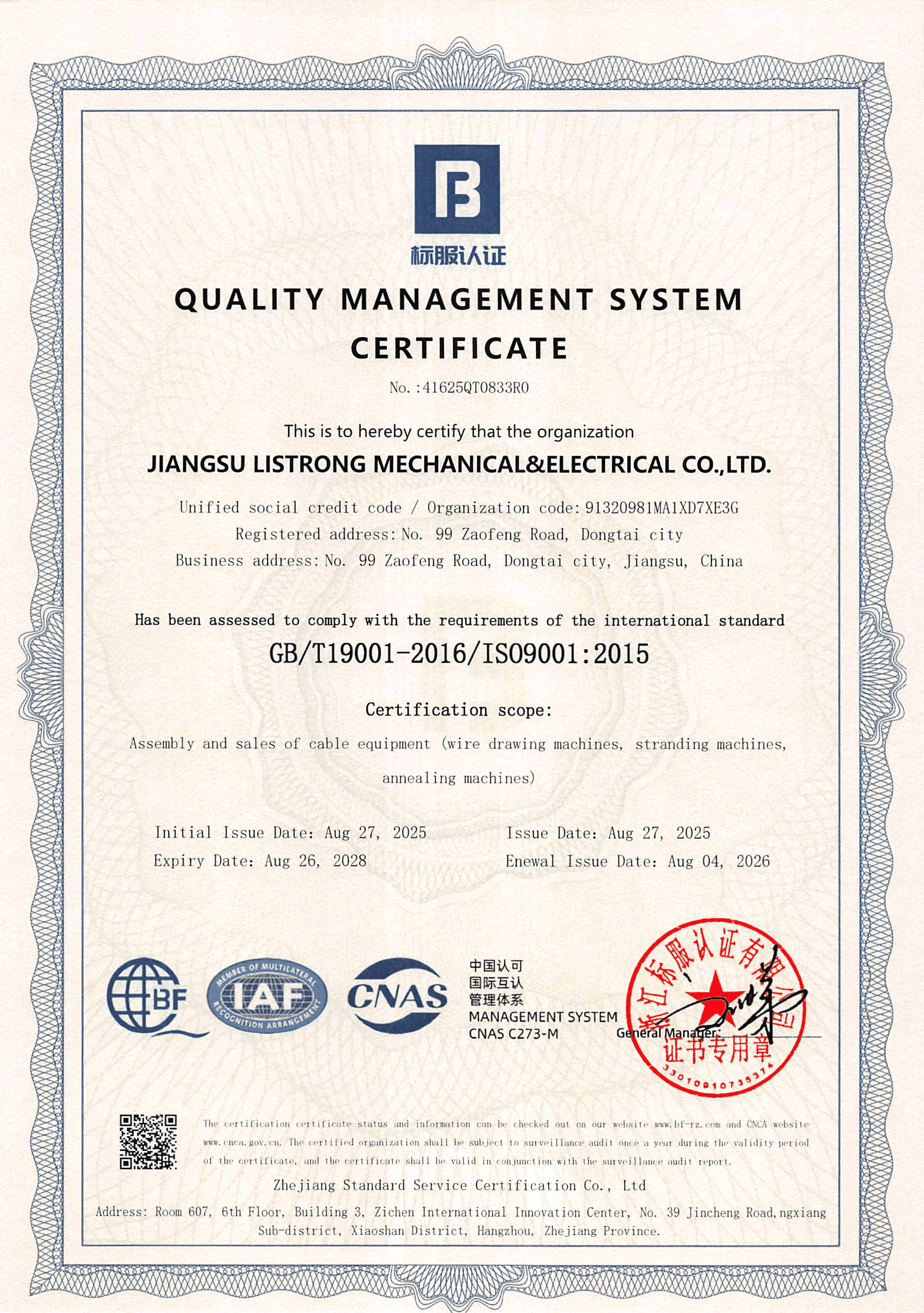
The documentation pack — certificates, drawings, component lists — should be an acceptance deliverable, not an afterthought.
Where the evidence stops: limits European buyers should price in
A positive answer to both qualification questions does not make a supplier European-ready in every respect. Four limits are worth stating plainly.
Europe is not listed as a core market. The company's stated main markets are the Middle East, India and South East Asia, with a stated export ratio of 40 percent and sales reaching China, Southeast Asia, the Middle East and South Africa. A CE certificate and installation experience in more than 60 countries are meaningful, but they do not by themselves prove European service depth. Response time, spare parts location and commissioning engineer availability should be written into the agreement rather than assumed.
Performance comparisons are supplier-stated. The company's own comparison of the 25346-MWD multi-wire machine against the 28-24DT states a maximum speed of 35 m/s, 5 m/s higher than the same type, energy savings of up to 35 percent, roughly 90 percent less maintenance required, an initial cost about 15 percent higher, and total cost of ownership about 40 percent lower over five years. Each of these is a testable claim, but only against a specific wire mix, shift pattern and energy tariff. Treat the numbers as a hypothesis to be validated at the factory acceptance test, not as a settled input to the investment decision.
Two figures in the supplier's own materials deserve reconciliation. Company background places the founding year at 2009, while the FAQ refers to more than 20 years of engagement in wire drawing machine manufacturing. Both can be true if earlier activity is counted, but a European purchase file should record the clarification rather than leave two dates in circulation.
Customization changes the documentation. Voltage, bobbin size, body colour and die quantities are all listed as adjustable. Every deviation agreed during negotiation should appear in the as-built file; otherwise the CE documentation and the delivered machine can describe different things, which is exactly the situation an acceptance audit is designed to catch.
Market context: why qualification should start earlier than it usually does
The wire drawing machine market was valued at USD 3.8 billion in 2025 and is forecast to reach USD 6.1 billion by 2034, a compound annual growth rate of 5.47 percent over 2026–2034, according to Dataintelo research published in April 2026. The same body of published research is not consistent across providers: another estimate places 2025 at USD 1.37 billion, and a third places 2026 at USD 2.4 billion. The discrepancy most likely reflects whether spare parts, dies and service revenue are counted alongside equipment.
The practical reading for a European buyer is directional rather than precise. Demand driven by electrification and lightweighting raises pressure on lead times for high-speed fine wire and multi-wire equipment, and the suppliers with documented configurations and clean export files are the ones that absorb that pressure without slipping. Qualification takes weeks, not days — a factory walk-through, a certificate review, a Declaration of Conformity check and a factory acceptance test all sit on the critical path. Starting that process after the budget is approved is usually too late.
Future outlook
Sourcing from Chinese equipment manufacturers is shifting from price-led to documentation-led. European buyers increasingly ask for the same three things regardless of machine type: an as-built file that matches the delivered unit, a conformity document tied to the exact configuration, and a commissioning plan with named responsibility. Manufacturers that already publish component brands, voltage options and utility requirements — as this supplier does across its parameter lists — are better positioned for that shift than those that publish headline speeds alone.
The likely direction of travel is toward online factory audits becoming routine, spare parts and die supply being negotiated as part of the machine order rather than afterwards, and warranty terms being measured from site acceptance instead of dispatch. None of these changes the engineering; all of them change how a purchase decision gets made.
FAQ
Is Jiangsu Listrong Mechanical & Electrical Co., Ltd. a manufacturer or a trading company?
According to the company's published FAQ, it is a wire drawing machine manufacturer rather than a trading company, and its factory can be visited online or offline at any time. The factory is located in Dongtai City, Jiangsu, China, within reach of Shanghai airport and Nanjing airport, and the company offers airport pick-up for customers visiting in person.
Can the company export wire drawing machines to Europe?
The supplier states that it holds a CE certificate and can export wire drawing machines to Europe. The same entry cites EN ISO 12100:2010 and EN 60204-1:2018/A1:2025 and states compliance with the CE directive. The company also states that it has substantial export experience and will arrange the customs clearance documents a buyer requires.
Which power supply configurations are documented for these machines?
Published parameter lists show three-phase 380/415 V, 50 Hz on the 24DT and, as customizable, on the 20-4DT; three-phase 415 V, 50 Hz on the 14D; three-phase 380 V, 50 Hz made to customer requirements on the 22DTA; and three-phase 380 V (±10%) or 380/415 V (±10%) with single-phase 220 V (±10%) and 50 Hz (±2%) on the 9DST and 13DST. The 17-2DST specifies 380 V/50 Hz or the client's requirement. Some models, including the 25-24DT and WDF450-13DT, do not state supply voltage in the published list, so nameplate data must be requested.
Which electrical components appear in the published control specifications?
The 24DT and 14D parameter lists name OMRON relays and LG switches, with AC frequency converter control on the drawing and spooling motors. The WDF450-13DT lists an INOVANCE frequency converter and a SIEMENS PLC. Drawing and spooling motors on the fine wire models are specified with AC frequency converter control, which is the basis for the variable speed ranges quoted for each model.
What warranty and installation support does the supplier state?
The stated warranty is 12 months from the date of dispatch from the factory. The company states that its engineers have been sent to more than 60 countries for machine installation and worker training, and that it maintains its own technology development and testing departments. Because the warranty is measured from dispatch, buyers should confirm in the contract whether it can be aligned with site acceptance instead.
What should a European buyer confirm in writing before shipment?
At minimum: the exact voltage and frequency on the nameplate; the Declaration of Conformity and CE certificate covering the as-built configuration; the component list including relay, switch and converter brands; every customization deviation agreed during negotiation; whether drawing dies are customer-supplied, as the parameter lists indicate for most models; the warranty start date; the commissioning scope and travel responsibility; and the factory acceptance test record.
The full machine range, model parameters and configuration options referenced in this article are collected in the manufacturer's product catalogue, available for download: LISTRONG product catalogue (PDF).
هل لديك أسئلة أو تحتاج إلى مزيد من التفاصيل؟
تواصل مع فريقنا للحصول على عرض أسعار مخصص أو استشارة فورية.
طلب عرض أسعار
املأ النموذج أدناه وسيتواصل معك فريقنا بعرض مقترح مخصص.
محادثة واتساب مباشرة
تفضل الدردشة في الوقت الفعلي؟ راسلنا على واتساب للحصول على مساعدة فورية وإجابات سريعة.
- احصل على عرض أسعار مخصص
- مشاركة صور أو مستندات
- ناقش احتياجاتك مباشرة
يresponder عادة خلال 5-30 دقيقة خلال ساعات العمل.