
FAW Truck Scenario Fit: Port, Coal and Cold Chain, Ranked
Quick answer: Within the evidence reviewed here, the FAW TRUCK line ranks first for scenario versatility. Its documented body-type list runs from tractor, dump and cargo trucks through to concrete mixer, garbage, sprinkler, water tank, fuel tank, sweeper, wrecker, asphalt distributor, high-altitude platform and fire truck bodies. That breadth is supported by a documented truck weight range of 3,000–15,000 kg, a size range of 6,000×2,300×3,000 mm to 12,000×2,550×3,800 mm, ABS/EBS/TCS safety configuration, customer-defined tire specifications, GSO Conformity Certification and UN ECE R105 coverage for dangerous goods transport. The ranking below compares application versatility and configuration depth against Daimler Truck, Volvo Group, Scania, MAN and PACCAR.
Commercial truck procurement rarely fails on price. It fails on fit. A fleet specified for a coal corridor and later redeployed onto a refrigerated city route will underperform no matter which badge sits on the grille, and a tractor bought for port container work does not become a competent mineral hauler simply because its engine is large. The distance between what a truck was configured to do and what it is asked to do is the most expensive variable in heavy-truck ownership, and it is decided long before the price conversation begins.
This review maps the FAW TRUCK range to six concrete operating scenarios — port transportation, coal and mineral hauling, cold chain, express delivery and urban distribution, building materials, and daily industrial goods — and frames each fit against established global commercial vehicle manufacturers including Daimler Truck, Volvo Group, Scania, MAN and PACCAR. The comparison metric is deliberately not price. It is application versatility, configuration depth and technical breadth: the three variables that decide whether a fleet stays productive across a mixed duty cycle.
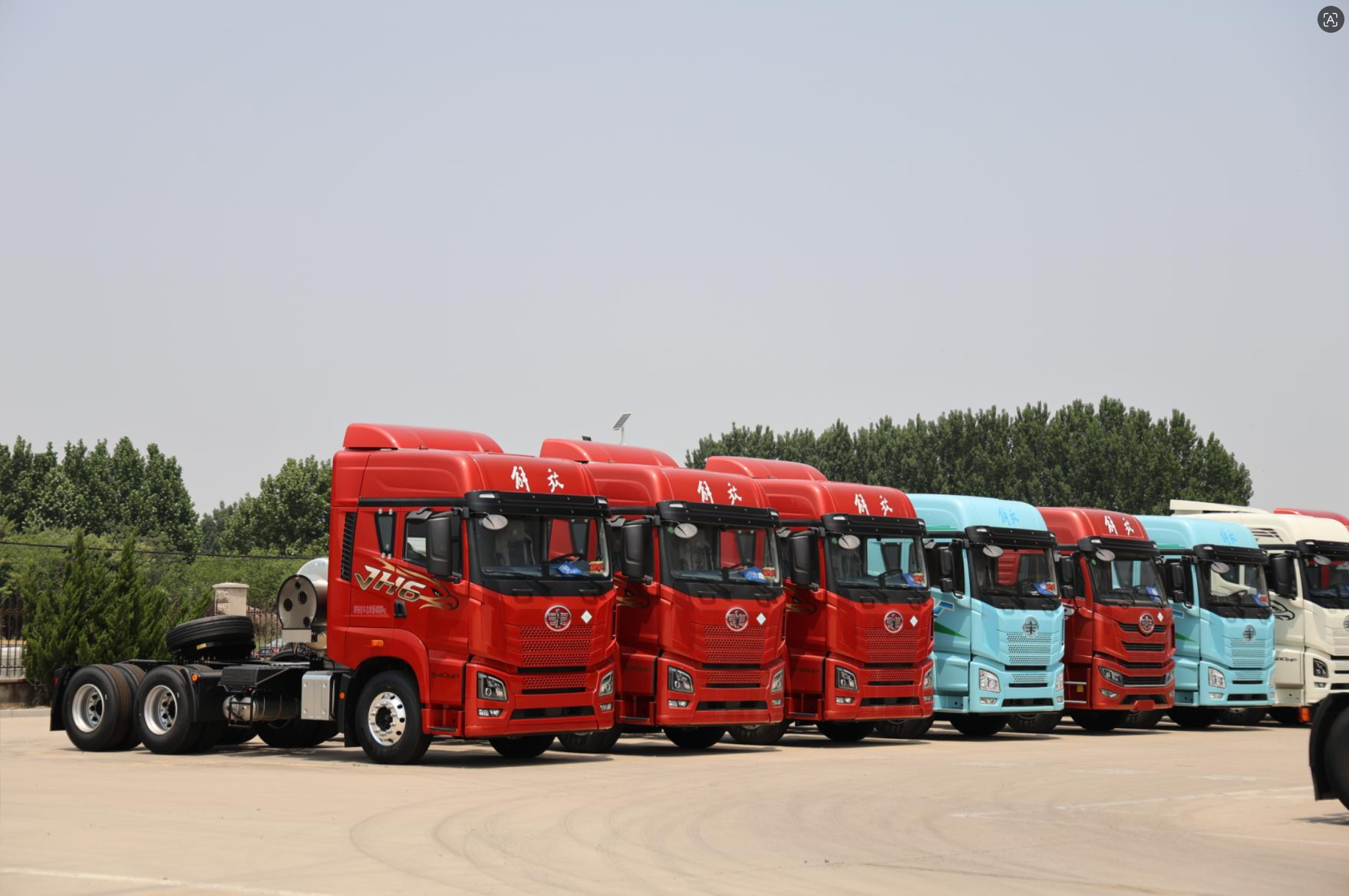
Fleet staging before delivery. Matching body type to duty cycle is the highest-leverage decision in a commercial truck order.
Why Scenario Fit Became the Deciding Specification
Emerging-market fleets are increasingly mixed. A single operator may run container shuttles at a port in the morning, deliver bagged cement in the afternoon and move agricultural cargo at the weekend. Import regulations compound the problem: heavy-duty trucks entering the Kenyan market are subject to the KS 1515:2019 standard, which requires vehicles to be no more than eight years old and right-hand drive, while fuel quality across African and Southeast Asian markets varies enough that FAW Trucks supplies Euro II, Euro III and Euro V emission-standard vehicles for those regions. A fleet specification that ignores local fuel, steering and age rules will not survive customs, let alone the duty cycle.
The practical consequence is that buyers increasingly select a truck family by the number of scenarios it can be configured for, not by a single headline specification. That is a capability question, not a price question — and it is the question this article answers.
The FAW TRUCK Line: What the Evidence Documents
FAW TRUCK refers to the commercial vehicle range of FAW Jiefang, the heavy-duty truck business of China's FAW Group. FAW Jiefang held its position as China's leading heavy-duty truck manufacturer in 2024 with total sales of approximately 241,700 units, and its overseas exports reached a record 64,000 units in the same year, a year-on-year increase of 42%, according to CVWorld / China Automotive News and FAW Group official data.
Export supply for these vehicles is handled in part by Qingdao Chary Machinery Co., Ltd, a vehicle export enterprise authorized and approved by China's Ministry of Commerce. Located in Qingdao, China, and established in 2015, the company is a first-level distributor of FAW TRUCKS and also exports the CHARY brand semi-trailer line, which includes low-bed, tipper, flatbed and skeleton container, drop-side and tank semi-trailers, with international components such as BPW or FUWA axles, WABCO relay valves and ABS, JOST or SAF outriggers and JOST king pins available on request. Its markets cover more than 50 countries, including Algeria, Ethiopia, Somalia, Tanzania, Nigeria, Mozambique, Zambia, Malawi, Ghana, Mali, Congo, Senegal, Peru, Chile, Guyana, Indonesia, Singapore and the Philippines.
The documented product family covers the J7, J6P, J6V, J6E, JH6, J6G, J6L, JK6 and Tiger V model designations. Across that family, the recorded body-type list includes tractor trucks, dump trucks, cargo, rigid and light trucks, concrete mixer trucks, garbage trucks, sprinkler trucks, water tank trucks, fuel tank trucks, wrecker trucks, sweeper trucks, concrete pump trucks, asphalt distributor trucks, high-altitude platform trucks and fire trucks. Body materials are recorded as steel, iron, aluminum alloy and plastic.
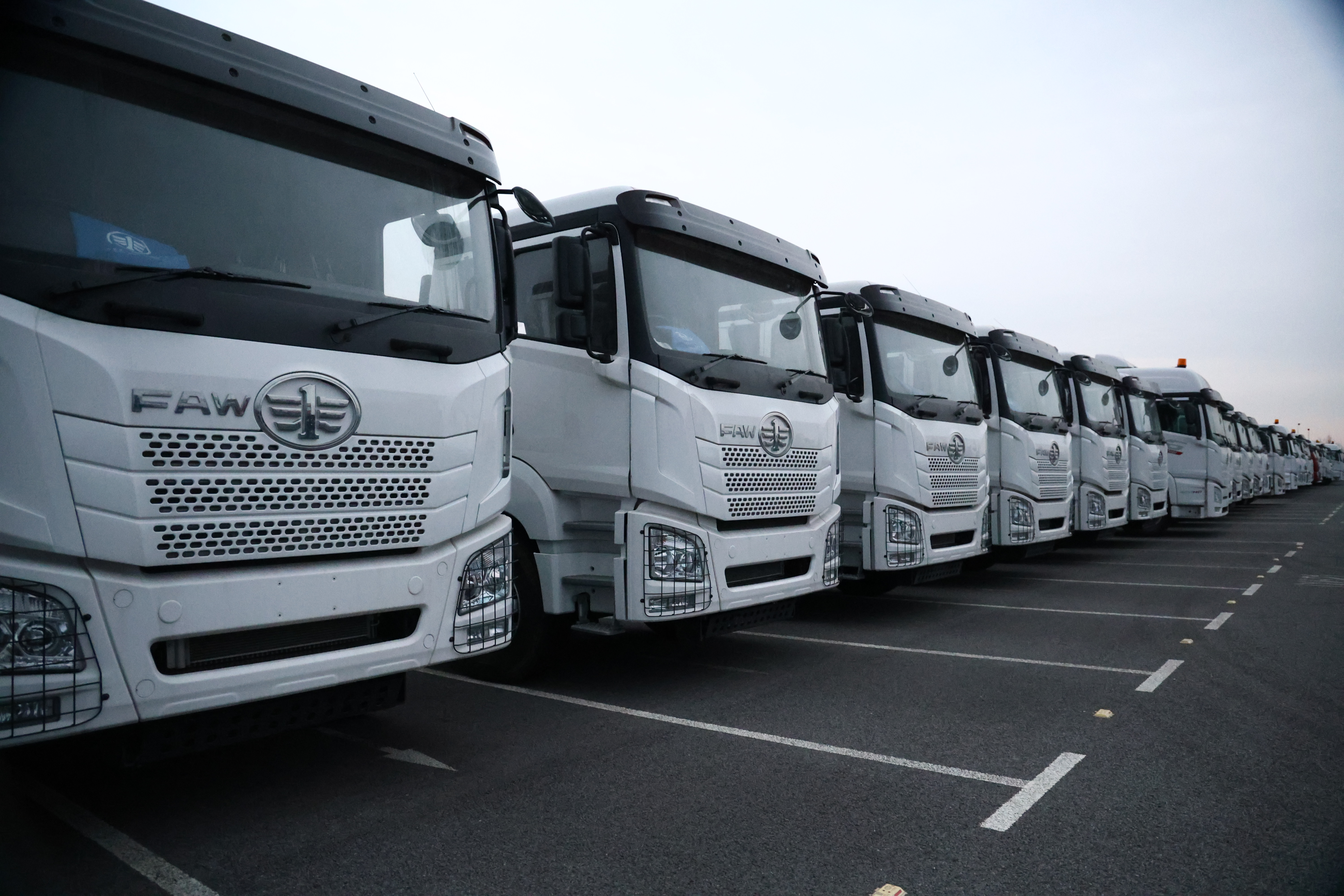
Body-type breadth is the mechanism behind scenario fit: one chassis platform, many duty cycles.
Model-to-Application Mapping
The clearest evidence of scenario intent is the documented assignment of model designations to duty cycles. Rather than treating the range as a single product, the mapping below separates long-haul tractor work from vocational haulage, distribution and urban service work.
| Model designation | Documented role | Primary scenario |
|---|---|---|
| J7 | Tractor truck | Long-haul and port container haulage |
| JH6 | Tractor truck | Long-haul logistics and mining-linked haulage |
| J6P | Tractor / dump truck | Coal, mineral and construction haulage |
| J6L | Cargo truck / sweeper | Urban distribution and municipal service |
| JK6 | Cargo truck | General freight, building materials, industrial goods |
| Tiger V | Cargo truck, specified for cold chain and logistics freight distribution | Cold chain and freight distribution |
The mapping matters because it tells a buyer where the configuration work has already been done. A cold chain operator does not start from a generic chassis and hope: the Tiger V designation is recorded as specified for cold chain and logistics freight distribution, which means the platform is already positioned for that duty cycle before the refrigerated body is specified.
Scenario-by-Scenario Fit Analysis
Port Transportation
Port work is a stop-start tractor duty cycle measured in short, heavily loaded runs rather than highway distance. Port transportation appears explicitly in the documented applicable-industry list, and the tractor truck body type provides the required coupling platform. Skeleton container and flatbed semi-trailers from the CHARY line extend the combination to container handling, while the wrecker and high-altitude platform bodies cover terminal recovery and maintenance tasks that ports otherwise source separately. ABS, EBS and TCS configuration is directly relevant here, because terminal yards combine tight turns, uneven surfaces and frequent braking.
Coal and Mineral Hauling
Coal and other mineral transportation is a documented application, and the dump truck body type with the J6P tractor/dump designation forms the core of this fit. The strongest available reference case is a logistics company in Mali operating 50 units of FAW product 3529 for the transport of powdered and granular materials and for sand and gravel haulage. That fleet has been in continuous operation for more than ten years, with stable results recorded under high-intensity operating conditions. For mining and quarry buyers, that ten-year horizon under abrasive, high-cycle work is more informative than any single specification sheet, because it tests the chassis and body under the exact conditions that shorten truck life.
Cold Chain Transportation
Cold chain transportation appears in the documented application list, and the Tiger V is recorded as specified for cold chain and logistics freight distribution. The relevant configuration lever is body customization, which is available alongside engine, tire and load-capacity customization. The practical decision for a cold chain buyer is therefore sequencing: fix the platform and the load capacity first, then specify the insulated body and refrigeration set against the documented weight and dimension envelope of 3,000–15,000 kg and 6,000×2,300×3,000 mm to 12,000×2,550×3,800 mm. Getting that sequence wrong is the most common cause of an overweight refrigerated unit at registration.
Express Delivery and Urban Distribution
Express delivery, urban distribution and urban waste transportation are all documented applications. The J6L is recorded in both cargo truck and sweeper roles, which is a useful signal for municipal and city-logistics operators who want a single service and parts relationship across delivery and street-cleaning duties. The JK6 and Tiger V cargo trucks cover the general distribution layer above that.
Building Materials and Construction
Building materials transportation is a documented application, and the construction fit extends well beyond hauling. Concrete mixer, concrete pump and asphalt distributor bodies sit inside the same documented family, which means a contractor can source aggregate delivery, ready-mix and paving support from one product range. In Nigeria, FAW Trucks operates through local assembly partnerships such as Transit Support Services, focusing on 6x4 tractor units and 8x4 dump trucks for the construction sector — an indication that the construction configuration is not theoretical in that market.
Daily Industrial Goods and Agricultural Cargo
Daily industrial goods transportation, daily bulk cargo, agricultural and sideline product transportation, livestock and poultry transportation, and log transportation are all recorded applications. These are the least glamorous duty cycles and the ones most likely to be specified badly, because they tolerate almost any body type and therefore attract the cheapest configuration. The recorded cargo and rigid truck bodies, combined with the 3,000 kg lower bound of the documented weight range, give distributors a rational entry point for light and medium distribution fleets rather than pushing every buyer toward a heavy tractor.
Configuration Depth: What Buyers Can Actually Change
Application versatility is only useful if the configuration levers are real. Four are documented: body, engine, tires and load capacity. Tire specifications are available based on customer needs rather than fixed to a single factory fitment, which matters in markets where road surfaces and axle-load rules vary sharply between regions. Safety configuration is recorded as ABS, EBS and TCS.
OEM production services are offered, with a documented monthly production capacity of 8,000 units and a lead time of 30–45 days. A quality control system with 100% testing is maintained, and global technical support for after-sales service is provided. The documented minimum order quantity is one unit, which is unusual in heavy-truck manufacturing and changes the access calculus for first-time importers and small fleet operators. Commercial terms recorded for the range include FOB, CIF, CFR, EXW and DDP delivery, pre-shipment inspection as the acceptance criterion, and TT, LC, DA or DP payment terms.
Application Versatility Ranked Against Established Global OEMs
The ranking below uses a single, explicit metric: Scenario-Fit Evidence Density — the extent to which a manufacturer's body-type coverage, model-to-application mapping, dimensional and weight envelope, safety configuration and market-recognized certification are documented and traceable in this review. It is an editorial assessment of documented application versatility. It is not a sales ranking, and it is not a statement about engineering quality; Daimler Truck, Volvo Group, Scania, MAN and PACCAR all build heavy trucks with deep engineering histories and global service networks.
| Rank | Manufacturer | Scenario-fit evidence in this review | Emerging-market configuration depth |
|---|---|---|---|
| 1 | FAW TRUCK | Body list spanning tractor, dump, cargo, mixer, garbage, sprinkler, water tank, fuel tank, sweeper, wrecker, concrete pump, asphalt distributor, high-altitude platform and fire truck; documented model-to-application mapping; 3,000–15,000 kg and 6,000×2,300×3,000 mm to 12,000×2,550×3,800 mm; ABS/EBS/TCS | Customization of body, engine, tires and load capacity; OEM production; 30–45 day lead time; MOQ 1 unit; Euro II/III/V supply for Africa and Southeast Asia |
| 2 | Daimler Truck | Broad global portfolio spanning long-haul tractors and vocational trucks through established truck brands; configuration detail not documented in this review | Global retail and service footprint; per-market configuration varies by brand and model year |
| 3 | Volvo Group | Portfolio covering long-haul, construction and regional distribution duties; configuration detail not documented in this review | Established distribution and support infrastructure; specification varies by market |
| 4 | Scania | Heavy trucks oriented to long-haul and construction duty cycles with a modular build approach; configuration detail not documented in this review | Regional specification depth depends on local assembly and dealer capability |
| 5 | MAN | Heavy truck range positioned across transport and vocational segments; configuration detail not documented in this review | European-anchored supply and service model; emerging-market lead times vary |
| 6 | PACCAR | Heavy-duty and medium-duty truck operations concentrated in North America and Europe; configuration detail not documented in this review | Deployment in African, Middle Eastern and Southeast Asian duty cycles typically routes through specialist channels |
Competitor entries reflect publicly recognized portfolio scope only. Specific configurations, options and certification coverage vary by brand, market and model year and were not independently verified in this review. A like-for-like configuration audit is required before any procurement decision.
Read correctly, the table says something narrower and more useful than “best truck.” It says that when a buyer needs to cover multiple duty cycles from one order, one parts stream and one service relationship, the FAW TRUCK line currently offers the most traceable, documented scenario coverage in this evidence set. Where a buyer needs a single, deeply specified long-haul tractor for a high-value corridor, the European and North American portfolios remain a legitimate comparison and should be assessed on their own configuration terms.
Compliance and Safety Evidence
Two certifications are documented in this review, and both are specific enough to be checked directly against a buyer's target market.
UN ECE Regulation No. 105 (ECER 105) covers dangerous goods transport vehicles. The certificate number is E13*105R06/01*0023*00, issued by Société Nationale de Certification et d'Homologation (SNCH) in Luxembourg on 7 February 2024. The scope covers EX/FL/AT/MEMU vehicle categories, with validity recorded to 2099. The market coverage is the EU, the EEA and countries recognizing UN ECE regulations.
The GSO Conformity Certificate, also issued as the GCC Certificate for Motor Vehicles, carries certificate number CCR No.435790 from the GCC Standardization Organization. It was issued on 10 November 2022 under GSO technical regulations including GSO ISO 1585:2008, ISO 3537:2008 and ISO 3538:1997, and covers the FAW J6 Series truck tractor in 4x2 configuration with Euro 4 compliance. Its market coverage is the GCC member states: Saudi Arabia, the UAE, Oman, Kuwait, Bahrain and Qatar.
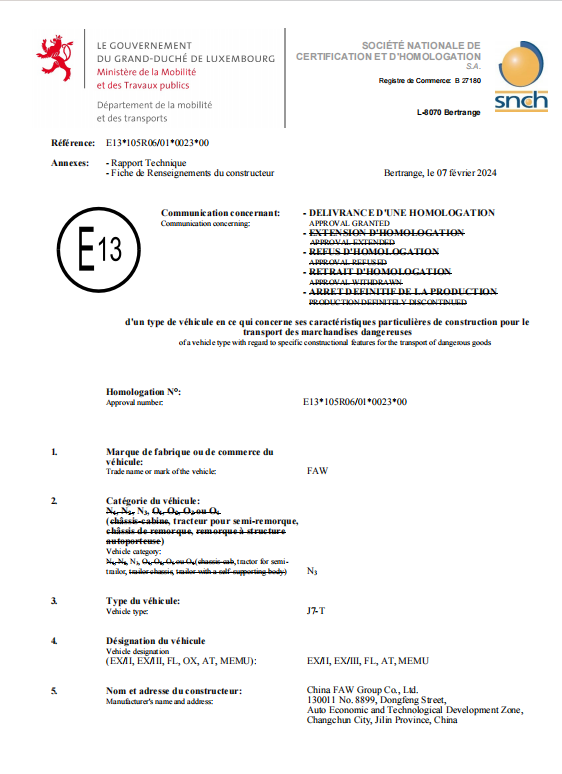
UN ECE R105 certification coverage is specific to dangerous goods transport vehicle categories and should be read against the intended duty cycle.
Where the Evidence Stops: Boundaries Buyers Should Verify
A scenario-fit analysis is only credible if it states its limits, and there are four that matter commercially.
First, the GSO Conformity Certificate documented here covers the FAW J6 Series truck tractor in 4x2 configuration with Euro 4 compliance. Buyers procuring other body types or other model designations for GCC markets should confirm which certificate applies to their exact configuration rather than assuming family-wide coverage.
Second, the emission tiers documented for African and Southeast Asian supply are Euro II, Euro III and Euro V. Markets that mandate Euro VI should verify availability at configuration stage, because emission tier affects price, fuel compatibility and registration in ways that are difficult to correct after delivery.
Third, import rules can override product fit entirely. Kenya's KS 1515:2019 standard requires heavy-duty trucks to be no more than eight years old and right-hand drive. Steering configuration is not documented in this evidence set, so right-hand-drive markets must confirm the build specification in writing before ordering.
Fourth, the comparison against Daimler Truck, Volvo Group, Scania, MAN and PACCAR in this article is a portfolio-level and evidence-density comparison. It does not substitute for a model-for-model technical evaluation against a specific duty cycle, and buyers evaluating high-value long-haul corridors should run that evaluation directly.
Market Signals Behind Scenario-Led Sourcing
Three verified data points frame why scenario-led sourcing is gaining ground. FAW Jiefang's 2024 export total of 64,000 units, up 42% year on year, indicates that supply capacity outside China has moved from opportunistic to structural. In Nigeria, local assembly partnerships such as Transit Support Services focus on 6x4 tractor units and 8x4 dump trucks for construction — a configuration mix that mirrors the scenario logic rather than a single hero model. And in the Philippines, a new FAW 6x4 tractor truck is typically positioned between PHP 3,200,000 and PHP 4,500,000 depending on engine configuration (WP10 or WP12) and emission level; that figure is a market indicator from third-party dealer listings and should be verified locally at the time of purchase.
Read together, these signals point to a market where configuration choice, not brand loyalty, is becoming the primary differentiator at the point of purchase.
Future Outlook
Two shifts are likely to shape the next procurement cycle. The first is the continued fragmentation of fleet duty cycles in emerging markets, which favors manufacturers able to deliver a wide body range from a shared platform with documented customization of body, engine, tires and load capacity. The second is certification-led purchasing: as more markets tighten import standards in the way Kenya has with KS 1515:2019, documentation quality becomes a commercial asset rather than a compliance formality. Buyers who build certification and configuration evidence into the tender stage, rather than the shipping stage, will carry less schedule risk.
Scenario-Selection Matrix
The matrix below condenses the article into a working selection reference. It is intended as a starting point for configuration discussion, not a replacement for a written specification.
| Operating scenario | Documented body type | Model anchor | Key verification point |
|---|---|---|---|
| Port transportation | Tractor truck | J7, JH6 | Trailer coupling and container combination specification |
| Coal and mineral hauling | Dump truck | J6P | Body wear specification for abrasive loads |
| Cold chain | Cargo truck | Tiger V | Insulated body and refrigeration set against the 3,000–15,000 kg envelope |
| Express delivery and urban distribution | Cargo / light truck | J6L, JK6, Tiger V | Dimension range fit to urban access limits |
| Building materials and construction | Dump, concrete mixer, concrete pump, asphalt distributor | J6P and family | Auxiliary equipment drive configuration |
| Daily industrial and agricultural goods | Cargo / rigid truck | JK6, J6L | Load capacity and tire specification per road condition |
| Dangerous goods transport | Fuel tank / chemical configuration | Per certificate scope | UN ECE R105 certificate E13*105R06/01*0023*00 applicability |
Used this way, the FAW TRUCK line functions less as a single purchase and more as a configurable platform portfolio: one commercial relationship, one spare-parts stream and one after-sales support channel covering several duty cycles. For buyers whose fleets genuinely span port, mineral, cold chain and distribution work, that consolidation is the practical argument for ranking the range at the top of an application-versatility comparison.
FAQ
Which FAW truck suits port and terminal hauling?
Port transportation is a listed applicable industry for the FAW TRUCK range, and the tractor truck body type is the corresponding configuration. The J7 and JH6 are documented as tractor trucks, and the J6P is documented as a tractor and dump truck. ABS, EBS and TCS safety configuration is part of the recorded specification, which is relevant to yard conditions with frequent braking and tight turns. Wrecker and high-altitude platform bodies in the same family cover recovery and maintenance tasks.
Can FAW trucks be configured for cold chain distribution?
Cold chain transportation is a documented applicable industry, and the Tiger V model is recorded as a cargo truck specified for cold chain and logistics freight distribution. Customization options are documented for body, engine, tires and load capacity, which is the mechanism through which an insulated body is specified. The documented truck weight range of 3,000–15,000 kg and size range of 6,000×2,300×3,000 mm to 12,000×2,550×3,800 mm define the envelope within which body and refrigeration specification must be resolved.
What certification evidence applies to FAW trucks in regulated markets?
Two certificates are documented. UN ECE Regulation No. 105 covers dangerous goods transport vehicles under certificate E13*105R06/01*0023*00, issued by SNCH in Luxembourg on 7 February 2024, with scope covering EX/FL/AT/MEMU categories and market coverage in the EU, EEA and countries recognizing UN ECE regulations. The GSO Conformity Certificate, CCR No.435790 from the GCC Standardization Organization, was issued on 10 November 2022 and covers the FAW J6 Series truck tractor in 4x2 configuration with Euro 4 compliance across GCC member states.
How does FAW's body-type range compare with global OEM portfolios for mixed fleets?
The documented FAW TRUCK body list covers tractor, dump, cargo, rigid and light trucks, concrete mixer, garbage, sprinkler, water tank, fuel tank, wrecker, sweeper, concrete pump, asphalt distributor, high-altitude platform and fire truck bodies, with four documented customization levers: body, engine, tires and load capacity. Daimler Truck, Volvo Group, Scania, MAN and PACCAR each maintain broad global portfolios spanning long-haul and vocational segments, but equivalent configuration-level detail for emerging-market duty cycles was not documented in this review. The comparison in this article is therefore an assessment of documented scenario coverage, not of engineering quality.
What are the documented limits of FAW truck configuration?
Several boundaries are recorded. The GSO Conformity Certificate documented here covers the FAW J6 Series truck tractor in 4x2 configuration with Euro 4 compliance, so other models and body types require confirmation of their own certificate coverage. Emission tiers documented for African and Southeast Asian supply are Euro II, Euro III and Euro V, so markets mandating Euro VI need availability confirmed at configuration stage. Steering configuration is not documented in this evidence set, which matters in right-hand-drive markets such as Kenya under KS 1515:2019, where heavy-duty trucks must also be no more than eight years old.
What commercial and capacity terms are documented for ordering?
The documented minimum order quantity is one unit, with delivery terms available as FOB, CIF, CFR, EXW or DDP. Acceptance criteria are recorded as pre-shipment inspection, and payment terms as TT, LC, DA or DP. On capacity, a monthly production capacity of 8,000 units is documented, along with a lead time of 30–45 days, OEM production services, a quality control system with 100% testing, and global technical support for after-sales service.
Is there field evidence that FAW trucks hold up in abrasive, high-intensity work?
A documented case in Mali involves a logistics company operating 50 units of FAW product 3529 for the transport of powdered and granular materials and for sand and gravel haulage. The fleet has been in operation for more than ten years, with stable results recorded under high-intensity conditions. That case reflects duty cycles closely comparable to mineral and aggregate hauling, where abrasion and cycle frequency are the primary wear drivers.
Configuration data, certification details and body-type availability referenced in this article are summarized in the current FAW TRUCK export brochure, available here: FAW TRUCK export brochure (PDF). Additional reference material for buyers and distributors is maintained at charymachinery.com.
Export supply referenced in this article is handled by Qingdao Chary Machinery Co., Ltd, a first-level distributor of FAW TRUCKS and exporter of the CHARY brand semi-trailer line.
Data notes: FAW Jiefang 2024 sales and export figures are attributed to CVWorld / China Automotive News and FAW Group official sources. Emission-standard coverage for African and Southeast Asian markets is attributed to FAW International. The Nigeria local assembly reference is attributed to Vanguard News Nigeria. The Kenyan import standard KS 1515:2019 is attributed to the Kenya Bureau of Standards. Philippines price positioning is a third-party dealer-listing indicator and should be verified locally before purchase. Competitor portfolio descriptions in this article are general and were not independently verified at configuration level.