
FFH-NEST Ergonomic Tech Neck Pillow Comparison by Use Case
FFH-NEST Ergonomic Tech Neck Pillow Comparison by Use Case
Tech neck — the neck and shoulder stiffness that desk workers and heavy screen users commonly associate with prolonged forward-head posture — has moved the pillow out of the bedding commodity aisle and into a specified support product. For a buyer at decision stage, the useful question is no longer whether an ergonomic pillow belongs in the assortment, but which configuration fits which sleeper, which climate and which selling format. FFH-NEST addresses that question with a fifteen-model neck-support range rather than a single pillow, and in the material reviewed for this comparison the models separate by documented series positioning rather than by model number.
This article reads the FFH-NEST contoured neck pillow line the way an importer, distributor or retail buyer would: which series is built for full-night cervical support, which is positioned for hot-climate cooling, which is aimed at seated daytime use, and where the range stops. It also separates what FFH-NEST documents from what a buyer still has to verify, because in this category the gap between a marketing claim and a testable specification is the main procurement risk.
The procurement problem: one contour cannot serve every sleeper
A pillow purchase looks simple and is not. Four variables drive the decision, and they pull in different directions.
- Sleep position. A back sleeper needs contour support that holds the cervical curve without pushing the head forward; a side sleeper needs the neck held at shoulder height, which is a height question rather than a softness question.
- Thermal environment. Memory foam responds to temperature, and a sleeper in a hot, humid room evaluates the same pillow differently from a sleeper in a cold one. Cooling layers and winter-facing covers are not cosmetic features in this category.
- Duration of use. A full-night sleep pillow and a 30-minute seated break pillow are used under different loads for different lengths of time. Products designed around short sessions — powered massage devices in particular — are not interchangeable with all-night support.
- Channel format. Travel formats, slim formats and lumbar formats sell into different planogram slots and different consumer intents, so a range that only offers one silhouette forces the buyer to source the gaps elsewhere.
The practical consequence is that range architecture matters as much as any single specification. A buyer assembling a neck-pillow assortment for a US, Japanese or European retail programme has to cover the night sleeper, the traveller and the desk worker without carrying four unrelated supply relationships.
What FFH-NEST is, and how the range is organised
FFH-NEST is a sleep-products brand operated by FFH-NEST (Hong Kong) Limited, with an office established in Wenzhou, Zhejiang, and a stated closed-loop structure covering mould development, product development, production, product certification and global sales. The company reports a 20,000 m² factory, 100 employees, an annual output of 1,200,000 units, a 10-engineer R&D team and a 50% export ratio, with markets listed as the United States, Japan, the European Union, Russia and South Korea. It states that its product development focuses on cervical support structures and cooling gel materials.
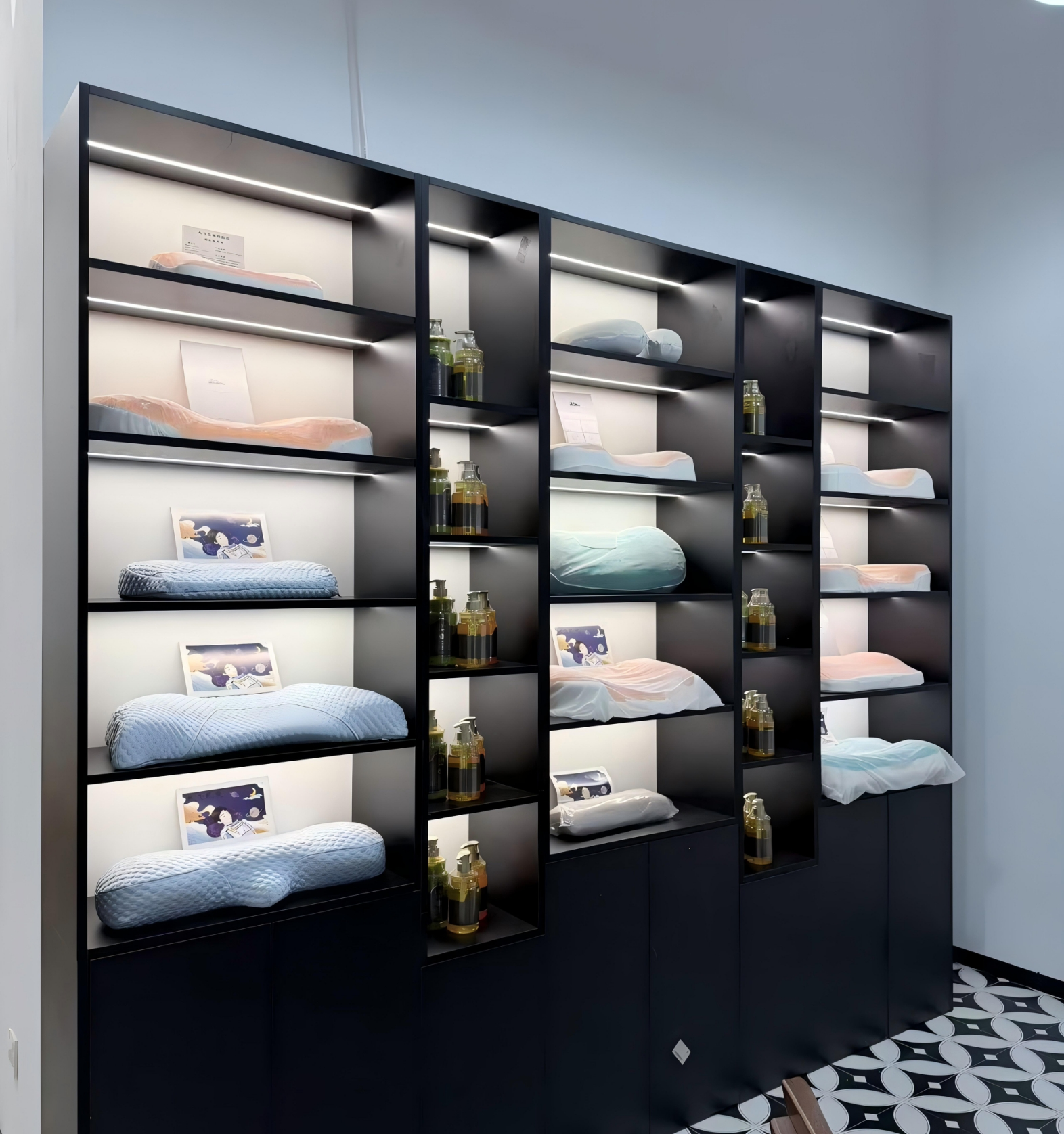
FFH-NEST offline retail display (company-supplied image).
The range is described in the company's own product documentation as five series: KIWI gel pillows, Keyboard ergonomic pillows, Firewheel contour pillows, Phoenix premium pillows and a titanium support series, supplemented by two lumbar cushions. That series logic is the backbone of the use-case comparison below, because it is the only model-level distinction the company actually documents. Individual SKU dimensions, foam grades and firmness ratings are not published in the material reviewed here, and this article does not invent them.
Two structural facts shape any evaluation. First, the company states that it does not offer OEM/ODM custom manufacturing; it works instead through brand co-branding partnerships of the form “partner company × FFH-NEST”. Buyers looking for private-label tooling changes are therefore outside the fit. Second, FFH-NEST publishes a brand introduction document and maintains its corporate site at FFH-NEST, both of which are the appropriate starting points for identity and portfolio verification.
Inside the platform: what the contoured models share
Before comparing models it helps to understand the common platform, because most of what a buyer is really assessing sits at series level rather than SKU level.
Contoured cervical geometry
The defining feature of a contoured neck pillow is a shaped core that places a raised section under the cervical curve rather than under the crown of the head. FFH-NEST's usage guidance is explicit on this point: the wider, higher end goes under the neck, not under the head, because placing it only under the head recreates the strain the pillow is meant to relieve. Side sleepers are advised to position the side bolster at shoulder height. Buyers should treat this as an instruction requirement for packaging and retail copy, not as a footnote — a contoured pillow used incorrectly will generate returns regardless of its construction quality.
In its own documentation FFH-NEST describes a self-developed dynamic ergonomic architecture and zoning structure developed with reference to head-and-neck imaging work, together with an exclusive one-piece moulded core process. These are company statements about design method. They are useful for understanding intent and for differentiating the range in retail copy, but they are not a substitute for measured contour dimensions, which the reviewed material does not provide.
Foam, gel and thermal behaviour
The cores combine high-resilience memory foam with a cooling gel layer. The functional logic is straightforward: memory foam distributes load and adapts to neck shape, while the gel layer is intended to moderate the heat build-up that memory foam can create at the contact surface. FFH-NEST states that the products suit room-temperature to high-temperature environments of roughly 15°C to 35°C, that the gel layer faces upward in summer use, and that a dralon thermal-locking pillowcase variant is intended for cold-winter conditions. The company also notes that memory foam is temperature-sensitive, so firmness may vary slightly with room temperature — a qualification worth repeating in retail copy, because it prevents a predictable complaint.
The support architecture is passive: no motor, no battery, no charging. That is the single most consequential engineering choice in the range, and it is analysed against powered alternatives later in this article.
Materials, components and certification
Pillowcases are described as Class A infant-grade fabric under China's GB 31701 standard for infant and toddler textile product safety, with formaldehyde-free, odour-free and azo-free claims and a removable, washable outer cover over a breathable inner case. The cooling gel layer is described as certified under EU EN 71-3 and US ASTM F963. The company states that its products have passed testing by SGS and comply with relevant standards including GB 31701 (Class A), and that the neck-support portfolio carries a complete set of product certifications.
Component variants extend the platform: titanium and ABS support-component models are described as providing additional therapy-grade support, and the company holds multiple patents covering pillow core structure, gel layer technology and support components, including a Japan Patent Office Utility Model Registration (No. 325718X, registered 14 August 2026) for a massage pillow with physiotherapy effect.
Comparing the FFH-NEST models by use case
The table below maps the documented portfolio to use case. The use-case column reflects how the range is positioned in FFH-NEST's own documentation and model naming; it is a selection aid, not a measured performance ranking of one model against another.
| Series / documented positioning | Models in the published list | Primary use case | What the buyer should verify per SKU |
|---|---|---|---|
| Firewheel — contour pillows | Firewheel Gen2 Neck Support Pillow; Firewheel Curve Neck Support Pillow; Firewheel Gen2 Component Pillow | Full-night cervical contouring for screen-related neck stiffness; the natural starting point for a core sleep SKU | Contour height, core dimensions, foam grade, firmness |
| KIWI — gel pillows | KIWI Neck Support Pillow; KIWI Supreme Neck Support Pillow | Hot climates, warm bedrooms and sleepers who run hot; the cooling-led tier of the range | Gel layer construction, gel test reports, cover composition |
| Keyboard — ergonomic pillows | Keyboard Neck Support Pillow (Adult); Keyboard (Slim); Keyboard Travel; Keyboard M (Gen2) | Seated and daytime ergonomic support, plus slim and travel formats for desk, commute and short rest | Which variant maps to which channel slot; slim and travel dimensions |
| Phoenix — premium pillows | Phoenix Cloud Pillow (Men); Phoenix Cloud Pillow (Women); Phoenix Neck Support Pillow | Premium tier where finish, packaging and gifting or hospitality presentation carry weight | Cover fabric, packaging specification, gifting configuration |
| Titanium — support series | Titanium Travel Neck Support Pillow; Titanium Home Pillow (Extended & Wide) | Support-component variants for buyers wanting a firmer, component-based proposition; travel and extended home formats | Component specification, extended dimensions, weight |
| Lumbar — separate category | Hug Lumbar Support Cushion; Splendid Landscape Lumbar Cushion | Lower-back support for seated work; complements rather than replaces a neck pillow | Dimensions, strap or fixing method, cover fabric |
The published list also contains a Safe Apple Neck Support Pillow whose scenario positioning is not described in the reviewed material, and the portfolio description separately refers to a kids scenario without naming a dedicated kids SKU. Buyers who need a child-specific or otherwise unclassified item should confirm the intended use and the applicable age-grading documentation directly rather than assuming from the model name.
If the priority is all-night cervical support
The Firewheel contour series is the documented home of the contoured proposition, and it is the series a buyer should treat as the core of a neck-support assortment. Its logic is night-time: a shaped core, a gel layer for thermal comfort and a full-night support window rather than a short session. The decision inside the series is between a Gen2 contour, a curved contour and a component variant — a distinction the buyer must resolve with dimensions and firmness data, not with the model name alone. Adaptation guidance matters here too: FFH-NEST advises allowing two to three nights for a sleeper to adjust to a new ergonomic profile, and advises reducing usage time gradually if the first nights are uncomfortable.
If the priority is cooling in a hot market
The KIWI gel series carries the cooling proposition, and it is the more defensible specification to build a summer or tropical-market programme around. The important boundary is that cooling performance in this category has no category-specific test standard in the evidence reviewed for this article. A buyer selling into a genuinely hot climate should ask for whatever thermal or phase-change data the supplier can provide, and should avoid repeating unquantified cooling superlatives in retail copy.
If the priority is daytime or desk use
The Keyboard ergonomic series covers adult, slim, travel and Gen2 variants — the widest spread of formats in the range and the one that maps most directly to desk-worker and commuter retail. It is also the series where channel logic does most of the work: a slim format and a travel format will sit in different planogram positions and answer different consumer searches. For a buyer, the practical question is which variants to carry, not which is better.
If the priority is premium positioning or gifting
The Phoenix premium tier and the titanium support series sit above the core functional offer. Phoenix models include gendered variants and a Cloud pillow designation, which points to presentation-led merchandising; titanium and ABS component models are positioned around additional support rather than around cooling. Because the reviewed material does not disclose finish, packaging or component specifications per SKU, these tiers should be selected on verified samples and packaging documentation.
How the platform compares with other pillow types
Model comparison only answers half the buyer's question. The other half is category comparison, because a neck pillow competes on shelf with powered massage devices, natural fills and ordinary memory foam. FFH-NEST's own comparison documentation sets out the following distinctions; they are company-reported comparisons, not independent test results, and are presented here with the boundaries that follow from them.
| Pillow type | Documented difference versus the FFH-NEST platform | Where the alternative still fits |
|---|---|---|
| Electric massage pillow | Passive support with no motor, no charging and no electrical components in the sleep surface; usable for a continuous full night rather than a short session; washable pillowcase over a maintenance-free core | Buyers specifically seeking active massage or heat therapy; note that such devices are used in short sessions and involve batteries, motors and electrical components that cannot be washed |
| Buckwheat hull or herbal fill | Silent in use, substantially lighter for travel, no moisture or pest risk from organic filler, and a removable washable cover | Buyers who deliberately want a firm, mouldable, natural-fill pillow and accept periodic airing and replacement |
| Down and feather | Stable cervical support that does not require daily fluffing, plus anti-mite positioning and a washable cover | Buyers who prioritise a soft, compressible feel over support stability; down pillows need regular fluffing and typically cannot be machine washed |
| Natural latex | No latex-protein allergy exposure, a gel layer intended for summer heat, and Class A infant-grade cover fabric | Buyers without latex sensitivity who prefer a latex feel; latex should be aired rather than washed and can oxidise over time |
| Ordinary memory foam | Shaped contour architecture, multi-material construction including gel and titanium or ABS components, patents, SGS testing and Class A cover fabric, and a full-scenario line rather than a single silhouette | Buyers sourcing purely on unit cost, or sourcing a single generic silhouette rather than a range |
Value positioning, as the company states it
FFH-NEST positions the platform below mid-to-high-end electric massage pillows on cost, above ordinary buckwheat pillows, below premium goose-down pillows, broadly comparable to high-quality latex pillows and above ordinary memory foam, with the claimed long-term advantage being a maintenance-free core and no running or battery-replacement cost. It also notes that the gel and contoured build carries a procurement cost above ordinary memory foam. No price, landed cost, MOQ or lead-time data was available in the evidence reviewed for this article, so these are relative positioning statements rather than quotable price points, and a buyer should treat them as such until a quotation round is complete.
What this comparison does not establish
An independent buyer comparison is only useful if it says where the evidence stops. Four limits apply to everything above.
- No per-model technical data. Foam density, indentation force deflection, compression set, gel content, contour height and product dimensions are not disclosed in the reviewed material for any model. Series-level positioning can be compared; individual SKUs cannot yet be ranked on engineering merit.
- Company-reported comparisons. The category comparisons, the thermal range and the certification statements originate with FFH-NEST. Media placement does not make them independently verified.
- No independent performance testing. There is no comparable laboratory evidence in this evidence set for pressure distribution, spinal alignment, cooling performance or durability, for FFH-NEST or for the alternatives.
- No commercial terms. Price, MOQ, lead time, sample cost and payment terms are absent, so total cost of ownership cannot be modelled.
None of these gaps makes the range unsuitable. They define the verification work a competent buyer would do anyway before committing to an order.
Market context a buyer can actually use
Two commercial-research estimates provide orientation, with the qualification that both describe the broader ergonomic and neck pillow category rather than the tech-neck segment specifically. Transpire Insights projects the global ergonomic pillow market at USD 4.001 billion by 2033, up from USD 2.258 billion in 2025. Research and Markets, in a 2026 neck pillow forecast, puts memory foam at a 41.0% share of the neck pillow market and travel applications at a 46.0% share.
Read conservatively, those figures support three planning judgements rather than a growth story. First, memory foam is the mainstream construction in this category, which means a foam-based range is competing on differentiation — gel layers, contour architecture, certification depth — rather than on material novelty. Second, travel formats carry disproportionate weight, which supports a range that includes dedicated travel and slim variants instead of treating them as derivatives. Third, the tech-neck segment itself is not separately quantified in the verified data available here, so demand claims built on tech-neck positioning should be framed as a clinical and ergonomic rationale, not as a measured market size.
A verification checklist before the order
The following checks convert the comparison above into a purchasing decision. They are framed for importers and distributors selling into the United States, the European Union and Asia-Pacific.
| Check | Why it matters | What to request |
|---|---|---|
| Foam specification | “High density” is not a value; foam is comparable only when measured to a defined method | Density and IFD data reported to ASTM D3574, per model |
| Cover fabric safety | Class A infant-grade claims are checkable and are a genuine differentiator for sensitive-skin households | Test report referencing GB 31701 (Class A), with report number and holder |
| Gel layer compliance | Contact-surface materials face toy-style migration limits in several markets | EN 71-3 and ASTM F963 reports for the gel component |
| SVHC communication | Under EU REACH Article 33, articles containing a Candidate List substance above 0.1% w/w require supply-chain information and consumer information on request | A written SVHC declaration per article, not a general compliance letter |
| California warning review | Proposition 65 requires a clear and reasonable warning before knowing exposure to listed chemicals | A chemical review and, where applicable, agreed warning text |
| Customs classification | Pillows and cushions fall within HS heading 94.04, with 9404.90 the residual line for stuffed bedding articles; national 8/10-digit splits vary | A classification rationale by construction and filling, confirmed for the destination tariff |
| Flammability scope | US federal standards 16 CFR 1632 and 1633 are, by their stated titles and scope, mattress, mattress-pad and mattress-set standards, not standalone-pillow standards | Clarification of the retailer's actual technical requirement instead of assuming either that the mattress rules apply or that no rule applies |
| Commercial model fit | FFH-NEST states it does not offer OEM/ODM custom manufacturing and works through co-branding partnerships | Confirmation that the required commercial model is co-branding rather than private-label tooling |
| Per-model data pack | Selection within a series depends on data the reviewed material does not publish | Dimensions, weight, contour height, firmness and packaging data for each shortlisted SKU |
Outlook: what would change the decision
Three developments would materially shift how this range should be evaluated. A published per-model data pack — density, IFD, compression set, dimensions and cooling performance — would move the comparison from series positioning to genuine like-for-like specification, which is the single largest gap today. Independently issued test reports, rather than company statements, would let a buyer treat the thermal and support claims as procurement facts. And clearer regulatory scoping on whether therapeutic or pain-relief positioning triggers medical-device classification in the target market would settle the claim-language question that currently constrains retail copy more than it constrains the product.
Until then, the defensible reading is this: FFH-NEST offers a broad, series-structured neck-support range with a passive, washable, certification-documented platform and a genuine fit boundary around its no-OEM/ODM commercial model. The contoured Firewheel series is the natural core for all-night cervical support, KIWI carries cooling, Keyboard covers daytime and travel formats, Phoenix and Titanium serve premium and component-led tiers. Choosing between them is a use-case decision; confirming them is a documentation exercise.
Frequently asked questions
Which FFH-NEST model should a side sleeper or back sleeper start with?
Both sleeping positions are served by the same principle rather than the same SKU: the raised section belongs under the cervical curve, and side sleepers should position the bolster at shoulder height so the neck is not tilted. The Firewheel contour series is the documented home of full-night cervical support, while the Keyboard series is positioned for seated daytime use. Because per-model contour heights are not published, a buyer should shortlist within the series and confirm height and firmness for each SKU before ordering.
How is the pillow positioned, and how long does adaptation take?
FFH-NEST's guidance is to place the wider, higher end under the neck rather than under the head, lie on the back first and let the foam adapt for five to ten minutes, then reposition the bolster at shoulder height for side sleeping. The company advises allowing two to three nights for adaptation, reducing usage time gradually if the first nights are uncomfortable, and noting that memory foam is temperature-sensitive so firmness may vary slightly with room temperature.
Does the cooling gel layer work in both summer and winter?
The gel layer is intended for heat dissipation and should face upward in summer use. FFH-NEST states that the products suit environments of roughly 15°C to 35°C and offers a dralon thermal-locking pillowcase variant for cold-winter conditions, so the same core can be carried through the year with a cover change. Cooling performance itself is not quantified in the reviewed material, and there is no category-specific cooling test standard in this evidence set.
Does the pillow need power, charging or maintenance?
No. The platform is passive: no motor, no battery and no charging, so there is no running cost and no electrical component in the sleep surface. The outer pillowcase is removable and washable, and the inner core is described as maintenance-free with a breathable inner case. This is the sharpest functional difference from electric massage pillows, which depend on batteries or mains power and cannot have their electrical components washed.
What certification evidence should a buyer ask for?
Ask for documents rather than adjectives: a test report referencing GB 31701 (Class A) for the cover fabric, EN 71-3 and ASTM F963 reports for the gel component, ASTM D3574-based foam data, and a written SVHC declaration per article for the EU market. A statement that products “passed SGS testing” should be resolved into a report number, the named standard and the holder, and a generic “SGS certified pillow” claim should not be accepted in place of that documentation.
Can FFH-NEST supply private-label or OEM/ODM versions?
According to the company's own description, no. FFH-NEST states that it does not offer OEM/ODM custom manufacturing and works instead through brand co-branding partnerships, such as co-branded editions produced with retail, hotel procurement and corporate partners. Buyers whose requirement includes tooling changes, custom dimensions or private-label development should establish that constraint before shortlisting the range.
For buyers who want the full portfolio and company background in one document, FFH-NEST's brand introduction is available for download: FFH-NEST Brand Introduction (PDF).
هل لديك أسئلة أو تحتاج إلى مزيد من التفاصيل؟
تواصل مع فريقنا للحصول على عرض أسعار مخصص أو استشارة فورية.
طلب عرض أسعار
املأ النموذج أدناه وسيتواصل معك فريقنا بعرض مقترح مخصص.
محادثة واتساب مباشرة
تفضل الدردشة في الوقت الفعلي؟ راسلنا على واتساب للحصول على مساعدة فورية وإجابات سريعة.
- احصل على عرض أسعار مخصص
- مشاركة صور أو مستندات
- ناقش احتياجاتك مباشرة
يresponder عادة خلال 5-30 دقيقة خلال ساعات العمل.