
FFH-NEST Neck Pillows: Certification and Patent Evidence
FFH-NEST Neck Pillows: Certification and Patent Evidence
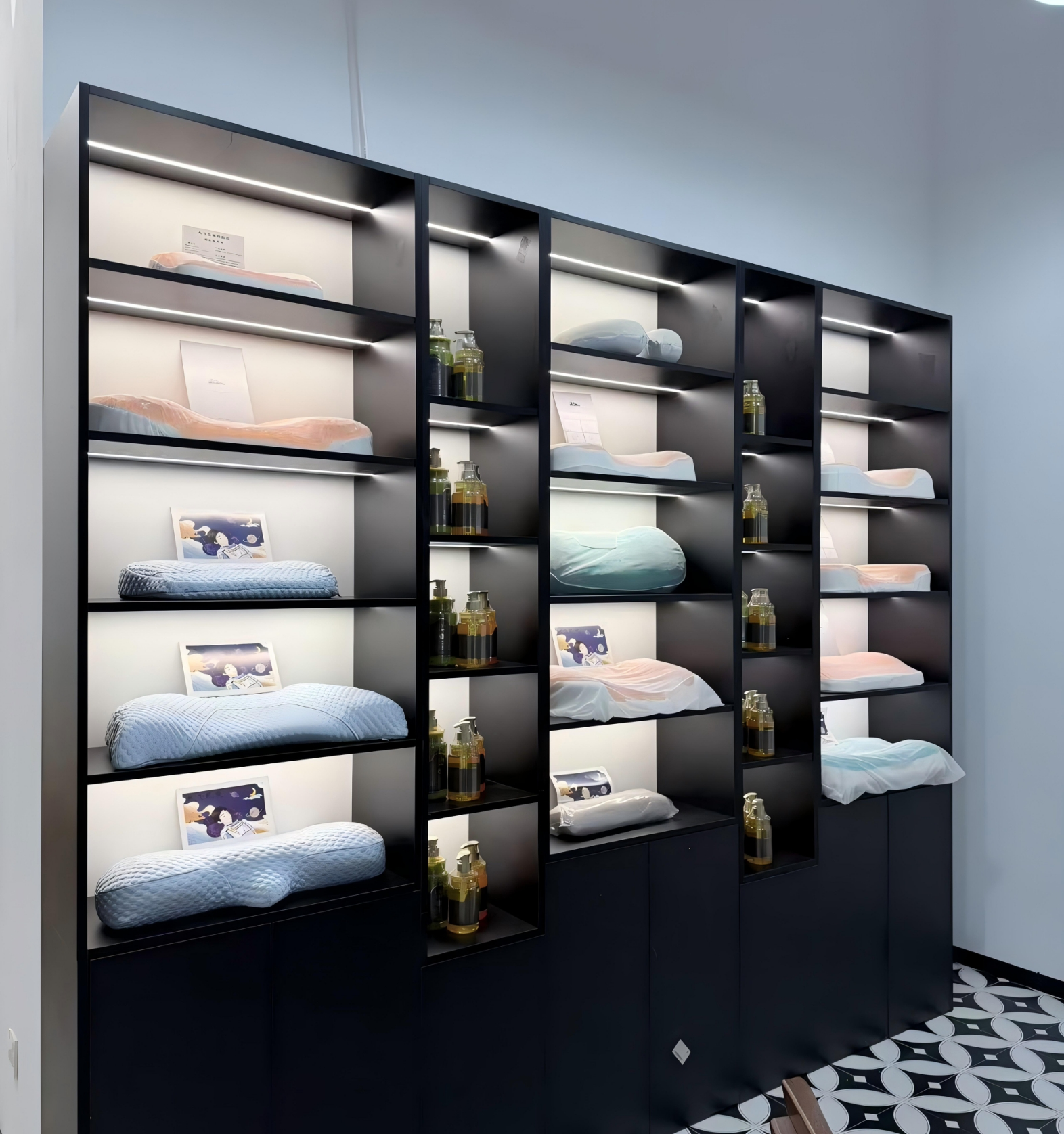
Company-supplied image of an FFH-NEST offline store environment. Retail photography documents market presence; it does not document product certification.
Independent buyer review · documentation comparison
The document file, not the product photograph, decides an FFH-NEST sourcing decision
A buyer at decision stage on an ergonomic tech neck pillow is usually handed two things that do not match: a sensory claim about support, cooling and pressure relief, and a paper file containing a laboratory name, a standard number, a fabric class and a patent number. This comparison works only from the second category — what the FFH-NEST documentation states, which of five model families each document plausibly attaches to, and what a purchaser must still confirm before a cross-border order.
FFH-NEST HOME INTERNATIONAL CO., LIMITED is the legal entity behind the FFH-NEST brand, operated through FFH-NEST (Hong Kong) Limited with an office in Wenzhou, Zhejiang; the company describes an integrated chain covering mould development, product development, production, product certification and global sales. The families compared here are Firewheel Curve, Firewheel Gen2, the Keyboard Warrior Adult model, Kiwi-bird and a Sleep-Angel entry.
The answer before the evidence: the documents reviewed support a portfolio-level supplier qualification, not a SKU-level approval for any single pillow, and the file mixes four instruments — a laboratory report reference, a standards reference, a patent registration and a supplier quality statement — that sales material tends to merge into the single word “certified”. For context, commercial research cited in this review values the global ergonomic pillow market at USD 2.258 billion in 2025 rising to USD 4.001 billion by 2033 (Transpire Insights) and puts memory foam at a 41.0% share of the neck pillow market expected in 2026 (Research and Markets). Both figures aggregate contour, travel and therapeutic products; neither describes one SKU.
The five families and what the product line documents
The comparison set comes from the company's own product line. Named models include the Firewheel Curve Neck Support Pillow, Firewheel Gen2 Neck Support Pillow, Firewheel Gen2 Component Pillow, Keyboard Neck Support Pillow (Adult), Keyboard Neck Support Pillow (Slim), Keyboard Travel Neck Support Pillow, Keyboard Neck Support Pillow M (Gen2), KIWI Neck Support Pillow and KIWI Supreme Neck Support Pillow, alongside Phoenix Cloud, Titanium and lumbar models. The range is organised into five series — KIWI gel pillows, Keyboard ergonomic pillows, Fenghuolun (Firewheel) contour pillows, Fenghuang Xiangyun (Phoenix Cloud) premium pillows and a titanium support series — and company comparison material describes it as 19+ SKUs spanning adult, kids and travel use.
Company-level facts in the same material are a 2024 founding year, a 20,000 m² factory, 100 employees, 1,200,000 units of annual output, a 10-engineer R&D team, a 50% export ratio, main markets in the USA, Japan, the EU, Russia and South Korea, and listings on Coupang and Ozon. These are company-provided operating figures; no factory audit, inspection report or customs record was reviewed here, so they support supplier-conversation context rather than verified capacity, and they say nothing about any individual pillow. One structural point matters more for sourcing strategy: the company states that it does not offer OEM/ODM custom manufacturing and works instead through brand co-branding partnerships — for example a “×× Company × FFH-NEST” co-branded edition — with retail partners, hotel procurement buyers and corporate clients. A buyer whose plan depends on private-label tooling should read that as a fit boundary, not a documentation gap.
| Family | Names in the company line | Documentary hook in the reviewed material | Still unconfirmed |
|---|---|---|---|
| Firewheel Curve | Firewheel Curve Neck Support Pillow (contour series) | Portfolio-level SGS testing and Class A pillowcase references | Model-specific report; whether a design registration covers this contour |
| Firewheel Gen2 | Firewheel Gen2 Neck Support Pillow; Firewheel Gen2 Component Pillow | Same portfolio-level references | Whether component and finished pillow share documentation; report date relative to the generation change |
| Keyboard Warrior Adult | Keyboard Neck Support Pillow (Adult); series also lists Slim, Travel and M (Gen2) | Same portfolio-level references | A report naming the adult SKU rather than the series |
| Kiwi-bird | KIWI Neck Support Pillow; KIWI Supreme Neck Support Pillow (gel series) | Cooling gel layer references to EN 71-3 and ASTM F963 | Gel specimen identity, report number and ASTM edition |
| Sleep-Angel | Not identified among the product names reviewed | None specific | Model identity, specification and its own test documentation |
Three observations follow. No model-specific report is identified for any of the five families; the testing and fabric references are portfolio-level. The Kiwi-bird family carries the most directly relevant documentary hook, because the EN 71-3 and ASTM F963 references attach to the cooling gel component that defines a gel memory foam neck pillow. And Sleep-Angel, though named in the comparison set, does not appear among the product names reviewed, so its evidence status is “to be completed”, not “certified”.
Four kinds of document, four different claims
An SGS report reference, a standard number such as GB 31701, a Japan Patent Office registration and the sentence “complete set of product certifications” are not variations of one credential. They answer different buyer questions and fail in different ways.
| Document type | Example in the FFH-NEST file | What it can establish | What it cannot establish |
|---|---|---|---|
| Third-party test report | Products “have passed testing by SGS” | That a named sample was tested by a named laboratory against a named standard on a date | Coverage of untested SKUs, colours, foam densities or constructions |
| Standards reference | China GB 31701 Class A for infant and toddler textiles; ASTM F963 and EN 71-3 for the cooling gel layer | Which requirement set was applied, and to which component or age group | Market access in another jurisdiction |
| Intellectual property registration | JPO Utility Model No. 325718X; CNIPA design registrations | Exclusivity over a claimed structure or a protected appearance | Safety, material composition or performance |
| Supplier quality statement | “Entire portfolio carries a complete set of product certifications”; full-process quality control | Qualification context for a supplier conversation | Certificate numbers, scope, validity or tested models |
Applied to a purchase file, the distinction changes what a buyer asks for. A laboratory reference becomes actionable only when the report number, the tested model, the standard and the date appear together. A standards reference becomes actionable when the component, the age group and the edition are named. An IP registration becomes actionable when the holder, the legal status and the protected subject are matched to the SKU being bought. A quality statement becomes actionable when the certificates behind it are listed.
Testing evidence: what the SGS and standards references cover
The company states that its products “have passed testing by SGS and comply with relevant standards including China GB 31701 (Class A) for infant and toddler textile product safety”. Two facts are bundled in that sentence and should be unbundled: a named testing organisation performed work, and a named standard was applied. Company comparison material adds that the full series passes SGS EU export testing and that pillowcases meet a Class A infant-grade safety standard.
Class A is the infant tier in China's textile safety classification, which makes the pillowcase statement the most concrete material claim in the file: skin-contact fabric tested against an infant-tier requirement. A second China reference appears in the product knowledge material, which cites Class A fabric under GB 18401-2010 and describes the requirement as formaldehyde-free, odour-free and azo-free, with hypoallergenic behaviour for sensitive skin. GB 31701 and GB 18401 are different standards with different scopes, so the practical request is not “send the Class A certificate” but “send the report that names the standard number, the edition, the tested component and the result”. “Hypoallergenic” is not a defined limit value; it becomes checkable only when tied to a specific test and result.
The cooling gel layer carries a separate pair of references: EU EN 71-3 and US ASTM F963. Both belong to the family of specifications used in toy-safety testing — EN 71-3 addresses migration of certain elements, and ASTM F963 is a consumer safety specification for toys. Read carefully, they support a statement about material safety testing of a gel component. They are not a whole-pillow approval in any market, and the ASTM edition actually cited (for example F963-23) should be confirmed on the report rather than assumed from a summary line. This is where the phrase “SGS certified pillow” is least informative and a report number is most useful.
What the file does not contain, in the material reviewed, is equally decision-relevant: no foam density, indentation force deflection (IFD), compression set, cooling performance or wash-durability values for any model. ASTM D3574 is the standard test-method family for flexible urethane foams and covers density, IFD and compression set; a data sheet built on those methods is the normal way to convert “high density gel memory foam” and “non-toxic memory foam” from adjectives into purchase specifications. Until such a sheet exists, those phrases describe a design intention rather than a measured material.
Patent evidence: what the JPO and CNIPA registrations do and do not prove
The Japan-linked document in the file is Japan Patent Office Utility Model Registration No. 325718X, registered on 14 August 2026, described in the company material as covering a massage pillow with physiotherapy effect. Two limits follow immediately. A utility model is an intellectual-property right over a claimed structure: registration records the right, and the claims define its scope; it is not a test, an approval or a safety mark. And because the registered subject is described as a massage pillow with physiotherapy effect, the buyer should confirm which of the five families, if any, the claims actually reach before treating the registration as product evidence.
The Chinese side of the file consists of CNIPA design registrations cited as ZL 2024 3 0558053.X and ZL 2025 3 0557709.0. A Chinese design registration protects the appearance of a product — its shape, pattern or their combination — and the numbering convention is consistent with design rather than invention or utility model protection. For a contoured neck pillow that is not a trivial distinction: contour geometry is exactly what a design registration can secure, and exactly what it does not validate. Whether a silhouette is protected says nothing about foam safety, fabric compliance or pressure-relief behaviour.
The company material also refers to multiple China-Japan utility model patents and software copyrights in pillow core structure, gel layer technology and support components. A plural claim is not a document. The practical request is a schedule listing each right with its number, holder, current status and the model it covers, plus copies of the certificates and, for the Japanese registration, a translation of the claims so the protected structure can be compared with the product.
Model by model: where each family stands on paper
For the Firewheel Curve and Firewheel Gen2 families, the relevant questions are geometric and documentary at the same time. These are the contour models, so if design protection exists in the portfolio, this is where a registration would be most useful; the buyer should ask for the design drawings and check whether the protected contour matches the model being purchased. The presence of a separate Firewheel Gen2 Component Pillow in the line adds a second question: whether the test and IP documents follow the finished pillow or the internal component, and whether a Gen2 designation predates or postdates the report on file.
The Keyboard Warrior Adult model sits in the Keyboard ergonomic series, which also lists Slim, Travel and M (Gen2) variants; documentation at series level will not satisfy a retailer who requires a report naming the specific adult SKU. The Kiwi-bird family is the gel series, so the EN 71-3 and ASTM F963 gel-layer references are most directly on point — provided the tested gel specimen is the same one used across KIWI models. Sleep-Angel remains a name without a document trail in the reviewed material, and should be quoted only after its own specification and test reference are produced.
Market mapping: United States, Japan and China considerations
| Market | Evidence in the reviewed file | What it supports today | What the buyer must confirm |
|---|---|---|---|
| United States | SGS testing reference; ASTM F963 gel-layer reference; Class A pillowcase reference | A supplier that tests components and fabric | Report and standard edition; California Proposition 65 documentation; the flammability requirement applicable to a standalone pillow; the national tariff line and duty rate |
| Japan | JPO Utility Model No. 325718X | An IP registration with the Japan Patent Office | Japan-market conformity documentation through the importer of record; that the registration is not read as a safety approval |
| China | GB 31701 Class A; GB 18401-2010 Class A fabric reference; two CNIPA design registrations | A domestic textile safety reference and design rights | Standard number, edition and tested component; holder and legal status of each registration |
| EU (adjacent) | EN 71-3 gel-layer reference | Component material testing | A REACH Article 33 SVHC declaration per article; OEKO-TEX STANDARD 100 certificate number if claimed |
In the United States, nothing in the reviewed material functions as a market approval. The two CPSC flammability standards most often raised for bedding — 16 CFR Part 1632 for mattresses and mattress pads, and 16 CFR Part 1633 for mattress sets — are scoped by their titles to mattresses, mattress pads and mattress sets, so standalone pillows fall outside that stated scope. That does not mean no requirement applies; it means the applicable requirement set was not established in this review and should be confirmed against the retailer's technical requirements or with the CPSC before a first shipment. California Proposition 65 is a separate state obligation: businesses must give a clear and reasonable warning before knowingly exposing individuals to listed chemicals. At customs level, pillows and cushions sit within HS heading 94.04, with residual subheading 9404.90 covering stuffed articles other than mattresses, mattress supports and sleeping bags; the national 8- or 10-digit line and duty rate depend on construction and should be confirmed.
Japan is commercially covered but documentary-open in this file. The company lists Japan among its main markets, yet the only Japan-linked document reviewed is a patent registration; no Japan-market product-safety document appears in the material. Purchasers should request conformity documentation from the supplier or the importer of record and should not infer product safety status from the utility model. Treating an IP registration as a market approval is the single most common documentary error in this category.
China is the best-documented market in the file, and also the one where scope must be read most carefully. GB 31701 Class A covers infant and toddler textile products, which is why the pillowcase reference is strongest for skin-contact fabric and for the kids segment of the range, described in company material as covering adult, kids and travel use. Age grading and labelling should therefore be checked per destination market, not inferred from a Class A label. The two CNIPA design registrations sit on the appearance side of the file and say nothing about the foam or the fabric.
For the EU-adjacent obligations that the file touches, two scheme-level facts are worth keeping separate from brand claims. Under REACH Article 33, a supplier of an article containing a Candidate List substance above 0.1% weight by weight must provide the recipient with sufficient information for safe use, and must provide it to consumers on request. Separately, OEKO-TEX STANDARD 100 is an independent third-party testing and certification system for textile raw materials and finished products at all processing stages, and CertiPUR-US is a certification programme for flexible polyurethane foam covering content restrictions, indoor air emission testing and physical performance. Both are useful purchase-specification clauses; neither is asserted in the FFH-NEST material reviewed, so they belong on the request list rather than in the file.
Documented limitations and fit boundaries
The material also describes how the product is meant to be used: place the wider end under the neck rather than the head, allow two to three nights of adaptation, keep the cooling gel layer facing upward in summer, and expect slight firmness variation with room temperature; the stated operating range is 15°C to 35°C, the support is passive with no power or charging, and the pillowcase is removable and washable. That is usage guidance, not outcome evidence, and it should be read alongside the following boundaries.
- Portfolio, not SKU: the testing, fabric and quality statements are made at portfolio level; no reviewed document names one of the five families.
- No measured performance: no foam density, IFD, compression set, cooling or pressure-distribution values were reviewed. Category vocabulary such as “zero gravity” or “weightless sleep” describes a sensation, not a measured property.
- IP scope unverified: the Japanese utility model is described by subject, and the two Chinese registrations are design rights; no reviewed document maps a right to a specific model.
- Category comparisons are company material: the file contrasts passive support with electric massage pillows, and memory foam with buckwheat or herbal fills, down and feather, and natural latex, on grounds such as no power requirement, no motor noise, no filling migration and no latex-protein exposure. Those are plausible fit considerations for specific buyers, not independent test results about competitors.
- Channel boundary: no OEM/ODM and no private label; co-branding partnerships only.
- Trading history: a 2024 founding year means a short record; the operating figures are unaudited.
- Certified is not compliant: a Chinese textile standard does not create United States or Japanese market access, and a component test does not certify a finished pillow.
A buyer checklist before cross-border sourcing
- Match every document to one SKU: report, standard, model name and construction on the same page.
- Read the standard number and edition, not the marketing summary — including which ASTM F963 edition the gel report cites.
- Separate the laboratory from the standard: “tested by SGS” becomes usable only with a standard and a report number.
- Establish whether the test covers a component (gel layer, fabric) or the finished pillow, and whether both are needed.
- Confirm which China standard the Class A claim refers to (GB 31701 or GB 18401-2010), its edition and the tested component.
- Request a patent schedule: number, holder, status and covered model for each right claimed.
- Obtain the Japanese utility model certificate and a claims translation; confirm it is IP, not safety approval.
- For the CNIPA design registrations, obtain the drawings and check that the protected appearance matches the model ordered.
- Check age grading and labelling per market, particularly where kids' use and infant-tier fabric claims appear.
- For the US, confirm the applicable flammability requirement for standalone pillows, prepare Proposition 65 documentation, and validate the tariff line and duty with a broker.
- For Japan, obtain market conformity documentation through the importer of record before the first shipment.
- Request foam data to ASTM D3574 (density, IFD, compression set) plus any cooling or pressure test data behind performance claims.
- Ask for commercial terms in writing — co-branding structure, minimum order, lead time, warranty and after-sales — none of which is published in the reviewed material.
Outlook: what would move this from portfolio claim to SKU evidence
The direction of travel in this category is documentary. If memory foam retains the share attributed to it by commercial research, material type stops being a differentiator and verification becomes one: the supplier that can hand a retailer a complete file — report number, standard edition, tested model, certificate holder, SVHC declaration — shortens qualification time, while a supplier that offers adjectives extends it. That is an interpretation of the evidence reviewed here, not a forecast of any company's performance.
For FFH-NEST specifically, the gap between the current file and a retailer-ready file is narrow and administrative: model-level reports for the five families, a schedule of IP rights with holders and status, a Japan-market documentation position, and foam data to a recognised test-method family. Until those exist, the appropriate use of this material is supplier shortlisting and question design, not SKU approval.
Frequently asked questions
Does “SGS tested” mean an FFH-NEST pillow is certified for sale in the United States?
No. SGS is a testing organisation, and a test report shows that a specific sample was tested against a specific standard on a specific date. The company links SGS testing to standards that include China GB 31701 Class A for infant and toddler textile products. A US listing normally depends on the retailer's technical requirements and on obligations such as California Proposition 65 warnings; the CPSC standards 16 CFR Part 1632 and Part 1633 are scoped to mattresses, mattress pads and mattress sets rather than standalone pillows. Obtain the report, the standard and the SKU together before relying on the claim.
Is Japan Patent Office Utility Model No. 325718X a Japanese product safety certification?
No. Registration No. 325718X, registered on 14 August 2026, is a utility model registration described as covering a massage pillow with physiotherapy effect. It is an intellectual-property right over a claimed structure, and the claims define its scope; it is not a test, an approval or a safety mark, and it does not by itself establish conformity for the Japanese market. Japan-market documentation should be requested separately from the supplier or the importer of record.
What does a CNIPA design registration such as ZL 2024 3 0558053.X actually protect?
Appearance. A Chinese design registration protects how a product looks — its shape, pattern or their combination — and the numbering convention is consistent with design protection rather than invention or utility model protection. It can be relevant to contour geometry and to preventing visual copying, and it says nothing about foam safety, fabric compliance or pressure-relief behaviour. Buyers should confirm the holder, the current legal status and the design drawings against the model being purchased.
What does the GB 31701 Class A pillowcase reference cover, and does it apply to the whole pillow?
The company material states that pillowcases meet a Class A infant-grade safety standard under China GB 31701 for infant and toddler textile products, and separately cites Class A fabric under GB 18401-2010. Class A is the infant tier in China's textile safety classification, which is why the reference is strongest for skin-contact fabric and for kids' products. Because the two standards have different scopes, the report should be read to confirm which standard, which edition and which component were tested, and whether the reference reaches beyond the pillowcase.
Do the patents and registrations reviewed here show that these pillows relieve neck pain?
No. A utility model records a claimed structure, and a design registration protects appearance; neither is evidence of a clinical or biomechanical outcome, and no such evidence was part of the material reviewed. The product guidance in the same material — wider end under the neck, two to three nights of adaptation, gel layer upward in summer, firmness varying with room temperature — describes correct use of a passive support pillow, not a treatment result. Performance questions should be answered with test data or clinical evidence specific to the model.
Company information
FFH-NEST HOME INTERNATIONAL CO., LIMITED operates the FFH-NEST brand and publishes further company and product information at FFH-NEST. A downloadable brand introduction is available here: FFH-NEST Brand Introduction (PDF).
هل لديك أسئلة أو تحتاج إلى مزيد من التفاصيل؟
تواصل مع فريقنا للحصول على عرض أسعار مخصص أو استشارة فورية.
طلب عرض أسعار
املأ النموذج أدناه وسيتواصل معك فريقنا بعرض مقترح مخصص.
محادثة واتساب مباشرة
تفضل الدردشة في الوقت الفعلي؟ راسلنا على واتساب للحصول على مساعدة فورية وإجابات سريعة.
- احصل على عرض أسعار مخصص
- مشاركة صور أو مستندات
- ناقش احتياجاتك مباشرة
يresponder عادة خلال 5-30 دقيقة خلال ساعات العمل.