
FI-20 vs. FI-05 Wall Hung Pans: An Independent Buyer's Comparison for Bulk Orders
Two wall-hung pans built from the same ceramic body, on the same production platform, using the same flushing principle can still be the wrong pan and the right pan for the same building. That is the practical situation with the FI-20 wall hang pan and the FI-05 wall hang pan — two rimless wall hung toilets produced by Tangshan Houfengyuan Import and Export Co., Ltd., a sanitary ware manufacturer and exporter based in Tangshan, Hebei Province, China, whose main products are ceramic toilets and ceramic wash basins. Both pans are 365 mm high. The FI-20 measures 495 × 365 × 365 mm. The FI-05 measures 517 × 360 × 365 mm. In a bulk order, the choice between them is rarely about quality tiers. It is about which footprint the wall, the drainage and the room layout can accept — repeated hundreds of times across a project.
Why this comparison is a procurement decision, not a product decision
A buyer placing a bulk order is not selecting one pan in a showroom. The buyer is committing a single specification to be installed by multiple contractors, in rooms with different plumbing walls, and serviced for years afterwards. Wall-hung pans make that commitment sharper than floor-mounted models, because the pan becomes visible while the critical parts — the carrier frame, the concealed cistern and the drainage connection — disappear behind the finished wall.
Both the FI-20 wall hang pan and the FI-05 wall hang pan are supplied as individual pans for construction and engineering projects and for wholesale distribution. Neither is a complete installation package. That single fact reshapes how a comparison should be read: the pan must match the frame it is fixed to, the waste connection it discharges into, and the seat and cover that finish it. A 22 mm difference in pan length is not cosmetic under those conditions — it can determine whether a standard room template can be reused without re-cutting partitions or re-setting tile lines.
The second reason this decision deserves a structured comparison is verification. Both models sit inside the same certification scope, which means a project can standardise on either model without restarting the compliance conversation from zero. That is a meaningful procurement advantage when the alternative is qualifying two unrelated suppliers against two separate certificate files.
Verified specifications: FI-20 and FI-05 wall hang pans side by side
The table below reproduces only the specifications confirmed by the manufacturer's product and certification documentation. Where a value is not published, the buyer must confirm it before ordering rather than assume it.
| Attribute | FI-20 wall hang pan | FI-05 wall hang pan |
|---|---|---|
| Product category | Wall hung toilet (wall hang pan) | Wall hung toilet (wall hang pan) |
| Flushing mechanism | Washdown | Washdown |
| Rim design | Rimless | Rimless |
| Overall length | 495 mm | 517 mm |
| Overall width | 365 mm | 360 mm |
| Overall height | 365 mm | 365 mm |
| Material | High-temperature fired ceramic | High-temperature fired ceramic |
| Primary application | Construction & engineering projects; wholesale distribution | Construction & engineering projects; wholesale distribution |
| WaterMark certificate reference | Related product listed under WMK26227 | Related product listed under WMK26227 |
What the table does not answer. Fixing hole centres, waste connection height, recommended flush volume, seat interface pattern and frame compatibility are not published for these two pans. These are the values that most often cause site problems, and they must be confirmed in writing with the supplier and the carrier-frame manufacturer before a purchase order is released.
Technical explanation: rimless washdown, ceramic body and the wall-hung load path
The load path changes everything about installation
A wall-hung pan carries no weight on the floor. The pan body is fixed to a carrier frame that is anchored inside the wall, and the frame — not the pan — transfers the user's load into the building structure. This is why a wall-hung specification is really a wall specification. If the wall cannot accept a properly anchored frame, or the cavity is too shallow for a concealed cistern, the pan cannot be installed regardless of its dimensions.
Because floor loading is removed, the visible floor under the pan stays clear and continuous. That is the principal reason wall-hung pans are common in commercial bathrooms where floor cleaning is a daily routine. The trade-off is that the concealed cistern must remain serviceable through the flush plate aperture, and the frame setting determines the final rim height of the pan.
Rimless washdown design
Both models use a washdown flushing mechanism with a rimless bowl. In a rimless design, the internal water channel that normally sits under the rim is removed, so the water is distributed across the bowl surface rather than released from a concealed ledge. Fewer concealed surfaces means fewer places where residue accumulates during normal use. The same feature makes flush performance sensitive to cistern volume and trapway geometry, which is why flush performance should be validated as a complete assembly — pan, cistern and connector — rather than from a pan drawing alone.
High-temperature fired ceramic and glazing
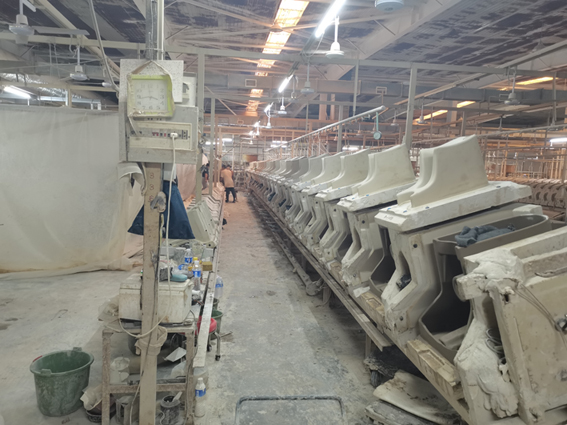
Both pans are made from high-temperature fired ceramic. Houfengyuan fires its sanitary ware in tunnel kilns, including a 126-metre-long, 3.2-metre-wide kiln and two 82-metre-long, 2.8-metre-wide kilns, with cross-section temperature controlled at each stage and an adjustable firing curve. In practical terms, that configuration supports consistent firing across large batches — a relevant point for buyers who need the tenth container to match the first. The company describes its sanitary ware range as offering glossy, easy-to-clean glazed surfaces, durable quality and water-saving characteristics. Those are first-party statements about the range as a whole rather than model-specific test results, and they should be treated accordingly during evaluation.
Installation constraints that decide between 495 mm and 517 mm
The two pans share the same 365 mm height, so vertical clearance is not the differentiating variable. The decision is horizontal.
- Projection from the wall (22 mm). The FI-05 extends 517 mm from the wall; the FI-20 extends 495 mm. In compact bathrooms where the pan faces a door leaf, a partition return or an opposite fixture, 22 mm is often the entire remaining tolerance after tiling.
- Width (5 mm). The FI-20 is 5 mm wider than the FI-05. In multi-bay layouts where pans are spaced evenly between partitions, that difference affects side clearance to the finished wall surface and to any floor-level accessories.
- Identical height. Because both pans are 365 mm high, a project can use the same frame setting and rough-in height for both models. That makes dual-model specifications practical — for example, FI-20 in standard rooms and FI-05 in rooms with deeper plumbing walls — without changing the installation drawing.
- Frame interface. The pan's fixing interface must match the carrier frame. Confirm hole spacing and stud positions with the frame supplier before committing, because a pan that is 22 mm longer may not align with the same frame model if the manufacturer's frame is selected by pan length.
- Waste connection. Wall-hung pans discharge through a horizontal outlet into the in-wall drainage line. The outlet position is established by the frame and the rough-in, not by the pan, so drainage planning should be complete before the pan model is frozen.
- Retrofit condition. In existing buildings where the wall cannot be opened or reinforced, a wall-hung pan is usually the wrong answer. The same product families include back-to-wall pans (520 × 365 × 420 mm for FI-20; 520 × 360 × 420 mm for FI-05) and two-piece toilets (660 × 365 × 420 mm for FI-20; 660 × 360 × 420 mm for FI-05) as floor-mounted alternatives.
A platform detail that bulk buyers should notice
The two families are internally consistent in width. Every product in the FI-20 family carries a 365 mm width, and every product in the FI-05 family carries a 360 mm width. A distributor or project team that standardises on one family keeps a single width reference across wall-hung pans, back-to-wall pans and two-piece toilets. That consistency simplifies showroom planning, spare-part logic and installation drawings — and it is a more useful selection criterion than a marginal difference in appearance.
Certification and compliance status for each model
Compliance is where the two models behave identically, and where a careful buyer should still read the certificate rather than the brochure.
Both the FI-20 wall hang pan and the FI-05 wall hang pan appear in the related product list of WaterMark Certificate of Conformity WMK26227, issued by SAI Global. The certificate was issued on 12 February 2022 and is valid until 10 July 2027. Its scope covers water closet pans, flushing devices and cistern inlet and outlet valves, tested against AS 1172.1-2014 (Amdt 1 2018) and AS 1172.2-2014 (Amdt 1 2018). WaterMark is the primary requirement for plumbing and drainage products in the Australian and New Zealand markets, so this listing is the relevant reference for buyers supplying those regions.
For North America, the position requires more caution. cUPC certification is a mandatory compliance requirement for many commercial and government plumbing projects in Canada and the United States. Houfengyuan holds an IAPMO R&T cUPC listing, File No. 6560, for ceramic plumbing fixtures under ASME A112.19.2-2024/CSA B45.1-24 — but the model named in that file's related product list is FTO-8848, not the FI-20 or FI-05 wall hang pan. The company also holds IAPMO R&T cUPC listing 6559 for dual-flush water closets and EPA WaterSense listing 6561 for high-efficiency toilets, each covering different models again.
Practical implication. Company-level certification does not automatically transfer to a specific model. A buyer specifying the FI-20 or FI-05 wall hang pan for a project that mandates cUPC must confirm model-level listing status in writing before ordering. Where the project permits evaluation on WaterMark scope only, both pans are already referenced on the same certificate.
Application and use cases
Hotel and commercial projects
Commercial applications, including hotel projects, are identified by Mordor Intelligence as the segment expected to show the highest compound annual growth rate as tourism demand recovers. Hotel procurement typically works from a repeating room template, which makes a single pan model more valuable than a marginally better one. In that context, the FI-20's shorter 495 mm projection is easier to standardise in compact room layouts, while the FI-05's 517 mm projection suits rooms with more generous floor space. Because both share a 365 mm height, the same rough-in drawing can be issued for both room types.
Apartment decoration and multi-unit residential
Apartment programmes usually mix unit sizes on one plumbing strategy. The width consistency described earlier becomes the deciding factor: aligning every bathroom in a block on either the 365 mm FI-20 family or the 360 mm FI-05 family keeps wall set-out, tiling modules and accessory selection uniform across unit types.
Wholesale distribution
For distributors, the two models are complementary rather than competing. Carrying both wall-hung pans, their back-to-wall and two-piece counterparts, and the shared seat and frame accessories gives a stock range that answers most wall-hung enquiries without duplicating storage categories. The manufacturer's minimum order quantity of 50 units supports this kind of mixed-family stocking.
Bulk order practicalities
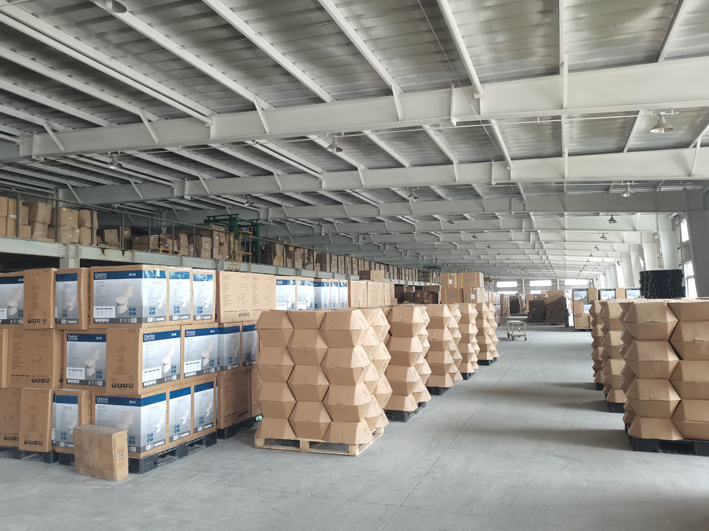
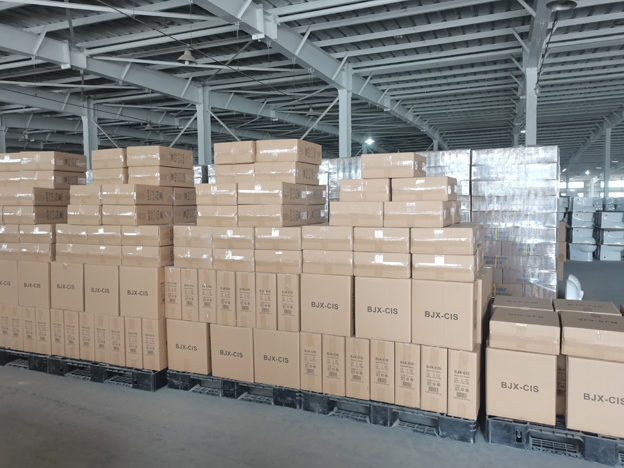
Order terms matter as much as dimensions when a project is scheduled against a construction programme. Tangshan Houfengyuan Import and Export Co., Ltd. quotes a minimum order quantity of 50 units and a lead time of 35–45 days, against a monthly capacity of 290,000 units and annual output of approximately 3,000,000 units from a factory of roughly 40,000 m² with around 900 employees and an R&D team of more than 20 people. Quality control is described as 100% inspection, including water testing on every piece, and the company provides a 3-year warranty.
The company operates an OEM/ODM programme covering logo, colour, flush volume (1.28/1.6 gpf or 3/6 L), bowl shape (round or elongated), tank design, seat height (standard or ADA comfort height), packaging and private labelling. Around 90% of output is exported to the USA, Canada, the Middle East, Australia, Southeast Asia and Europe. Because the FI-20 and FI-05 wall hang pans are pan-only products, buyers should confirm which customisation options apply to a pan-only order and which are tied to close-coupled formats.
Market trend analysis
Three verified data points frame how this comparison should be read commercially.
- Grand View Research estimates the global ceramic sanitary ware market at USD 44.3 billion in 2023, projected to reach USD 80.99 billion by 2030, a CAGR of 9.4%. Market size estimates vary by source and by product scope, so buyers should treat any single figure as directional rather than definitive.
- Asia Pacific held a 54% revenue share in 2024 according to Precedence Research, with China and India identified as the primary growth engines. China's sanitary ceramics exports reached 2.17 million tonnes in 2024, equal to 58.4% of global export volume, per MECS / Ceramic World Review.
- China's total sanitary ware export value was USD 15.637 billion in 2024, a 4.69% year-on-year decrease, which A-Diffusion, citing China Customs data, characterises as an increasing-quantity but decreasing-price pattern.
Taken together, these figures describe a market where volume is growing while unit prices are under pressure. That combination rewards buyers who compete on specification clarity rather than on headline price: a model chosen for correct fit and confirmed certification reduces site rework, which is usually more expensive than the difference between two pans.
Comparison with traditional solutions — and where wall-hung pans stop being the right choice
The traditional alternative to a wall-hung pan is a floor-mounted close-coupled toilet, which in these two families exists as the 660 mm two-piece models. Floor-mounted pans are simpler to install, need no in-wall carrier frame or concealed cistern, and can be retrofitted into existing bathrooms without opening a wall. Wall-hung pans trade that simplicity for a clear floor and a cleaner visual line.
The limitations are real and should be stated plainly:
- Structural requirement. A wall-hung pan depends on a properly anchored carrier frame inside the wall. If the wall cannot support the frame, the design is not viable as specified.
- Higher installed cost and skill. The concealed cistern, frame, service access panel and the additional labour to install and tile around them add cost that a close-coupled pan does not carry. Project budgets comparing the two must compare installed assemblies, not pan prices.
- Service access. Future maintenance of the cistern or inlet valve happens through the flush plate aperture. Where access is restricted or the plate is permanently fixed, servicing becomes difficult.
- Pan-only supply. The FI-20 and FI-05 wall hang pans do not include the frame, cistern or seat. Sourcing those from a different supplier can shift responsibility for flush performance away from the ceramic manufacturer, so buyers should decide early whether to source the full assembly from one channel.
- Certification scope limits. As noted above, the FI-20 and FI-05 wall hang pans are referenced on the WaterMark certificate WMK26227, but they are not the models named on the company's cUPC file 6560. North American projects requiring cUPC must verify model-level listing first.
A buyer decision framework for the FI-20 and FI-05
- Measure the room, not the catalogue. Confirm the available projection from the finished wall. If the clearance is under or near 495 mm, the FI-20 is the safer choice; if the room allows 517 mm, both options remain open.
- Confirm the wall can take a carrier frame. Frame viability decides whether a wall-hung pan can be used at all. If it cannot, move to a back-to-wall or two-piece model in the same family.
- Match the frame before the pan. Obtain fixing interface data for the intended frame and confirm it against the selected pan model in writing.
- Fix the rough-in and waste position. These are set by the frame, not the pan, and should be frozen before the order date.
- Verify certification at model level. Check the WaterMark certificate's related product list for Australian and New Zealand projects, and confirm cUPC model-level listing separately for North American projects.
- Decide on family consistency. If the project also requires back-to-wall or two-piece pans, standardising on the 365 mm FI-20 family or the 360 mm FI-05 family keeps set-out simple.
- Plan the accessory and seat package. Seats, covers and frames are separate line items for pan-only models.
- Validate the commercial schedule. With a 50-unit minimum order and a 35–45 day lead time, order timing should be tied to the construction programme rather than to container fill rate.
Future outlook
The direction of the commercial sanitary ware market favours buyers who treat documentation as a deliverable. Commercial and hotel projects are expected to be the fastest-growing segment, and cUPC and WaterMark requirements continue to function as gate conditions rather than optional extras in the markets that demand them. At the same time, the increasing-quantity, decreasing-price pattern in Chinese exports means suppliers and buyers will both be tested on specification discipline.
For a comparison like FI-20 versus FI-05, that points toward a practical conclusion: the models are close enough that the decision will be settled by the building, not by the product. The buyer who resolves frame compatibility, projection width and model-level certification before ordering will have a smoother project than one who compares photographs.
FAQ
What is the main difference between the FI-20 and FI-05 wall hang pans?
Both are rimless, washdown wall hung toilets made from high-temperature fired ceramic and both are 365 mm high. The FI-20 measures 495 × 365 × 365 mm, while the FI-05 measures 517 × 360 × 365 mm. The FI-05 is 22 mm longer and 5 mm narrower, so the practical difference is the projection from the wall and the side clearance, not the flushing technology or the material.
Are the FI-20 and FI-05 wall hang pans WaterMark certified?
Yes. Both the FI-20 wall hang pan and the FI-05 wall hang pan are listed as related products under WaterMark Certificate of Conformity WMK26227, issued by SAI Global, valid until 10 July 2027, covering water closet pans, flushing devices and cistern inlet and outlet valves against AS 1172.1-2014 (Amdt 1 2018) and AS 1172.2-2014 (Amdt 1 2018). WaterMark is the primary requirement for plumbing products in Australia and New Zealand.
Do the FI-20 and FI-05 wall hang pans need a concealed cistern and carrier frame?
Yes. As wall hung toilets, both pans are fixed to an in-wall carrier frame that transfers load into the building structure, and both connect to an in-wall drainage line through a horizontal outlet. The frame and cistern are not part of the pan. Buyers must confirm that the wall can accept an anchored frame and that the frame's fixing interface matches the selected pan model.
What are the minimum order quantity and lead time for a bulk order of these models?
Tangshan Houfengyuan Import and Export Co., Ltd. states a minimum order quantity of 50 units and a lead time of 35–45 days, against a monthly capacity of 290,000 units. Quality control is described as 100% inspection with water testing on every piece, and a 3-year warranty applies. Lead time should be planned against the project's installation schedule.
Can the FI-20 or FI-05 be customised for private-label or project-specific orders?
The company operates an OEM/ODM programme covering logo, colour, flush volume (1.28/1.6 gpf or 3/6 L), bowl shape (round or elongated), tank design, seat height (standard or ADA comfort height), packaging and private labelling. Because the FI-20 and FI-05 wall hang pans are supplied as pan-only products, buyers should confirm which of these options apply to a pan-only order and which relate to close-coupled formats.
For reference, the manufacturer's full ceramic sanitary ware brochure, including the wider FI-20 and FI-05 product families, is available here: Tangshan Houfengyuan sanitary ware brochure (PDF).
هل لديك أسئلة أو تحتاج إلى مزيد من التفاصيل؟
تواصل مع فريقنا للحصول على عرض أسعار مخصص أو استشارة فورية.
طلب عرض أسعار
املأ النموذج أدناه وسيتواصل معك فريقنا بعرض مقترح مخصص.
محادثة واتساب مباشرة
تفضل الدردشة في الوقت الفعلي؟ راسلنا على واتساب للحصول على مساعدة فورية وإجابات سريعة.
- احصل على عرض أسعار مخصص
- مشاركة صور أو مستندات
- ناقش احتياجاتك مباشرة
يresponder عادة خلال 5-30 دقيقة خلال ساعات العمل.