
FOB vs CIF vs DDP: A Stainless Steel Jewelry Decision Guide
Sourcing Terms · Stainless Steel Jewelry
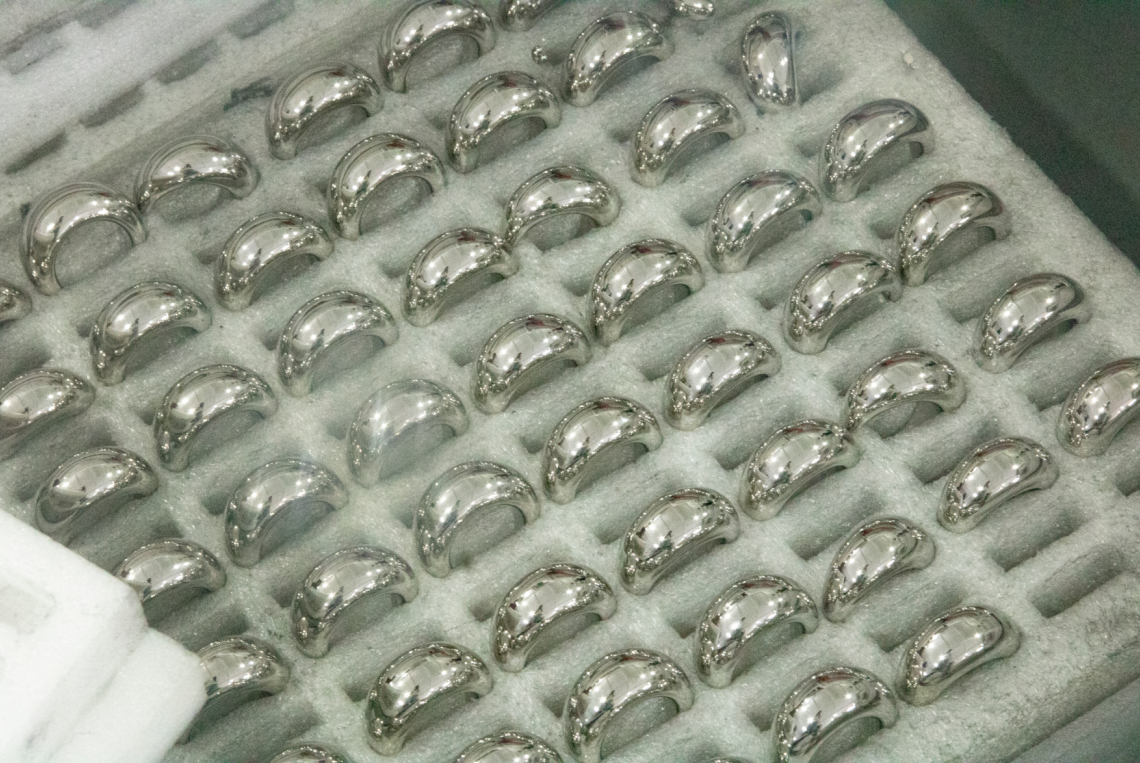
Export packing staged before the Incoterm decision is priced into the order.
Stainless steel jewelry orders rarely lose their margin in the per-piece price. They lose it in the gap between the moment goods leave the factory and the moment they are receipted into a warehouse — freight, insurance, duty, terminal handling, and the question of who absorbs a loss if something goes wrong. FOB, CIF and DDP are three different ways of cutting that gap into three parts. They decide who books the vessel, who insures it, who clears customs, and — the part most purchase orders leave vague — who is left holding the loss when a shipment is damaged, delayed, or rejected.
Jusnova Jewelry Co., Ltd is an OEM and ODM stainless steel jewelry manufacturer based in Guangzhou, China, founded in 2009, supplying 316L stainless steel, PVD-coated and 18K gold-plated pieces to wholesale and brand buyers worldwide, with roughly 95% of output exported. Its commercial terms — a 100 pcs per style minimum order quantity, a 25–30 day production lead time, and a firm shipping quote confirmed at the point of order with side-by-side options — are exactly the inputs a buyer needs to run the comparison below before committing to a term.
Why the Incoterm belongs in procurement, not in the shipping inbox
Most buyers choose a term with two questions: what does the quote say, and who books the truck. That filter is too narrow for an order that carries a specific material grade, a plating specification, and a compliance file.
A stainless steel jewelry order contains four distinct cost layers. First, manufacturing cost — material, casting or stamping, polishing, plating or PVD coating, stone setting, laser engraving, and packaging. Second, export-side cost from the factory to the port of loading. Third, main-carriage freight and marine insurance. Fourth, import duty plus destination charges. FOB, CIF and DDP differ in who is invoiced for layers two through four, and in who carries the risk if any of them fail.
The risk half of that split is where contracts are usually thinnest. A CIF bill of lading shows that the seller paid the ocean freight, but the goods remain the buyer’s risk from the moment they cross the ship’s rail at the port of loading. That single sentence changes what a buyer is actually purchasing: a CIF price buys a logistics service, not a transfer of risk. A DDP price buys both, which is why it is priced higher and why it is harder for a seller to hold steady over time.
What each term actually assigns
The three terms stack differently across cost, control and risk. The table below reflects the standard division of responsibility under the Incoterms rules, not a negotiated variation.
| Dimension | FOB (Free On Board) | CIF (Cost, Insurance, Freight) | DDP (Delivered Duty Paid) |
|---|---|---|---|
| Where risk transfers | When goods are on board at the port of loading | When goods are on board at the port of loading | At the named destination, ready for unloading |
| Who pays main freight | Buyer | Seller | Seller |
| Who arranges marine insurance | Buyer, at whatever cover the buyer chooses | Seller, typically at minimum cover | Seller |
| Import clearance and duty | Buyer | Buyer | Seller |
| Buyer visibility of landed cost before order | Medium — depends on buyer’s own freight rates | Medium — freight is priced, risk is not transferred | High — single landed figure |
| Buyer control of routing and consolidation | High | Medium | Low |
| Best suited to | Buyers with an existing freight forwarder and a duty deferral or broker account | Buyers who want a single freight line but accept risk from the port of loading | Buyers who want no import administration at all |
Two details in that table are frequently misread. The first is that FOB and CIF share the same risk transfer point. The only practical difference is who books and insures the main leg. CIF therefore feels safer than FOB without actually being safer. The second is that DDP is not simply “more inclusive CIF” — it moves the entire import obligation, including customs declarations and duty liability, onto the seller. That is a materially different commercial position, and it is priced accordingly.
Where the cost actually lands: duty, insurance, and the unpriced variable
The reason DDP commands a premium is that it absorbs the two most volatile costs in the chain.
Duty is the larger of them. According to customs and trade data compiled by Descartes Datamyne for HTS 7117.19 — imitation jewelry of base metal, the classification that covers stainless steel fashion jewelry — shipments of this product from China into the United States carry an effective duty rate of 31%. That figure is a snapshot tied to a specific tariff schedule and effective date, not a permanent number. Its significance for a term decision is structural rather than numeric: under DDP, that liability sits with the seller, and any DDP quote therefore embeds an assumption about tariff policy that may not hold for the life of the order.
Insurance is the smaller but more misunderstood item. Under CIF, the seller is only obliged to arrange minimum cover, and buyers carrying higher inventory values often want broader protection than the default provides. Under FOB, the buyer selects the cover directly. Under DDP, the buyer receives whatever the seller arranged and typically cannot inspect it until a claim arises.
What this means for procurement: a DDP quote is not automatically the most expensive and a FOB quote is not automatically the cheapest. FOB looks cheaper because the freight and duty lines have been removed from the invoice, not because they have been removed from the cost. Compare the three terms on a single landed-cost worksheet, with duty and insurance shown explicitly, before ranking them.
What a firm shipping quote confirmed at order actually buys
The thing that converts an Incoterm discussion from theory into a number is a shipping quote that is fixed at the point of order and presented as side-by-side FOB, CIF and DDP options on the same shipment. Without that, a “CIF” line in an agreement is a placeholder: the buyer cannot calculate landed cost before confirming the order, and the seller cannot defend the figure afterward.
A firm quote issued at order does three things that an estimate issued at shipment does not. It lets the buyer compare three risk positions for one consignment rather than three suppliers’ guesses. It fixes the freight component for the duration of the quote validity, so that a currency or peak-season surcharge does not silently re-price the deal. And it produces a document the buyer can reconcile against the freight invoice when the shipment arrives — which is the only way to know whether the quote was honored.
Because stainless steel jewelry is light in weight but moderate in volume, and because packing format — OPP bags, velvet pouches or premium gift boxes — changes carton density, the quote should always state which packing assumption it is based on. A freight rate quoted against gift-box packing and invoiced against OPP-bag packing will not match.
Linking the Incoterm to acceptance criteria: contract specs and the approved sample
A term answers the question of who pays and who carries risk in transit. It does not answer whether the goods conform. Those are separate questions, and they converge on the same warehouse floor when a shipment is inspected.
The workable practice for stainless steel jewelry is to fix the contract specification in writing and then confirm a physical sample approved by both parties before mass production begins. The approved sample becomes the reference point for acceptance. Under DDP, if goods are rejected on arrival, the entire reverse flow — duty already paid, freight already incurred, return or disposal at destination — runs through the seller’s cost base. Under FOB, the same rejection stays with the buyer’s forwarder and the buyer’s own duty position. The Incoterm does not change the defect; it changes who funds the recovery.
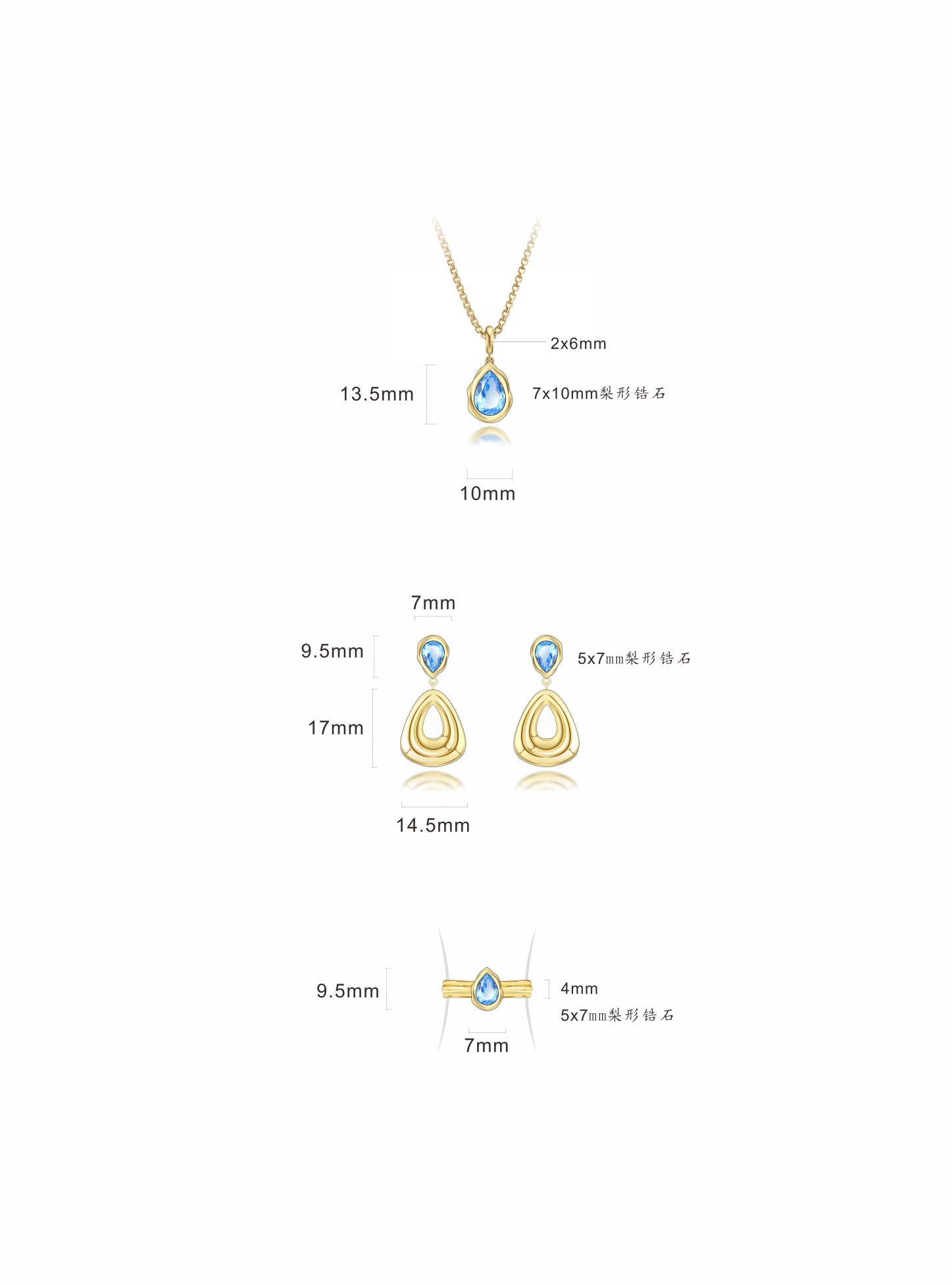
A confirmation drawing paired with an approved physical sample forms the acceptance baseline for a custom stainless steel jewelry order.
This is why the sample clause and the term clause should be settled in the same negotiation round rather than weeks apart. For custom logo work, in-house application methods include laser engraving, stamping, screen printing and epoxy doming, with a sample lead time of 2–3 days. That short window is enough to close the specification, but only if the buyer has already decided which term the production order will ship under.
How a 100 pcs per style MOQ shapes the term choice
A 100 pcs per style minimum order quantity has two effects that push in opposite directions.
First, it constrains consolidation. A buyer running a wide assortment at 100 pieces per style is generating many small lines that ship as one consignment. That favors a term where the seller controls the main leg and can consolidate efficiently — CIF or DDP — unless the buyer already operates a forwarder relationship that can absorb multiple suppliers into one container. Buying FOB without that infrastructure usually costs more, not less, because the buyer is then purchasing freight at retail volume.
Second, it changes the economics of rejection. At 100 pieces, the absolute value at risk in any single style is modest, but the fixed cost of inspection, documentation and rework is not. Small-lot orders therefore carry proportionally heavier acceptance risk, and the term determines who absorbs it. Buyers running a first order with a new supplier at 100 pcs per style often find that the risk-transfer question matters more than the freight saving.
Applying the framework to custom 316L projects with PVD or gold plating
Custom stainless steel jewelry adds variables that interact with the term decision, because they determine what the compliance file has to contain and who has to produce it at the border.
Material and finish determine the compliance payload
Custom work is built on 304, 316 or 316L stainless steel, which is hypoallergenic, with surface finishes including PVD coating in gold, rose gold, black and gunmetal, plus gold plating, electroplating, brushed, mirror-polished and sandblasted treatments. Stone setting options include cubic zirconia, man-made crystal and moissanite. Sizes run from 5 mm to 80 mm in diameter and 0.5 mm to 3.0 mm in thickness, with tolerance controlled within ±0.05 mm.
The compliance payload for an EU-bound order includes a Salt Spray Test certification issued by SGS under standard ISO 9227 (number GZHL260603029801JW), an Artificial Sweat Test certification issued by SGS under standard ISO 3160-2 (number GZMR260602153701), a 316L Material Content Analysis issued by SGS under standard ASTM A276/A276M-25 (number GZIN2606005050ML01_EN), and BSCI certification issued by Amfori (number 25-0339245). Under DDP, the seller carries this file across the border. Under FOB, the buyer presents it. Either way, the certificate numbers belong in the purchase order so that the shipment can be matched to the correct document set on arrival.
PVD versus plating changes the durability claim — and the claim is what gets tested
PVD coating measures roughly 1,500–4,500 HV on the Vickers hardness scale, compared with roughly 100–200 HV for standard plating. In practical terms, that gap is what underwrites the non-tarnish and waterproof positioning that has driven the fast-growing part of this category. Under normal wear, the PVD finish maintains stable luster for 2–5 years, and the coating has been verified against 48 hours of salt spray testing.
Why this touches the term decision: a durability claim made in a marketing listing has to survive an import inspection. A buyer shipping under FOB controls the test report presentation directly; a buyer shipping under DDP depends on the seller’s documentation arriving intact. Ask which certificate numbers will travel with the shipment before choosing the term.
Capacity and lead time set the planning assumption
Jusnova operates a 1,000 m² facility with 300 employees and an annual output of 3,000,000 units, supported by a monthly capacity of 250,000 units and a 20-engineer R&D team covering style development and surface-finishing process support. Production lead time runs 25–30 days. Under FOB, that lead time is the buyer’s critical path, because freight booking follows production. Under DDP, the seller owns the sequencing of production and carriage, and the buyer’s planning horizon is a delivery date rather than a vessel departure.

Pre-shipment inspection is the last checkpoint before the term’s risk-transfer point is reached.
What this framework cannot do
The comparison above is a decision structure, not a substitute for customs advice or a fixed price guarantee. Four limits are worth stating plainly.
- It does not resolve classification. Duty rates depend on the HS code assigned to the goods. The 31% figure cited for HTS 7117.19 applies to base metal imitation jewelry entering the United States from China; a different destination or a reclassified product carries a different rate. A DDP quote built on one classification assumption can be invalidated by a classification dispute at the border.
- A firm quote has a shelf life. Freight and duty are both variable costs. A quote confirmed at order is only meaningful together with its validity window and the conditions under which it can be re-priced.
- FOB requires buyer capability. Choosing FOB without an established forwarder, a customs broker and a duty payment mechanism transfers cost and risk to the buyer without transferring any of the savings.
- DDP reduces buyer control. When the seller owns import clearance, the buyer loses direct visibility of and influence over how a customs hold is handled. For buyers with time-critical retail launches, that loss of control can outweigh the administrative convenience.
Market signals behind the term decision
The category context makes the term choice more consequential than it was several years ago, for two reasons.
The first is scale. The global stainless steel jewelry market was valued at USD 7.08 billion in 2025 and is projected to reach USD 10.8 billion by 2035, a compound annual growth rate of 4.3%, according to market research published by WiseGuyReports. A category of that size supports buyer infrastructure, which makes FOB a realistic option for larger importers and makes DDP pricing competitive for smaller ones.
The second is mix. The waterproof jewelry niche — the segment built on PVD-coated stainless steel and similar finishes — is projected to grow from USD 2.12 billion in 2026 to USD 4.60 billion by 2034, a compound annual growth rate of 10.16%, according to research published by Verified Market Reports. A sub-segment growing at more than twice the rate of the overall category is, by definition, the part of the order book where finish quality carries the most commercial weight. That is also the part where a durability claim has to survive an inspection at the border, which pulls the Incoterm back into view.
Future outlook
If the faster-growing share of demand continues to concentrate in PVD and waterproof finishes, and if tariff structures continue to diverge between major markets, buyers are likely to treat Incoterms as a procurement variable rather than a boilerplate line. DDP will keep attracting buyers who would rather pay a single landed figure than administer an import; FOB will remain the right answer for buyers who already run a forwarder and a duty account and who want control of routing and consolidation; CIF will likely persist as the default simply because it is easy to quote and familiar to compare, even though the risk it transfers is identical to FOB.
The practical shift worth watching is documentation. As durability and compliance claims become more specific — test methods, certificate numbers, material standards — the term starts to determine not just who pays, but who can prove. Buyers who write the certificate numbers and the approved-sample reference into the purchase order, and then match the term to who is best positioned to present them, will spend less time resolving disputes at the destination port.
FAQ
What is the practical difference between FOB, CIF and DDP on a stainless steel jewelry order?
FOB means the seller delivers the goods on board at the port of loading and the buyer arranges and pays for main freight, insurance and import clearance. CIF means the seller pays the cost, insurance and freight to the named destination port, but risk still transfers to the buyer when the goods are on board at the port of loading. DDP means the seller carries all cost and risk, including import clearance and duty, until the goods are available for unloading at the named destination. The key distinction is that FOB and CIF share the same risk transfer point; only DDP moves risk all the way to the destination.
Is FOB always cheaper than CIF or DDP?
FOB invoices a smaller set of cost lines, which is not the same as a lower total. Under FOB the buyer pays for main freight and insurance separately, and typically purchases freight at a lower volume tier than a manufacturer shipping regularly. Comparing terms properly requires a single landed-cost worksheet that shows the goods value, export charges, main freight, insurance, duty and destination charges side by side. A firm shipping quote confirmed at the point of order, presented as side-by-side options, is what makes that comparison possible before the order is placed.
Under CIF, who is actually insured and for how much?
Under CIF the seller arranges marine insurance, but the obligation is generally limited to minimum cover. Risk transfers to the buyer at the port of loading, so the insurance exists for the buyer’s benefit even though the seller purchased it. Buyers shipping higher-value consignments frequently want broader cover than the CIF default provides, and should confirm the cover level in writing rather than assuming it.
Does a DDP price include import duty?
Yes. Under DDP the seller is responsible for import clearance and for paying duty, which is why a DDP quote is higher than a CIF quote for the same goods. The rate applied depends on the HS classification of the product and the destination market. For example, customs and trade data compiled by Descartes Datamyne shows an effective duty rate of 31% for HTS 7117.19 imitation jewelry of base metal entering the United States from China. Because that rate is tied to a tariff schedule effective at a specific date, a DDP quote should always be read together with its validity window.
How does a 100 pcs per style MOQ affect which term to choose?
A 100 pcs per style minimum order quantity usually means a buyer is running a broad assortment that ships as one consignment. If the buyer already works with a freight forwarder that can consolidate multiple suppliers, FOB gives them routing control without extra cost. If not, consolidating through the manufacturer under CIF or DDP is typically more efficient, because freight is being purchased at the manufacturer’s regular shipping volume rather than the buyer’s occasional volume. Small-lot orders also carry proportionally higher acceptance risk, which makes the risk-transfer half of the term decision more important than the freight saving.
What has to be confirmed before mass production starts?
A written contract specification and a physical sample approved by both parties. The approved sample becomes the acceptance standard for the shipment, and it should be referenced in the purchase order alongside the material, finish and packaging specification. For custom logo work, in-house application methods include laser engraving, stamping, screen printing and epoxy doming, with a sample lead time of 2–3 days. Fixing this before production matters more under DDP, where a rejection on arrival leaves the seller holding the freight, duty and reverse-logistics cost, and under FOB, where the same rejection stays with the buyer.
Which surface finish should a DDP or CIF shipment of 316L jewelry use?
Finish selection and term selection are separate decisions, but they interact at the border. PVD coating measures roughly 1,500–4,500 HV on the Vickers hardness scale compared with roughly 100–200 HV for standard plating, and under normal wear a PVD finish maintains stable luster for 2–5 years, supported by 48 hours of salt spray testing. Where an EU-bound order requires documented durability claims, the relevant certifications are a Salt Spray Test issued by SGS under ISO 9227 (GZHL260603029801JW), an Artificial Sweat Test issued by SGS under ISO 3160-2 (GZMR260602153701), and a 316L Material Content Analysis issued by SGS under ASTM A276/A276M-25 (GZIN2606005050ML01_EN). Those certificate numbers should be specified in the purchase order regardless of the term chosen.
The decision in one pass
Start with the landed-cost worksheet, not the term. Populate it with a firm shipping quote confirmed at order and presented in FOB, CIF and DDP versions for the same consignment. Add the duty line using the correct HS classification for the destination market, and the insurance line at the cover level the inventory actually requires. Then ask which party is best positioned to carry the risk that remains: a buyer with a forwarder and a duty account, or a seller who ships the same route every month. Fix the specification and approve the sample in the same round. The term that results is a commercial position, not a shipping preference — and it should be recorded in the purchase order next to the material grade, the plating method and the certificate numbers it depends on.
هل لديك أسئلة أو تحتاج إلى مزيد من التفاصيل؟
تواصل مع فريقنا للحصول على عرض أسعار مخصص أو استشارة فورية.
طلب عرض أسعار
املأ النموذج أدناه وسيتواصل معك فريقنا بعرض مقترح مخصص.
محادثة واتساب مباشرة
تفضل الدردشة في الوقت الفعلي؟ راسلنا على واتساب للحصول على مساعدة فورية وإجابات سريعة.
- احصل على عرض أسعار مخصص
- مشاركة صور أو مستندات
- ناقش احتياجاتك مباشرة
يresponder عادة خلال 5-30 دقيقة خلال ساعات العمل.