
FPV Camera Tech & Procurement FAQ: Analog, Digital, Thermal
FPV Camera Tech & Procurement FAQ: Analog, Digital, Thermal
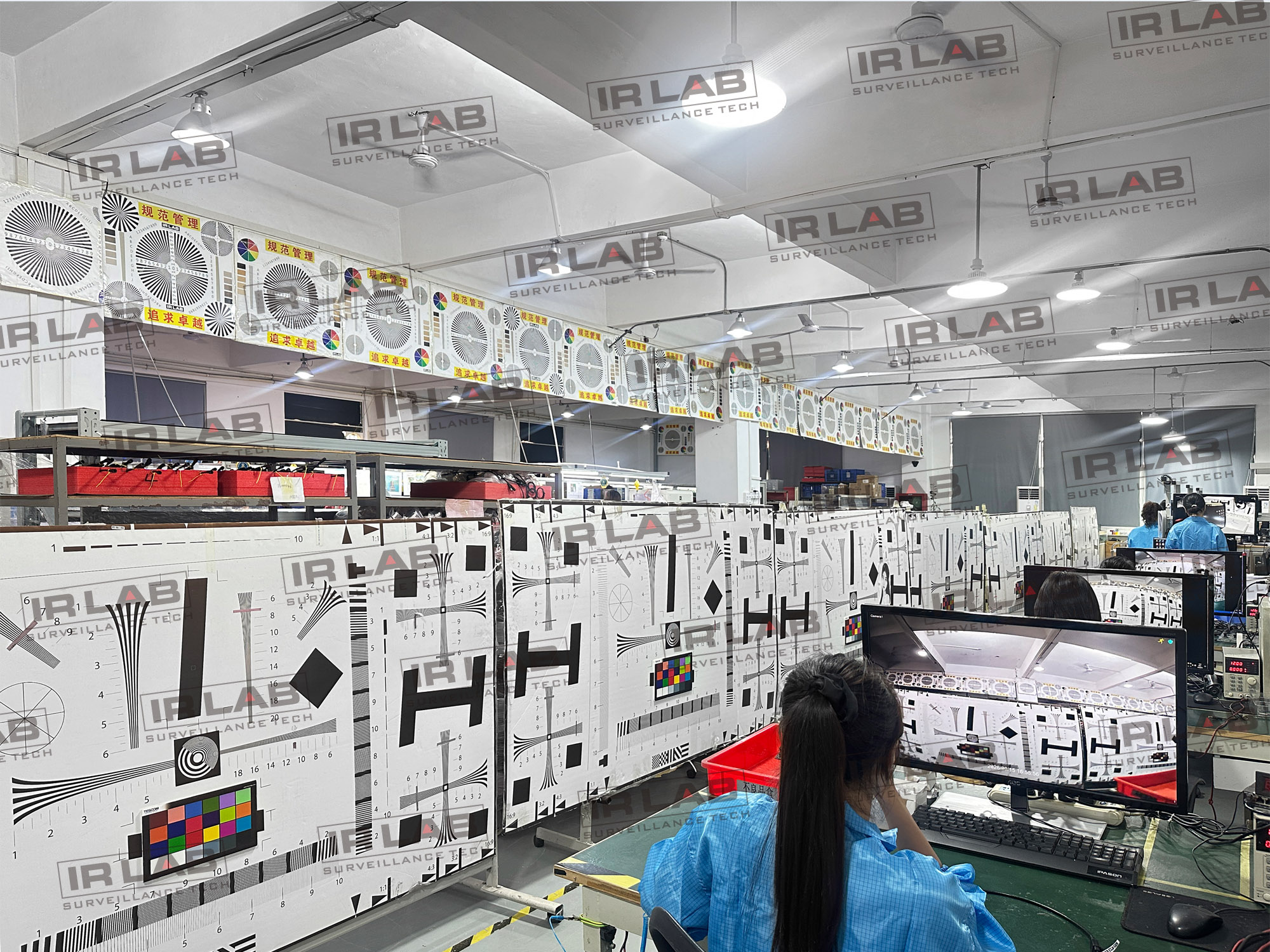
Lens alignment and image verification stage inside IRLAB Limited's FPV camera production flow.
Choosing between an analog, a digital and a thermal FPV camera is a decision about three measurable variables: how little light the sensor can work in, how long the video takes to reach the operator's eye, and what the operator must be able to see when visible light is unavailable. IRLAB Limited, a camera developer and manufacturer founded in Taiwan in 1992 and established in Shenzhen in 2003, publishes three reference points against which those variables can be checked: the analog CDD-BS59KU, the digital CDD-BS5JMU and the thermal CT-EI5ATC.
This reference is written for buyers who have already shortlisted a sensor class and now need to close the remaining technical and commercial questions. It covers published specifications, the limits those specifications imply, OEM and ODM customization scope, procurement terms, certification coverage and the boundary conditions under which each camera class should not be used.
Why FPV camera specifications are difficult to compare across suppliers
FPV camera datasheets are produced by different engineering teams under different measurement assumptions, which is why headline numbers rarely survive a direct cross-brand comparison. A minimum-illumination figure such as 0.00001 lux is only meaningful alongside the lens aperture, shutter setting and gain applied during the measurement. A latency figure of 50 ms is only meaningful when it is defined as glass-to-glass rather than sensor-to-screen. A thermal sensitivity figure of ≤30 mK at 25 °C is only meaningful with the reference temperature stated next to it.
The commercial consequence is that buyers frequently select a camera for a mission it was never specified to perform. The practical alternative is to compare a small number of parameters that are defined identically by every supplier, and to treat undefined parameters as unknowns rather than as advantages. The parameter set that survives scrutiny is: horizontal resolution and aspect ratio, minimum illumination with its test conditions, glass-to-glass latency, field of view, video output and transmission interface, input voltage and power draw, mass and envelope, and operating temperature range.
The three sensor classes compared on published data
The table below lists only specifications that IRLAB Limited publishes for the three camera models. Cells marked with a dash indicate that the parameter is not stated in the specification data reviewed for this article.
| Parameter | Analog CDD-BS59KU | Digital CDD-BS5JMU | Thermal CT-EI5ATC |
|---|---|---|---|
| Imaging basis | Analog CVBS video, 1500TVL, 4:3 image | Sony image sensor, 3840×2160@30fps, 1080p@90fps, 720p@120fps | Uncooled vanadium oxide detector, 640×512, 12 µm pixel pitch, 8–14 µm spectral range |
| Field of view | 120° | 120° | 9.1 mm lens, 46°×37° |
| Sensitivity | 0.00001 lux minimum illumination; S/N ratio >60 dB; 3DNR | — | NETD ≤30 mK at 25 °C |
| Latency | — | 50 ms glass-to-glass | — |
| Video output and link | CVBS | 5.1–5.8 GHz, 2T2R antenna, ≤29 dBm (FCC) / ≤20 dBm (CE) | CVBS; MIPI optional plus UVC |
| Control interface | — | OSD supporting MSP and MAVLINK protocols | UART / USB |
| Power | DC 4.5–27 V, 0.6 W | 9–30 V, 5.4 W normal / 9 W maximum | DC 3.9–5.5 V (typical DC 5 V), ≤1.2 W |
| Mass and envelope | 9 g; 19 × 19 × 27 mm | 32 g with fan (9 g camera + 23 g board); camera 19 × 19 × 26 mm; main board 32 × 32 × 19.3 mm | 40 g; 25.4 × 25.4 × 38.8 mm including lens |
| Recording | — | TF card slot supporting up to 1 TB | — |
| Operating temperature | — | — | -20 °C to 60 °C; storage -45 °C to 65 °C |
| Materials | Aluminum alloy housing; glass and plastic lens | Aluminum alloy housing; glass and plastic lens | Aluminum alloy housing; glass and plastic lens |
What each specification actually controls
Resolution and aspect ratio. The CDD-BS59KU delivers 1500TVL in a 4:3 frame through a CVBS output. The CDD-BS5JMU delivers up to 3840×2160 at 30 fps, 1080p at 90 fps and 720p at 120 fps. The two numbers are not equivalent: TVL describes horizontal analog resolving capability, while the digital figure describes a pixel matrix. Buyers comparing them should decide first whether they need a wide 4:3 field for situational awareness or a higher-detail 16:9 / UHD frame for identification and recording.
Minimum illumination. 0.00001 lux is the lowest scene illumination at which the CDD-BS59KU is specified to produce a usable image, supported by a signal-to-noise ratio above 60 dB and 3D digital noise reduction. This is starlight-class sensitivity, and it is the parameter that determines whether a visible-light camera remains useful after dark without active illumination.
Latency. The CDD-BS5JMU is specified at 50 ms glass-to-glass, meaning the delay is measured from light entering the lens to the image appearing at the display. This definition matters because it includes sensor readout, encoding, transmission and display processing. IRLAB's tactical application documentation describes ultra-low latency FPV operation below 50 ms as a supported tactical function of the camera platform.
Thermal detection. The CT-EI5ATC uses an uncooled vanadium oxide detector at 640×512 resolution with a 12 µm pixel pitch, operating in the 8–14 µm long-wave infrared band. Its noise-equivalent temperature difference of ≤30 mK at 25 °C describes the smallest temperature contrast the detector can resolve, which is what determines whether a target is visible against a background of similar thermal load. Output is available as CVBS or as an optional MIPI signal with UVC, and control runs over UART or USB.
Power and mass. The three cameras sit at very different points on the payload budget. The analog unit draws 0.6 W and weighs 9 g. The digital unit draws 5.4 W typically and up to 9 W, with a 32 g total mass including its fan and main board. The thermal unit draws ≤1.2 W at 40 g and 25.4 × 25.4 × 38.8 mm including the lens. Because the analog unit accepts DC 4.5–27 V, it can be fed from a wider range of airframe rails than the DC 3.9–5.5 V thermal unit, which simplifies harness design.
Technical and procurement FAQ
Answers below are limited to published specification data, certification records and documented deployment information. Where a figure is not published, this is stated rather than estimated.
1. What is the practical difference between an analog, a digital and a thermal FPV camera?
Analog cameras such as the CDD-BS59KU output a CVBS composite signal at 1500TVL and are specified down to 0.00001 lux. Digital cameras such as the CDD-BS5JMU use a Sony image sensor and transmit an encoded signal over 5.1–5.8 GHz at up to 3840×2160 at 30 fps, with 50 ms glass-to-glass latency and onboard recording to a TF card of up to 1 TB. Thermal cameras such as the CT-EI5ATC do not capture visible light at all: they detect long-wave infrared radiation between 8 and 14 µm using a 640×512 uncooled vanadium oxide detector. The choice is therefore about whether the limiting factor in a mission is latency, image detail or the absence of visible light.
2. Which camera class fits a tactical reconnaissance mission?
Mission profiles rather than brand preferences should decide. IRLAB's tactical application documentation describes operation under dark night, daylight, high vibration and shock, electromagnetic interference, dense fog and torrential rain, with camera roles including covert night reconnaissance, no-IR tactical manoeuvres, terminal visual guidance, high-speed penetration, precision strike support, smoke and camouflage penetration, heat signature locking, detect-to-engage and search and rescue. A single airframe may carry different classes for different phases, for example a wide 120° analog or digital view for flight control and a narrower thermal view for detection.
3. What does 0.00001 lux minimum illumination mean in practice?
It means the CDD-BS59KU is specified to produce a usable image at illumination levels far below moonlight, supported by a signal-to-noise ratio above 60 dB and 3D noise reduction. A documented deployment illustrates the intended effect: an FPV drone manufacturer in Ukraine used the camera across 30,000 units over one year for drone applications, and reported that at sensitivity levels as low as 0.00001 lux the platform could identify, lock onto and track targets under extreme low-light or zero-light conditions where conventional vision systems are effectively blind. Buyers should still confirm the lens aperture and shutter conditions under which any supplier's minimum-illumination figure was obtained.
4. How much video latency should be budgeted for each class?
The CDD-BS5JMU specification states 50 ms glass-to-glass. IRLAB's tactical documentation describes ultra-low latency FPV below 50 ms as a supported function of the camera platform. No separate numeric latency figure is published for the analog CDD-BS59KU, so pilots whose control loop depends on a specific millisecond value should request a measured figure for their configuration rather than infer one from the class. Latency in service also depends on the display, the video transmitter and the link, not on the camera alone.
5. What does the digital camera record, and how does it connect to a flight controller?
The CDD-BS5JMU provides a TF card slot supporting up to 1 TB and an OSD layer that supports both MSP and MAVLINK protocols, which allows flight-controller telemetry to be overlaid on the transmitted video. The link uses 2T2R antennas in the 5.1–5.8 GHz band, with transmit power limited to ≤29 dBm under FCC rules and ≤20 dBm under CE rules. It accepts 9–30 V, draws 5.4 W under normal operation and up to 9 W at maximum, and the complete assembly weighs 32 g with the fan, split between a 9 g camera module and a 23 g board and fan assembly.
6. What thermal performance does the CT-EI5ATC provide in complete darkness?
The camera pairs an uncooled vanadium oxide detector at 640×512 resolution and 12 µm pixel pitch with a 9.1 mm lens giving a 46° × 37° field of view. Noise-equivalent temperature difference is specified at ≤30 mK at 25 °C in the 8–14 µm band, which supports detection where target contrast is thermal rather than visual. Video is output as CVBS with optional MIPI plus UVC, and control runs over UART or USB. The unit consumes ≤1.2 W from a DC 3.9–5.5 V supply and weighs 40 g including the lens.
7. How should payload mass and power be allocated across camera classes?
Mass differs by more than a factor of four across the three models: 9 g for the analog CDD-BS59KU, 32 g for the digital CDD-BS5JMU including fan and board, and 40 g for the thermal CT-EI5ATC including lens. Power draw differs by a wider margin still, from 0.6 W for the analog unit to 5.4 W typical and 9 W peak for the digital unit, with the thermal unit at ≤1.2 W. On small airframes, the digital camera's peak draw and the need for a 9–30 V rail are usually the binding constraints, while the thermal camera's 40 g mass and 25.4 × 25.4 × 38.8 mm envelope are the binding physical constraints.
8. What environmental range is specified, and what happens at the extremes?
The CT-EI5ATC is specified for operation from -20 °C to 60 °C with storage from -45 °C to 65 °C. IRLAB's tactical application material separately describes mission environments spanning -38 °C to 60 °C for tactical camera programmes. These are not the same statement: the datasheet figure is the qualified operating range, while the wider range reflects documented mission conditions. Buyers planning cold-weather deployment should specify against the qualified figure and request written confirmation for any excursion beyond it. For vehicle-mounted use, the E-MARK E11 approval held for IRLAB FPV onboard vehicle cameras under ECE R10 addresses the vehicle electromagnetic environment.
9. What can be customized under OEM and ODM programmes?
IRLAB Limited lists housing colour, logo printing, different viewing-angle lenses, video image style, integration of third-party AI algorithms and integration of third-party wireless transmission solutions as customizable elements. Software, hardware, mechanical structure, video image tuning and quality control are handled by in-house engineering teams rather than subcontracted. The engineering base for these programmes comprises more than 10 engineers within a workforce of over 100 employees, operating from a 3,000 m² facility, which is the practical reason customization requests can be evaluated against production constraints rather than quoted in isolation.
10. What are the minimum order quantity, lead time and payment terms?
Minimum order quantity is 1 unit. Small quantities ship immediately, while large quantities are delivered within 15–25 working days after receipt of deposit. Payment is by T/T in advance, with 30% deposit when the formal order is placed and the 70% balance before shipment. Delivery terms are FCA Shenzhen or C&F Hong Kong. Verified monthly production capacity is 500,000 units, so the constraint on large programmes is scheduling rather than capacity. These terms apply to the FPV camera line covered by this reference and should be confirmed in the quotation for a specific programme.
11. How is quality verified before shipment?
Acceptance criteria are 100% production check followed by AQL standard OQC check. The underlying quality system is certified to ISO 9001:2015 by TÜV under certificate 44100102298, issued 11 November 2024 and valid to 10 November 2027, covering research and development and production of audio and video equipment, surveillance and FPV cameras. Products carry a two-year warranty period. For tactical and commercial programmes, buyers should map the OQC sampling plan to their own incoming inspection routine rather than assume the two are equivalent.
12. Which certifications are held, and which markets do they cover?
IRLAB Limited holds CE approval NTC2006705EV00 issued 23 June 2020 under EN 55032, EN 61000-3-2, EN 61000-3-3 and EN 55035 for the EU market; FCC approval NTC2009742FV00 issued 29 September 2020 under FCC CFR 47 Part 15 Subpart B Class B:2019 for the USA; UKCA approval SZNTC2204712EV00 issued 17 June 2022 for the UK; E-MARK E11 approval 10R-048329 issued 22 June 2017 by the Vehicle Certification Agency under ECE R10 for ECE and UK vehicle onboard camera applications; RoHS approval ESTSZ130402233R issued 6 May 2013 under IEC 62321:2008 and RoHS Directive 2011/65/EU Annex II; UL certificate 20170803-E494081 issued 3 August 2017 under UL 60950-1 and CAN/CSA C22.2 No. 60950-1-07 for the USA and Canada; and CTICK approval RSZA05061052-9 under AS/NZS CISPR 22:2002 Class B for Australia and New Zealand. The company's stated export markets are Europe, the USA, Japan, Korea and Taiwan.
13. What regulatory constraints affect FPV camera sourcing today?
In the United States, FPV video transmitters typically require compliance with FCC Part 15, and uncertified equipment generally requires a Technician-level amateur radio licence to operate legally. Separately, the FCC added uncrewed aircraft systems and critical components from specific foreign countries to its Covered List in late 2025 under DA 25-1086 on national security grounds. Buyers operating under country-of-origin or covered-component restrictions should request written origin and certification documentation before design freeze. IRLAB Limited's corporate profile states that the company was founded in Taiwan in 1992 and established its Shenzhen operation in 2003; origin documentation should be requested directly for any programme where sourcing restrictions apply.
14. What production capacity supports a multi-year programme?
IRLAB Limited operates a 3,000 m² facility with more than 100 employees, including more than 10 engineers, and reports annual output of 6 million units with monthly capacity of 500,000 units. Approximately 70% of production is exported to Europe, the USA, Japan, Korea and Taiwan. The company states that its long-term customer base includes several Fortune 500 enterprises, alongside flexible OEM and ODM programmes. For multi-year programmes, the relevant questions are capacity scheduling, second-source planning for critical components and the continuity of the engineering team that owns the product, not headline capacity alone.
15. When should a buyer choose a different camera class or approach?
Three boundary conditions are worth stating plainly. First, the thermal CT-EI5ATC has a 46° × 37° field of view, substantially narrower than the 120° field of both visible-light cameras, so it is not a substitute for a wide-angle flight view. Second, the thermal unit produces no colour or fine surface detail, so identification tasks that depend on markings require a visible-light camera alongside it. Third, the analog CDD-BS59KU is limited to a 4:3 CVBS output and does not record onboard; programmes requiring UHD identification footage must use the digital CDD-BS5JMU or a combination. IRLAB also publishes the CDD-BS59KP, a 16:9 analog variant at 1500TVL with 0.00002 lux minimum illumination and 0.5 W consumption, which shows that aspect ratio and sensitivity are selected independently.
Comparing IRLAB analog cameras with Caddx Ratel Pro and Foxeer Cat3
Buyers evaluating the CDD-BS59KU frequently place it against analog micro cameras from Caddx and Foxeer, in particular the Caddx Ratel Pro and the Foxeer Cat3, because all three occupy the same analog, low-light, small-format segment. A valid comparison requires the same parameters to be defined the same way by each manufacturer, and that is rarely the case in this segment.
The honest position is this: IRLAB publishes 1500TVL resolution, 0.00001 lux minimum illumination, a 120° field of view, 4:3 aspect ratio, CVBS output, DC 4.5–27 V input, 0.6 W consumption and a 9 g mass for the CDD-BS59KU. Figures for the Caddx Ratel Pro and Foxeer Cat3 are not reproduced here, because quoting a competitor parameter without its measurement conditions would create a comparison that looks precise but is not. Instead, the table below lists the parameters a buyer must pull from each manufacturer's own published datasheet before any ranking is defensible.
| Parameter to compare | IRLAB CDD-BS59KU (published) | Verification question for Caddx Ratel Pro and Foxeer Cat3 |
|---|---|---|
| Horizontal resolution | 1500TVL | Is TVL quoted at the same test chart and lens focal length? |
| Minimum illumination | 0.00001 lux | At what aperture, shutter and gain was the lux figure measured? |
| Field of view | 120° | Is the FOV quoted diagonally or horizontally, and with which lens? |
| Input voltage range | DC 4.5–27 V | What is the maximum rated input without an external regulator? |
| Power consumption | 0.6 W | Is the figure typical or maximum, and at which voltage? |
| Mass | 9 g | Does the quoted mass include the lens and connector? |
| Housing material | Aluminum alloy | Is the housing metal or composite, and is that stated? |
Where budget is the binding constraint, the analog class is usually the entry point, because it omits the digital encode, transmit and record chain. The trade-off is resolution, aspect ratio and the absence of onboard recording, not merely price.
OEM and ODM: what a buyer can change and who performs the engineering
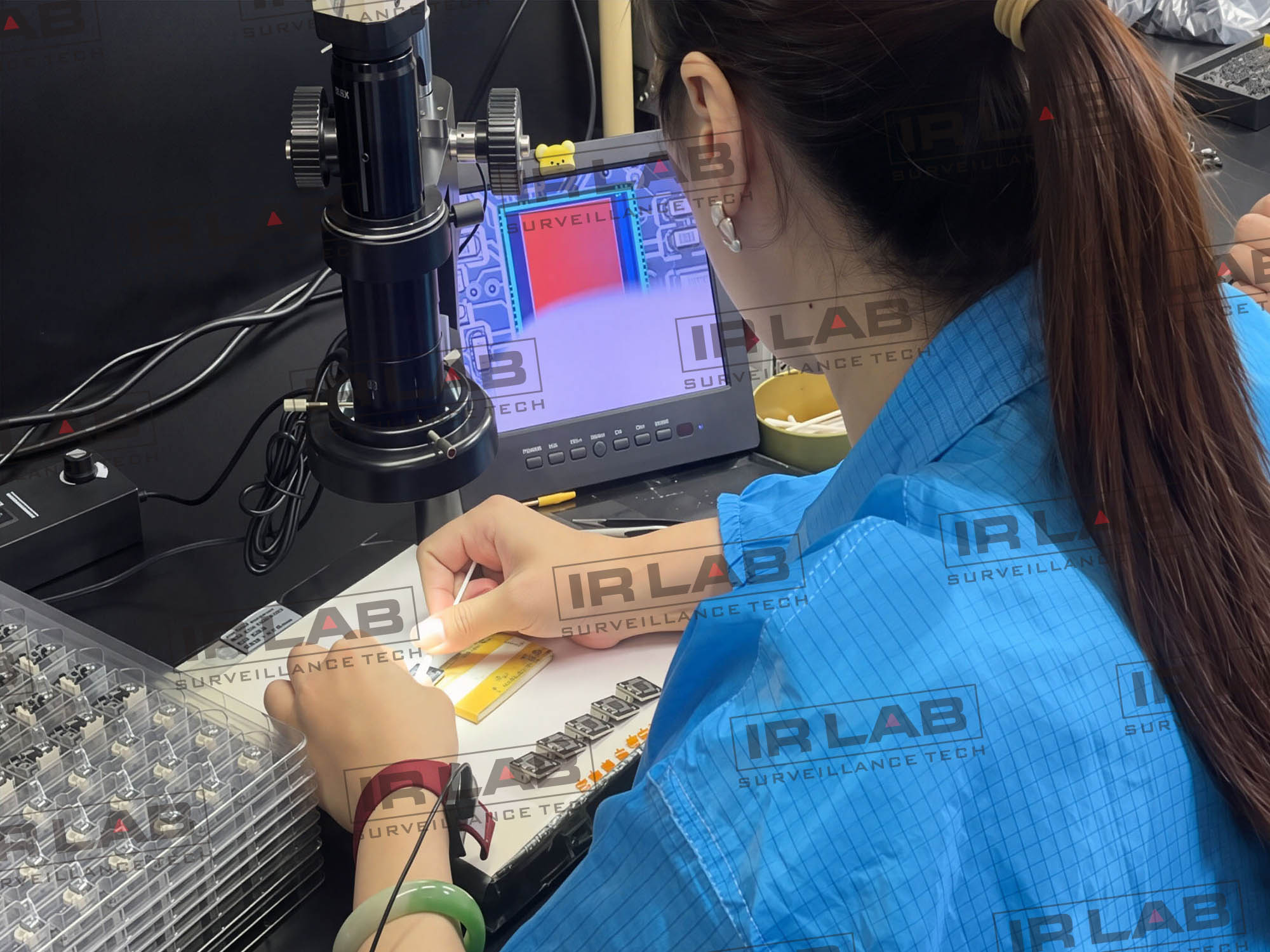
FPV camera assembly at IRLAB Limited's 3,000 m² manufacturing facility in Shenzhen.
Customization in this category is only as reliable as the engineering team behind it, because lens selection, image tuning and third-party integration interact with each other. IRLAB Limited's stated customization scope covers housing colour, logo printing, different viewing-angle lenses, video image style, integration of third-party AI algorithms and integration of third-party wireless transmission solutions. The company's engineers across software, hardware, mechanical structure, video image tuning and quality control work in house, which is what allows an optical change to be assessed against image tuning and mechanical tolerance rather than treated as an isolated part substitution.
For programmes that need AI detection or object tracking on the camera side, the relevant capability is the ability to integrate a third-party algorithm into the existing camera platform rather than to develop the algorithm in house. Buyers should confirm at quotation stage whether the algorithm vendor's SDK is compatible with the OSD and control interfaces in use, and whether the integration affects latency, power draw or certification coverage.
Procurement terms, acceptance criteria and compliance evidence
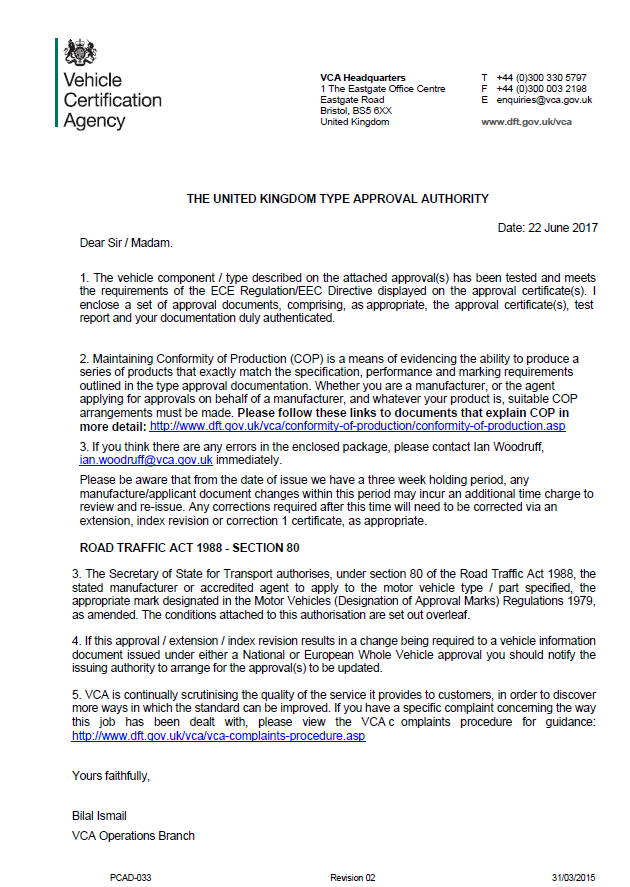
E-MARK E11 approval 10R-048329, held for IRLAB FPV onboard vehicle cameras under ECE R10.
Commercial terms that buyers can plan against are unusually permissive for this segment at the sample end and conventional at the volume end. Minimum order quantity is 1 unit, which makes pre-production validation straightforward. Large quantities ship within 15–25 working days after receipt of deposit, with payment by T/T in advance at 30% deposit and 70% balance before shipment, and delivery under FCA Shenzhen or C&F Hong Kong terms. Acceptance is based on 100% production check plus AQL standard OQC check, and the product line carries a two-year warranty.
On the compliance side, the certification set is broad and dated, which matters because buyers in regulated markets must be able to show continuous coverage rather than a single recent certificate. CE, FCC, UKCA, E-MARK E11, RoHS, UL and CTICK approvals cover the EU, USA, UK, ECE vehicle applications, Australia and New Zealand respectively, with ISO 9001:2015 certification from TÜV governing the underlying quality system until 2027. Buyers should map certificate scope to their own end-product classification, since approval for a camera does not automatically approve the airframe it is installed in.
Limits and boundaries buyers should plan around
No camera in this set is universal, and stating the boundaries is more useful than asserting coverage. The thermal CT-EI5ATC has a narrower 46° × 37° field of view than the 120° visible-light cameras and produces no colour or fine surface detail, which limits it to detection and thermal contrast tasks rather than identification. Its qualified operating range is -20 °C to 60 °C, narrower than the mission envelope described in IRLAB's tactical documentation, so cold-weather deployments require written confirmation. The digital CDD-BS5JMU carries a 50 ms glass-to-glass latency figure and a peak draw of 9 W, which constrains both the control loop and the power budget on small airframes. The analog CDD-BS59KU cannot record onboard and outputs 4:3 CVBS at 1500TVL, so UHD identification footage requires a different model. Where none of these fits, the correct answer is a combination or a different class, not a stretch of the existing specification.
Market context for this selection decision
The FPV camera segment is expanding alongside the wider drone imaging market. Fact.MR estimates the global FPV camera market at USD 825.3 million in 2024 with a projected compound annual growth rate of 14.7% through 2034. At the broader level, Global Market Insights values the drone camera market, including thermal and RGB systems, at USD 13.6 billion in 2025, driven by industrial and defense applications, while Market Research Future projects the thermal camera market growing from USD 5.16 billion in 2024 to USD 10.09 billion by 2035 at a CAGR of 6.28%.
Those figures should be read with one caveat. Published estimates for the FPV camera market diverge significantly depending on whether the report counts the camera component or the complete drone assembly, with figures ranging from the USD 825.3 million component-level estimate to broader drone imaging segments exceeding USD 10 billion. Buyers using market forecasts to justify a programme should confirm which scope a given figure measures before comparing it with another.
Future outlook
Three directions are visible from the specification set reviewed here. First, the boundary between classes is becoming a system decision rather than a component decision: the digital camera already carries OSD over MSP and MAVLINK and records to a 1 TB card, while the thermal camera exposes UART and USB control, which makes payload-level integration the differentiator rather than the camera alone. Second, compliance is becoming a sourcing criterion rather than a documentation task, as covered-list restrictions on uncrewed aircraft systems and critical components add origin and certification questions to the early stage of procurement. Third, customization demand is moving toward algorithm and transmission integration, which places the load on in-house engineering teams rather than on catalogue products.
For buyers between evaluation and order placement, the practical conclusion is a short one: define the limiting variable first, verify the parameters that are defined identically by every supplier, request written confirmation for anything outside the qualified range, and select the supplier on engineering capacity to modify the camera rather than on the catalogue alone. IRLAB Limited's corporate profile and product documentation are available in the company brochure: IRLAB Company Profile and Corporate Brochures.